The Fraud of Vedic Maths
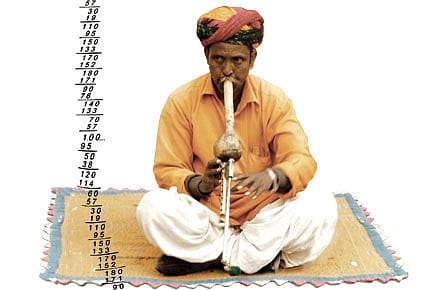
Those who seriously still think ancient India had devised a parallel mathematical system need to acquaint themselves with an inventive Shankaracharya called Bharti Krishna Tirthaji.
Creative Indian
The sutras, unfortunately, only reveal how little Tirathji knew of maths. But his quest was still forgivable

In 1965, a book titled Vedic Mathematics was published in English. Since then, the subject has become an industry that shows no sign of diminishing. In its latest manifestation, parents who know no better are shelling out serious money in the hope that their children will become scientific geniuses. They really shouldn’t bother. The subject amounts to nothing more than a few cheap parlour tricks, and there is nothing Vedic about it. But the story of how it came to be makes for a fantastical tale. 

Bharti Krishna Tirthaji was born in 1884 with some talent for science and mathematics. But he eventually paid heed to a passion for Sanskrit and philosophy, and joined the Sringeri math in Mysore to study under its Shankaracharya. In 1925, he became a Shankaracharya himself. All through these years, he’d kept up his interest in science and mathematics. Many scholars before him had dismissed the Atharva Veda as arcane and difficult to understand, but Tirathji decided to spend time studying it in the belief that he could excavate the knowledge that he felt must lie there. 

After eight years of ‘deep’ contemplation, he claimed to have found 16 sutras which explained all of mathematics. He, it is said, then wrote 16 volumes on Vedic mathematics, one on each sutra. Mysteriously, just before their publication, the manuscripts were lost. But in 1960, the last year of his life, Tirathji managed to rewrite one volume which was published in 1965 as Vedic Mathematics.

As stories go, this is not a bad one, but the evidence does nothing to support it. The 16 sutras expounded by Tirathji do not appear in any known edition of the Atharva Veda. Tirathji’s defenders have claimed that Tirathji was so immersed in Vedic thought that he was able to glean what the Vedic seers had in mind even if it was not explicitly so stated anywhere in the Vedic corpus. If one were to actually concede this meeting of minds between Tirathji and the ancient Vedic seers, it would have the unfortunate consequence of implying that not just Tirathji but even these seers were limited in their mathematical understanding.

All the sutras largely do is make the burden of addition and multiplication faster (though never nearly as fast as the cheapest pocket calculator), and even that, they do at a cost. Students studying the traditional method of multiplication should ideally understand (and bad teachers themselves fail to grasp this) what multiplication is, how it works, and how it is in essence an act of repeated addition. Tirathji’s methods are just rules that make mathematics seem like a bunch of tricks which are easy to implement but difficult to understand.

Take, for example, the multiplication of 9 and 7. Line them along with their difference from 10. That is:

9–10 = –1 and 7–10 = –3

9–1

7–3

——

6   3

You obtain the answer in the following fashion: the unit’s digit is the two differences multiplied together, –1 x –3 = 3 and the other digit 6 is just either of the diagonals added together, that is, 9–3 = 7–1 = 6. This method can be extended to much larger numbers. It is a neat trick, but it does not make multiplication easier to fathom, quite the contrary.

Let us then set Tirathji’s claims aside. The 16 sutras expound all of mathematics no more than astrology expounds all of modern astronomy. So what drove him and his followers (who brought out the book) to make a claim so extreme based on so little? 

The answer lies in Tirathji’s times. The man was an early nationalist, and he worked with GK Gokhale in 1905 when the latter was president of the Indian National Congress. Among Gokhale’s initiatives was an effort to spread education among the Indian masses. Tirathji was caught between his devotion to the math and Gokhale’s vision. In 1908, he actually left the math to head a National College in Rajamahendri. 

Three years later, he went back to the math, but the experience would have left Tirathji with little choice but to confront the message that Englishmen such as Macaulay had so forcefully fashioned, that the ancient history and knowledge of India were worth nothing when set against the most elementary aspects of Western thought.  

To men like Tirathji, it was clear that if the secret of Western domination over India lay anywhere, it lay in the knowledge of the sciences, and mathematics stood at the heart this knowledge. What better answer to such hubris than to show that in fact all of mathematics had already been revealed in the Vedas? 

The sutras, unfortunately, only reveal how little Tirathji knew of mathematics. Today, they only symbolise the strivings of a colonised mind searching for some self-respect, and we can find their equivalent in the Sangh Parivar’s absurd attempts to search for the technology of the jet engine in the udankhatola of The Ramayan. At least Tirathji’s quest was far more understandable and forgivable, given his times, but that we Indians should still take it seriously only shows the extent to which our creative imagination remains colonised. How much better off we would be if we could forgo the portentous name given to these tricks and learn to enjoy them as a Shankaracharya’s fancy.

OLDER COMMENTS FIRST

20 COMMENTS

Permalink

BAdly written article. I am assuming your
journalist's mind does not have a bent for
mathematics beyond addition and subtraction.
Obfuscation I will hand you.
The sutras did in fact give multiple proofs of
Pythagoras theorem, Differential and integral calculus.
So why dont you come clean and let us know
have you taken math beyond class X .

15 August 2010 | hypocritebuster

Permalink

anybody who any appreciation of mathematics would appreciate what the Shankaracarya has bequethed the world. Unfortunately this hack writer not only has no feel for mathematatics, it appears that he has not even read the book "Vedic Mathematcis". That's why his hollow commentary makes no mention of the alternative proof of Pythagoras theorems, the elaborations on calculus and other leads in the Shankaracarya's book. And merely parrots McCaulay's outdated opinion. Guess who's still suffering from a colonised mindset?

16 August 2010 | Goloka

Permalink

agree with goloka

16 August 2010 | rohit

Permalink

A sophisticated attack as usual, but the intelligent reader instinctively understands and knows how the author jumps and leaps from one convenient assumption to the next searching for motives for his prior goal - to denounce everything Indian. Regardless of whether the math is found in the Vedas or not, the whole tone of the article is preposterous. Unknown to the author, people study Indias real contributions to the roots of mathematics elsewhere, and treasure it, in books and sources more academic than the politically motivated and prejudiced rants like presented this magazine articles.

17 August 2010 | Rantings of an ugly mind

Permalink

The level of logic displayed in these comments is a fair indication of why so many still believe in Tirthaji’s fraudulent claims. Since Tirthaji never wrote anything that was beyond the reach of a good high school student my qualifications are not relevant to the debate but I do have an MS in mathematics. Not one of these comments has claimed there is anything Vedic about his work, which makes it clear that he was writing in the twentieth century. Given this to barely allude to calculus is not a sign of genius, quite the contrary. As for the claim that I am disputing the Indian legacy in mathematics, nothing could be further from the truth. From the knowledge of Pythagorean triplets in the Shulba Sutras dating back to at least the fifth century BC to the study of integral solutions of Diophantine equations by Aryabhata and then to the Kerela School’s work on infinite series in the fifteenth century or thereabouts, the Indian contribution has been substantial. It is fraudulent claims such as Tirthaji’s that stand in the way of our appreciating our real as opposed to our invented achievements.

17 August 2010 | Hartosh

Permalink

You need to understand the devanagri script first and
sanskrit second my friend to
see the beauty of the sutras which have been so clearly illustrated
in the Shankaracharya's book.
"The sutras, unfortunately, only reveal how little Tirathji knew of mathematics"
What this article is a heavily biased piece with the aim of slandering homegrown
math of the ancients used by millions of students across the world.
I mean who do you think you are slandering seers. The rishis have for millenia
meditated on the vedas to extract their true meaning.
Just because you cant do it does not mean the rishis haven't or can't.
I would recommend reading Fritjof Capra's "Tao of Physics"
"there is nothing Vedic " , at least cite the sources of misinformation if you
wish to have some impact.

18 August 2010 | Neel

Permalink

The Vedas' stock cannot but rise and rise, that much should be clear to you, Professor Hartosh Singh Bal. All bull, will run

18 August 2010 | Trend Tracker

Permalink

Hartosh sahib, I believe nobody other than Tirthaji claims to have studied the Vedas here and that too with his zeal (Ramanujan also ascribed his genius to some Devi). So we do not know whether the Sutras (which seem to be in Sanskrit!) are actually from the Veda or not, or whether they were "revealed" to him or not. But even if Tirthaji did invent about the Sutras on which he bases his "Vedic Maths", your attack on him is uncalled for. Yes, his methods can not replace the basic fundamentals of Maths, but they can be useful to many. And if we can celebrate a Trachtenberg, there is no harm in celebrating our own Tirthaji.

His methods are not simply some tricks as alleged by you; the book in fact explains why a particular method works. And you are also wrong regarding the "cheapest pocket calculator". Try solving the large numbered problems of the Nikhilam Sutra and I am sure you will get the irritating "E" in your pocket calculator!

And you are so very true about the foolish attempts with the udankhatola (pushpak?!) though!! :)

19 August 2010 | K S S

Permalink

I was gifted a copy of "Vedic Mathematics" by my very Catholic school (fortunately, not before my truly impressionable age was past). I have to strongly agree with every word the essayist says here. The tricks are indeed clever and curious, but they belong in a book with the name "Mathematical Tricks" or some such, not the actual name the book bears.

To underscore what the essayist says about the colonial's inferiority complex, there is the other example--of the exegesis of all sort of scientific data from the Quran. Some Muslims claim that all sorts of modern science is encoded into the Quran, and that a careful reading of the original Arabic is the only way... sounds familiar doesn't it? There are even a few Biblical conspiracy theorists in the US who claim similar things, as a counterexample, but that's probably the exception that proves the rule.

20 August 2010 | Matthai

Permalink

Excellent article.
But you know, Mr Bal, most of these obstinate Vedas-contain-everything retards aren't worth wasting a shout on.

23 August 2010 | oldrubbish

Permalink

Poorly written article, i think he hasnt gone through written books on mats

25 August 2010 | Kaja

Permalink

i think you studies the vedas properly.my friend we must choose the words carefully because they reveal the situation of our.i think yours logic n your belief is in great delima.good luck my friend.

6 September 2010 | swamprabhu

Permalink

The book Vedic Mathematics by Bharti Krishna Tirthaji is a useful collection of speed maths and mental maths methods which can amuse children and adults alike. Jonathan Crabtree, creator Australian Numerals

7 September 2010 | Jonathan Crabtree

Permalink

Your site is awesome - it educates people like me in just a minute. Keep up the good work. Here's another source that is also worth looking for about mathematics www.mgupload.net

Margarette
www.mgupload.net

3 February 2011 | Margarette

Permalink

if you really mean that vedic mathematics is nothing more than cheap parlour tricks then i must say that i pity you.....!!!

3 February 2011 | tejas natu

Permalink

dude try finding out a saquare root of 10 digit number using your head and if you find the age old vedic math cheap tricks worthy enough also try using dem. you realise the difference and will think twice before labeling some ones life long work as a sham. or if u think its easy enough then go n devise one or two trick of yours.

2 June 2011 | your name

Permalink

thats the perfect answer to give....

9 September 2011 | Yugal

Permalink

I Pity you mate!

6 January 2012 | Kenneth williams

Permalink

rantings of a colonial mind.wake up man , ur friends were kicked out long time ago 1947 to be pricise.

19 January 2012 | surender

Permalink

And could you, Mr Hartosh Singh Bal, write down your credentials on the blog in comparison to Sri Bharathi Tirthaji Maharaj to qualify yourself and credibly cast aspersion on his claims... also mention how much Sanskrit you know to be able to comprehend Sanskrit Sutras and Vedas any better than a Sri BTM ? looking forward to hear from you... thanks.

30 January 2012 | Hemant

Post new comment

The content of this field is kept private and will not be shown publicly.

CAPTCHA
NOTE: Please enter letters [case sensitive] in the box provided before you submit your comment. This is to prevent automated spam submissions
Image CAPTCHA
Enter the characters shown in the image.