The Last of the Aryans
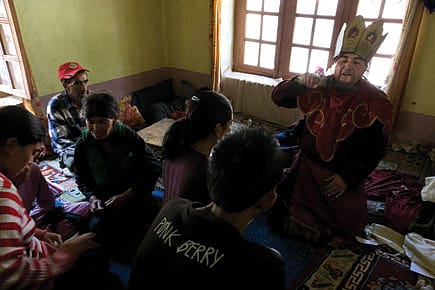
Nobody knows of their real origin, but Brokpas attract curious visitors, some of who try to satisfy their fantasy of having pure Aryan babies
In 2007, filmmaker Sanjeev Sivan released his documentary Achtung Baby: In Search of Purity on the phenomenon of German women travelling to Indian villages by the Line of Control (LoC) in Kashmir to get impregnated by men they believe to be racially pure Aryans. These villages are inhabited by a tribe called Brokpas, who are rumoured to be the 'last pure specimens' of the Aryan race. Across the world, several people still regard Aryans as the 'Master Race'—tall, blue-eyed blondes endowed with superior intelligence and values.
While Brokpa folklore says that the community arrived here from Gilgit in Pakistan just across the LoC, there is a view that they are actually descendants of Alexander the Great's army, whose Genghis Khan-like sexual profligacy is a matter of legend. Much Greek DNA is said to exist in north India even today. What marks Brokpas out, however, is that they have lived isolated lives for centuries in such an inaccessibly harsh terrain that they seem to have kept their DNA untainted by outsiders. Thus, the tantalising prospect of purity.
Shooting the documentary was far from easy for Sivan. With the help of an Indian colonel, he traced a German lady holidaying with a Brokpa man in a resort in Leh. Back then, foreigners weren't allowed easily into Darchik, the man's village, so Leh was chosen as a love-nest. Sivan had to shoot secret footage of the two roaming around together, and then persuade the lady into speaking to him. The Brokpa man had no inhibitions in being filmed.
In the film, the lady tells us how she isn't the first, and "definitely not the last" to travel this far to have an Aryan child, one who, she imagined, would grow up grateful for the gift of racially superior intelligence. She speaks of an organised system behind such pregnancy tourism, but refuses to elaborate. "It's not wrong, what I'm doing," she says, "I'm paying for what I want."
This half-uttered disclosure leaves your imagination to concoct a trail of shady travel agents having closed door meetings with interested foreigners in seedy offices in Paharganj, a lurid story of the sexual exploitation of naïve men of the highlands. Why should only women come to get impregnated by Brokpa men, you wonder. How have their womenfolk escaped a similar fate? The answer probably lies in the Alexander & Genghis Sons and Co theory. The genes, it seems, are passed along only by men. Women are treated solely as incubators.
The German lady in Sivan's film had not only paid the man for his services, she was gracious enough to bring gifts for his family and children. The Brokpa man is happy with the arrangement. "I have no expenses to pay," he says. "I have nothing to lose. I want to keep doing this. My children will come to visit me one day and take me to Germany."
The film doesn't reveal the German woman's face. The Brokpa man though, is easily identifiable. He is Tsewang Lhundup, 32, from Darchik village, Kargil district.
Tsewang still doesn't know how Sivan found him. He doesn't even know why the German lady chose him. "Mostly, they look for tall people with long noses," he says, "I don't know why they chose me." Tsewang is not tall. Nor does he have a big nose. He is pudgy. "Maybe they liked my behaviour," he reckons.
Tsewang is a changed man now, many years after the documentary was shot. For starters, he is now a 'Lhaba' (a shaman or witch doctor). He has gained weight and the respectability that accompanies a healer. People come to him in throngs from neighbouring villages, Buddhists and Muslims with problems as varied as indigestion, insomnia, boils and kids who skip school.
Tsewang is still as straight talking as he was in the film. He stands by everything he said before—for, the truth is the truth, he explains. But he does feel slightly "sharminda (embarrassed)": "One can't openly talk about these things." He is a father of four (the four he is aware of and whose mother is his wife). When we visited him, his wife had left the village for a few days. In the film, she implies that she is aware of her husband's German friends.
Tsewang had to drop out of school—having studied only till the 8th standard—after his father passed away, replacing him in his work. His circumstances have played a role in his choices. If the German lady offered him money to impregnate her, the documentary filmmaker offered to help him find odd jobs with the Indian Army. At the moment, Tsewang works in the local water supply department six days a week and attends to patients on Sunday as a Lhaba.
Such is the fate of Brokpas living in Dha, Hanu, Darchik, Garkon and other closeby villages—far away places that inhabit the margins of India's national consciousness.
They qualify as exotic on most counts, beginning with the elaborate floral head-dresses the women wear even when they work in the fields, reminding you of how the Mexican painter Frida Kahlo dressed and her choice of colours. The head-dress includes rows of coins stitched together for ornamentation, with some dating as far back as 1890, and bright ribbons. Even the men sport a flower or two. Brokpas not only look and dress 'exotic', they also behave differently. The local deity worshipped here abhors cows and chicken, hence both are considered taboo, villagers explain. Some of this is changing, though, under the influence of Buddhism and Islam. Fraternal polyandry—with brothers sharing a wife—is also prevalent in the Brokpa community, but instances of this phenomenon have gone down considerably now.
Typecasting Brokpas as 'exotic' has been so overdone, however, that even Mona Bhan, an anthropologist studying the community for almost a decade, is weary of speaking about them. "I have been quoted out of context by journalists and filmmakers who visit Brokpa villages with the sole purpose of realising their own fantasies of a pure Aryan race," says the assistant professor of anthropology at Depauw University, Indiana, US, "a fantasy deeply rooted in our persistent yet unspoken obsession with race as a marker of identity and otherness."
However, to an outsider, the customs and appearance of Brokpas only provide further evidence of their 'exotic' lineage.
Most tourist guidebooks and eager villagers highlight the traditional Brokpa abhorrence of the cow, be it cow's milk or beef, as a sign of their uniqueness. How this uniqueness fits in with the Aryan image, a race popularly deemed to be of cattle herders in olden days, these guidebooks don't explain.
The theory claiming Brokpas to be Aryans, says Bhan, is a legacy of the British, who were deeply invested in racial categorisation for purposes of exercising authority, not just marking identity. She is currently writing a book that explicitly tackles this complex relationship between race and colonial governance. "Several Company Orientalists, scholars who worked for the colonial enterprise, played an instrumental role in popularising perceptions of Aryanism in the Northwestern Himalayas," she says. "They based it on an ill-conceived framework that conflated racial frameworks of identity with the region's 'distinctive' linguistic features. Since certain languages spoken in the Northwestern Himalayas were thought to share similarities with other Indo-Aryan languages, the speakers of these languages were also categorised as Aryans."
Among Brokpas themselves, an awareness of their 'Aryanness' has spread far and wide with the influx of tourists and others drawn by the tag. Within just decades, the process of exoticising is firmly and disturbingly in place. Aware of Aryan looks and cultural traits, Brokpas are now seen to seek these out in themselves.
When we enter Darchik village, a local tells us about how tall his grandfather was, how Aryan his physique was. He says this because he himself is a short, thin man, rather like a Tibetan. He also shows us photographs on his mobile phone of a fair, blue-eyed girl who lives here, for he himself has dark-brown eyes. In all the travelogues and photo essays on this community, you will not find this man, or the likes of him. Photographers prefer to follow him to the blue-eyed girl's house, and writers prefer to speak of his large, broad-shouldered grandfather.
The promise of an Aryan experience brings in a fair share of visitors to these villages, ranging from curious backpackers, aggressive journalists and researchers to people seeking the extraordinary. Tourists from France, Iceland, Austria, Japan, Korea, Poland and even Israel have left their signatures in the guesthouse rosters here. The Army too welcomes important guests and higher-ups here with a traditional Brokpa dance.
Murli Menon, author of books like Power to Succeed and Power to Relax has researched various tribes all over the world, including the Long Neck tribe of Chiang Mai, Orang Asli of Malaysia and Siddhis of Gir. He's also stayed with Brokpas for around three months, intrigued by a writer's observation that they lead stress-free lives.
Menon recorded the songs they sing at sunset, and plays it in the relaxation workshops he conducts for corporates. "It has a hypnotic tone," he says, "Some people who find it difficult to sleep find it useful." During his stay, he found that Brokpas have fewer addictions than others, their life expectancy is higher, and they tend to lead more active lives. He attributes their fitness to the almost vegan diet they follow, and their joie de vivre to their tradition of singing and dancing.
On his website, Menon has also uploaded photographs of himself hugging the fabled Juniper tree. 'The energy aura of these trees was phenomenal,' reads his note below the pictures, 'One could feel a new vigour in each and every cell of one's body when you stepped onto this sacred grove of the Aryans of Dah.'
Tsewang Lhundup, the Lhaba of Darchik, offers different reasons for their freedom from stress. "We don't have dowry, so there is no tension of having daughters," he says. "We eat what we grow, so don't worry about our meals. We may not be rich, but we are not extremely poor either."
Recently, two foreign journalists reached Dah seeking the story of the Neo Nazi Tourist in search of the Pure Aryan Seed. They were both White women, and went around asking every male they could find, young and old, if they had been propositioned. Since they couldn't find any, but still needed a story, they switched to asking local men hypothetical questions. What if women came looking for the Aryan seed here? Would the men comply? Lundup Dorje, 31, couldn't help but laugh when they posed such questions to village elders. "They asked even 70- and 80-year-olds what they'd do if a foreign woman came looking to breed. One old man replied that he is willing to contribute."
Lundup is a curious man who runs a guesthouse in Dha for backpackers. Through them, he has understood why foreigners are so interested in Aryans. "In the world, everything is a mixture," says he. "So they are looking for the pure." He may not entirely grasp the nature of such attention, but he is definitely using it to market the apricot jam he makes. It comes from the Land of Aryans, reads the publicity brochure.
One man who tries to educate his fellow villagers about their ethnicity and origin is Tsewang Gailtsen, a Buddhist Brokpa from Garkon village. He is a lecturer in political science, teaching at the Higher Secondary School in Silmo, a town that also has Brokpas who have converted to Islam, like their brethren on the other side of the LoC. "In Ladakh, 'Brokpa' is considered derogatory," he says. The community is stereotyped as an inferior, dirty, uncivilised people; a Ladakhi proverb warns never to store an axe over one's head, nor have a Brokpa nearby. But tourists, they have an entirely different point of view. "Tourists look at us with respect," says Gailtsen, "They look at us as a pure race, as the few that haven't been assimilated." They help stoke Brokpa pride.
In the past, DNA samples drawn from Brokpas have been sent to the Genographic Project. Based on the sample study, Professor Pitchappan, the project's regional director, says that the community seems to be "ancient" and "isolated". However, there isn't enough global data to say where they migrated from. "To discuss their Aryan claims," he says, "one needs to define who an 'Aryan' is first, what are 'Aryan' genetic characteristics. This is very hard to define…"
The truth is, no one really knows where Brokpas come from. The confusion is hilariously represented in a blurb on them in a Lonely Planet guide to India. Titled 'Lost Tribes', it says in all seriousness, 'The facial features of the Brokpa (also known as Drokpa or Dards) 'people of the pastures' have led to speculation that the tribe has descended from Alexander the Great's invasion force or even a lost tribe of Israel.' That is as good as saying these people could have come from anywhere.
But in their search for a Master Race, pregnancy tourists and other curious visitors from all over the world have given the Brokpa self-esteem a hefty boost. Which is probably a good thing. As the professor puts it, "Let them feel proud of themselves, their culture. We need not interfere with their pride. We do not have the liberty."