The Literary Raj

For all their posturing and weighty pretences, the Indian elite’s life of letters is still strangely beholden to the British
hangover
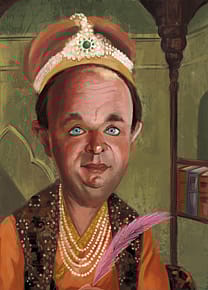
If William Dalrymple appears central to our literary culture, it says something far more damaging about us than about him (Illustration: VIVEK THAKKAR)

In February 1934, the young Claude Levi-Strauss took a ship from Marseilles to Santos. At the end of the journey, a journey mirroring so many made over the past 400 years from the First World to the Third, he arrived at an observation that seems obvious only once it is stated: ‘Travel is usually thought of as displacement in space. This is an inadequate conception. A journey occurs simultaneously in space, in time and in the social hierarchy.’

The British travelling to pre-Independence India were an extreme example. Younger sons with limited means of getting ahead in the UK, would land up in India and presume to lord over hundreds or thousands of Indians. The relation between the two countries has changed dramatically since, but the effects of journey remain.

There is still a vast expat community that enjoys some of the benefits of such travel from the West to India. In many professions, the journey does not offer much—a doctor or an engineer from the West would not overawe his counterpart here—but there remain professions where the advantages are enormous, especially those related to the written word, a reflection of the fact that English mediates our own social hierarchy.

This is most notably so in the case of a foreign correspondent. What would be a reasonable salary in London is outrageous in Delhi. A residence in Golf Links or a farmhouse in Mehrauli is perhaps not the best beginning to an Indian sojourn, especially when you add to this a lack of knowledge of a local language and easy access to the people who frequent the Niira Radia tapes, but it has its comforts.

The money, important as it is, is not the only factor determining the journey up the social hierarchy. Not all foreign correspondents are equal; there is a hierarchy even among them, which has much to do with our perception of the world. The importance of their country of origin is only one factor, a factor that would explain why those from the US matter but does nothing to explain the pre-eminence of British journalists long after their country has ceased to matter globally.

They remain inheritors of a Raj that still lingers. It even allows some of them to cap their tenure with an India book. Who else would have the temerity to sum up a continent after a two- or three-year stay confined mostly to Delhi? The problem with such books is that long before they have been written, the Levi-Strauss effect has already undone the reasonably intelligent, mid-level journalist who first landed in India (these are generalisations, but it feels good to be dishing them out rather than be subjected to them).

Despite such obvious drawbacks, the success of the genre abroad is easily explained; such a book is first read and reviewed abroad by a group of peers, who if they have seen India (China or Africa), have indeed seen the foreign correspondent’s India (China or Africa) and so only end up applauding a reflection of their own vision. The reviews become a testament to the virtues of the book in the minds of readers who have never seen India.

The real question then is not why the genre exists abroad, but why we value it here. Recently, after the Radia tapes, I found myself at a book launch facing a rather sceptical British journalist, who argued the BBC would never have tolerated such behaviour but this is India after all and here we should excuse far more. In the course of the conversation, it occurred to me that this was the first book launch in Delhi where I did not have to scrounge for food; the waiters were constantly hanging around.

They were only reflecting a perception of the White man they hold in common with our critics and publishers. Our ability to fawn extends well beyond the foreign correspondent. Our publishers need the stamp of British approval. All you need to do is compare the advances paid out to books submitted locally with books that first got accepted in the UK. Or, for that matter, look what happens to sales of a book after it wins the Booker; somehow, the Pulitzer counts for nothing.

This constant need for British approval allows writers from the UK to produce and sell books that should be junked in India. In the course of this year, we in India were subjected to an overdose of publicity for Jad Adams’ book on Gandhi, The Naked Ambition. This insightful writer has suggested, ‘When Gandhi was tormented by sexual thoughts, perhaps his impacted colon was pressing on his prostate gland and stimulating him sexually. This would explain why some diets, by reducing his constipation, would help him feel less sexual.’ Here is constipation as a prompt for priapism. Why instead did the world wait another 60 years for Viagra? Why was this so fascinating to us that we had to give space to reviews of the book?

Earlier in 2010, we had a visitor from Britain at a literary festival in Jaipur. Geoff Dyer in 2009 had written a book called Jeff in Venice, Death in Varanasi, which many reviewers in India found deeply insightful. I wonder if they read the same book that I did, for these same reviewers thought nothing of Elizabeth Gilbert’s Eat, Pray, Love, which inflicted much the same trauma on India. But then, Geoff Dyer is a ‘serious British author’, so he can treat us to the fictional version of the foreign correspondent’s India. The traffic in Varanasi is described in detail, as are the cows and the ghats and the deliverance Varanasi provides.

I did wonder what prompted Dyer’s invitation to Jaipur in the first place, and in considering the answer, I could only think of the organisers of the festival. Click on the festival website and the first name that comes up is William Dalrymple: ‘the author of seven acclaimed works of history and travel, including The City of Djinns, which won the Young British Writer of the Year Prize and the Thomas Cook Travel Book Award; the bestselling From the Holy Mountain; White Mughals, which won Britain’s most prestigious history prize, the Wolfson, and The Last Mughal, which won the Duff Cooper Memorial Prize. He divides his time between New Delhi and London, and is a contributor to The New York Review of Books, The New Yorker, The New Statesman and The Guardian. He published Nine Lives: In Search of the Sacred in Modern India to great acclaim in October 2009, and the book went straight to the top of the Indian bestseller list. He is a director of the DSC Jaipur Literature Festival.’

I have been told that Dalrymple is a personable man, and in my own encounters with him I have indeed found him so, but what is of interest in this context is not Dalrymple the man, but Dalrymple the phenomenon. How did a White man, young, irreverent and likeable in his first and by far most readable India book, The City of Djinns, become the pompous arbiter of literary merit in India?

I think the answer lies in the description cited above. This director of an Indian literary festival does not consider it important to mention an Indian prize he may have received or an Indian publication he may have written for. His eyes are trained on the recognition that Britain’s literary world offers (even if there is the hint that commercial success in India has started mattering), and in that recognition lies his strength.

If Jaipur matters as a festival, it is because of the writers from Britain it attracts. When I talked this piece over with a top publisher at one of India’s leading publishing houses, the person, seeking anonymity ‘to protect the interests of the authors at the publishing house’ said: “Indian publishers and writers are peripheral to the enterprise. The list of authors that I send year after year is casually ignored—and that, I believe, is the case with most Indian publishers.”

Indeed, the authors who made Jaipur a celebrity event are men like Ian McEwan. In our literary culture, obsessed with Britain, a great writer from Europe can visit Delhi and fail to find mention on what pass for the literary pages of our magazines and newspapers, but a man like McEwan would be fawned over. Because a McEwan attracts attention, the festival does too, and as a result the same Indian authors who are peripheral to the enterprise seek its endorsement.

The festival then works not because it is a literary enterprise, but because it ties us to the British literary establishment. Getting that literary establishment to take note of India requires making use of a certain romantic association that stretches back to the Raj.

A recent newspaper report quoted Sanjoy K Roy, managing director, Teamwork Productions, organiser of the Jaipur Literary Festival, as saying: “After the success of the Jaipur Literary Festival, we wanted to do something down South. Kerala has so much green to sell to an international audience. It will be a beautiful location, on a hilltop. In Jaipur, we have seen the palaces and romance, in Kerala, there will be the beaches and Ayurveda.” This is literary tourism, with Dalrymple nothing more than the principal tour guide for writers arriving in India.

With no other means of arriving at literary excellence, we have mistaken the guide for the real thing. It is not for nothing that over the recent past, Dalrymple has been in conversation with authors as diverse as Tishani Doshi (though a romance linking Wales and Gujarat is perhaps a fit setting for him) and Sonia Faleiro (what could Dalrymple have to contribute to the Bar Girls of Bombay?; on the evidence of the evening, not much). Symbols matter, and if Dalrymple appears central to our literary culture, it says something far more damaging about us than about him.

OLDER COMMENTS FIRST

45 COMMENTS

Permalink

I read this article with great interest. Shouting out from the website of the JaiLitFest is Tina Brown's now famous quote "The greatest literary show on earth!" You write - "If Jaipur matters as a festival, it is because of the writers from Britain it attracts." Perhaps it does. Most Indian readers of books in the English language have started reading British authors and then moved ahead with American, Indian and these days authors from Africa. That is a fact.
It is not obvious from what you write if you have attended the Jaipur literature festival. Let me tell you what it means on the ground to readers and regulars at the festival. It means listening to Urdu and Hindi poetry from Gulzar, Javed Akhtar, Prasoon Joshi while sitting on the floor in a packed hall (because the chairs are all taken) next to young college girls and boys from outside Jaipur who have made the trip to the festival just to hear them. It means running into an unknown Hindi teacher from Ahmedabad who also writes in the Sindhi language and one finds common interests in books to talk about. It means discovering writers as yet unknown to you like Andrew O'Hagan or Claire Tomalin last year and getting a chance to hear them talk. It means listening to a great speech by Girish Karnad on books, writing, drama and culture. It also means listening to Wole Soyinka. It also means connecting unexpectedly with a Parsi school girl from Baroda who is a book lover and avid reader and has travelled to Jaipur with her mother just to be at the festival and who intends to come again the the following year to hear her favourite author - Orhan Pamuk talk. It also means watching school and college crowds filling up the hall to listen to Chetan Bhagat and ask him questions. Perhaps some of these young readers will become great writers one day. Most importantly, it means for thousands of readers and book lovers to spend five wonderful days in the world of books and newly made friends with common literary interests.

Incidentally, the festival has two directors, the other director whom you conveniently forgot to mention is Namita Gokhale. One of the authors to feature in January 2011 is your very own Manu Joseph. But you must know that already.

For readers and book lovers, the festival is a great once a year event.
You write "The festival then works not because it is a literary enterprise, but because it ties us to the British literary establishment. Getting that literary establishment to take note of India requires making use of a certain romantic association that stretches back to the Raj." Who really cares? Definitely not readers of good books written by Indian, American, British or African writers or those of any other continent/nationality for that matter.

1 January 2011 | Namita Waikar

Permalink

The writer has nailed the problem that is plaguing us, English language and it's leverage as a ladder to reaching the top of social pyramid. i must admit, this was a problem i faced when i started honing my skills in English, i was forced to learn British English as opposed to american English. American English is treated as low class and as not having a definitive form nor structure and that it's filled with slang and useless words, regardless of the fact that cutting-edge research, as we speak, is going on in American English. i can easily associate with the lament expressed by the author. we are still in a way slaves to the British language and it's sensibilities. we are miles away from carving our own niche in English. i hope we are more progressive in this way and are freed from the shackles of Britannia instead of obsessing over language which is used mostly in period dramas and films.

2 January 2011 | sreeharsha nanduri

Permalink

Hartosh, you make me feel my age. A decade ago, we were complaining, fairly bitterly, that except for the occasional Stephen Hawking lecture or the odd visit by a Derrida or a Chomsky, Indian readers had no access to authors from elsewhere. (Not just British authors--this would include writers like Anne Applebaum, Donna Tartt, Michael Ondaatje or a Wole Soyinka.) Nor did we have much in the way of Indian conclaves that replicated the grand old darbars and mushairas. The few festivals that did come up were either seminar-style talkathons, not terribly inviting to the general reader, or festivals like Kitab--which was both disorganised and racist.

Now we're complaining that the JLF works only because it ties us to the British literary establishment, and that its success depends, if I read you right, on celebrity names from the West. I wish you'd been there to see the kind of crowds Nayantara Sahgal and Sister Jesme pulled last year, or the poetry session the lady in the comments mentions above, or the audience for the sessions on Dalit writing--for local audiences, at any rate, it's not just the McEwans or the Soyinkas who make Jaipur a good festival. I've been at Jaipur as a panelist twice, and have happily paid my own way in other years as a journalist and then as a publisher; what works for me is precisely what you complain about--the presence of writers from all across the world, alongside some of the best and most interesting of Indian writers. Jaipur saves me the cost of passage to Edinburgh or Melbourne, and I hope it will never lose the focus on local Indian writers as well.

If your argument is that we're still obsequious when it comes to courting Western publishers and in our dependence on the approval of the West in general, I agree completely--I've made that argument several times in my own columns. We still wait for a book to receive a big advance in the UK or for the chaap of approval from the West before we applaud writers--we're not confident of our own opinions. But there's little need to slam one of the few festivals that actually works for readers in India.

On the subject of Geoff Dyer, we must agree to disagree, but he is an odd example to cite. Many of us like his criticism, especially his writings on jazz; I loved the Venice section of Jeff in Venice, Death in Varanasi, and thought his Varanasi section was a shade better than most of the naive-tourist books written about Varanasi, including some written by our own Indian writers.

On the subject of Dalrymple, I don't quite follow your argument. He's lived in India for a sufficient length of time, and based most of his books on the history of the country. What you think of the quality of his writing is another matter--and should really be the subject of a long essay if you feel strongly about this--but I'd say that the only reason you have to disqualify him from being an advisor on the JLF has nothing to do with his literary credentials (as good as most other Indian writers) or his knowledge of the country (more than the foreign correspondents' 2 or 3 year stint), and everything to do with the colour of his skin. I don't see why someone who's lived in India for as long as Dalrymple has should be disqualified for being white--though his nationality has stopped him from being considered for the only Indian prize he might be eligible for, the Crossword Prize for Non Fiction. That is, presumably, why he didn't cite any Indian prizes he may have won--he has appeared, with ritual predictability, on Indian bestseller lists, but he has not yet received an Indian prize.

2 January 2011 | Nilanjana

Permalink

Hartosh,
It's fairly obvious that you've never been to Jaipur or else if you have, you somehow managed to ignore all the popular sessions that featured people writing and declaiming in strange native dialects because it didn't fit with your thesis.
As to Dalrymple's credentials - well he's lived in India since 1992 and he speaks, reads and writes at least four of the languages featured on Indian currency notes.
Admittedly he has an appalling accent in all of them but then his English is also appallingly accented. He's also bothered to go through the process of getting a PIO card. Could you match that?
I'd reckon he's more knowledgeable about amader Bharatvarsha than most "Indians" born and bred. (How do you define an Indian anyway - is it about the colour of the skin or the ability to ingest chillies?)
DD

2 January 2011 | Devangshu

Permalink

Hartosh,

The reason I'm commenting on this article is because you mention me in it and I feel obligated to respond.

You question why William Dalrymple was invited to launch my new book, Beautiful Thing, in Delhi, when he, apparently, had 'not much' to contribute to the subject.

I would like to say, firstly, if I had to look for a writer who knew as much or half as much about bar dancers as I do I would have been up on that stage alone. Since I didn't relish the thought of a monologue, I chose to invite someone whose work I've always admired, who writes non fiction about India from India, and above all, who has been supportive of my work both directly and indirectly. (I should point out that outside of the festival circuit, and the launch, I've met William socially exactly once). For these reasons I was, and remain, most grateful that William agreed to participate in my book launch and helped make it an interesting and successful event. Readers of OPEN can judge William's contribution and your take on the event for themselves; footage of our conversation is available on my website: http://soniafaleiro.com/audiovdo.php as well as on youtube.com.

William Dalrymple and Namita Gokhale have made the Jaipur Literature Festival a world class event in which not just marquee names from around the globe, but even authors like myself find space to share their work, publicize it, meet readers (overwhelmingly Indian), interact with writers from India and around the globe, and feel, for a few days, not isolated as one usually is as a writer, but part of something energizing and inspiring. I couldn't care less about the nationality of anyone associated with the festival, or how other people may perceive or treat them. I will judge them by their actions and accomplishments, not things over which they have no control.

I've been a mainstream reporter since I was 21, and over ten years later I can count on one hand the number of people (other than family or friends etc.) who have encouraged me to write . I need a few extra pairs of hands to count those who've done the opposite! The fact is that in India today, young writers, and writers in general I should say, have few places or people to turn to for any kind of support, moral or otherwise.

Jaipur is one such place, and William one such (rare) writer who is generously and openly supportive of other authors and aspiring authors. For some people that may count for more than it should because of his race and citizenship. For others, for exactly the same reason, it may count as less. For me, and the countless other writers (and I dare say also for readers and the Indian publishing industry in general) whom William has taken the time to support, either directly or indirectly through he and Namita Gokhale's creation of, and tireless contribution to, the wonderful, un-paralleled Jaipur Literature Festival, it has meant a great deal.

4 January 2011 | Sonia Faleiro

Permalink

Hartosh, you managed to write yet another stinker that would get you lot of comments and this seems precisely the reason why you wrote this snorefest. If you think that Open is India's equivalent of NYRB or The New Yorker, it only cements my belief that you are being a typical Indian journalist who doesn't read anything beyond the Indian dailies and magazines.

Why should we celebrate Indian writers when they can't write compellingly? Just because Chetan Bhagat is a fellow Indian doesn't mean I'll put my Franzen aside and pore over Chetan's bad writing. If we are celebrating foreign writing, that's because their writing speaks to us. Please refrain from being contrarian for the sake of being contrarian. Please stick to your own WikiLeaks: the Radia Tapes.

4 January 2011 | Jagannath

Permalink

Is writing and publishing a zero-sum game or can the energy and enthusiasm from one writer benefit others? Does the success of one writer detract from the success of others?

Although not personally a fan of Gilbert, it is obvious that the blockbuster success of her Eat Pray Love book has drawn new readers to literature by and about Indians.

The quality of Dalrymple’s research and writing about a country that he so obviously loves has, in my opinion, done great service to the Indian literary scene. Let’s hope other writers can step up to the crease and create complementary works.

4 January 2011 | Anthony Mitchell

Permalink

Happy New Year to you all!

4 January 2011 | Samit Basu

Permalink

It was all fine and merry reading this article until I read this: "these are generalisations, but it feels good to be dishing them out rather than be subjected to them." Then I thought ok so may be I shouldn't really take this article seriously :- )

Nevertheless I do want to say a few words speaking generally. One shouldn't mistake literary culture with the literature of the culture. A writer, once she (or a he) begins to gather enough courage to start imagining herself as a writer, is nearly always worried to death about the craft of her writing. The nervousness and the exhilaration that this particular form of expressing brings to one's life is a life-changing experience. Believe me and this is a very critical difference you will miss comprehending if you are not a writer though you may still be a part of the literary culture. I've never been to any literary festival in India (or for that matter anywhere else) but I gotta think if a writer goes there then it's more likely that she is immersed in her craft and it's a personal cause for her to find some way to improve it. Everything else that other people see from outside doesn't really register in the priority of the writer. People who write articles such as these ought to at least make a graceful attempt to understand the experience of what it means to be a writer. Or at least allow themselves to be swayed by what a writer writes, what any writer writes. Do that once, and you would be surprised how much good that openness will do to one's own writing. Really.

Here's one easy test: let's say everything that Hartosh says here is true, i.e., that Dalrymple is a bad guy, the Indian literary elite is in the thrall of a "White man" and all that. Now can anyone seriously imagine that out of such an oppressed literary culture anything useful will emerge? If the answer is no then why bother? A stick is a stick is a stick. It's not a knife. But I don't think Hartosh believes it's all sticky mud. So, then what have you (Hartosh) seen that gives you hope? I'd love to hear that part of the story from you.

But seriously what's all this "White man" stuff anyway…

Raj

5 January 2011 | Raj

Permalink

This article was coming along all fine and merry until I read this: "these are generalisations, but it feels good to be dishing them out rather than be subjected to them." Then I thought ok so may be I shouldn't really take this article seriously :- )

Nevertheless I do want to say a few words speaking generally. One shouldn't mistake literary culture with the literature of the culture. A writer, once she (or a he) begins to gather enough courage to start imagining herself as a writer, is nearly always worried to death about the craft of her writing. The nervousness and the exhilaration that this particular form of expressing brings to one's life is a life-changing experience. Believe me and this is a very critical difference you will miss comprehending if you are not a writer though you may still be a part of the literary culture. I've never been to any literary festival in India (or for that matter anywhere else) but I gotta think if a writer goes there then it's more likely that she is immersed in her craft and it's a personal cause for her to find some way to improve it. Everything else that other people see from outside doesn't really register in the priority of the writer. People who write articles such as these ought to at least make a graceful attempt to understand the experience of what it means to be a writer. Or at least allow themselves to be swayed by what a writer writes, what any writer writes. Do that once, and you would be surprised how much good that openness will do to one's own writing. Really.

Here's one easy test: let's say everything that Hartosh says here is true, i.e., that Dalrymple is a bad guy, the Indian literary elite is in the thrall of a "White man" and all that. Now can anyone seriously imagine that out of such an oppressed literary culture anything useful will emerge? If the answer is no then why bother? A stick is a stick is a stick. It's not a knife. But I don't think Hartosh believes it's all sticky mud. So, then what have you (Hartosh) seen that gives you hope? I'd love to hear that part of the story from you.

But seriously what's all this "White man" stuff anyway…

Raj

5 January 2011 | Raj

Permalink

Good one.

I think its time for India to have a non-anglo/west narrative on our history and litrature, we sure don't want a mediocre british or otherwise writing about varanasi and other indic ethos in their western conceptual framework.

india-forum.com

5 January 2011 | mk

Permalink

Very interesting stuff Harjot. There is no doubt about how the subtle influences still work and how it will take more time for us to get over them.

By the way, I was thinking we should get Jad Adams in India to answer queries of readers in India who write to the "Health Magazines" about the sexual problems they are having.

In fact he may be the right chap to also consult with all the so called "Sexologists" who promise instant cure to all sexual problems on the public walls in both rural and urban India. Jad Adams could add his stuff to the public walls as well - maybe his way of writing will help the native "Sexologists" communicate better!

One possibility that I see is that he could combine the next trip to the Jaipur Literature Festival to get some of the above assignments!

6 January 2011 | Ashutosh Malik

Permalink

On a tangential note...

I agree with you in bits and pieces, Hartosh. It is ingrained in us Indians to seek approval from outsiders -- British, Americans and, soon, Chinese too I suppose. But why subject literary products and producers to such generalisations? A Chetan Bhagat, despite his obnoxious writing, is a hit among the masses. So is A P J Abdul Kalam I reckon. As far as Dalrymple is concerned, I guess he is more into India than I myself am! So let's leave the folks alone to write.

But my point is slightly more personal. Pardon my for the observation.

Reading your columns, once escape the feeling that there is a minefield of pent up anger in you. The frustration, irritation and angst in your tone is marked. Perhaps that is why even when you make an important and relevant point, it comes across mindless because of the tone. Maybe you could work on that and then look to join the Jaipur Literary Festival.

6 January 2011 | Harish C Menon

Permalink

I think Open should increase the point size of the comments text, and perhaps consider black instead of this watery grey.

6 January 2011 | Kakul

Permalink

I think I understand where Hartosh is coming from. When he says all those things about William, he says explicitly that his being a sole important figure in these literary discussions, says something more damaging about Indians than him. A country of a billion should have more williams. I think what he is getting at is this: it is easy for a white guy to come to india and be taken seriously.

And, Nilanjana and the others, while it's so, so great that there are writers from all over the globe and opportunity to hear new authors, I would't say that the discussions or the general atmosphere is as open or welcoming as it could be. It's probably better than your seminars, but at least in the seminars you can be anonymous. Here, loads of important, connected people are trying to be shining stars, trying to network and impress other important people.

7 January 2011 | P.

Permalink

I fully agree with Hartosh that William Dalrymple's becoming an important arbiter of literary merit in India is not a very healthy phenomena. Moreover, Dalrymple , though pretending to write race-neutral fictional accounts of the British Raj, often ends up romanticizing the White Moghuls. Also, dare I say, the shallowness of his writings on India is so typical of the genre. I remember, in his City of Djinns (indeed his best book so far) he is describing the day of Dussera i(the tenth day of the Dussera Festival) in detail , and mentions the glory of full moon in the night !! Is it that he has engaged himself so much with the British and Moghul past of India that he is completely oblivious to the life and culture of Hindus who constitute 80 - 85 % f India ? If you donot knw a country well enough, you should avoid writing (at least literary) boks on it.

9 January 2011 | Sanjay

Permalink

I attended the Jaipur Literature Festival in 2010, this is the first time I had been to one, and I must say it was a good experience. From Indian writers to the likes of Alexander Mc Call Smith and Hanif Khureshi, book lovers, writers and journalists got more than they bargained for.
I agree with some of Haritosh's comments with some reservation. One wishes that there was a bit more of representation of Indian writers in organizing committee for the Festival. But do you think the resulting outcome would be any different? At least William Dalrymple understands India, and has some sense of how it works. Rather, I prefer to see him at the helm of affairs than a motley set of bureaucrats or a bunch of new age corporate money bags organizing the Festival. The last thing we would want to see is the festival becomes a place where people come to ‘sell’ books. It still is about writing and literature as opposed to the ‘lets sell 20,000’ copies that pervades the publishing world today. The organizers have ensured that the Festival is efficiently run, it is open enough (free entry for writers, journalists etc. with ample time and opportunity for interaction with authors) and we manage to draw and enviable list of authors and publishers compared to a lot of other international festivals. I've been to one where to meet the same authors we had at Jaipur, one had to foot up about Rs. 1,000 to attend a single session.
Having said this, the bigger problem is us. I also believe that some of what Haritosh says is a part of our mental make - up as a nation. His comments should be recognized and not trashed. I don’t think he’s having a go at Dalrymple, rather his will written piece is about our mindset. It works differently back at home where it’s all about connections and who knows who. There still is the sense that acceptance/ recognition in the US or UK is gold standard, the audience be damned. Some members of our society also prefer finding themselves among 'intellectual' 'white' company. I guess it gives them bragging rights. We are ones who want to see ourselves among the likes of Mr. Dyer. We have people who run publishing firms, including internationally respected imprints, who use the firm's resources to spinelessly publish their relative's work and then brag about it at publishing conventions and forums. There are others who take a sense of pride in publishing books by friends and family while other writers wait in frustration for their work to move through the 'slush pile'. In the Western society such behavior would be condoned and it would be the end of the road for such 'professionals' who follow a set of fast-track processes for their friends and family, as opposed to a wait and groan ones for outsiders. It’s the reason why people I haven't seen for 15 years since school send me their mother in - law's poetry to publish, despite making it clear that we have submission guidelines. We shouldn't blame Dalrymple for our problems; he’s the least of it. We should take a long hard look at ourselves. The expose by Haritosh & Co. on the Radia tapes is very real, and is a glaring example of how everything works in our country.
Meanwhile, let’s enjoy the Jaipur Festival for what it is. Happy New Year!

11 January 2011 | Ahmed

Permalink

Just a couple of points. I think it is a bit absurd to bring up race and nationality in creative spaces. A writer or a musician is good because he or she touches a universal chord.
Second, the Jaipur Lit Fest has taken books out of the exhaustingly pretentious and judgmental literary space where they were stuck for many years. Here, even someone who merely enjoys reading -- and may not be terribly smart or critical, nor have something important to say -- can find space to come and participate. Now isn't that nice?
Finally, as a young writer, this festival was important for me because I met so many other young writers from other parts of the world. We have stayed in touch, even read one another's work. Writing can be a very isolated world, so I am grateful for this.
So even if flawed, let's applaud the valuable contribution the festival has made -- for writers, book-lovers, publishers and general literary hedonists!

11 January 2011 | Namita Devidayal

Permalink

I attended the Jaipur Literature Festival in 2010, this is the first time I had been to one and I must say it was a good experience. From Indian writers to the likes of Alexander Mc Call Smith and Hanif Khureshi, book lovers, writers and journalists got more than they bargained for.
I agree with some of Haritosh's comments with some reservation. It maybe a good idea to provide a few hours (even after hours) to new writers/ publishers to showcase their efforts. One wishes that there was a bit more of representation of Indian writers in organizing committee for the Festival. But do you think the resulting outcome would be any different? At least William Dalrymple understands India, and has some sense of how it works. Rather, I prefer to see him at the helm of affairs than a motley set of bureaucrats or a bunch of new age corporate money bags organizing the Festival. The last thing we would want to see is the festival becomes a place where people come to ‘sell’ books. It still is about writing and literature as opposed to the ‘lets sell 20,000’ copies that pervades the publishing world today. The organizers have ensured that the Festival is efficiently run, it is open enough (free entry for writers, journalists etc. with ample time and opportunity for interaction with authors) and we manage to draw and enviable list of authors and publishers compared to a lot of other international festivals. I've been to one where to meet the same authors we had at Jaipur, one had to foot up about Rs. 1,000 to attend a single session.
Having said this, the bigger problem is us. I also believe that some of what Haritosh says is a part of our mental make - up as a nation. His comments should be recognized and not trashed. I don’t think he’s having a go at Dalrymple, rather his will written piece is about our mindset. It works differently back at home where it’s all about connections and who knows who. There still is the sense that acceptance/ recognition in the US or UK is gold standard, the audience be damned. Some members of our society also prefer finding themselves among 'intellectual' 'white' company. I guess it gives them bragging rights. We are ones who want to see ourselves among the likes of Mr. Dyer. We have people who run publishing firms, including internationally respected imprints, who use the firm's resources to spinelessly publish their relative's work and then brag about it at publishing conventions and forums. There are others who take a sense of pride in publishing books by friends and family while other writers wait in frustration for their work to move through the 'slush pile'. In the Western society such behavior would be condoned and it would be the end of the road for such 'professionals' who follow a set of fast-track processes for their friends and family, as opposed to a wait and groan ones for outsiders. It’s the reason why people I haven't seen for 15 years since school send me their mother in - law's poetry to publish, despite making it clear that we have submission guidelines. We shouldn't blame Dalrymple for our problems; he’s the least of it. We should take a long hard look at ourselves. The expose by Haritosh & Co. on the Radia tapes is very real, and is a glaring example of how everything works in our country.
Meanwhile, let’s enjoy the Jaipur Festival for what it is. Happy New Year!

12 January 2011 | Ahmed Faiyaz

Permalink

Just a couple of points. I think it is a bit absurd to bring up race and nationality in creative spaces. A writer or a musician is good because he or she touches a universal chord.
Second, the Jaipur Lit Fest has taken books out of the exhaustingly pretentious and judgmental literary space where they were stuck for many years. Here, even someone who merely enjoys reading -- and may not be terribly smart or critical, nor have something important to say -- can find space to come and participate. Now isn't that nice?
Finally, as a young writer, this festival was important for me because I met so many other young writers from other parts of the world. We have stayed in touch, even read one another's work. Writing can be a very isolated world, so I am grateful for this.
So even if flawed, let's applaud the valuable contribution the festival has made -- for writers, book-lovers, publishers and general literary hedonists!

12 January 2011 | Namita Devidayal

Permalink

Hartosh, I completely disagree with this article and wanted to write a belated response to this as I have just written a piece about JLF for Business Standard and had the time to think about some of these issues. I'll address your arguments point by point

1. i cant think of too many foreign correspondents who are brits who have written about India after their posting - ed luce is the only one. so not sure its a trend. i know of one other foreign corresspondent who is going to write a book but its much more focussed and while set in India is another kind of book altogether. so i do think the premise of your piece, we admire 'white men' for whatever they write because we havent got over our colonial past is slightly nebulous. i would even argue that as a publisher i find having non indians write about india usually becomes an issue. rather sad, as the bulgarians to the best of my knowledge havent damned rana dasgutpa for writing about them. jad adams got attention because of his particular approach to Gandhi and because he wrote about Gandhi. Rh uk publishes a number of English writers who have written about india each year – many of them receive little or no attention, and their books dont sell in any quantities.
2. JLF being essentially a festival for big international names - utterly wrong. almost all my writers, in the last five years, have been fairly unkown and from the subcontinent. and jlf has supported some of my writers in a way that no one has. this year my authors are manju kapur, namita devidayal, moni mohsin, arunava sinha, narayan wagle and my star author of the year, shehan Karunatilaka. Not all glam names. i dont know which publisher you've been talking to but if they're not represented its not because jlf doesnt promote local indian writing. the organisers do have particular interests and passions, for example translation, urdu culture, subcontinent writing are all big interests . the larger pt i am making is jlf is largely a festival that promotes unknown, subcontinent names with the occasional glitter of some big names. often even many of their international names arent that well known. rh uk's authors this year includes james kelman, atiq rahimi and etgar keret alongside amis, coetzee and mankell. secondly the indian names actually draw the biggest crowds in the festival - gulzar was the star of the last festival. there were 30,000+ people in the festival last year, and they weren't all cosmopolitian delhi-ites for whom mcewen was the bigger draw. jlf's gravitas and staying power comes because it combines all worlds - interesting regional language writing, international authors, subcontinent writers writing in english. there are often tensions but its this combination which gives it its strength.
3. in extension to that - its very complimentary of you to place will d at the centre of the whole enterprise. anyone who knows the festival will tell you that its success lies in the fact that there is a triumvurate at the top, each bringing in their own strengths. namita gokhale does most of the indian programming with a focus on regional languages. this year for example she's done a session on hindi blogging. Its largely due to namita’s passion that my nepali author Narayan wagle and sri lankan Shehan karunatilka have been invite. will brings in the international names, but also writers who work in areas that interest him, eg there's always great journos at the festival. steve coll came last year, david finkel, ahmed rashid and jon lee anderson are coming this year. musharraf farooqi the extraordinary urdu translator of amir hamza and hoshruba has been invited a fair number of times. sanjay roy keeps the wheels turning smoothly, and part of jlf's strength is that it is the best run festival india has ever had. what upset me about this piece is that you didnt in any acknowledge jlf's massive achievement and the impact it has had on indian literary life. it really has done something no lit fest has managed to do in the country and its easy to dismiss these in a slightly cruel, largely illogical fashion, and might have been more interesting to really examine it and then address its real flaws which it ofcourse does possess. More importantly in honing in on the only ‘white’ man, who is very, very much part of a trinity, you’re guilty of the very prejudices you want to address
4. and lastly goeff dyer - as his publisher i thought it might be useful to spell out why he was invited to the festival. dyer's book was hailed as one of the best novels of that year - from james wood, perhaps the world's greatest literary critic, in the new yorker, to being included in the ten best novels of the year in the new york times, perhaps the most influential end of year book list of any newspaper. now i can understand why this adulation might baffle people but i'd be rather suprised if jlf didnt say to themselves - here's a novel about india by a respected british writer which has been more feted internationally than any other novel of that year, i think our audiences should hear this man. thats what good programming is about. Wouldnt you agree?

12 January 2011 | Chiki Sarkar

Permalink

Dear Hartosh,

One thing to add is that Indian diaspora writers are just as feted as big western writers, at JLF. But to many, William Dalrymple is as much an Indian writer as Salman Rushdie, one lives abroad and the other in Delhi; who do we classify as the bigger 'foreigner'? Rana Dasgupta lives in India and wrote about Bulgaria, Ghosh wrote about Egypt, Suketu is writing about NYC; how is their race and ethnicity even an issue, when it comes to literary merit? The primary qualification for writing is surely knowledge and literary talent.

As fiction and poetry editor at The Caravan, I deal with the politics of writerly identity all the time; at the end of the day, as much as I'd like to have a neat balance of writing from around the country or globe, it's the merit of the work and writer which decides things. (And the merit of the work will also be disputed by readers who love or hate what we publish; it's the beauty of literary democracy.) So yes, we might have more Pakistanis or Bengalis, but editors and critics are not meant to be proponents of affirmative action - it's about equal opportunity, in the purest sense, no?

It's time to do away with these classifications; yes, salary and other disparities are still a major issue in a city where non Indians are often still rented nicer flats than Indians, but let's not continue to extend this to literature. Sure, some get through the gates, but plenty of unworthy (again this is relative) Indian writers get through those gates as well, as we discussed in that excellent, controversial article of yours last year. We have to take the first step in doing away with the prejudices ourselves, or we will always fixate on race as opposed to merit/ talent.

Also, I enjoyed the 'smaller' sessions as much as I did the big, last year and the two years prior to that; I think it's all about what each person decides to focus on, and in this instance it seems like white/ phoren writers are the only focus (even if for the purpose of this piece). Now to get you to JLF, Hartosh!

13 January 2011 | Rajni George

Permalink

There is a word overload on this discussion board, so I will be brief:

1. That Indian Writing in English remains colonized is a fact that only the co-opted or blinkered deny. This is not only to do with books, but other kinds of writing too, and is part of a broader institutional framework of West alignment that extends to many other spheres.

2. William Dalrymple deserves sympathy. He is a jolly fellow who began with a sneery but funny book City of Djinns. It was sloppy in what was vouched for in good faith. Thereafter, he matured somewhat, lost some of his sneer and grew interested in 1857 and Mughal history. This is a passion which should be indulged. You must admit The Last Mughal offers good coffee conversation, like Ed Luce's In Spite of the Gods, if you do not take it literally.

To end, I know nothing of this festival you talk about, but William and others like him would do an even more valuable job of peering into India's past if they dare to study a subject now taboo under Western hegemony. The intellectual intercourse in India that inspired the Scottish Enlightenment of the 18th century. The obscuring of this link is a disservice to the truth and confirmation of Hartosh's main argument.

13 January 2011 | KLM Gawahi

Permalink

The Jaipur Literature Festival 2011. Like us at http://www.facebook.com/pages/Jaipur-Literature-Festival/101108103298896 to follow the biggest literary event on earth
Please

14 January 2011 | Pankaj

Permalink

THIS IS DEFINITELY THE MOST PAROCHIAL, DISGUSTING PIECE I HAVE EVER READ AND MY IMMEDIATE REACTION IS TO JUST STOP READING OPEN.

DALRYMPLE IS MORE "INDIAN" THAN MOST OF US AND IT'S TIME WE RESPECTED GOOD WORK INSTEAD OF BEING CONFINED TO OUR NARROW MINDSET THAT HAS NO ROOM FOR ANYONE AND ANYTHING "NON INDIAN"

14 January 2011 | BABITA BARUAH

Permalink

This was an insightful piece and the author was spot on with regards to the Indian fascination for even the most mediocre foreign (usually British) author. Not to say that Dalrymple is mediocre.His early travel books were brilliant but once he started to see himself as more of a historian the books became weightier and more heavy going. His constant dismissal of other Indian authors is particularly annoying.
Yet we only have ourselves to blame. We want foreigners to explain our culture to us. only their explanations are deemed palatable.
The only Indian author to merit equal media attention is Arundhati Roy again because she won a British prize. And also spends her time being condescending to Indians and India.

14 January 2011 | Nina

Permalink

This is a stupid thesis; if you boys have such a huge grouse about the Jaipur Lit. Fest, um, shut up and organise your own. Invite all the Indian writers you care to. This is such an Indian attitude: instead of trying to do something better, let's pull down the existing excellence. I'm not sure how racist this piece is, but it sure is stupid. If you don;t want to contribute to something wonderful, at least have the decency to step out of the way. i have not heard of this website before this, and will now go out of my way to dissuade people from visiting it every chance I get.

Oh, and I'm not Brit, I'm an Indian, born and living in Bombay from 65.

14 January 2011 | Albert Barton

Permalink

Hartosh Ji, You are a prize idiot. Now I feel so much better. Thank you.

14 January 2011 | Sara Srini

Permalink

Cmon Haritosh. U cant be too serious all the time !!

The book fest is about fun, some serious discussion and booze. Dont make this an anti-imperialist sort of affair.

I found the Jaipur fest, wildly engrossing and enjoyable.

17 January 2011 | Sanjay Mittal

Permalink

Or maybe the Brits just write better. And it endures.

17 January 2011 | Jose the Terse

Permalink

William Dalrymple's response includes some BIG lies.
1)He did not conceive or found the Jaipur festival. Pramod Kumar did. Dalrymple was brought in later by Namita Gokhale (now co-director) to be an adviser, and proceeded to take it over and then claim to be the founder and then use it to promote his pals. Colonialism in action.
2)Dalrymple has not lived here since 1984. He was a full time student at Cambridge University from 1984 to 1987, then lived in England for a couple of years before coming here as a journalist. He returned to UK after City of Jinnsi and only came back to live in India when he was driven out of London by the scandal of his affair with Farah Damji.

18 January 2011 | sarabjit

Permalink

This is a saddening 2D account of both Indian psychology and India-UK relations which in my opinion have changed a lot over the last few decades in very positive ways. It takes time to move beyond the binds of history, but there have been great strides in that direction and Dalrymple has been at the forefront of promoting such a shift!

20 January 2011 | AC

Permalink

This is a really good observation. But, I am of the thought that most of the people who will read this will agree with you and go back to worshiping the 'white man'. Is there a cure to this madness at all? And this exists not only in the literary world, but also in other spheres of our Indian societies. India has always been looked at by the west as a good 'business partner' nothing more... When we ourselves emphasize on the need to know English, why will the West not take advantage?

20 January 2011 | Shruti Rao

Permalink

Interesting article Hartosh, what you have pointed out is something that most of us see, fee, at times speak but no one writes.

I feel what many have got it wrong is that they have zeroed the entire debate to one festival and one author in particular- Dalrymple. I see no harm in accepting the colonial hangover as it exists. Till the time west recognises our talent we don't accept them, and this goes beyond literary circuits. the immediate example that comes to my mind is actor Irfan Khan, post a BAFTA nomination and (award i am not sure) we recognised the actor, who til then was doing side characters in tv serials.

YOurs is a valid argument, but on the other hand i would say having been at the festival in Jaipur, its a nice platform for people to interact with authors British, Indians or anyone for that matter.

good you wrote this and started the debate.

Cheers,
Avinash

21 January 2011 | avinash

Permalink

While we all chafe at the white man and his dominance over our consciousness, is it not ironical that we use his language to write and speak to each other. Is it then a surprise that while using his language we inadvertently go book to the roots of the language which is recognition by the English. If we are really exercised by the domination by the white on us then we need to get rid of English as the dominant language and use our own.

21 January 2011 | Vidhu Goel

Permalink

Hartosh,
Hats off!! It is people like you who should come forward and lead a charge to de-colonize Indian mind. Thanks for writing this.

22 January 2011 | Sid

Permalink

It is obviously through some mathematical sleight of hand, (which ordinary mortals like us who like a good read, period cannot understand), that Bal makes a link between Dalrymple co-running the Jaipur Festival and his setting himself up (or the Indian Literary Establishment allowing him to be) an arbiter of our literary tastes. The logic of his argument defies me. I am told that Bal has written a mathematical novel, which my phobia prevents me from attempting to read. I also hear that he may be writing a travel book on the Narmada, which I would love to read, when he is done with it. He has run into rough weather with Indian Literature before, with his earlier essay on ‘books to ban’, which was very competently demolished, as his current thesis has been earlier in this thread by Chandrahas Chaudhury. Then, he dissed books that he had not read. Now, he is doing it to festivals that he has not attended. It is a tribute to his bravado that he has not attempted to hide this fact.

I don’t ever recall Dalrymple setting himself up as an arbiter of Indian Literature, only as a celebrant of its richness and diversity. He may well have made some money on the way, and if so, I say more fist to his elbow! If anything, Dalrymple is a soft target. He has been writing about India for 20 years, and is as visible in airport book kiosks as he is on the Wheeler’s cart in Palakkad station. By all accounts, as Sonia Faleiro's response makes clear, he has always encouraged young and talented Indian writers and has been generous in his support; Mehmood Farooqi provides ample testimonial to this in the acknowledgement to his brilliant, Beseiged: Voices From Delhi, 1857. Dalrymple has also been in the past the target of severe criticism - (Guha, Dhondy, Habib) which too he has heroically defended. There may be several reasons to fault the Jaipur Festival, but the people who run it and those who attend cannot be one. In a country starved of places for literary discussion, there is only reason to celebrate it. This is a personal position, and Bal may well have reasons not to agree, but then he must focus on what the festival does, and not on who runs it, or what it says about us – as Bal doesn’t tire of reminding us. This self-loathing too is hard to fathom, for it does reveal a narrow parochialism. If, as a first principle we accept that a book’s merit is the writing itself and not where the writer was born, or where he went to college, then a literary festival’s merits or otherwise must be what it does, and what those who attend feel – not who runs it.

India’s IT czars never shy of boasting about their dollar revenues. I don’t see why the literary establishment should The IT billionaires are feted as icons of India’s response to western domination. What would Bal say, if I argued that they are no better than cyber-coolies? I wonder.

In a myriad different ways, writing – and getting published – is a more honest way of earning a living. Bal does it himself – he should grow up and accept it.

23 January 2011 | SG

Permalink

It seems that we Indians do not trust anyone who tries to do something good for the people, irrespective of their skin color. Personally, I admire what Mr. William Dalrymple is doing. I must admit that I have not read anything about his work, however, anyone who tries to help further any cause is a hero in my books.

I have lived most of my life abroad and received my higher education from the UK as well as the United States. I have been in the global business for over 45 years. In the past, I have offered my experience and service free of charge to the University in Pune, The Prime Minister's Office as well as the Punjab State, and besides giving lip-service, nothing came out of it. We Indians seem to be suspicious, by nature, of anyone who wants to help, especially without getting renumeration - or is it that we are not secure enough in what we do?

On the other hand, when I offered my services to the US Governmental bodies, I was sent to Romania for their privatization of Industry. I have been a Grand Juror here in California and have been instructing and advising on business, especially International Business with SCORE Organization. I also give seminars at Norcal World Trade Center and even with the US Dept. of Commerce - all on a voluntary basis.

And believe me I have gone through the airport grilling more often than most, and to me that is just ignorance and poor training of staff by trainers who have no understanding of what they are training others for. People have faced discrimination on the streets in America and in other countries, I can honestly say that in my 55 plus years of global travel, I have never had that happen to me. PERIOD. And on top of that, considering that I am a Sikh and still wear a turban!

Instead of throwing accusations at “them”, let us see what we can do to further our understandings of each other. Maybe we might learn something that would help us see "others", so to speak, as "human beings" irrespective of their skin color.

My kudos to Mr. William Dalrymple and his work. Keep up the good work

Sincerely
Paul Singh

26 January 2011 | Paul Singh

Permalink

Hartosh, congrats on the superb article. You are absolutely right. It's a pity that we haven't closed the gates to whites after we got independence. India is for the browns, and there should be no place for the others. They are running our literary festivals now, and tomorrow they will want to run our country again.

Don't you worry about those who criticize your article. The losers. It's good that you didn't reply to their rants. Way to go!!!

29 January 2011 | Kulshad

Permalink

Plenty of desi folk around who travel the other way and are eulogized simply because they are writing decidedly "brown" tomes that are perfect for a market that likes to feel multicultural. So who cares if a few white folk are eulogized around these parts. Its the same tight, lit clique after all.

I am sure The Road to Oxiana is wildly over the top about Iran and yet it is readable. It may be the same with Dalrymple - perhaps no one is looking for an authentic account of India - whatever that is.

Oh and Dalrymple has never written anything as good as In Xanadu. He should have stayed home.

9 February 2011 | Shama

Permalink

Dalrymple has always shown huge sensitivity towards india, retained his objectivity, always has lucid central themes and years of research.

You on the contrary have shown none of those qualities.

The only good thing abut this article is the colored caricature of a nawab in library.

2 March 2011 | Agrawal Sumit

Permalink

To understand Mr Bal's comments better,I would be interested in his insights on the game of cricket in India.

29 April 2011 | Rathin Sen

Permalink

pagoley kina boley chhagoley kina khaye!

9 August 2011 | raka

Permalink

wow.
This has been an amazing discussion to read. I am an australian who has just become engaged to my indian boyfriend of 6 years and am now living in delhi. I am aware of certain racist attitudes in my home country to non european migrants but this is usually amongst the disenfranchised sections in our society (eg unemployed). with decades now of asian and african migration to our country we seem to be assimilating new cultures quite well. Inter-marriage is well accepted in our culture and we see the advantage of accepting new religions and cultural practises into our country under an australian defining ethos of a "fair go for all".
In India so far i have certainly been treated differently perhaps based on the colour of my skin but also indirectly based on the fact that i am assumed to be wealthy. I have been humbled by the extraordinary respect and hospitality i have received in the villages and towns of India. At times i have been embarrassed to receive such respect as i have not demonstrated anything to earn it. i wish to be afforded the respect only of any other betrothed woman in this society. However I have become aware that while i am treated with respect there are certain sections of the community here that do not want inter-marriage as if I may corrupt the cuture.
still trying to find my way in this maze of stereotypes....

15 January 2012 | teresa omodei

Permalink

For any fiction to impact readers, it must be the soulful tale of a people steeped in their native soil, and not a hotchpotch of characters assembled in makeshift tents laid with cross-cultural pegs, which the Indian English novel is for the best part of the published kind, and in that lies Bal's truism "if Dalrymple appears central to our literary culture, it says something far more damaging about us than about him."

21 January 2012 | BS Murthy

Post new comment

The content of this field is kept private and will not be shown publicly.

CAPTCHA
NOTE: Please enter letters [case sensitive] in the box provided before you submit your comment. This is to prevent automated spam submissions
Image CAPTCHA
Enter the characters shown in the image.