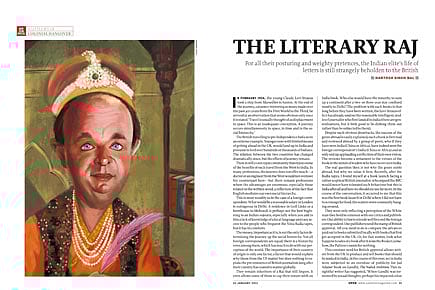
The piece you ran this week [‘The Literary Raj’, Open, 10 January], and the whole-page cartoon you ran with it, felt to me blatantly racist. I am glad to see that most of the comments posted under the piece [on the Open website] seemed to agree that Hartosh’s principal grouse seemed to be the colour of my skin.
After all, I am hardly a pampered expat on a three-year expenses-paid stint. I have lived in this country on and off for more than 25 years—most of my adult life since I first came here in 1984—and have done so on the hard-earned royalties of my books. I have now written five books on India which, whatever their many failings, surely represents a serious commitment of time, work and love to this country.
I conceived, co-founded and co-direct the DSC Jaipur Lit Fest, which is now the largest in the Eastern half of the globe, and brings fine writers together in 12 of India’s 22 official languages. Thanks to the funding we work hard to raise, it does so entirely for free, for anyone who loves literature, in addition to which we raise money to provide bursaries for those who can’t afford it to attend from across India. To date, I and my co-director Namita Gokhale have been paid little more than expenses for this labour of love, which now takes up about a quarter of our year.
Over two-thirds of the writers I and Namita invite are desi. The British contingent, Brown, Black and White, make up a minority within the minority of the firangi contingent. This year our two keynote international speakers are Turkish and South African, and our special subjects are literature from India’s Northeast, from Palestine/Israel, and from the region now known as Af-Pak. The idea that this joyously multi-vocal festival, which has fought hard to promote Dalit, bhasha and minority literature, represents some sort of colonial hangover is both ignorant and extremely offensive, not just to me but to the whole team who labour to make it happen, and to the sponsors who donate funds to make it possible to present the writers without charge.
So why publish a snide and malicious piece that casually rubbishes both my work and the literary mela I helped to found, by someone who has never once attended the festival? I know Hartosh likes to create controversy and probably even he doesn’t believe half the rubbish in this piece. But racism is never funny, and I don’t see why I should put up with it any more than anyone else.
Just reverse the proposition for a moment. If anyone was to suggest that Vikram Seth had no right or qualification to write a novel about England like An Equal Music, or to live in the large house bought with his advances from his magnificent books, it would be regarded as blatantly racist. If anyone was to suggest that Amit Chaudhuri shouldn’t judge the Booker Prize, or direct Britain’s leading creative writing course, because he was too Bengali, or that Salman Rushdie should not be president of PEN as he was of Kashmiri Muslim origin, it would be regarded as blatantly racist. If an ostensibly liberal magazine in the UK ran an article headlined on its front page, ‘London’s over-rated foreign writers’, it would rightly be denounced as blatantly racist. If they published an unflattering cartoon of, say, Naipaul dressed as an English lord, mocking him for setting himself up as a Brown Lat Sahib in Wiltshire, that magazine could potentially be taken to court.
Yet you do this and more, merrily traducing as a Raj hangover an anti-colonial Scot, who has written fiercely critically of the Raj for a quarter of a century. To me, at least, this reeks of double standards and reverse-racism which is all the more alarming in that your editorial team seem blithely unaware of it, and that it comes from so intelligent a writer as Hartosh (who, incidentally, is very welcome to come to the festival for the first time and see what it’s actually like rather than how he imagines it. I am even happy to buy him a drink if he bothers to move from Delhi.)
My adopted country is in general pretty tolerant of people who choose to come and live here, and I have only once before had to write a letter like this, defending my existence as a writer in the country I love. But I do think there is an important principle at stake here, and to me at least, that piece felt little more than the literary equivalent of pouring shit through an immigrant’s letterbox.
Yours,
William Dalrymple


OLDER COMMENTS FIRST
29 COMMENTS
Permalink
This is geopolitics, not William Dalrymple, stupid! How can you erase centuries of cultural colonialism in two decades of economic growth? Dalrymple is doing his best to mend the fences in his own small way.
Permalink
Well done William, a very well thought out and written reply to Hartosh's article. It's a shame that in this day and age we are still categorised by our place of birth or the colour of our skin ahead of our experience and personal commitments.
Permalink
any reason why my comment is not up by now??
Permalink
I am very disappointed in you Mr. Dalrymple. I would have expected that someone like you would rise to the challenge and explain how the Jaipur festival is in fact more representative than is claimed. You have done this partially but have used a device unworthy of you - at least one of your keynote speakers, though from a country other than the UK, is one who has won many accolades from the UK. I do look to the UK as an authoritative arbiter on English Literature - the country's has had centuries of practice and can certainly be seen as particularly reliable when it comes to affairs of the language. If that is what you also think - honesty would have been appreciated.
The racism charge is absurd. It is absurd not only in its ignoring of the power dynamics that form an integral part of racism, but also in its implication that racism is less likely to be visible in British mainstream media. Has Britain any brown Prime Ministers (or 'first ladies/ gentlemen)? Did anyone take action against Melanie Phillips for her paranoid rants? Here is one about a 'conspiracy' through which Asian immigrants will transform Britain - http://www.melaniephillips.com/articles-new/?p=690.
This Islamophobic woman is published in the Spectator and the Daily Mail rather regularly.
I have always welcomed your contribution to literature in this country, and I have always maintained that anyone can learn to love a country and make it their own. I can understand why Hartosh's article would offend you (though I think you missed his point, which is that we should be creating and nurturing our own Dalrymples instead of relying solely on imports who choose to come and love our country). But I am truly disappointed in the manner in which you have responded - it does you no credit at all.
Permalink
@Babita: your comment appears where you posted it ~ in the original article (the Literary Raj). Please check this link: http://openthemagazine.com/article/art-culture/the-literary-raj#comment-...
~Ed
Permalink
Wiiliam, I am a great fan of your writings, esp. City of Djinns, which helped me to rediscover and love Delhi. However, I was slightly bemused by the tone and content of your piece above. I would have actually expected someone like you to be delighted at the wonderfully drawn cartoon of yours - and even pin it up your wall as a memoir of your time in India - instead of taking offence to it! You have been a great literary and cultural ambassador between East and West, and you don't need to prove your worth by peppering your defence with desi phases and cliches. That just seems so contrived. While I don't agree with everything that Hartosh says, he has a valid point that we Indians generally tend to fawn upon white-skinned foreigners, and that gaining their approval is often a prerequisite for gaining success and recognition at home. Rightly or wrongly, you have been a beneficiary of this peculiarly post-colonial Indian flaw. But, surely, his point is more of a commentary on us than it is on you. Why not just agree with it, and use it to positive effect to poke fun at yourself and at us, instead of being so sensitive? Perhaps the time that you have spent among the glitterati in Delhi has made you more Indian than you realise.
Permalink
Man, you're like the Sarah Palin of the Indian literary scene - me, me, me, poor little me, look at how everyone's jumping on me. Thank the lord there's no mention of blood libel in the article. Get over yourself. Bal was clearly discussing the subservience to the British literary establishment within the Indian intellectuals, publishing industry and chatterati and not the colour of your skin.
Permalink
Like many other things that are now essentially and inextricably Indian, the English language too had its origins in a foreign land. So what? The language of Rushdie and Seth and Ghosh and dare I say Dalrymple, is no less authentic and no less relevant to the Indian experience than the verses of Kalidas or Kabir. Yes Indians have a firang fixation and yes writing in English by brown and white skin alike has greatly enriched the cultural life of contemporary India. Neither are particularly profound or original insights about India. Grow up please Mr Bal and Mr Dalrymple. We expect a better quality of debate on more genuine issues from our intellectuals, whether native born or adopted. Or is this debate too, like many other things in Indian media today, something wholly contrived in the service of Mammon?
Permalink
A good rebuttal to a confused and racist argument.
Permalink
WD the beneficiary of a privileged upbringing, and is benefiting from the backwash of colonialism.
I doubt if he has ever experienced a racism or prejudice that has disadvantaged his life in any way.
As for the caricature , it is no worse than anything found in the British papers.
Permalink
Perfectly penned Mr.Dalrymple! Reverse racism serves no purpose. Racism is nasty from whichever end it originates.
Permalink
Mannn !!! You definitely seems to be pissed off... lol
What Hartosh wrote may be blatant, but it surely makes sense.
There are these feelings in this nation which somehow give more respect to a foreign equivalent of local things. I am not just talking about literature, be it anything. these feeling have strong roots. Most of my fellow intellectual Indian fellows will cease to acknowledge it, trying to reflect a "globalization of India" mindset, but its there and prevalent.
Its having a very remarkable, unthinkable effect on our subconscious, which can be summed up to be called as - "Lack of Confidence" in crude terms.
Why is it that we are still relying on Russians or Americans for high end technologies ??? Why is it that every other reality TV show is a copy of American or European series ??? Because we rely more on them then we rely on our ourselves.
I don't blame any particular person (in this case Mr. William Dalrymple ), neither Hartosh meant to, but there is no denying of the feelings that he talked about.
Permalink
Dear Mr Manu Joseph,
I have been reading with interest and a growing sense of dismay, articles and rebuttals being issued by Mr. William Dalrymple on the Jaipur Literature festival, its origins and now finally on his version of how he thinks the festival is successfully executed. Most of this has been printed in Open and now in his latest interview to the Crest Edition of the Times of India.
The time is perhaps now right to clean up the current spate of ‘post colonial’ whitewashing that Mr. Dalrymple seems to be indulging in. For the record, the festival was NOT conceived or Co-directed by him or Ms. Namita Gokhale for that matter when it was started in 2006. That honour if you were indeed to call it one, would rest solely on myself as the first Director of the Jaipur Virasat Foundation and of the Jaipur Literature Festival 2006. The literature festival was conceived during discussions on a drive back to Jaipur from Delhi with Ms. Faith Singh the founder of the Jaipur Virasat Foundation and Ms. Di Robson our then International Festival advisor.
Ms. Gokhale to her credit has always acknowledged this, though for some reason it seems to be a rather uncomfortable truth for Mr. Dalrymple to accept. This year it seems to be getting even more unpalatable for him as can be seen in his polemic “The piece you ran is blatantly racist”. Or perhaps it’s just a bit of inconvenient truth that he would like to air brush out of history, completely once and for all when he repeatedly goes on to state that “ I conceived, co-founded and co-direct the Jaipur Literature Festival…” The truth is anyway out in the public domain if one were to look at the 2006 literature festival brochures and pamphlets. Mr. Dalrymple and Ms. Gokhale are listed purely as advisors to the festival.
My concern now turns to incredulity when I see his latest interview in the ‘Times of India’s Crest edition’ dated 15th January when the self proclaimed declares and I quote “ The USP is, there's nothing sarkari, official or even professional about it. We don't even have an office. There are no full-time paid members of staff. Festivals like Sydney have a full-time director and support staff. We don't even have a telephone! This is run via four Blackberries, basically friends doing this from their bedrooms. But it's full of love and enthusiasm”.
What is Mr. Dalrymple talking about? Of course the festival has an office. Last, I heard the festival was being run and produced by Teamworks Films that has at least 40 people working day and night to pull off this grand event. Does he really think, visas, hotel accommodations, travel logistics and the entire planning of sessions for 220 authors over 5 days gets done by 4 blackberries and friends working out of bedrooms? The unkindest cut is of course to say that there is ‘nothing professional’ about the planning of the festival. Perhaps the efforts of Mr. Sanjoy Roy and Ms. Sheuli Sethi (who I have never met, but has been brilliantly producing the festival) are not professional enough for him. They definitely seemed good enough for the 180 speakers and 30,000 people over 5 days who attended last year’s festival.
Elsewhere in the same interview he remarks that 40 people turned up for the first festival, I suspect the truth that 300 people came to hear Ms. Shobhaa De in a fully packed hall with additional chairs set out in the lawns is a scar still festering somewhere. His own audience that year was considerably poorer!
The real issue is however not who conceived this festival or ran it for the first year or even worked on it for the second year and so on and so forth. The real issue is a growing sense of overarching ownership that Mr. Dalrymple has for the festival over the efforts of countless Indians who have worked very hard to make the festival what it is and still do the dogs work to make it happen every year. I would never debate Mr. Dalrymple’s immense contribution to the festival and the fact that it has reached where it has today purely by his and Ms. Gokhale’s untiring efforts. Though in his current inclusive version of history that slips out in every interview, she only works on “Desi / Bhasha” bits of the festival, the western writers who come are of-course purely by his efforts. Nothing could be further from the truth. Ms. Gokhale has pioneered the literature festival idea in India and was for this very reason invited as our fist advisor to the Jaipur Literature festival in 2005.
A senior Indian academic and collector of popular Indian art once told me of how a European counterpart of his always referred to her own collection as an archive while calling his a database. Racism plays out in very subtle ways and very often we are able to pin point the truth of the matter much after the attack is over. As Mr. Hartosh Singh Bal correctly summarized in his rebuttal to Mr. Dalrymple, to mock the experience of racism is easy for someone who has never really had to face it. Ask me? I left the Jaipur Virasat Foundation because of that and it has taken me this long to be able to say it.
Thanks & Regards
Permalink
Dear William,
Your contribution to Indian writing & Jaipur festival is undebatable.
India has always attracted and welcomed personalities like yourself. Racism is a global phenomenon. You should remain undeterred by such comments and focus on the festival.
You are loved and admired in your adopted country India.
cheers!
V
Permalink
William, I dare say that if you cant understand the “Brit is right” syndrome – which is so well prevalent throughout India- that he was talking about, then you really cant claim any understanding of India. Even when I read your Last Mughal, I had this feeling of ‘you aren’t really getting the actual point’. You have proved me right by this stupid response of yours. And another revelation that has been made here is that you lie. You lost one reader.
Permalink
The problem really has to do with the Indian tendency to mindlessly idolize people. Just because Dalrymple writes about India, should Indians be beholden to him and become his worshippers? And that's what some Indians have done to him - made him into a colossus, a scholar, and a great man!
And when such people take a stand even on matters that they understand poorly, they become even more important. For example, in one or two of his interviews, Dalrymple has given expression to some of his political biases and helped push a definition of secularism that is non-applicable in a country such as India. He has also given his approval to the ruling party and its President. Indians should avoid excessive adulation and hero-worship and be more mindful of what's important to them. We do have a tendency to exalt anything that the White man does and says.
Permalink
Dear Mr. Dalrymple,
I hope you are sensitive enough to see that no matter what, your whiteness matters. How many Desi writers in English would have struggled for 5o years without any visibility, because they are just another Indian?
In the Attenborough movie Gandhi, Bapu asks the English priest Charles Andrews to leave India, because the history of freedom movement would otherwise be attributed to an English Man's advice to Gandhi. Gandhi reasoned to Andrews that it was probably best for sympathetic Britons like himself to leave the freedom struggle to Indians. Would you call Gandhi racist? Why was it necessary for Namita Gokhale to have you as co-director to add to its visibility?
A similar flaw is present in the Indian Literary Establishment, sadly even after 60 years of independence. The Adigas, Kiran Desais and the Roys get high visibility only after they are awarded British prizes. The Desi writers are relatively invisible.
The point is our own inferiority complex (for example the white female benefactor in the movie Lagaan), not your love of India.
I'd also like you to consider the idea that "Whiteness" comes with automatic privileges which white people are unaware of, or consider as natural law. See Rajiv Malhotra's description of how the "White" cultures anthropologize other cultures, but never their own.
http://rajivmalhotra.sulekha.com/blog/post/2004/09/dialog-on-whiteness-s...
Permalink
Mr. Dalrymple,
I know I am late to this party, and I was glad to read in DNA that you regret accusing Open of racism. But it was surprising to see an intellectual of your reputation using the term so insensitively--and so inaccurately--in the first place. As a scholar, you know that 'racism' refers to an ideology based on the idea that some racial or ethnic groups are superior to others. Racism is neither simple nor static--you know this, as well; in The Last Mughal and The White Mughal you wrote, among other things, about the complex and changing British attitudes towards Indian Muslims in the nineteenth century. But although racism has taken on many forms over the years, it is almost invariably accompanied by unequal relationships of power and some kind of explicit or implicit threat to groups of people labeled 'inferior'.
The Open article was not advancing an ideology suggesting you are part of an inferior race; it was not printed in a context where you and people like you are systematically excluded from power; and you weren't worried that you might be beaten or lynched as a result of it. You may say it hurt your feelings; you may say it was unfair or wrong. You might--if you stretch it--claim it was prejudiced or discriminatory. But calling it 'blatantly racist,' was, at best, a terribly silly thing to do. And comparing what happened to you to "shit through an immigrant's letterbox" was something a bit more serious than silly. The immigrant with the shit in his letterbox is not typically given a full page in a major magazine to explain how he feels about being wronged, and the exchange between he and the pourer of shit does not end up with a shared round of drinks. Shit in a letterbox, like a burning cross, is an act intended to spread fear; as a literary man, you should know it is not the sort of symbol to be lightly invoked.
When I first saw this controversy, I thought it remarkable that people were so restrained in their response to your claims of injury. Maybe 'racism' is a term that doesn't have as much traction or history in India as it does in the west--here we tend to think in different terms--communalism, colonialism, caste oppression come to mind. Whatever the reason, I think you've gotten off easily. In future, before you use the 'R' word, take three deep breaths, and remember what my 13 year old son said when he heard about this controversy, "But racism's not for white people!" Simple, really. Yes, I know that since the Thatcher-Reagan years, politicians in your country and mine have been courting the conservative white (southern segregationist/National Front) vote by throwing around terms like 'reverse racism', and 'reverse discrimination'. But I don't think that is the company you want to keep.
On a related topic, I would also suggest you avoid yelling 'sexism' if you are ever asked to vacate the Ladies Compartment of the Delhi Metro.
Permalink
No doubt "racism" or whatever you want to call it remains a big problem in multicultural nations, but I have to say I get sick of hearing the privileged, educated Indian elite complain about that time they felt belittled at an immigration counter or some such petty incident, when the extent of Indian prejudices against their own people - for their dark skin, for their class or caste, or even just where their family comes from - remains so disgustingly intense, widespread and socially acceptable.
Why don't we sort this kind of stuff out first? The Brits have at least managed to get to the point where they find such prejudices socially distasteful. Other than "child molester", "racist" is perhaps the worst thing you can call a Brit.
Let's be honest: No one has a problem with "brown people" more than Indians.
Permalink
Noone has a problem more with brown people more than Brits, not Indians, with reference to your last line and your obsession about class, caste etc is typical of how you typecaste us Indians! Not only do you not understand India, but you have no qualms in making your living off Indians while mocking them and running them down at every turn, all the while superciliously talking about how emancipated Britain is! Yeah, right - ask anyone who has been at the receiving end of Multicultural Britain, with sneering references to darkies, and Pakis!! As my African friend told one of you supercilious Brits - we may be third world, but you remain by your attitude, turd world
Permalink
I agree with William, he has every right to be here and he has an amazing body of work to validate his stay here, not that he needs to. Place of birth is a random accident, franklly Hartosh's article is facile and reflects lazy thinking. When a man has not even visited the place he is commenting upon, what does it reflect? It was a gimmicky kind of an article to leverage JLF's publicity for his own end. Quite honestly surprised that it was published on this site.
Racism is ugly whichever side it sleeps on.
Permalink
@Akash
Clearly you do not understand Britain, or haven't been there for a few decades. "Darkies" and "Pakis" have been considered abusive and unacceptably racist terms by mainstream British society since the end of the 1970s. Britain is not perfect - nowhere is - but to say that British people are not concerned about stopping racism is simply untrue. An accusation of racial prejudice is a big deal to most Brits. Meanwhile, the only people I know who think words like "Pakis" and "Chinkies" are perfectly fine to use are Indians. There is also an obvious and blatant preference for fair skin over dark skin in Indian society.
Presumably Indians get a free pass on this because... well, why? If it's vicious racist abuse when British people do this, why is it fine when Indian people do it? Is it simply because they're not white? Surely, racism or ethnicism in all its forms should be considered objectionable.
I suppose you could argue, "India suffers from a form of auto-racism because centuries of white colonial oppression left us with the equivalent of a cultural psychological disorder - the abused becomes the abuser" - but how many more decades after Independence need to pass before India finally drops that excuse? And why not start accepting and actively dealing with this problem right now?
All that said, Akash, you appear so angry that it seems you or someone you love must have experienced racist treatment at some point in your life from a British person, and that's a great shame.
Permalink
I read the article with growing dismay. Admittedly it helps to sell a few more copies, but the quality of journalism stinks. The writer has not even been once to the festival ! And i thought we had enough of arm chair critics.
Permalink
Dear Mr. Dalrymple,
I apologise on behalf of this magazine's writer, and hope you continue to write on India with sensitivity and equanimity.
This magazine is generally provocative; even the editor often writes snarky op-eds on both South India and Delhi: they are well-read equal opportunity offenders.
I expected you would ignore this little snark on your writing and the Jaipur fest. But since you are observably hurt, allow me to apologise.
Sincerely,
Karthik Balasubramanian
Permalink
Dear Mr. Dalrymple,
I don't want to even apologize for this nasty attack on you from a fellow Indian who l get the feeling is projecting the negativity and colonial insecurities that still has fantastic grip over the indian psyche.
Every indian and especially the indian elite suffer from this anathema and bring down all things positive in this country.
You are damned if you do or damned if you don't pay attention to these dampners. Please ignore these negativities and i pray that you continue the brilliant work you are doing and the amazing contribution to the indian literary scene.
So what if the literary festival is full of uk and US based writers (which its not though I have not attended the festival I am following it online via the videos).
If you want a indian festival nobody is stopping you from creating one ?
Indians and especially some indian journalists are these weasels who like to shoot down success hiding behind false nationalism and feel their contribution would be to play on the macaulayistic insecurities of both elite and vernacular sensibilities hoping to grab their share of fame through destruction than construction.
I also get the feeling that indians any show of strong personalities and you appear to be one as one needs to be to put together any kind of enterprise in india.
I am not comparing you to lalit modi but watch out for the collecitive malice generated by indian elite especially if people like hartosh manage to get sympathy or patronage from a powerful politician.
They will bring you down and destroy all things good in the name of nationalism and misplace anti-colonialism. More strength to you and hope you remember that there are millions and millions of indians like me who admire and adore what you are doing for india. You will go down as the one of the greatest indians of 21st century for your contribution to Indian literature and I don't care which language that renaissance happens in.
Permalink
Anyone who tries to bind literature within a geographic space and into a socially constructed concept like race, nationality, doesn't "GET IT". Mr. Dalrymple continue doing what you do. India is richer, more compassionate and beautiful than the sum of a loser's insecurity. You of all people should know it!
Permalink
I don't think Dalrymple needs to face flak for this piece written in defence. Let's not forget that his books have been incredibly popular and liked by the Indian readers, irrespective of what a few critics/journalists have to say. Besides, it's about what an author writes, not about what country, caste, class he/she belongs to. This is really hitting below the belt!! And if we as Indians are being accused of being racist, we shud stop and think about it instead of being emotional and defensive about it. A case in point is the alleged racist attacks on Indians in Australia between 2008-2010. While most were actually petty crimes, very few were racist but the Indian media was glad to colour them all as racist! That was unfair, blind and racist on our part, i'd say!
Permalink
"Bal's reasoned rebuttal of William's irrational outburst should have left Dalrymple stranded in his literary tracks. Well, I've read Bal's article, which for Dalrymple, the ‘piece felt little more than the literary equivalent of pouring shit through an immigrant’s letterbox’. Though I have not read any of William's works, his 'filthy' reaction born out of an imagined personal slight, should make one scary to lay hands on his 'perceptive' books about us Indians."
Permalink
I came across Dalrymple's apoplectic rebuttal here first - all about the reverse-racism and personal attacks and skin-color. Then I went through Bal's piece to see what the brouhaha was all about. Instead of defending himself and his credentials with reverse-racism claims, if the diversity, inclusiveness and symbolism that the Jaipur festival now represents were put into focus, Dalrymple would have sounded more convincing. Also, did he really need to use Indian words showing his "Indianness" and love for India for more acceptance for his viewpoint?
Every Indian here is aware of the colonial hangover of desis fawning and looking toward the Brits for approval - Bal just gave it his assessment with apt examples.
Anyway, I am licking my chops for the many rebuttals from others.
Post new comment