Joke Studio India
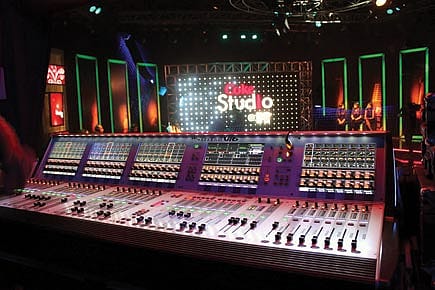
The UN project-like earnestness with which popular singers like Sunidhi Chauhan are made to collaborate with not-so-famous talent from across the country makes for spectacularly unmoving performances
'Import-export' was a phrase that was very popular in my childhood: its sound threw up an algebra of image, curiosity and morality, and was used liberally to describe a professional life that survived on the potential difference between two places separated by barbed wire. This was, of course, before globalisation, and it is interesting to trace the trajectory of the life of this expression post-Independence and post-liberalisation. It was used for people, especially the kind my parents wanted me to avoid; for products, whose value seemed to multiply after some transmogrifying travel; and also, though very rarely, for a place where such trade proliferated. I remember it being used as a joke by an invigilator in an examination hall to warn us off copying, but I have no memory of it ever being used to describe a sensibility or even a cultural transaction.
When I watched Coke Studio India this summer, it was the consciousness of that lack of usage that came to my mind. Pakistani music first arrived in small towns like ours with Hawa Hawa by Hassan Jehangir. We had no idea why it was called Pakistani, especially because we never got how it was Pakistani. Video films, Pakistani television serials that came to us via Bangladesh with Hindi subtitles, an odd snatch of music caught on a television camera during a Test match in Lahore, and so on: this barter economy of 'culture', as if it came in sealed packets, was lopsided, in all senses. Pakistani music, for an uninitiated listener like me, meant nothing. Why then, did I prefer Coke Studio Pakistan over its Indian counterpart?

The Liberation of Bengal
05 Jun 2026 - Vol 04 | Issue 74
A silent revolution ends the reign of fear
Most of the bands that performed on Coke Studio Pakistan owed their state of mind to the state of their nation, their unease with its systems of polity and culture, a politics that defines their song-writing and compositions, something Rohail Hyatt, its inventive producer, capitalised on. Leslie Lewis, once one half of the group Colonial Cousins, that name itself a giveaway to his discourse of fusion, is Coke Studio India's dripping candle, responsible more for messy wax drippings than fire and light. Coke Studio Pakistan's popularity owed much to its tweaking of traditions, an uncommon assimilation of the poetry of the commonplace and the metaphysical blueness of the dargah that nowadays goes by the simplified and accessible name, Sufi. Coke Studio India had no such tradition to turn to, and looking for a common denominator, its needle stopped at Bollywood. But Hindi film music was already a product of fusion itself, contextualised to the rhythms of storytelling, and though alarmingly deaf to the music of place, it had managed to bind most of India into a rosary, the aleatoric moment of the bead in the hand being analogical to what Hindi film directors called 'inspiration'.
Watching Coke Studio India brought back memories, in a tangential way, of my childhood reaction to the Amitabh Bachchan song, Angrezi main kehte hain ki I love you … (Khuddar, 1982). I remember being pleased in an odd way, the child's pleasure of having watched her moral science lessons come to life, that one moment where Bachchan's larynx became India, the 'unity in diversity'. The Angrezi-Bengali-Punjabi 'influences' on Hindi film music are almost scatological to note, perhaps because of most music directors coming from these parts—the 'Angrezi' in that equation, of course, deriving from copy-paste-tweak inspiration from English songs. AR Rahman made the 'Madrasi' sound accessible to the Hindi film audience, just as the Indian Railways pantries made idli-dosa-sambhar a pan-Indian cuisine. But that is only a distilled—and often artificial—flavour, even a misnomer, like eggnog.
Two sounds were distinctly missing from that pantheon: 'South' India; and in spite of SD Burman's incorporation of many 'tribal' sounds from Comilla and Tripura, or Salil Chowdhury's occasional collector instincts, the sounds of 'Northeast' India. It is, therefore, interesting to see how Coke Studio India works to the neo-constitutional agenda of Ek Chiriya, Anek Chiriya. In the juxtaposition engineered by Coke India, the singer or band of musicians from the provinces is, by singing with the usually more famous singer from Mumbai, allowed to claim a space within the already sealed structure of the popular film song, but this is not a subaltern's singing back, but singing into. So, in spite of energy, enthusiasm and fresh ambition, the result is most often soulless, a tick-the-box progression through the paces, but completely lacking in the history that comes from tradition. Also, the 'studio' of the title, let alone its location, is an artificial space, a constructed space akin to a laboratory; so there is cross-fertilisation but not the cross-pollination of a forest or even a garden.
The position of the outsider is not used in these performances. There is no audible counter-agenda at work, something that made the Noori performances (a Pakistani rock group) on Coke Studio Pakistan, for example, so rivetting. What I also found disappointing is how rural and semi-urban traditions have been ignored completely: it seems to have been decided that any tradition that cannot make use of Leslie Lewis' arrangements, with their unashamed reliance on percussion, is unfit to partake in any such hand-shaking event. And so the songs of India's own gypsies, not those appropriated as banjara music by Hindi cinema, or those that use only the ektara, are left out of this mission.
The Northeast performances are most interesting. As in most discourses about the region, the Northeast is treated either like a museum or as something unformed. Papon, who has been called the Bob Marley of the Northeast in another essentialising we-are-the-world gesture, one that seems to drive the spirit of a programme—and enterprise—such as this one, sings a medley of Bihu songs in the studio, but a performer like him (I have been witness to agricultural labourers singing and dancing to one of his songs playing on a cellphone in the paddy fields of lower Assam) enters the studio at a disadvantage. It is a bit like being asked to run the second lap first in a 400 metre race. The occlusion of any element of chance makes the original composition, as in the Bihu songs, seem like a heritage monument that is being visited with plans for restoration.
"I have always been fascinated by the Northeast: it seems so dark and mysterious. Tell me, what is it really like?", a woman in Bangalore asks Kaberi, the protagonist in Jahnavi Barua's novel, Rebirth. Coke Studio India raises a hand to answer that question. In Bichhua, an Assamese song that was curated by Salil Chowdhury for the Hindi film Madhumati (1958), is taken up by Sunidhi Chauhan, Mausam and Bondo. The soullessness of the performance meets both ear and eye, especially against the backdrop of the acrobatics of musical instruments, the drum beat used quite effectively, even in the 'innocent' tribal mechanism that Hindi cinema continues to invest in. Inside the Studio, that drum beat, its importance exaggerated by camera close-ups of both the instrument and musician, becomes just a prop. It doesn't measure energy like Salil Chowdhury's drum beat did. This is not only song but also ensemble folk play. And so, Sunidhi Chauhan's conscious use of a silver necklace that is common in the Northeast, especially among the Garo tribe, and the presence of such faux-tribal accoutrements in the same frame.
A deliberate retracing—and re-enacting—of the original journey is seen at work here: its 'origin' was Assamese, and so an Assamese singer is brought into this musical conversation, his role almost solely to reclaim the Assamese quotient. In this hilarious dynamics of the substitution of an aesthetic—a culture, a sensibility—with a singer is coded the many fundamentalisms that demand such quota casting. As children, we often laughed at BCCI selectors who wanted a certain ratio of players from their home 'zone', but to see that joke continued into middle age is to feel sad for a nation that is so lacking in confidence. This version of affirmative action, one that almost echoes a Rajdhani Express travel map, flowing out of the capital to its different corners, changing them but remaining almost wholly unchanged, is the bane of a 'nationalist' culture and polity like India's.
In the trailer of a performance by Richa Sharma, Bombay Jayashree and Rashid Khan, the three singers are allowed a ten-second byte. Richa talks about the importance of music to her life in her teenagerish what-love-means-to-me rhetoric—"Music is everything for me…"; Jayashree about music being her "breath"; but it is Rashid Khan's words that are most interesting. And it is not because Khan is one of my favourite vocalists. Rashid Khan's words have a curious, even innocent, lack of sophistication about them, something that was visible to viewers of a Bengali talent hunt television show a year back: "Yeh jo fusion hai… mere liye bahut mainey rakhta hai…". Right, Khan saab, that is exactly what I want to know: what meaning does fusion hold for you? And isn't classical music fusion too? Bombay Jayashree wants to be born as an "Indian musician". A strange urge, but perfect for Coke Studio India. For this is an arranged marriage, and a threesome in such a situation only reminds one of Princess Di's words about her marriage: "There were three of us in this marriage, so it was a bit crowded."
Perhaps it is also pertinent to question the motive behind this differential calculus. Or, is it integration? Why else this summation-like intent in bringing two singers from completely different traditions together? To disprove Samuel P Huntington (of the 'clash of civilisations' theory)? The denial of organicity of such a project in a country like India, the result of a United Nations like impulse, only makes one aware of differences: in O Majhi Re, for example, one becomes aware, after the sthayi, that east is east and west is west, and never shall Shaan and Saurav Moni's musical scales meet. Also, polyphony might be a marvellous thing, but certainly not in the music here.
Fusion comes with a history of trial and error, of lived experience, of contexts of adjustment and withdrawal; one needs only look as far as rock 'n' roll music to see how it derived from a fusion of blues, Gospel and country music. 'A combination of north and south …' is how the composition Vethalai is introduced. Kailash Kher, with the unconscious associations of his name with the northern Kailash parbat, and Chinnaponnu carrying the south of the Vindhyas in her larynx, are expected to represent northern and southern India as athletes do in inter-zonal meets. The artificial nature of such inbreeding—Tamil street music with Hindi Sufiana—often results in something that is like a Durga Puja pandal of the Taj Mahal: an assemblage of details, a display of craft, but entirely without atmosphere, the lifeblood of any kind of music. The long aalaps that made some of the Coke Studio Pakistan performances rivetting are missing, and along with it, unfortunately, are flair and talent. Not one singer this side of the border could match the extraordinariness of Sanam Marvi. Coke Studio India's failure, so far, has not only been its choice of mostly ordinary singers, but the complete lack of surprise in its collaborative juxtapositions. None of the singers has been asked to adopt a new genre; inventiveness has begun to seem like a soiled expectation. What one musician-writer said a few years ago, using his music project as commentary and critique of the pathetic state of 'fusion' music in India, is true of Coke Studio India: "This is Not Fusion."
Sumana Roy's first novel, Love in the Chicken's Neck, was longlisted for the Man Asian Literary Prize 2008. She is working on a collection of stories about clothes, tentatively titled SML