That Prodigious Proclivity for Trickery
The heat and dust are factors, of course. But it’s also our penchant for scheming that makes us a nation of legendary spin bowlers
Wizardry
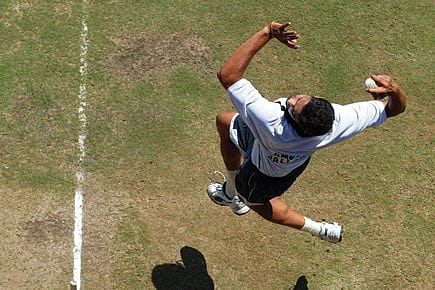
KEEPING IT SHADOWY  Leg spinner Anil Kumble in his delivery stride

When one comes to write a book on a specialist subject within a specialist subject—and I think we can safely describe spin bowling as just that—there might be a reasonable expectation that a general audience wouldn’t know what to expect from it. In fact, with Twirlymen, the opposite proved to be the case. One particular expectation popped up clearly and consistently. Every time I spoke to a cricket fan about the project, they alighted on the same question. And in each and every interview I did with former and current players, or legendary observers of the game, that same question came up. It was my ever-ready companion each time I set down to write, the incessant enquiry that gave force and direction to the task at hand.

Why do Indians like to spin?

Why is it that, South Africa aside, India are the only Test team to have played with four spinners in the same side? How can it be that one nation—albeit with a vast population—produces no bowlers of genuinely express pace, but a conveyor belt of spinners of the calibre of Gupte, Bedi, Chandrasekhar, Prasanna, Venkataraghavan, Kumble, and Harbhajan, and all in the space of a few years?

No shortage of explanations has been offered by cricket writers over the years; but before turning to them, it may be worth adding a few caveats. The tendency of Indian bowlers, even today, to think of themselves as merchants of mystery rather than purveyors of pace is not the only instance of a national characteristic spreading through one form of bowling. Take the case of English left-arm spinners, for instance. They have tended, over decades now, to be slightly mad.

Phil Tufnell, that hugely talented spinner who now makes his fortune as a contestant on celebrity shows, was one of the game’s great pranksters, and a victim of pranks too. At one Test in Australia, a crowd member shouted: “Oi Tuffers! Lend me your brain, I’m building an idiot.” Keith Medlycott, a brilliant left-arm spinner selected to tour with England, was suddenly struck by the yips, the fatal disease that causes a bowler to completely lose his ability to deliver the ball to the batsman. Fred Swarbrook was another one to get the yips. Eventually he went to a psychologist, who told him to keep a pebble in his pocket, and rub it before he came in to bowl. One day when he sent the ball flying into the air, only for it to land on his own head, his captain Eddie Barlow said: “Fred, have you thought about rubbing the ball and bowling the pebble instead?”

So it’s not only Indians whose eccentricities can be clearly traced in bowling methods. But we should be sceptical, too, of the idea that packing a side with spinners is peculiar. In fact, such a claim is absurd when one considers the grand sweep of cricket history.

When cricket began to spread in the late 18th century, ‘bowling’ meant literally that: bowling in the manner of ten-pin bowling, with the ball rolled along the ground. A bowler’s best hope, if he wanted some deviation off the pitch, was to hit a fox hole or mole hill. It was only significantly later that bowlers actually started to give the ball some air. Even then, they were restricted to bowling under-arm.

It was not until close to the middle of the 19th century that round-arm bowling—releasing the ball at shoulder level—was introduced; and only much later was over-arm bowling, the form bowlers use today, deployed. The implication of this is that, for nearly the entire first century that cricket was played competitively, a bowler’s best hope was to impart the ball with spin, because generating pace with under-arm or round-arm deliveries is very hard to do (unless you’re Lasith Malinga). Seen from this perspective, the domination of fast bowling in today’s teams is a kind of decades-long aberration.

So, with these caveats—that other nationalities produce their own eccentricities, and that spinners dominated bowling attacks until the 20th century—let us return to the question of why Indians prefer to spin.

When I set down to write the book, my initial working subtitle was A Cultural History of Spin Bowling. I only changed tack when it dawned on me just how unlikely this history of mystery is, and how utterly beholden to the vicissitudes of fate. But my initial feeling, that understanding spin bowling was a route to understanding different cultures, found no surer expression than in the curious case of Indian spinners.

Indians, as readers of this distinguished publication can well attest, are an intellectual bunch. On the whole, they tend to be cerebral, and delight in mind games and flights of imagination. This sits very comfortably with what I have called the spinner’s spirit. As I write in the first chapter of the book, ‘Spin bowling speaks to a frame of mind, a spirit and attitude, that is eccentric, manipulative, relaxed about deceitfulness, curiously obsessed with the twisting motion of spherical objects, and bent on ingenuity’—in other words, the Indian frame of mind.

The spinner is just as attacking as the pace bowler, but seeks to think the batsman out rather than bounce him out. His weapons are more cerebral than pure power; and he wishes to make the batsman fearful not of pain, only ignominy. In all these respects, he speaks to the cultural tendencies of Bangalore and Bombay (as I still insist on calling it), not Barbados or Brisbane.

If that is the cultural explanation, perhaps there are some natural ones too, and I’ll leave it to the aspiring anthropologists among you to argue over whether nature and culture amount to the same thing. In one of my favourite passages from the pen of George Orwell, he refers in the seminal essay A Hanging to ‘the bobbing gait of the Indian who never straightens his knee’. There is wisdom in that. Many Indians, especially those of an early generation, are small and sinewy of build, not 6’8” and terrifyingly muscular like the great West Indian fast bowler Joel Garner. Such comportments lend themselves much better to the demands of spin and swerve than swing and pace.

And what of climate? The sweaty heat of an Indian summer means the spinner can get through 30 overs in a day if need be, whereas the pace bowler, with his absurdly long run-up, cannot. It’s true that many other cricket playing nations—West Indies and Australia, for example—have very hot summers, but perhaps they are not as dry. Of course, the dry summers of India produce pitches that are dustbowls by the end of the first day, or even before. This too encourages bowlers to spin, knowing they’ll be able to extract plenty of grip from the pitch, rather than seam or swing, neither of which is encouraged by the climate.

Something resembling this, then, is my answer to the question of why Indians bowl spin. It is a complex interplay between cultural and natural factors. But above all, it is because the very essence of spin bowling is victory by deceptive means—and the intellectual agility at the core of that is in turn the very essence of Indian civilisation.

+++

Amol Rajan’s book Twirlymen: The Unlikely History of Cricket’s Greatest Spin Bowlers was published by Yellow Jersey earlier this year

OLDER COMMENTS FIRST

10 COMMENTS

Permalink

And you are the same Amol Rajan who who writes a cricket column in the Independnant. A column bordering on abuse. For example "Indian petulance is just another reason to hope they lose"and citing as fact made-up rubbish.

But here - suddenely you give back your UK citizenship and embrace the motherland? Now its "our"spin bowlers"is it?

Amol Rajan you sad wanker.

12 July 2011 | Spoonman00

Permalink

If that's the case, then England should be teeming with unplayable spinners. Are'nt they, the masters of "Trickery"?

12 July 2011 | Rajeev Iyer

Permalink

Good article Amol. But you missed a few things. Many of those things apply to Pakistanis too but they have produced many good fast bowlers. Another important difference is that many Indians are vegetarians. Even the ones who do eat meat, don't eat it very regularly compared to other countries. Non-veg/meat not only gives you more strength and muscle growth or maintenance, but something that even Gandhi said was that it made you think aggressively and violently. The best fast bowlers of the world need to be aggressive and violent. It is no surprise that in recent times many of India's fast bowlers have been Muslim even though they are a minority of the population. It the same reason why Indians seem to be bad fielders. Australians and South African like the dive around and get dirty. Indians like to be clean and not move around as much.

12 July 2011 | Gizza

Permalink

This article violates a very basic scientific principle: is there a simpler explanation that can explain the facts.

We dont have the athletic culture and body frame needed to produce fast bowlers.

The reason we played 4 spinners at once is because we could not play or find a single fast bowler. Its not because the nation was so full of intellectuals. Bedi would be the same idiot whether he ran in from 5 yards or from 50. Its just that he was incapable of running 50 yards like most indians in society were.

It is only now with a national increase in emphasis on fitness that we are starting to develop fast bowlers. And coincidentally(?) we are winning outside India. May the tribe of fast bowlers and may we continue to emphasize fitness.

And lets stop this utter nonsense of ascribing our inability to run in fast to an over developed intellect. An underdeveloped body, which is the reason we dont have fast bowlers, is no proof of an over developed mind that supposedly leads to producing spinners.

13 July 2011 | skeptic

Permalink

o you bumbling smart ass,

trickery is a part of fast bowling, and there are spinners who don't trick! you are trying too hard to find the meaning of spin bowling. the meaning of spin bowling is not hidden anywhere. its in your face. wysiwyg. nothing more nothing less. learn to appreciate that.

13 July 2011 | Vijay Lawaris

Permalink

Gizza
Mate you are either a v poorly informed Indian or are a Pakistani. This is the kind of meaningless tripe that gets paraded as arm-chair psuedo science.
Just FYI - the butcher of Najafgarh - most destructive batsman in the world - Vireder Sehwag is a vegatarian. Wonder where he gets that "violence and aggression". If you read any history you would also know that great Sikh and Maratha warriors who gave the Mughals and Afghans a run for their money were also vegetarian. Of course if you are Pakistani then you wont know and I forgive you.
But you need not be well informed in history - even in modern times - India's fastest recorded bowler (who I am sure you dont know) is Javagal Srinath - another vegetarian. The current fastest in the team is Ishant Sharma - and he doesnt sound Muslim either.
It is a great sign that players of various faiths are part of the Indian team - but ppl like you who have been brought up with either a sense of racial superiority or inferiority as the case may be - are the kind India can do away with. You probably belong in Pakistan if you aren't there already. Next time do some reseach before posting rubbish.

13 July 2011 | Rationalist

Permalink

No "Rationalist" I am Aussie though I am a fan of Indian cricket. Sehwag scores his runs quickly because of his timing. He mostly uses the pace of the ball against fast bowlers. Only once he gets in can he truly dominate spinners and that too through perfect timing. He doesn't scores runs in the same way Hayden, Graeme Smith, or Pollard does (through sheer power). In the same way Dhoni can hit sixes through sheer power.

Srinath towards the end of his career was terrible. He used to pant after bowling a single ball and his drop in pace was far greater than the typical non-subcontinental pace bowler. Ishant does seem to be an exception for the moment. One can only presume that nuts, dairy and legumes feature highly in his diet (more so than the average Indian) or else his muscles won't keep up with the rest of his body.

No offense but you don't sound very rational but rather a biased vegetarian. One shouldn't let their ego get in the way of analysis. I myself eat mostly vegetarian foods because I believe in a balanced diet (especially compared to others brought up in Western cultures) but I'm no fast bowler! Oh and most Sikhs eat meat mate. Anyway can't wait for the Sydney Test. Will see the likes of Tendulkar, Dravid and Laxman for the last time. Should be a cracker!

14 July 2011 | Gizza

Permalink

I forgot to add that another reason for the lack of aggression in the Indian team generally is the values Indian culture and religion espouses, in particular Ahimsa. A fast bowler has to enjoy hurting the batsman when bowling bouncers. If you feel ashamed when a batsman is bruised you can never be a true fast bowler. Of course cricket is a gentlemanly game and compared to most other sports it definitely is but there are times when causing pain is a necessary part of the game. This might also explain India's general lack of performance is other sports (those which are more physical and violent).

And "Rationalist" forgot to add at least I don't say cricket became popular in India because Brahmins liked the "clean" sport. I know of people who say that unlike soccer/football, cricket is a cleaner game and hence suitable for the upper-castes. I don't obviously believe in this silly theory as the game is popular among Muslims, Christians and Buddhists too in the subcontinent.

14 July 2011 | Gizza

Permalink

We are talking about fast bowlers, Indians, fitness, vegetarian diets and all that but I haven't noticed one knowledgeable comment here since nobody mentioned Kapil Dev- one of the greatest all-rounders of all time, one of India's best captains and also India's best fast bowler to date, apart from being the fittest fast bowler in world history.

It was said that Kapil never missed a Test due to injury and quite rightly so since he played 131 Tests- only Courtney Walsh with 132 Tests has played more.

In fact, only a handful of fast bowlers have played even 100 Tests. Kapil was a complete all-rounder and was an inspirational captain as well. He had so many responsibilities yet he soldiered on for 131 Tests.

I don't know what sort of diet he pursued but he might be vegetarian. Dhoni is also vegetarian I think.
Being vegetarian has nothing to do with sacrificing athletic ability.
The fastest animal is the Gazelle, the largest- the elephant, the strongest- rhinoceros, the tallest- giraffe are all vegetarian!

Earlier Indians couldn't pursue cricket/fast bowling as a viable profession hence even those with athletic ability chose academic careers.

Nowadays with the advent of the IPL and endorsements, those Indians with athletic ability are taking up cricket as a sport and soon we shall see top fast bowlers come from India.

It has nothing to do with pitches or coaching. It has everything to do with attracting the right talent. Strong men with ability and will in the Caribbean chose American sports like NFL or NBA and that is why there is a dearth of WI fast bowlers now- only Fidel Edwards, Jerome Taylor and Kemar Roach and even they are inexperienced and not so skilled.

It's nice to know the situation is not so in India. I'm sure in the coming few years India will see many fast bowlers in its pantheon.

15 July 2011 | Kieron

Permalink

@KIERON

you are overrating Kapil Dev like most Indians do. He was a good bowler, but never a great one. His could qualify as a great bowler only in the late 70s and early 80s. Rest of time he was an accurate medium pacer. His batting was a talented batsman though, but fairly inconsistent.

Most of the bowling all rounders the world has seen were great bowlers and OK batsmen (Hadlee, Imran, Marshall, Akram etc). Botham and Kapil were better batsmen than the above but Hadlee, Imran, Marshall and Akram were far far superior bowlers.

Yes he was natural athlete and a very good fielder.

And he was not a vegetarian.

16 July 2011 | sal

Post new comment

The content of this field is kept private and will not be shown publicly.

CAPTCHA
NOTE: Please enter letters [case sensitive] in the box provided before you submit your comment. This is to prevent automated spam submissions
Image CAPTCHA
Enter the characters shown in the image.