My Cup Runneth Over
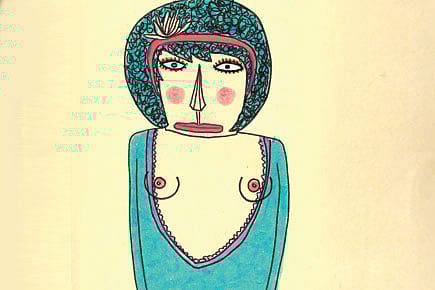
The pleasures of being well endowed
At 11, I got breasts. I remember it as something that happened overnight—one day, I was a flat-chested innocent running about topless after my brother in the front garden, and the next, a jittery-juddery girl with breasts, looking over her shoulder to catch anyone eyeing her frontage. It probably did not happen that way, but I suppose that is how you remember cataclysmic events in your childhood.
So anyhow, at 11 I got breasts, and a lifetime of negotiating with the power they wield began. At the time, I was part of a gang in school, with four overly short boys and four unduly flat girls. Much before they became sites of veneration, my fledgling boobs, therefore, turned into objects of adolescent ridicule. "Arpita can't run fast enough because she has to carry her tits," they yelled after me. The boys joined in the name-calling in the girls' presence, but on the PE field, or while playing dark room on birthday parties, they brushed past me hoping for a feel-up.
Soon Marks & Spencer bras became part of the shopping list I handed to my father, much to his chagrin, every time he travelled to the UK. I can picture him now, looking furtively through the lingerie selection, not daring to ask for help from the pert salesgirls standing by, as he selected functional, non-frilly bras for his 13-year-old daughter. Back home, much before I received a postcard from a boyfriend showing Picasso's famous painting of Paloma running with her breasts hanging out of her dress, I started strutting my stuff in Delhi's conservative Bengali locality Chittaranjan Park, often going for walks in the evening in a tight T-shirt with no bra. Yup, by 13 I had discovered the power of having a distinctive pair of breasts. Gone were the days when I walked down the streets looking at the ground with my shoulders hunched over, or with book-filled arms crossed over my chest. I was redefining the Hindustani male adage, chhaati chauri karke chalna, and enjoying every minute of it. Boys on the school bus would offer me their seat just to be able to stand over me, and I always took the seat.

The Liberation of Bengal
05 Jun 2026 - Vol 04 | Issue 74
A silent revolution ends the reign of fear
In college, though I attempted to reverse the trend by dressing in sober block-printed kurtas, salwars and dupattas, and khadi kurtis with jeans, the breasts did not go unnoticed. After the first-year results were out, the college underground bulletin announced, 'Arpita Das tops History Hons making the batch "top-heavy" indeed!' I sighed and returned to my deep plunging vests in second year.
Little did I know then that a time would come when all this frontal power-play was going to take a backseat, and a rather more fraught experience would engulf my poor boobs.
My daughter was born when I was 29. Although in the first trimester of my pregnancy my breasts felt like they had been used by a dhobi to thrash his washload clean, it was in my second trimester that I began to feel truly alarmed. My breasts suddenly did not feel my own; they felt like they had turned into twin beasts. Faint reassurance came from a pregnancy reference book: 'Breast changes, fullness, heaviness, tenderness, tingling; darkening of the areola; sweat glands in the areola become prominent, like large goose bumps—in short, get used to the chesty look!' Hey, I was fine with the 'chesty' look. But the real shocker lay in wait at the Lamaze classes I attended. We were solemnly told that our breasts were about to perform their most important function—breastfeeding—and we had to 'ready' them for this. 'Readying' involved some rather dodgy massaging to coax the milk glands. I massaged away anxiously, even as I wondered if my history would get in the way of their new righteous role. Well, I needn't have woried, at least not yet, because I started lactating a week before I delivered, which I was told happened sometimes. I had clearly massaged well.
A week later, I gave birth to a pre-term baby girl and the next morning I was told she was too weak to suckle. At that precise moment, for the first time since adolescence, my breasts ceased to be powerful. We were told to get hold of that gift to modern motherhood, a handy breast pump. Started the routine of pumping my breasts several times a day to get as much colostrum and then milk into the bottle en route to my baby's tiny mouth. However, the breast pump failed to perform a miracle, and inexplicably, from flowing breasts a week before delivery, my breasts failed to produce anything but a sorry trickle by the sixth week. Regardless, I pumped away, taking turns with my husband when I got tired, and watching him go at it tirelessly. At the end of the sixth week, my irate gynaecologist informed me that I was developing an abscess in my breasts, and in any case, I had got all the important antibodies into the baby in the first five weeks, and now formula could do the job just as well. I was aghast.
My plan before delivery was to breastfeed for the first six months till I returned to work, and here, I was being declared out in the sixth week. Dejected, as I turned to formula, I sought reassurance on the internet that their boobs had failed other women too, failed at their 'most important function ever'. Not a peep anywhere. Evidently I was the only woman on the planet who hadn't managed to breastfeed her baby.
An aunt who had never had a baby spoke sensibly. Our mothers' generation, she said, had taken breastfeeding so lightly and turned to formula so quickly that by our time there had been a reaction reversal. But everywhere else I turned, television ads, the backcover of the paediatrician's report card, LCD displays outside government hospitals in the city, I read: 'Breastfeeding is BEST for baby'. I was lost. My glorious breasts had failed me.
Two years later, suffering from anxiety caused by tremendously low self-esteem, I found myself telling my therapist about the experience. She heard me out patiently and softly said: "But why don't you move on, and let your breasts do what they did best for you—make you feel attractive?" My head whirled and the universe went topsy-
turvy for a moment. The first thing I did after my session that day was go to the nearest mall to buy myself the laciest bras I had ever owned. My breasts were making a definite comeback.
Last winter, my friend, writer and vascular surgeon Ambarish Satwik read from his essay on how the binary of the boobs is more aesthetically pleasing than the singularity of the bust to a rapt if somewhat confounded audience in my little bookstore. So delighted was I by the piece that I asked him to read it a second time, so we could relish the bosomy analogies once more. In my excitement, I failed to notice the growing displeasure of a couple of women who, through pursed lips, asked Ambarish questions about fetishising a woman's breasts before leaving in a huff.
After the tense moment had passed, I sat back and thought to myself—I love what my breasts can do.