Reckless in Kashmir
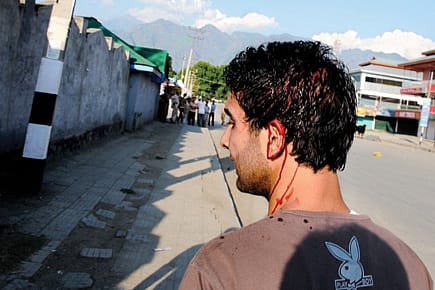
The new crop of young Kashmiris think nothing of facing teargas shells or bullets. With them around, New Delhi needs to be worried. Extremely so
The boys are in hiding. The police are active, raiding their houses. But the boys are away, staying with this relative or that. Mobile phones have been put away, even their batteries removed. But at the end of each day, fresh pictures and video clips mostly posted under fake identities make their way to Facebook: of them pelting stones; flashing victory signs, their faces masked; climbing police gypsies; running away and jumping into Srinagar's Dal Lake.
And they don't do it for money, they say. Not even for fun. But to protest against the "occupation of our land". These are the new-generation protestors of Kashmir: English-speaking, Nike-wearing boys, fans of Bob Dylan, at the forefront of the recent agitation here. They have degrees in business administration, computer applications and the like. Some of them are still in college. Aged 17 to 21, they are already veterans in engaging Indian security forces in the Valley. They have seen their friends dying in front of their eyes. They have received bullet injuries themselves, or have been hit by rubber bullets and teargas shells, many times over in some cases. Some have been arrested under the stringent Public Safety Act. But nothing deters them.

The Liberation of Bengal
05 Jun 2026 - Vol 04 | Issue 74
A silent revolution ends the reign of fear
Go back a day before: in downtown Srinagar, 20-year-old Irfan (name changed) takes out a Palestinian scarf and secures it around his face. It has four holes, for eyes, his nose and mouth. It is the day that separatist leader Mirwaiz Umar Farooq has been granted permission to hold a protest rally on the condition that there be no violence. On a hot afternoon, thousands of men, women and children have gathered outside Jama Masjid, Srinagar.
The crowd, swelling by the minute, chants slogans in unison, slogans that range from 'death to India' to 'freedom for Kashmir'. In between, somebody remembers the 'martyrs' too—mostly boys like Irfan—who have died over the past month in police firing.
The Mirwaiz emerges, and the march begins. On the way, masked men pop out of the procession and make vehement requests, asking onlookers to join. Most of them do. Some people are content to peep out of the windows of their houses, recording the scenario on their mobile phones. A few in the crowd sprinkle water on the rest for some relief from the heat. Drinking water tinged with orange squash is being served to protestors. Women sing wanwun, traditional Kashmiri songs that hail the fallen men as bridegrooms of azaadi, of 'freedom'.
Irfan is part of this protest. His shoes that he says he bought recently at a suburban Delhi shopping mall are already worn out, thanks to the constant cat-and-mouse game he plays with security personnel. He is not some school dropout. He has a bachelor's degree in computer applications, and uses his Sony Ericsson phone to capture images of stone pelting that he later uploads on Facebook. One of his friends recently used his PhotoShop software skills to digitally replace Mahatma Gandhi's photo on a Rs 1,000 note with that of Kashmiri separatist leader Syed Ali Shah Geelani. It is a hit on various social networking sites.
Handling the crowd is another young man who calls himself Masood Wafai. He has a business in Russia, and has arrived in Kashmir a week ago. "We are under occupation," he grimly says, "And I have not come here at the invitation of somebody, to earn Rs 150 for pelting stones, as the State accuses us of. I have left a business to take part in the protests."
At a market square, the Mirwaiz alights from his Scorpio SUV and tries addressing the crowd with the aid of a tiny loudspeaker that proves to be inept for the job. In five minutes, he is gone, rushing back in his vehicle with bodyguards to offer prayers at Srinagar's lakeside Hazratbal shrine. "This is a signal that the crowd can now do whatever it wishes to," whispers a local journalist. The crowd follows on foot. A few get tired and take rides on a few passing motorcycles.
En route, at the Kashmir University gate, the police and CRPF are waiting for them. The road has been sealed with barbed wire. Led by a young deputy superintendent of police, the cops' contingent approaches the crowd with a stern warning, advising the protestors to abort the march. There is a ruffle through the crowd, and a debate ensues for about ten minutes. Behind barbed wire, boys from a neighbouring locality come out of their homes, ignoring the curfew, to raise slogans. On hearing their cries, the main crowd of protestors is emboldened to raise its ante. In the police contingent, a policeman with 'Sexy Ayoub' scrawled on his shield caresses his teargas gun. A police Gypsy blurts to life with warnings for those who have just emerged from their houses. "Go back," they are told.
As they do so, a young man comes to me and extends his hand. "Hi, I am Kamal Khan (name changed)," he introduces himself. I recognise him. Back in Delhi, Kamal had been sending me pictures and links of stories on my Facebook account about the killing of protestors. 'So many people have been killed, shame to Indian democracy,' he would write. Before leaving for Kashmir, I had sent him a message saying that I would like to meet him. 'Send me a message on Facebook and I'll get in touch myself,' he wrote back, 'The internet is being monitored by the police.' And now, by sheer coincidence, the crowd of protestors had ended up outside his house—and he spotted my face.
Kamal has an MBA degree. He takes out a cigarette, lights it, and speaks about "oppression of Kashmiris" in the same breath. "For us there is no difference between the local police and the CRPF," he says, "They are both an organ of the Indian State, out in Kashmir to repress the genuine sentiments of people."
That moment, the negotiations taking place behind us snap off, and the cops charge the crowd with laathis and teargas shells. A police Gypsy takes a turn to roar its way against the boys on the other side of the barbed wire. Kamal and I run away. In any such melee, the police does not distinguish between protestors and journalists. In the past few weeks, many journalists have been beaten up severely while covering similar protests. Kamal turns into a street and I turn into another. A hand pulls me into a house, and the door slams shut. A boy looks at me, smiles and says, "Bachh gaye!" I am offered water and an invitation to the attic, from where the action on the road is visible.
After a few minutes, I go back out—to see a boy rushing towards the university gate. He has been hit by a stone and his head is bleeding. There is teargas smoke all around. A magistrate is standing at the gate, watching the sequence of events. "I don't know when this will end," he says.
A man passes by in shabby clothes. The magistrate tries to stop him. "Ashfaq, it is me," he says. The man looks at him blankly, mumbles something and just runs away. "Allah! Can you imagine, this man is a PhD, and now I don't know what has happened to him," says the magistrate, amid the noise. Teargas shells are still being fired. At the end of the road, Sexy Ayoub stands smoking a cigarette. "This teargas smoke doesn't bother me any longer. Even my tears have dried up," he says, staring at a motorcycle that fell down in the commotion. A little later, the police party makes another big appearance. The protestors have been chased away. A CRPF soldier walks past the fallen motorcycle and smashes its rear-view mirror with a blow of his laathi.
"They might turn on us now," a fellow journalist tells me. A returning policeman is a little edgy. "Are you from Delhi?" he asks; and for lack of better words, or perhaps just overwhelmed by emotion, he mutters: "Mohabbat aur jung mein sab jaayaz hai (All's fair in love 'n' war)."
The day's protest is over, even if some protestors try to re-assemble and throw stones. We return. Just a mile away, it is quiet on the road that runs along Dal Lake. There are many men making a show of their patience here, fishing rods in hand. Amarnath yatris, back from a pilgrimage to the cavernous Shiva shrine in the higher reaches of Kashmir, are buying corncobs. There is also a visitors' rush at Nishat Garden, with water gushing as usual from the mouth of a stone lion at its entrance.
The following day, I meet Irfan at a deserted spot on the outskirts of Srinagar city where he is in hiding. Born in 1987, Irfan's father is a senior government employee. He grew up in a Kashmir of curfews and military crackdowns. "As children," he recounts, "we saw security forces killing some of our relatives in cold blood. I was in seventh class when I came out for the first time, burnt an American flag and then pelted a few stones." In 2007, one of his close friends Muntazir died in police firing in response to stone pelting. He was in class ten. Over the past few years, Irfan has taken part in hundreds of protests. In the meantime, he also completed his degree in computers that he puts to full use. One of the Facebook communities he helped form, named Kal Kharaab Kashur ('Reckless Kashmiris'), has a police case against it, he claims. "I want to settle down too, like normal young people, but Kashmir is my first priority," he avows.
One of Irfan's stone-pelting partners is a young boy in the final year of his college. "As kids, we didn't understand issues," shrugs the collegian, "But as we grew up we felt that India was like our colonial master." And then the two get talking about some of the missions they undertook. "You remember how his brain oozed out after the police fired?" "That day I ran away, but he was hit by a teargas shell." "He has been sent to a jail in Jammu under the PSA and I heard they have broken his limbs." "That day I jumped into Dal Lake and a rubber bullet hit my leg." "You should have seen him climbing that police jeep and shattering its glass." Such snatches of conversation are routine, it seems.
"We will keep on protesting like this," says Irfan's friend, "And if some day we realise it is not helping, we will not hesitate to pick up arms like our elder brothers did." As he plucks out his undershirt to cover his face for a picture, he says, "We don't want secularism. We don't want democracy. We want Islamic laws in Kashmir." Their other friend tries to explain this. "You see, recently the BJP had organised a Bharat Bandh, and their men broke so much property and beat up people. But was a single teargas shell fired at them? Then, why is it that we have to face not only teargas shells but bullets as well?" he asks. "India is in search of peace. We are in search of freedom. Why is it so hard to understand that we have no common ground?" demands another boy.
One of their friends they call Mandela is in hospital. On 6 July, a police officer fired two bullets at him during an incident of stone pelting. One missed him, while another pierced his chest an inch above his heart and exited from the right. Another bullet killed his friend Abrar who was standing next to him. In the hospital, Mandela, whose real name is Owais—he is 18—lies on a bed, weak and unable to speak. "He cannot tolerate what is happening around him. So he comes out and protests," says his father, Abdul Hameed. "There is too much anger on the streets. Films are not fiction. They are real. As they show when there is injustice, people pick up stones. And guns, too," says his cousin, attending to him by his hospital bedside.
A few miles away from the hospital, Chief Minister Omar Abdullah holds an all-party meet. He has aged in the past few weeks; his hair is more salt than pepper now. People in the Valley are unhappy with him. Journalists are unhappy with him. The police are tired. Ordinary people are tired.
Amidst the turmoil, Broadway Hotel in Srinagar feels like an oasis of peace. Uniformed gatekeepers open its revolving door, and a few foreign guests discuss the merits of Parmesan cheese. Inside the hotel restaurant, journalists sit in groups, drinking coffee and smoking cigarettes in spite of the 'No Smoking' sign, talking of the 'political void' and the previous night's football match. At the bar, two men discuss how tough it is for the poor to earn anything in such difficult times. One of them takes a sip from his glass and then puts it down. There's a TV screen aglow with highlights of Spain's World Cup victory. "I think we should call Paul the Octopus. Maybe he can predict when peace will return to Kashmir."