The Case for Strategic Silence
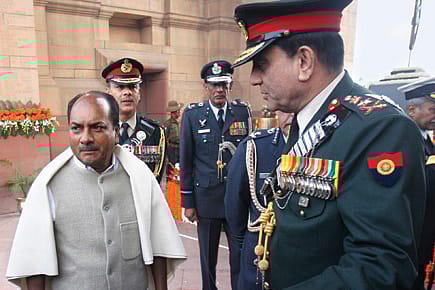
If it's a "matter of concern", pray do something for a change, Hon'ble Defence Minister
The Pokhran desert is a forbidding landscape, barren and without imagination. There is monotony to the whole place. It was here last month that the Indian Air Force made its biggest ever fire-power demonstration. It was a brilliant display of India's air war fighting capability, as Su30 MKIs fired air-to-air R-73 short range missiles, and Jaguars teamed up with Mig-21s in formation for deep penetration strikes. For the first time, India displayed its night time bombing arsenal. For good measure, Indian Special Forces simulated a commando attack behind enemy lines. The applause was deserved.
If capability was everything, India would have had heft in its neighbourhood. Alas, the Union Defence Minister is no strategic visionary. Time and again, he has underlined quite the reverse—India's strategic timidity.
At the post air show conference, AK Anthony, the man who holds India's defence portfolio, held forth on the existence of terror camps in Pakistan. He even gave the exact number, 42. These camps, declared the minister, were "a matter of concern for India". Indeed.
Some days later, the minister was all concerned once again. This time, he expressed anxiety over the US decision to supply Pakistan with laser guided bombs and 18 spanking new F-16s, apart from a bunch of remotely piloted vehicles.

The Liberation of Bengal
05 Jun 2026 - Vol 04 | Issue 74
A silent revolution ends the reign of fear
Another time, he was asked about the 'two front war' doctrine that India's Army Chief had mooted. Anthony's answer was amazing in its complete lack of meaning. He told reporters that India was not a war mongering country. So, did he mean that the Indian Army Chief was indulging in war mongering?
Military doctrines are important pillars of strategic thinking and have been since the early times of war. A military doctrine is not war mongering, it is a statement of a country's strategic intent. It calls for thought, not displays of anxiety from the country's defence minister. In that context, it was supremely insensitive of Anthony to speak of his own Army Chief's doctrine in such terms. Such arrogance hurts the morale of the armed forces and puts a question mark over the very coherence of the country's civil and military defence apparatus.
Clearly, the civilian leaders are at variance with the men in uniform on an issue as fundamental as how India should wage war should push come to shove. Needless to add, the media in China and Pakistan reported the comment with much glee.
India's Defence Minister sounds almost banal when he says at forum after forum that he is concerned. It would be much better if he said nothing at all. An aspiring great power with nuclear capability and intercontinental missiles in the works sits uncomfortably with a defence minister who comes across as a bundle of nerves.
Will America change its policy of supplying military hardware to Pakistan? Or will the Islamic republic dismantle jihadist camps just because India's honourable defence minister is concerned? Sometimes, in diplomacy, silence scores over rhetorical overkill. China knows this well. It was not 'concerned' about the US arming Taiwan, it slapped retaliatory sanctions on Boeing. It was not 'anxious' that the US President met the Dalai Lama, it went about its work. China operates through policies, not empty words.
Having a defence minister who is prone to public displays of anxiety and seems bereft of strategic purpose does little to reassure India of its security. Like the desert landscape of Pokhran, it is unimaginative. The verbosity should stop.
A great country should not be 'concerned'; it should have a plan B. What is it that we propose to do about US arms transfers and Pakistan's attitude to jihadist camps? If the answer is nothing, it's better to keep mum. Empty words make India look a little foolish.