A Perfect Blue

A chance discovery in a laboratory leads scientists to a blue pigment that is close to perfection.
new hue
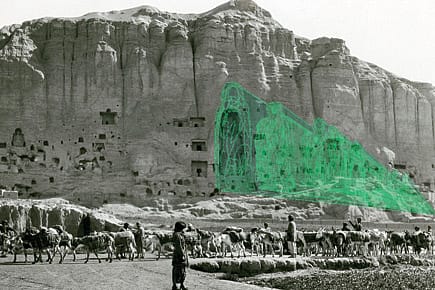
At the request of Afghanistan’s government, California-based artist Hiro Yamagata will install a permanent laser projection system in the valley to superimpose 140 faceless, overlapping Buddhas

The mines at Sar-e-Sang village in Afghanistan are the main source of the semi-precious stone Lapis Lazuli. For much of its history a great part of the trade in this stone has followed a route through the nearby Bamiyan valley and it is here that the ultramarine pigment obtained from the stone was first used to colour the great Buddha of Bamiyan.

The appeal of ultramarine lay in the brilliance of its blue, but its expense had led many to look for substitutes. Azurite was used by several Renaissance painters such as Raphael, but over the years the blue has faded into a dull green.

Ultramarine was eventually synthesised in the lab but it retains one drawback, a vulnerability to damage from any acidic medium. Other blue pigments have their own problems. Cobalt blue can be a carcinogen, Prussian blue can release cyanide. It was only in the 1930s that a usable synthetic pigment—Pthalocyanine Blue—that overcame most of these drawbacks was first produced.

Now a chance discovery in an Oregon State University department of Chemistry lab may have led scientists to do even better. “Basically, this was an accidental discovery,” says Mas Subramanian, the Milton Harris Professor of Materials Science at OSU. “We were exploring manganese oxides for some interesting electronic properties. Our work had nothing to do with looking for a pigment. Then one day a graduate student who is working in the project was taking samples out of a very hot furnace while I was walking by, and it was blue, a very beautiful blue,” he says. “I realised immediately that something amazing had happened.”

According to the researchers, at about 1,200 degrees centigrade this manganese oxide turns into a vivid blue compound that could be used to make a pigment able to resist heat and acid, be environmentally benign and cheap to produce from a readily available mineral.

0 COMMENTS

Post new comment

The content of this field is kept private and will not be shown publicly.

CAPTCHA
NOTE: Please enter letters [case sensitive] in the box provided before you submit your comment. This is to prevent automated spam submissions
Image CAPTCHA
Enter the characters shown in the image.

Science Buzz 26 Dec 2009 - 01 Jan 2010
  • Aromas to Fight Obesity

    Scientists in the Netherlands claim a possibility exists for developing foods that would fight the global epidemic of obesity with aromas that quench hunger and prevent people from overeating. Their article appears in ACS’ Journal of Agricultural and Food Chemistry. Rianne Ruijschop and colleagues focused on foods that release hunger-quenching aromas during chewing. Their analysis found that aroma release during chewing does contribute to the feeling of fullness and possibly to consumers’ decisions to stop eating. The report cites several possible applications, including developing foods that release more aroma during chewing or developing aromas that have more effect in triggering feelings of fullness.

    ?
  • Soot Warming Up the Himalayas

    A new Nasa study confirms that soot and dust contribute as much to atmospheric warming in the Himalayas as greenhouse gases. This warming fuels the melting of glaciers and could threaten fresh water resources in the region. “Over areas of the Himalayas, the rate of warming is more than five times faster than globally,” says William Lau, head of atmospheric sciences at Nasa’s Goddard Space Flight Center in Greenbelt, Maryland. “Based on the differences it’s not difficult to conclude that greenhouse gases are not the sole agents of change in this region.” Rising populations in Asia, industrial and agricultural burning, and vehicle exhaust have thickened concentrations of black carbon in the air.

    ?
  • Saturn’s Bizarre Hexagon

    Cameras aboard Nasa’s Cassini spacecraft have captured the most detailed images yet of the intriguing hexagon shape crowning the planet. The new images of the hexagon, whose shape is the path of a jet stream flowing around the north pole, reveal concentric circles, curlicues, walls and streamers. The last visible-light images of the entire hexagon were captured by Nasa’s Voyager spacecraft nearly 30 years ago, the last time spring began on Saturn. The location and shape of the hexagon in the latest images match what they saw in the Voyager pictures. Scientists are still trying to figure out what causes the hexagon, where it gets and expels its energy and how it has stayed so organised for so long.

    ?