Einstein Is Right Again
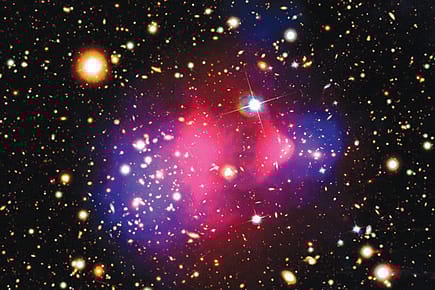
New observations on a scale far beyond our solar system confirm Einstein’s theory of gravity and lend support to the existence of dark matter.
dark truths
According to Einstein’s theory, mass distorts the very fabric of space-time, so light travelling near a large mass travels a longer path than light near a smaller mass because of this distortion.

By now, the news that Einstein has been proven right can at best elicit a yawn. Every few months a new set of observations or an experiment is pitched as another confirmation of his insights into the nature of our universe. But the latest such report comes with an added bonus of shooting down alternate theories of gravity and goes on to suggest that the conjectured dark matter invisible to astronomers, but observable only through its gravitational effects, actually seems to lurk in the universe.

An analysis of more than 70,000 galaxies by University of California, Berkeley, University of Zurich and Princeton University physicists demonstrates that Einstein’s theory remains our best bet for understanding what happens at a cosmological level, at magnitudes billions of times larger than our Solar System. To understand the analysis, it is necessary to go back to how Einstein saw gravity. According to his theory, mass distorts the very fabric of space-time, so light travelling near a large mass travels a longer path than light near a smaller mass because of this distortion. As astronomers have peered deeper and deeper into space, they have been forced to postulate a mysterious dark matter to explain the distortion they observe. Discomfort with this dark matter has led scientists to propose alternate forms of gravity that do away with dark matter yet explain the distortions visible to astronomers.

The latest analysis chose to examine these contesting theories by measuring a ratio termed EG. The ratio was used to factor out distortions involved in carrying out measurements of distant galaxies. The observed value turns out to be 0.39 while Einstein’s theory predicts a value of 0.40, much closer than the prediction of any other model. While this does not tell us what dark matter is, it does suggest that it may not be a figment of some theoretician’s imagination.

0 COMMENTS

Post new comment

The content of this field is kept private and will not be shown publicly.

CAPTCHA
NOTE: Please enter letters [case sensitive] in the box provided before you submit your comment. This is to prevent automated spam submissions
Image CAPTCHA
Enter the characters shown in the image.

Science Buzz 20 Mar 2010 - 26 Mar 2010
  • You Can Be 18 Till You Die

    According to a new study published in Journal of Gerontology: Social Sciences, if you feel old beyond your own chronological years, you are probably going to experience a lot of stuff associated with ageing. “But if you are older and maintain a sense of being younger, then that gives you an edge in maintaining a lot of the abilities you prize”, says Markus H Schafer, a doctoral student at Purdue University, who led the study. The study compared nearly 500 people’s chronological age and their subjective age to determine which one has greater influence on cognitive abilities during older adulthood.

    ?
  • ‘A’ For Success, ‘F’ For Failure

    According to a study in the British Journal of Educational Psychology, seeing the letter ‘A’ before a test can improve a student’s score, while noticing an ‘F’ may reduce it. In three experiments, undergraduates were asked to complete identical tests, which were labelled ‘Test Bank ID: A’, ‘Test Bank ID: F’ and ‘Test Bank ID: J’. The ‘A’ group got 92.3 per cent correct on average; the ‘F’ group, just 78.5. “We hypothesised that if students are exposed to the letters A and F prior to an academic test it could affect their performance,” says Keith Ciani of the University of Missouri, who conducted the study with the university’s Ken Sheldon.

    ?
  • Half Cock Mystery Solved

    It was previously thought that sex chromosomes in birds control whether a testis or ovary forms, with sexual traits then being determined by hormones. A study by The Roslin Institute at the University of Edinburgh, however, identified differences between sex cells that control the development of sexual traits. They call the phenomenon cell autonomous sex identity. The study involving chickens with white (male) plumage on one side and brown (female) plumage on the other. Dr Michael Clinton, who led the study, said: “We now believe major factors determining sexual development are built into male and female cells”.

    ?