Soaking up the Sun
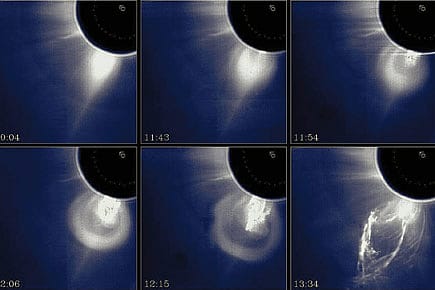
A solar eclipse provides a rare glimpse of the sun's atmosphere, otherwise difficult to see
On 22 July, parts of India will witness a total solar eclipse lasting over four minutes. It will be another 123 years before an eclipse surpassing this duration will be witnessed. Undoubtedly, as in the past, various superstitions will be observed, and astrologers will once again make predictions of doom that will not bear out. Amidst all this, it is easy to lose sight of some real science that gets done during an eclipse.
An eclipse allows a rare view into the solar atmosphere—the corona, which is otherwise difficult to observe due to the brightness of the solar surface. During an eclipse, we have a better view of the part of the corona close to the sun's surface than even space telescopes can provide. It is here that violent solar storms gather energy that allows them to occasionally burst through the sun's magnetic field and send a mass of charged gas surging outwards. These violent solar explosions are called Coronal Mass Ejections (CMEs), and high-energy particles from these storms contribute to the northern and southern lights. The picture above is a set of time-lapse images showing the development and progression of a CME.
Occasionally when this charged gas travelling at speeds of over 1,000 miles a second and its accompanying magnetic field head towards the earth, it interferes with all electromagnetic signals, such as radio, television, and telephones. It can damage satellites, disrupt satellite communications and result in power blackouts. It would pose a serious radiation hazard to astronauts on board a space shuttle.
In 1989, six million people went without power in Canada and the US for over nine hours after a CME, and in 1977 another CME knocked out a communication satellite, leading to the failure of pagers across the world. While four minutes of the total eclipse on 22 July will certainly not be enough to understand the phenomena in the corona, this vital span does provide a rare window to events that impact us in ways that we are often not even aware of.

The Liberation of Bengal
05 Jun 2026 - Vol 04 | Issue 74
A silent revolution ends the reign of fear