IPL: Body Blow
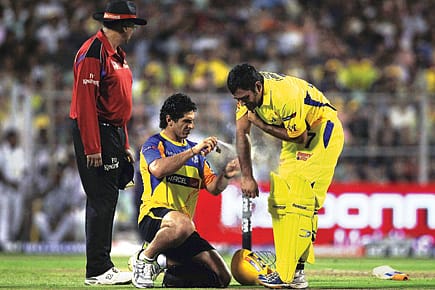
Is playing in the IPL worth jeopardising a player's fitness and prospects for international matches?
Is playing in the IPL worth jeopardising a player's fitness and prospects for international matches?
As I write, the Indian Premier League (IPL), edition 3, is ten days old. And in the first week itself the injury list looks visibly alarming. Two of the eight starting captains are sitting on the bench, three key players are out of the tournament with injuries, and many more are nursing minor injuries that have forced them to miss more than a game each.
The Indian skipper Mahendra Singh Dhoni is out with a bruised hand, and Gautam Gambhir is sitting out with a hamstring injury. In fact, Gambhir was rushed to Sri Lanka for ayurvedic treatment on the suggestion of teammate Tilakaratne Dilshan.
To complicate matters further, the IPL, without doubt a commercially successful cricket extravaganza on TV, has now added two new teams for its fourth edition, adding 34 more games to the existing 60 in 2010. It will be running for 51 days in 2011, and will see a whopping 94 games being played. With the 50-over World Cup also due in the Subcontinent between 18 February and 29 March 2011, the game's fans, expectedly, will be tired of cricket with the IPL following suit within a week of the World Cup final.
Simply put—for 100 days, starting 18 February 2011, Indian cricket fans will be forced to digest cricket day in and day out, putting the proverbial golden goose at grave risk of being killed. Let's face it, if injuries continue with such alarming frequency, India's chances in the World Cup would weaken dramatically enough for a mass backlash against the billion-dollar league.

The Liberation of Bengal
05 Jun 2026 - Vol 04 | Issue 74
A silent revolution ends the reign of fear
To be fair to the IPL, this is the only window period when it could have been played in 2010. And it is indeed a strange decision on the International Cricket Council's (ICC's) part to hold two T20 world cups within nine months of each other, placing the IPL in a spot. Both the ICC and IPL Governing Council seem so driven by commerce that they have exposed performers to injuries and cricket audiences to a saturation in interest. The entry of two new IPL teams, which have been bought for well over Rs 1,500 crore, has hardened the team owners' hunt for business opportunity, even if it means forcing players to the grind.
Just consider India's schedule in 2011: in January, the Indian team will be finishing its tour of South Africa and getting ready to take on the world for the ODI World Cup at home, expected to dominate the cricketing horizon for a month and a half. As mentioned above, it will be followed by 51 gruelling days of the IPL. Soon after the IPL, India embarks on a tour of England, which will continue for three long months. Then comes the Champions League, followed by an ODI bilateral series against Australia and a tour down under for a Test-cum-ODI series.If I get bored trying to even recall the never-ending fixtures, think of all the fans expected to devour them and pump up the TRPs. Cricket is being milked, and it is time that fans stood up to the overwhelming pressures of the market.
Also, what the injuries are doing is that they are posing a direct threat to sport as an international contest. As young sportscaster Viren Ferrao says, "We are all watching a match mechanically sitting in front of the television set. The novelty value has disappeared, and even the thought of having to sit through 94 games is frightening."
Similar sentiments are expressed by my colleague Ragini Kumar: "You don't feel any emotion after any of these games. Frankly, it doesn't matter who wins or loses. After a point, it is all the same. Without the tri-colour in question, you don't feel the same spunk."
The exciting thing about sport is that every big international match has a strong undercurrent of national unity, something that is missing in the IPL. Remember India's victory on 1 March 2003 in the World Cup tie against Pakistan at the Centurion? Streets and lanes all over India reverberated with sounds of bursting crackers, slogan chanting and conch-shell blowing. Religious shrines had people waving the Indian tri-colour with pictures of Sachin Tendulkar stuck in the middle of the Ashoka Chakra. Even the Indian Army Chief NC Vij congratulated the team for their win. In Gujarat, where nationalist social cross-currents can get quite jingoistic, there were incidents of Muslims being stopped from celebrating (followed by rioting, injuries and also a death in Ahmedabad). The point is, international cricket and fervour go together. After 1 March 2003, to many fans, it no longer mattered whether India made it any further in the tournament.
Such fervour is alien to an IPL game, despite the billions making their way into the BCCI coffers. A prolonged IPL might even pre-empt Indian fans from celebrating many a possible Indian triumph, all because of bets being made by business on the future of this fledgling form of the game. As Steve Waugh said, "The IPL is more for the average cricketer. They realise it is their best opportunity to make the headlines and earn money. Never before could they get such an opportunity. The addition of two new teams may well end up de-sensitising fans because too much of anything might prove to be counterproductive."
It is exactly for this reason that we see leading Australian players like Michael Clarke and Mitchell Johnson refusing the attraction of IPL riches. To them, the Baggy Green matters more. Winning the T20 World Cup is more important than making a few million in the IPL. Playing for Australia is still the ultimate achievement for an Australian cricketer. Once again, I am forced to turn to my favourite icon, Sachin Tendulkar. Those cardinal words—that he is first an Indian and only then a Mumbaikar, words that resulted in unnecessary controversy, words on which Sachin the champion patriot held firm. In his words, "My name is Sachin Tendulkar and I play for India." That is what Indian cricket should be all about. Hope the BCCI is listening.