Losing the Idea of India
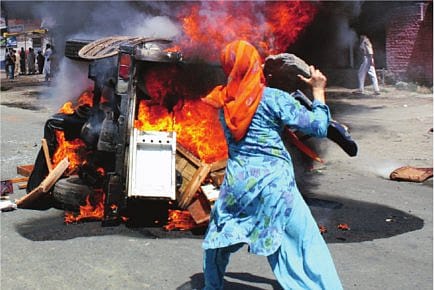
Sometimes alienation can be addressed the usual way. Sometimes not. In this rather special case, maybe it's time to begin all over again: by listening
At the height of terrorism in Punjab, KPS Gill is said to have remarked that it was a battle between Jutt Sikhs. As a Jutt Sikh—those who sneer at such categorisation live in an India that exists only in their imagination—I can only add that Punjab is still part of the Indian State because there were an overwhelming number of Jutt Sikhs who felt that the Idea of India was worth defending.
For this very reason, the years of terror in Punjab left me with disdain for the movement's fellow travellers in Delhi. Many of them used the rhetoric of 'Rights' in defence of AK-47 wielding murderers. This language in the guise of liberalism managed to hide the truth about fundamentalism even as Punjab moved on with a full realisation of the disaster that had been averted. But today, in the context of Kashmir, I cannot but agree with the same people who I believe were so wrong about Punjab.
The difference between the two situations goes back to the question of why so many Jutt Sikhs had and continue to have a stake in the Idea of India. For many of them, the attachment to the idea was pragmatic, it offered material prosperity, but for others such as me it was the attraction of an inclusive idea of India, however imperfectly realised, over any refuge of the faithful where those not of the faith would be second class citizens.

The Liberation of Bengal
05 Jun 2026 - Vol 04 | Issue 74
A silent revolution ends the reign of fear
The different histories of Punjab and Kashmir have ensured that very few Kashmiri Muslims feel so. It can be argued whether the fault lies with the Indian State or Kashmiri Muslims, but surely no community can arrive at a feeling of belongingness on its own.
This is why we have jawans of the Central Reserve Police Force (CRPF) recruited from Bihar and UP facing Kashmiri youth on the streets of Srinagar. India could not be the villain in Punjab if Jutt Sikhs were fighting Jutt Sikhs. In Kashmir today, it is, and justifiably so. If day after day Indian troops are allowed to go on killing adolescents armed only with stones (you can find no parallels in Punjab), I for one am burdened with the feeling that very soon there may be little left to defend in the Idea of India.
It is far too easy to blame this on Omar Abdullah's failings. About one year earlier, after the rape and murder of two women in Shopian, the Chief Minister of Jammu & Kashmir (J&K) responded to the anger of Kashmiri crowds much as he now has—by withdrawing from the public and letting the police and CRPF assert control. Basharat Peer, a close observer of the state and author of the critically acclaimed Curfewed Night, was scathing then and what he said is no less valid right now: "The Kashmir he [Omar Abdullah] lived and lives in is a secured, isolated castle. In his Kashmir, you don't stop at a check post; you don't raise your hands and show your identity card; you don't squat in an empty ground in a crackdown with the rest of your town; you don't feel the anger and fear when your classmates go missing and never return." A year has passed since, and J&K's young CM still remains isolated from popular sentiment in the Valley.
But Kashmir was a problem long before Omar Abdullah ever fought an election. Between Atal Behari Vajpayee and Manmohan Singh, we have witnessed nine Prime Ministerial visits to Kashmir over this decade and the announcement of two ill-thought-out economic packages totalling Rs 36,700 crore. This has made no difference. Committing more troops to the Valley has proved pointless, as has throwing more money at the problem. Bereft of ideas, it is no wonder that at this critical juncture India's Prime Minister is virtually in hiding.
He is not the only one living in denial. A colleague in office, as we argued over Kashmir, rather impassionedly claimed that the young men out on the streets did not know what they want. I think what is far more pertinent is that they clearly do know what they don't want. And maybe we should pay attention to that.
I hold no brief for those young men—I don't agree with them in the least. If their idea is of a homogeneous Kashmir made up only of Kashmiri Muslims, it arouses little sympathy in my mind. Neither have they faced up to the complicity of their own in the violence that was directed against Kashmiri Pandits and led to their mass exodus from the Valley. But when we raise these questions, we hold them to far higher standards than we have imposed on ourselves.
They don't want the Army. For anyone who has travelled to any region of this country where the Army's writ runs, this is not very surprising. This has nothing to do with questioning the patriotism of those who serve in the Indian Army, it is the very nature of the institution.
We have over the years become inured to horror stories in Kashmir, and by failing to react we readily concede the point the angry young men are making. They are different. They have been made so by their experiences. We can't even begin to understand what they have undergone.
They don't want to be ignored by the political process. Prime Minister Manmohan Singh hopes to pen an agreement with Pakistan or the Hurriyat Conference and achieve a solution. It may already be too late for that. There is no one in Pakistan who exercises a hold over these young men, and the Hurriyat itself is not leading but is being led by them. If the election of Omar Abdullah to power held out only a brief hope, it was only because what the young men expected of him was not within his power to deliver, and that became obvious rather soon.
There are the usual arguments to rebut these claims. In sum, they amount to nothing more than the Sangh Parivar's territorial argument for Akhand Bharat, as if our attachment is only to the mountains and valleys of Kashmir and not the people residing there.
This, then, is the reality of Kashmir. Like those young men out on the streets of Srinagar in their tens of thousands, I am not sure what I want. I do not think an independent Kashmir is a feasible or realisable idea, but short of that, India should be willing to go to any extent possible. But like those young men, I do know what I don't want. When CRPF jawans acting in 'self defence' end up killing a nine-year-old boy on the street, I don't want it said that they are doing it in my name. I don't want it said that they are doing it to safeguard an Idea of India. An inclusiveness enforced by outsiders at gunpoint is not much of an idea.