Web Exclusive
qed

Hartosh Singh Bal turned from the difficulty of doing mathematics to the ease of writing on politics. Unlike mathematics all this requires is being less wrong than most others who dwell on the subject.

EMAIL AUTHOR

Oh, for a Book to Ban!
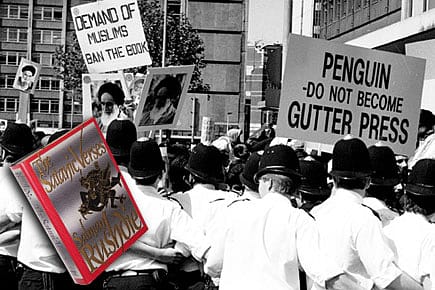
‘Satanic Verses’ was banned 20 years ago. In all the navel-gazing contemporary Indian fiction, where’s the book that has the power to offend?

Twenty years ago, give or take a month, The Satanic Verses was banned in India. Over the course of this month, there will be no dearth of writing on the ban of books, but on this anniversary, the real tragedy is not that book bans are still alive in the country but that there is a diminishment of the kind of literary ambition the book represents. Today you would be hard put to find Indian fiction in English that anybody would want banned.

Take a look at this year’s shortlist for the Shakti Bhatt Prize:

» Anuradha Roy: An Atlas of Impossible Longing

» Chandrahas Choudhury: Arzee the Dwarf

» Mimlu Sen: Baulsphere

» Mridula Koshy: If It Is Sweet

» Palash Krishna Mehrotra: Eunuch Park

» Parismita Singh: Hotel at the End of the World

» Preeta Samarasan: Evening is the Whole Day

Baulsphere is non-fiction. The others, well, the titles speak for themselves. If you want to convince yourself, go glance at the blurbs in a bookstore or on the Web; I did, and there is not a book of fiction on the list I want to read. Individually some may be well written, taken together the list only illustrates the point I made, unless of course there are dwarves or eunuchs out there who are offended.

A friend while strongly recommending Chandrahas’ book told me he was glad that Indian authors were no longer trying to write the great Indian novel. Precisely the point: when is the last time anyone tried? In the past two decades, liberalisation has changed the country, we have witnessed the rise and perhaps the fall of the BJP and the BSP, but the literature of this generation of writers is mostly about a few people staring at their navels.

The only authors to have recently tackled ambitious subjects are not the ones who should be left alone to do so. Consider two: Arvind Adiga’s White Tiger and Indra Sinha’s Animal’s People. One takes on liberalisation, the other the Bhopal gas tragedy. Both bear the stamp of other lands, which explains Adiga’s failure to get either his driver or his Bihar right. Indra Sinha has learnt his Bhopal only through one of the two main activists working for the victims. As someone who has reported out of Bhopal for two years, I know that the person excised out of Indra Sinha’s book is the one who has done much of the work on the ground, and it may be worth pointing out that he is a Muslim who is not fluent in English. Fiction creates its own world, but when it distorts we need contrary versions to contest the truth and we just don’t seem to be producing any of our own.

In part our books are limited in scope and ambition because this is all our circumstances allow. No recent Indian author has managed to live out an extravagance of ambitions, and the domestic publishing industry must share the blame for this. Publishers earn enough to support the cost of large establishments and a set of largely incompetent editors, but when it comes to writers in India, they seem to not have money. A writer of fiction works a day job and labours to finish the little he can because that is all the publisher will pay for.

But that is only part of the answer. Books written within such limits need not be limited—Kafka also had a day job. Two years ago, justifying the choice made by his generation, Sarnath Banerjee had said: “We want to rediscover our own voices, which means telling the stories of our own lives. Definitely not tales of three generations of cinnamon and papaya in little gardens in Tamil Nadu. One example: over the past year, a woman friend of mine has had sexual relations with 16 people. And she can no longer recall which of them was the first.’’ Unless I am one of those 16 people, I think I prefer the papaya. We are stuck with these people wanting to tell the story of their own lives. Unfortunately they all seem to have lived out the same life.

The problem then is not with individual authors or individual books, but with what constitutes the world of recent English fiction. A small circle of people acquainted with each other make up the circuit of writers, reviewers and editors. This world is largely a product of Bengalis and Malayalis living in south Delhi or south Mumbai writing for each other. Maybe not quite, you can throw in a few people in Bangalore and Chennai, but there is no escaping the monotony and effeteness of much that is finally published.

Which is why the few books that shock and surprise come from outside this world. The most prominent example from the recent past is Basharat Peer’s Curfewed Night. It is a book of non-fiction, written out of the personal experience of growing up in Kashmir. No publisher funded the work. Peer, a journalist, took time off and spent his own money on writing the book. My bet is that when we do come across a book of fiction that has the same capacity to astonish, it will have been written by someone from a similar background, someone who has acquired the language but not the circumstances that go with it in Delhi or Mumbai. Even as a failed attempt such a book would count for far more than another quiet, well-written book that adds up to nothing.

OLDER COMMENTS FIRST

86 COMMENTS

Permalink

Excellently said, Hartosh Singh Bal. Indian fiction has been in coma for a while because the urban bratback with no connect to any authentic sensibility have started doing all the writing encouraged by a collection of mutual backscratchers. Such dullness, such ennui. These writers are the kids who feel brave and bold because they have learnt to say "fuck" in the college canteen and are hoping that some girls are getting turned on by their display of testicular strength.

Is it any wonder that nonfiction has been what everybody with a brain has been reading? Even if it is as hard to read as Amartya Sen or as ill informed as Jaswant Singh? Both at least strike cause for intellectual analysis and debate, agree or disagree with their provocations. Peer is excellent, yes, but would anyone in our little braindead cosyland called India care to be troubled a little by others' troubles?

13 September 2009 | Priti

Permalink

Oh, forgot to add (refer myvery vexed previous comment). The red border technique in the picture with this article is in appallingly bad taste. For a good article, particularly so in its insinuation.

13 September 2009 | Priti

Permalink

Nice one bro.

13 September 2009 | Less exciting than my girlfriend

Permalink

Duh what bad taste?
Article rocks. Open rocks. QED

14 September 2009 | Logic Master

Permalink

Thank you for a v entertaining read - I agreed with vast tracts of it but still do feel that in fiction, execution far more important than the grandness of the subject matter. The Great Gatsby is considered the Great American Novel but if someone had set out to write the Great American Novel by-the-numbers, it would not have ended up being Gatsby, I'm certain of it.

One can only tell one's own story, even if it's about foolish, decadent, nihilistic party-goers. If it's told well, I believe the result will be infinitely superior to a bad attempt at the profound. You make a great case though...almost convinced me...

14 September 2009 | Haseena Charsaubees

Permalink

There is an Indian saying - apni ada pe fida
This is the case with almost all writers in this country. Novel writers especially, since they think kowtowing to our colonial masters is the whole point of writing. This includes writers from newspapers, magazines and other outlets who are also desperate for a pat from lands far away. The formula is easy. Find out what 'alien culture' makes them insecure, and go after it with a hammer (to a man with which everything looks like a nail). Then you get shitloads of cash
The commies got this right. Yeh azadi jhooti hai

17 September 2009 | Bhim ne Duryodhan ko

Permalink

Hartosh, I'm one of the authors on the list you provide -- a list you judge as not to your reading taste even though you have evidently not bothered to read a page of the work of any. I thank you at least for citing your friend's "strong recommendation" of my book *Arzee the Dwarf*, but despite having got off lighter than the others -- for which gesture I am ever in your debt, for we novelists are calculating creatures -- I think there may be a few things I want to say in response.

You begin with the banning of Rushdie's *Satanic Verses* two decades ago and declare: "Today you would be hard put to find Indian fiction in English that anybody would want banned." The banning of *Satanic Verses* was, it is generally agreed today, a foolish and knee-jerk action by the Indian government, and India remains one of the few countries where it is still illegal to sell the book. Despite the hysteria and controversy surrounding the book upon its publication, no western government thought it fit to ban it.

So it surprises me that an act of such randomness on the part of a government (and whatever the debate about what governments can or can't do, it's generally agreed they're not very good when it comes to judging fiction) should for you become the litmus test for judging the ambition of contemporary fiction. Had the Indian government not banned *Satanic Verses* (and this could easily have been the case), the book would still have been as good or bad as it is. Only you would then have had to actually read it to have anything to say about it, while now you at least know it WAS banned, and therefore IS good.

Indeed, you don't seem that interested in quality issues, as if this is irrelevant in a work of fiction, even though you then quickly pass judgment on two "ambitious" Indian novels as not being good, because inauthentic. That is, you perversely insist that the ambitious Indian novels being published today are not well-written enough, while the "quiet, well-written books" -- well, you won't even read them.

By your logic, were some mediocre novel critical of Hindu society were to be banned, say, by the Gujarat government, that would immediately become an ambitious novel that everyone should read. But only a PR agent would want to think this way about books. Frankly, such a stance is an insult to the entire endeavour of artistic creation. Our powers as writers are limited to realizing our imagined worlds as best as we can. We are not out to write bannable books so that you may read us, although I certainly agree it's a pleasant feeling to be banned and it helps sales in the long run (as your own argument proves).

Your standards for judging fiction seem peculiarly journalistic, as if all that fiction writers do is report true stories while changing the names here and there and adding bits of dialogue and chapter numbers. "As someone who has reported out of Bhopal for two years," you declare," I know that the person excised out of Indra Sinha’s book is the one who has done much of the work on the ground...." Was *Animal's People* a fact-finding commission? Is everyone who did "work on the ground" in a real-world scenario supposed to be given a starring role in a work of fiction? You don't argue at any point, citing a specific passage or interpretative point of view in the book, that its depiction of Bhopal gas tragedy is flawed or manipulative. Your status as "someone who reported out of Bhopal for two years" is supposed to be enough to support your judgment. To judge a work of non-fiction, perhaps (though I would contest even this). But for a work of fiction? Is that all you need? Your problems with the book are actually a direct consequence of the problematic assumptions with which you begin -- assumptions I am surprised you hold, considering you've published a novel yourself (the subtitle of which was, if I recall right, *A Mathematical Novel*).

Also, may I point out that it is not just us fiction writers, but you non-fiction writers and reporters too who need to pull up your socks? It will not have escaped your notice that Jaswant Singh's book *Jinnah, Partition and Independence* was recently banned by the Gujarat government. In one swift and satanic leap, Jaswant Singh, despite all his wooden prose style, has become the leading Indian non-fiction writer of his day. When can we novelists expect to see a ban-worthy work of comparable ambition and consequence by a journalist or professional non-fiction writer? We're tired of reading the quiet, well-written reports you guys are churning out by the dozen -- that's really not what journalism is about.

Lastly, I'm sorry to hear that you won't be reading *Arzee the Dwarf* (your smirking comment about "dwarves and eunuchs" suggests that you think group identity is the primary identity any individual or fictional character has). But please make sure then that you pre-book my forthcoming novel, *Love In The Time of Naxalism*, which should be more to your taste. In fact, if you have reported on the Naxal movement, may I consult you on it? I promise I won't leave you out of the book (although I may be mischievous and compose a scene where you are shown actually READING a novel, page by page, pencil in hand).

17 September 2009 | Chandrahas Choudhury

Permalink

First you admit that you haven't actually read any of the books that you so sweepingly dismiss, then you hold up, as your shining example of hope a book which is NOT afflicted by the deadly malaise of insideriness and nepotism a book by... um... yer best mate Basharat. It's not often one gets to witness someone putting their foot in their mouth and shooting it whilst pulling out the rug from underneath. Spectacular. Well done.

17 September 2009 | Anita Roy

Permalink

I think your article comes across as extremely ill informed, how I wish you had read atleast two of the books on the shortlist before shoving your foot in your mouth

17 September 2009 | Vijay

Permalink

So the book that offends is a good book. So the book that deals with "real" issues of liberalisation and Bhopal gas tragedies and other Great Indian issues is the novel of ambition. And quiet, well-written ones aren't.
Why should novels do the job of Indian journalism? Why should fiction be called upon to do the work of non-fiction?

17 September 2009 | A

Permalink

Of course you've deliberately set out to provoke, but even if one ignores the many confusions and obfuscations in the piece, what's staggering is the way you ignore the differences between fiction and non-fiction. So Indra Sinha has his version of Bhopal -- it's his novel, for Christ's sake. To criticise it on grounds of not being close to the lives of real activists is, well, pretty pointless. And then again, to segue from "the small circle of people" that constitutes the world of English language fiction to Basharat Peer's autobiographical narrative is patently absurd. As the earlier commentator has implied, perhaps you ought to simply read a bit more. (Throwing in Kafka's name out of the blue isn't going to cut it, you know.)

17 September 2009 | Sanjay

Permalink

Only if you were better equipped to write this essay - but of course a 'mathematical novelist' possibly can make deductions and pass judgements without caring to read and by simply looking up (googling) blurbs. I must say that's real hard work and sums the state of journalism in India rather aptly. That you've even managed to misspell the latest Booker winner's name (Adiga is spelt with a single A) - but then when one takes on the onus of writing for a cause and with such vengeance - these are minor issues.

And such fire against the 'small circle of people' - one thought that you would be a part of it - no?! South Delhi, good wine, a journalist who's spent TWO years in Bhopal - you should make the cut! Just read a bit more - and then write essays - it's likely that you'd then be taken seriously. Else, we'd rather read about the 'eunuchs and the dwarves'! At least they write better!

17 September 2009 | vahin

Permalink

I thought this was a balanced and truthful perspective on Indian publishing - and also, everyone, it's his opinion. For someone to speak up yes, from within the circle he speaks of, is brave, and I think we are forgetting that. What he is trying to do is give us an overview, and book blurbs do decide what we read - though of course we should read a book and give it a fair chance, some books just don't get our attention or interest if there's nothing to go on, and that is what he's saying.

Taste of course varies, but by and large there has been stagnation in terms of what is being published, many feel, and what Hartosh is calling for is books that stand out, that beg to be read, in a very tough market - of course I will also point out, Hartosh, that publishers and editors also have to make numbers work in this very tough market, and need a midlist. That publishers are trying to do this and support popular fiction etc is commendable too; we need our own detective novels and adolescent fiction, though of course, we need good novels, and we are too smart to be told (or sold) the same story of sexual coming of age again and again. However, we can't have only a midlist, and I think this is Hartosh's point. But we should also take into consideration that people are trying to change this and there are also some excellent books coming out. We just have to keep working at it, is all. Note: I'll still pass on the papaya!

17 September 2009 | Rajni George

Permalink

Hang on--did I read this right? Yes, I did--in fact, I read it twice, just to make sure I didn't jump to conclusions unfairly. In fact, to be extra fair, I'll quote the bit that stopped me in my tracks: "The others, well, the titles speak for themselves. If you want to convince yourself, go glance at the blurbs in a bookstore or on the Web; I did, and there is not a book of fiction on the list I want to read."

That's quite a statement for a journalist to make. I'm surprised that anyone would actually defend this piece! Now let's be fair; if one isn't picky, then careful consideration of a book's title along with a "glance at it's blurbs" is a fair way to choose books for one's personal library. It's your money! But to actually publish a column condemning a book-- much less a shortlist or an industry--well for that, we usually expect slightly higher standards: we expect the reviewer to actually read the book! In fact, last I checked, that's still the standard being asked of elementary school students who write book reports: not enough to say, "ma'am, I didn't read the book because of the title and the bit on the back, but here's my report."

Yet it seems I am mistaken; apparently standards are changing when it comes to how we review books. I don't want to be one that gets stuck in the old ways. Still, I'm sure you agree that journalism must remain "balanced." Now that you've decided it's all right to trash books you've not read, let me suggest some ways you could remain "balanced" in your approach to literature.

It's simple really. You just need to say GOOD things about books you haven't read! The easiest thing to do would be to choose books written by personal friends or people who slip you a few hundred bucks. But I, for one, would not suggest that approach; too crass. No I have a better (and more profitable) suggestion: to balance all the books you trash without reading, you can publish good reviews for unread books in return for increased advertising revenue from the publishing houses. You could call them review-omercials if you want to be "ethical" about it--but I wouldn't bother. They do this in the film industry all the time, so I'm sure it's absolutely fine!

Good luck! I'm sure this will work.

18 September 2009 | Hari

Permalink

Haha this is good fun :) Hartosh, well done! And C Hash, well said too!
I've been wondering for years why Chetan Bhagat sells more than everyone else, and why none of the books Sarnath describes as "three generations of cinnamon and papaya" make any kind of lasting impact, either in people's minds or the book market.
The thing writers and publishers seem to forget is that the reader is under no compulsion to like any book, or magazine article. Or to even read them if they do not seem interesting enough.

20 September 2009 | Samrat

Permalink

Hartosh, are you seriously suggesting that a book's worth should be measured by whether it is banned?

Down the toilet, then, with one of my favourites: John McEnroe's "Serious". Or Apsley Cherry-Garrard's "The Worst Journey in the World". Neither one banned.

Oh, it was fiction you meant?

Down the toilet, then with another of my favourites: Steven Pressfield's "Gates of Fire". Or Amitav Ghosh's "Shadow Lines". Or Dr Seuss's "The Cat in the Hat". None of them banned.

All mediocrities, I now learn.

20 September 2009 | Dilip D'Souza

Permalink

THE MOST invigorating online debate yet on this website.

Keep it up, gentlemen.

Writers, kindly write more trashy pulp.

Hartosh, kindly speak the truth to pulp power

Shall be a regular watcher :)

20 September 2009 | Reginald

Permalink

"A small circle of people acquainted with each other make up the circuit of writers, reviewers and editors."

Spot on.

20 September 2009 | Dev D

Permalink

Chandrahas, I can only presume your pique has prompted you to take up positions you would not otherwise assume, for what else can explain the conceit of ``we novelists’’ versus ``you reporters’’. There is no guild of novelists that allows you, me or anyone to speak on its behalf. And you were saying something about my giving primacy to group identities?

But for arguments sake were I even to grant you that journalism in this country is lousy, non-fiction trash, so what? We also have very bad roads, does that excuse mediocre fiction. Or are you suggesting that any reader must bear accountability for his or her entire profession before commenting on works of fiction? So any attempt to evaluate fiction must await the second coming.

Let me again try and state what I have and have not said. My knowledge of the books on the Shakti Bhatt prize, like of any reader, is not as limited as you claim. There is a whole industry out there, incestuous as it is, trying to get me to buy these books. There has been no shortage of reviews of these books, including your own. Several extracts have been published, including portions of your book. I find myself disinterested in these books because they are reminiscent of much of recent Indian fiction that I have read and found wanting. If the only response to this is that I must read these particular four or five books before saying anything on the subject, well then I am addressing illiterates. By that argument once again no one would ever comment on fiction because there would always be some such books out there he would not have read.

My critique is based precisely on the element you think I am putting to one side – quality. Just because a book is well-written does not make it a good book. I believe much of recent Indian fiction in English has been middling at best or to put it more politely in Rajni’s words, of the mid-list. This may or may not be true of your book or others on that list but I’m not addressing that question at all, I’m trying to understand why Indian fiction has come to this stage – the middling stage if you will.

In this context, to answer Dilip, I have not said that book bans justify a book, rather I’m pointing out that recent Indian fiction in English does not evoke much of a response at all, whether illegitimate and extreme, from those who demand a book ban, or legitimate and far more moderate, from readers such as me. The two authors I do mention in contrast, Rushdie and Kafka are by no means journalistic but they do stand for a certain idea of quality, representing that very literary ambition and imagination I find missing in recent Indian fiction in English.

Take the diversity of central Europe of the early twentieth century. We find our echo in the clash of languages and identities that was mediated by the vast bureaucracy of the Hapsburg Empire. After the first war came the rise of fascism and communism. Our best guides through this era still are writers such as Robert Musil and Hermann Broch. In a book not quite as well known as many of his others – The Spell – Broch studies the rise of fascism through the eyes of a doctor who has moved to a remote mountain village. Does this make it a journalistic novel, far from it.

When I point to Adiga and Indra Sinha, it is to state that there are others from outside the country who have mined this material. The dangers in letting others do this become apparent in these two cases. The authors know the material secondhand, or so it seems to me. Authenticity is not everything but neither is it nothing. I feel we would have been much better off with writers here attempting this material. There are several reasons why this is not happening. One is of course the publishers themselves who will not take risks or put up money to support writers within the country, the other is the writers themselves and the world they inhabit. It limits them from much of the material around us that would make for invigorating fiction. With that in mind I remain hopeful that my appearance in your next attempt at fiction will redress this lack of vigour. After all what better than a sardar or two (those group identities again) to ensure earnestness is not mistaken for seriousness of purpose, or to call a spade a spade.

21 September 2009 | Hartosh Singh Bal

Permalink

I agree completely with you Hartosh

22 September 2009 | Kavita Bhanot

Permalink

Fight! Fight!
To those of you reading this who couldn't be arsed to read the lengthy comments before this, let me provide a summary:
Anita Roy is winning.

22 September 2009 | Samit Basu

Permalink

Bad summary, Mr SimpleQueen Prophecy Basu, Anita Roy's comment lacks incisiveness because his happenstance acquaintance with Basharat Peer does not invalidate Hartosh Singh Ball's argument. The ambition of Rushdie's Verses is nowhere to be seen in today's stultifying mediocrity that rolls off the presses to well deserved YAWNS.

How many people in India's haughty literary world understand what ol' droopie was saying?

Are they even equipped to understand and engage him in an intellectual manner?

How literate are these people really?

Do they know anything outside their little well in which they croak, these Koopmandooks with laptops?

22 September 2009 | Frog who leapt out of the WELL

Permalink

no no, not saying Hartosh's argument has been invalidated. I heartily support him. And Chandrahas. And everyone else. Merely providing fight stats.

Anita has thus far provided the sharpest, most incisive comment in this thread - and also the most entertaining, which is all I'm looking for. And I suspect Hartosh can defend himself far, far better than his anonymous supporters.

Do carry on. Don't mind me - this is not my fight.

Also, his surname is not Ball. Cheers.

22 September 2009 | Samit

Permalink

You know, I'd actually agree with Mr. Bal's central point, if only the 'arguments' he makes to support it weren't so embarrassingly inept. The idea that book banning is somehow a measure of literary ambition is patently ridiculous - outside of hack journalism provocative does not equal progressive. And to begin a piece by touting Rushdie and then go on to criticize Sinha for providing an unbalanced view of reality is plain laughable.

Then there's the judging books by their covers thing. It's not just that Mr. Bal is criticizing books he hasn't read for being unambitious, it's also that he seems unable to cite a book that he has read and considers unambitious. This suggests that either a) his assessment of contemporary Indian writing being unambitious is based on hearsay (readsay?) or b) that he has no clear idea of what he means by unambitious - since providing real examples of lack of ambition would require defining what lack of ambition means (and as an aside, what, exactly, is so 'ambitious' about quasi-journalistic realism? Wasn't that the sort of thing they did in the 19th century?). It doesn't help that he goes on to rail against Bengalis and Malayalis and people living in South Mumbai and South Delhi - you can't help wondering what cocktail parties he didn't get invited to.

Most of all though, what strikes me about this piece is its insecurity. Why does ambitious / experimental writing have to come at the expense of more conventional novels? Surely the two can co-exist. If Mr. Bal wishes to call for more ambitious writing, fine. But why attack writers who aren't interested in pushing boundaries? If there are people out there who want to write good solid safe prose, I say we let them. And encourage other people, who are interested in being more ambitious, to write the big ambitious tomes. If the Indian lit scene needs anything, it needs variety. What it does not need is some embittered critic with his inchoate theories dismissing books he can't be bothered to read in the name of 'progress'. What was it Shakespeare said: "who stand so much on the new form, that they cannot at ease on the old bench?"

22 September 2009 | Aseem

Permalink

Hartosh: Somewhere in this seething mass of emotion, I'm guessing you had a genuine argument on the lines of: "Nothing in the last 20 years of Indian writing in English has been as ambitious/ as ideologically or politically intense as a book like The Satanic Verses." That's an interesting perspective, and worth a better debate.

But I'm constrained to point out that yes, you do have to read books before you criticize them (and to hope that you do at least read books before you review them, or would reading other reviews still remain sufficient preparation)?

Also just to note that you've dismissed a large chunk of the ouevres of Amitav Ghosh, Amitava Kumar, Siddhartha Deb, I Allan Sealy, some of Vikram Seth, some of W Dalrymple and Suketu's Maximum City, to mention only the best-known among contemporary IWE writers.

I'm not saying this as snark, but I do wish you had done your research and been more thorough before penning this. This isn't about defending contemporary authors (by the way, several of the books on the Shakti Bhatt Prize list are worth your time, but that's just my opinion) versus the gods of the past. If there is a narrowing of ambition, or a shift in direction/ perspective in the IWE brigade, it's worth discussing--but not if you end up playing defense all the time because you haven't done the basic amount of reading required.

If you can still make your argument after you've browsed the major works by IWE writers over the last twenty years, I'm sure many of us would be willing to listen. But at this point, why should any of us--readers, writers, journos--do any more than think, hey, interesting perspective, but we can't trust this guy's knowledge base. And while you've actually managed to touch on pretty much every issue that IWE writers obsess about, you're packing too much in to each paragraph, and anyone who's read the current canon could rip your points apart. That would be fun in a gladiatorial sort of way, but I don't see how it would move this debate forward, so I'll refrain.

Just a final point: ambition in itself isn't a guarantee of a great novel. (I'm thinking of two recent books specifically that both tried to tackle the Big Indian Picture and that didn't quite make it.) On the other hand, a book like All About H Hatterr is technically not ambitious--but try imagining Indian 20th c writing without Hatterr's remarkable, insane, compelling voice. Or think of the great American novel. One of the greatest of all time, currently celebrating its 40th anniversary, is a book about a Jewish guy with a history of offal deviancy complaining about his life and his mother on his therapist's couch. You can't get more navel-gazing than that, and yet, Portnoy's Complaint doesn't need you or me to confirm its classic status.

Get back to what you started with, which had nothing to do with bans or dissing books you have no intention of reading: if you're feeling dissatisfied with the last 20 years of Indian writing in English, what's missing? Is it there in the genres, there in works in translation, or absent from the entire literary scene? What about the new writers--why *don't* they speak to you?

22 September 2009 | Nilanjana S Roy

Permalink

I don't know who you are, but I can say for certain that you are an idiot. I have been involved with the Bhopal gas victims since 1994, which is some thirteen years longer than you, and the catastrophe in Bhopal has been evolving and growing for a quarter of a century, so two years is nothing and I question your claim to be an expert. There can be no question of a real person being excised from my novel since it is just that – a novel – a work of fiction, and in any case, a writer can draw on whatever sources he likes and include, exclude or change anything he likes. Many people have believed they recognised themselves in the characters from my novel, but none, not even the friend to whom I owe most, is depicted as himself. The person you claim I failed to depict is apparently "a muslim not fluent in English." Does he, or perhaps she, also happen to be "disgruntled"? After Union Carbide's attempt to pin blame for the gas disaster on a hitherto unknown Sikh terrorist group called Black June was received with ridicule, it invented a "disgruntled employee" which it. like you, failed to name. I don't know why I should feel so disgruntled about your stupid article, but it may have something to do with the fact that the weather in France is turning cool, I cannot find a decent supplier of firewood, the electrician has just put in an outrageous quote and I have run out of Chateau Lamartine – otherwise I would not have bothered to comment on such rubbish.

23 September 2009 | Indra Sinha

Permalink

I think you might have had too much Chateau Lamartine to drink, Mr Sinha. That may account for the personal abuse you rather vulgarly throw in the direction of someone you disagree with. Calling someone an idiot is easy. You could call me an idiot for writing this, and then I would call you a cretin in return. It would not have advanced the discussion one inch though. Maybe you should open yourself another bottle of wine.

23 September 2009 | Suzy Sahni

Permalink

Hartosh: Before you defend your self any further - do me a favor. Spend 30 minutes in your neighborhood book store and read 'The Good Mother' from Mridhula Koshy's - 'If it is Sweet'.... If that is not an example of brilliant writing coming out of India - then what is.

And I do have a question for you.... lets say the (your) Great Indian Novel came out tomorrow and had all the ingredients you are looking of - including a reason to piss of the India Govt.... would that in your mind somehow justify the existence of these books - after all your peeve seems not that these books which you have not read arent "well-written" but that there isnt a book out there that others have read and felt offended enough to prevent you from reading it.

23 September 2009 | Prasad

Permalink

For Thor's sake, Bal's 'good enough to ban' shtick is figurative, you literalist buggers. He's asking where's the next Rushdie. It's a valid question.

Not reading the books beforehand? Weakens the argument. But he didn't claim to be doing reviews. He said he was just unmotivated to read them.

23 September 2009 | Braganza Pickle

Permalink

Exactly - thank you. This is an overview and Hartosh has given us examples of books that he tried and failed to like, as well as referred to books he does not want to read. As Samrat has pointed out, no one is compelled to read or like. And it's a sad day when someone who reads doesn't want to - that's what we should be most worried about. If he wanted to do a book review, he would have done one, no?

I don't think he is dismissing all the books people have mentioned in the comments above either, because they weren't banned or aren't 'big' or ambitious enough - what he is saying is that there are quietly well-written books (not such an evil and of course there are many great books which are 'quiet' - it's just that ideally we shouldn't have all great books be quiet or about the same world) and not so well written books (in his opinion, he is allowed that, people!), but that what he would also like to see out there is more books that mine the material that is not being written about because everyone seems to want to write the same kind of book. Of course we can't force people to write about something in particular, but one can only hope. And he is also pointing out that there are people from these different worlds who have stories, but not the means to tell them - and that this is starting to change. Is this not true, in India? Note: this doesn't mean we shouldn't or won't enjoy a book from the world we are accustomed to, it just means there's more out there. So let's take his point, and not take it personally.

But yes, what fun to argue, as Samit has gleefully declared. I mean, when was the last time anyone said anything about a friend of a friend? Good job on starting up a much-needed debate, Hartosh!

23 September 2009 | Rajni George

Permalink

To be frank, no matter what corrosive anger lay at its's heart, White Tiger and Animal People are awful novels. Half way through you want to put it down and just read some non-fiction or a pointillisitic novel on "frivolous" things that has the benefit of being well written. Maybe a lot of the novels you write about are dreadful too (I haven't read them) but that's beside the point. Just as much as a small group of academics may be writing about cinnamon, there seem to be a small group of middle class academics who seem to try and validate their existence by writing about "issues". Simply writing about it doesn't make your own life and reputation in anyway more important than that of the run of the mill writer. As a lay reader (I am not a writer of any sort) I am cynical about fiction/non-fiction on "grand themes" or being subjected to the petty politics of writers - really these turn on age old careerism whereby the writer becomes more important than the issue and the people affected (and the reader - the gentle, middle class reader who thinks he/she is making a "difference" by buying the book, pshaw - pays the price by way of the wallet). And your article also demonstrates that proper criticsim in India has a long, long way to go. You honestly need to do better than a tirade. Luckily online content is free.

Also that comment on Bengalis, Malayalis, Bangalore, Chennai etc. is unwarranted, do you have a personal axe to grind here? If things are so regional, why the hell should anyone south of the Vindhyas be even bothered about the stupid dramas of the North like Partition or Kashmir (no one can deny that reams of material are written by people from the North who ask everyone of us to care deeply about the loss of Lahore etc. etc.). Why are these in any way more important than the daily, drama-free, ordinary lives of say Bangaloreans?

23 September 2009 | Shama

Permalink

ps - sorry i meant: when was the last time someone said something about the BOOK of a friend of a friend! Shama: I think he means that we are used to reading about these same worlds, not that any one world is more or less important than another. Some worlds are just let written about. Agree that 'issue' books aren't necessarily good books, but he has made that point too...

23 September 2009 | Rajni George

Permalink

Rajni, that's an argument that can be made about anything. regional books in translation for e.g are not visible. Actually each of these will have their own cliques and it all depends on which clique makes itself heard.

Also opinions vary on whether Satanic Verses has literary ambition. Unless having a fatwa laid on you is ambition. Fatwas are now so commonplace that knowing which sentiments are offended can get a book banned quite fast and is an excellent marketing tool. Actually that 16 men and one woman book can find itself banned quite quickly provided someone mentions it to the Shiv Sena.

Basically a lay reader like me who supports the industry by actually buying books reads reviews and opinions on what is great fiction with caution. Burnt my fingers too often. So I am not off to buy the kashmir book if that was the intention.

23 September 2009 | Shama

Permalink

"Not reading the books beforehand? Weakens the argument." Sorry, but it kills the argument. I don't trust a critic who can't be bothered to do the basic amount of reading required before you make sweeping generalisations of this kind. And his declaration that he won't read a shortlist before dismissing its contents doesn't make me more willing to trust him when he refers to Indra Sinha and Adiga as "the only authors to have recently tackled ambitious subjects".

Let's leave aside issues of quality, but strictly in terms of ambitious subjects and off the top of my head--Tarun Tejpal's Story of My Assassins, Vikram Chandra's Sacred Games, Rushdie's Shalimar and Enchantress, Ruchir Joshi's The Last Jet Engine Laugh, Seth's A Suitable Boy, Amitav's last three books and even David Davidar's Emperor of Solitude tackle massively vast themes. (Some do it brilliantly, some are @fail, but that's a different matter.) So I can't trust Bal on even the basic premise of his argument. Any more than I can trust him on his opinion, not of Animal's People, but of Indra Sinha's research, given that he didn't bother to check how long Sinha had been following and reporting on Bhopal--it's there on the Animal's People website, just a Google search away, but clearly even that was too much work.

Rajni: "what he is saying is that there are quietly well-written books and not so well written books (in his opinion, he is allowed that, people!), but that what he would also like to see out there is more books that mine the material that is not being written about because everyone seems to want to write the same kind of book." It's a really nice argument. I wish Bal had made it with any degree of clarity in his article, instead of you having to make it in the comments for him.

The one thing I do agree with Bal about is the "monotony" of much that is published these days. I'm afraid his article falls into an equally classic stereotype--the opinion piece written by someone who refuses to do even the most basic amount of research needed to back up his views.

23 September 2009 | Nilanjana S Roy

Permalink

In addition to everything Nilanjana said — re: Satanic Verses — literalist here would like to point out that the response you speak of mainly came from people who staunchly refused to read it, or were just plain illiterate.

And may I humbly point you to Jack Green’s “Fire the Bastards”? It’s a feisty critique of publishing and reviewing business, a solid defense of an ambitious novel, makes several points you are trying to make — all backed by meticulous research.

23 September 2009 | Shah of Blah

Permalink

http://blogs.villagevoice.com/runninscared/archives/2009/09/i_will_not_r...
("It rarely takes more than a page to recognize that you're in the presence of someone who can write, but it only takes a sentence to know you're dealing with someone who can't.")

Frankly, I don't believe a reviewer ought to be held to a higher standard than this. Asking people to read every page of every novel they comment about is being needlessly pedantic. But yes, one gets the feeling from this article that Hartosh simply trusted the blurbs and didn't actually sample the works himself. But then I can't conceive of any literary-minded person being THAT lazy. I think I would give Hartosh the benefit of the doubt here.

23 September 2009 | Snob

Permalink

Isn't it ironical that an article on the lack of books arousing passions arouses so much passion? QED Hartosh.

23 September 2009 | Sumana

Permalink

Hi dear N, but I think he did say all this - only more controversially! And naming a few names, which of course always offends...

23 September 2009 | Rajni George

Permalink

The point that Hartosh is making is a general one about English fiction being published in India today, of which I am sure he has read enough to have a valid opinion. Responses which criticize him for not having read the books on the shortlist or which take the book banning reference literally seem to miss this point. I’m glad that he has initiated this debate, it is something I have been thinking about for some time, and it is in this spirit that people should contribute, rather than defending the book that they have written or published or making personal attacks, or watching from the sidelines as if everything is about entertainment.

Hartosh’s point, that the literary world is monopolized by a handful of writers, reviewers, and publishers who all know each other, is undeniable. I've found that many of them seem to be related to each other or have studied together. It is underlined by the fact that most of the people who are making comments here are part of this circle and know each other. It is hard to believe that in a country the size of India, such a small handful of people make up the English language Indian literary circle.

In my opinion, a reason for the issue that you raise Hartosh, is that writing in English, or being a ‘writer’ (perhaps due in part to international recognition and a number of prizes) has come to be seen as a sexy profession. There is a generation of people who have sufficient grasp of the language, some talent, exposure, connections, time and the money, to pursue this career. Stronger than the desire to write, and to write a particular story that they are burning to tell, to critique and comment on the world around them, is the desire to be a ‘writer,’ with all the prestige that is perceived to come with this title. To be published, to be invited to festivals, to do readings, to have fans. These ‘writers’ are in a hurry to publish their novels, even if they have nothing to say. A lot of the time that might be spent writing and rewriting, reading, thinking, questioning, observing and living, all of which takes far too long, is spent in getting themselves known, making the right contacts, getting into the charmed inner circle. It is these contacts who will publish their books, write their blurbs and reviews and promote them. Once the book is published, rather than letting the work speak for itself, ‘writers’ throw themselves whole-heartedly into self-promotion; organizing events, creating fan pages for themselves on facebook and inviting people to be their fans, putting up all the reviews that their friends have written praising their book. All this is part of the process of packaging and selling a brand. Perhaps it is idealistic to see writers and books in romantic isololation from the market, maybe it is necessary today for writers today to play this hands-on role in the book business and in selling their books, and those who do not follow this tried and tested path, sink into oblivion, unpublished or unread. I’m sure that most writers struggle with these issues and how much they should give in to these pressures, how much they should or should not be sucked into the circus. The aspect that concerns me, and which I believe Hartosh is raising, is that so many writers, sucked into this process of turning themselves into brands, often stand for nothing else but this brand, and this comes through in their writing, leaving it hollow.

On the other hand, there are writers like Indra Sinha and Arvind Adiga who are using their pens to say something, to raise awareness of an issue, which is admirable. There are two points I would make about this however. One of these is a point which Hartosh has made. That of authenticity. Of course fiction writers should be free to write about other worlds and people, but this is very difficult to do well. What I felt as I read White Tiger (I haven’t read Animal's People) was just what I felt when I watched ‘Slumdog Millionnaire,’ that the details and textures, the small brush strokes were missing . The worlds and people depicted, because they are not known intimately, are created with broad brush strokes, and what is lost is the detail, the layers, the contradictions, the characrers, the humour, of great art. What we have instead, is something that is between fiction and non fiction and there is nothing wrong with this, the two do not need to be separate realms. The second problem I have, is that, by continuing to speak for these ‘poor and oppressed’ people, the small privileged group of people who have the power to speak and be heard, continue to hold onto their power. When do people get to speak for themselves?

I don’t agree that there need to be more ‘great Indian novels,’ this is a part of the problem. India is a huge country, how can one person aspire to tell the entire nation’s story? But there does need to be more ambition in terms what writers want to say in their work, more examination of why we want to write or be writers. Even ‘Bengalis and Malayalis living in south Delhi or south Mumbai’ can rise above the cliches and write about their world in fresh, enlightening ways; commentary, dissection, observation, satire of the society that they live in, and the politics of class and gender etc within this. At the same time, we all, as writers, publishers, reviewers, can make more of an effort to support and help bring out rooted writing by those from other worlds, in English or in translation, instead of telling their stories for them. (The case of Baby Halder’s book is a wonderful example of this.) The books that are written by newcomers may not be perceived to be of the highest literary standard, but it is only those who have had a certain education, certain exposure and the time, money and leisure to read and write, who will insist that this is the only or most important thing. Indians today co-exist at different stages of history, and literature falls into this. Before James Baldwin and Toni Morrison, you had the simple but powerful and influential slave narratives of Olaudah Equiano and Mary Prince. Publishers could also think less of the market and what they think the market wants, and realise the ideological power they have to inform reading tastes and to influence society, to take risks and bring out books that need to be read. There also needs to be better editing, and more than this, infrastructure, support, education for those years and years of struggle and practice that are needed to grow into being a writer. It is encouraging that there are many people today who are working quietly towards this.

23 September 2009 | Kavita Bhanot

Permalink

Nilanjana, I am bemused by your comments, you seem to be agreeing with much that I say and then are taking me to task for what I haven’t said. The confusion I think lies in your reading, not my writing. For one do go back to my reply to Chandrahas that precedes your post, especially the point about not reading the books in question. The article actually is not about the books that you seem to so hold dear. Much that you have raised has already been answered earlier, that leaves me with just a few odd points that I think require a response.

You write - The one thing I do agree with Bal about is the "monotony" of much that is published these days. How `these days’ differs from the recent past can perhaps be subject to discussion but we are saying the same thing. Monotony would be another word for several different writers writing similar prose.

I am clearly writing on the anniversary of the ban, I am not talking of the entire span of Indian fiction in the intervening 20 years. Allan Sealy and Siddhartha Deb are authors I admire and they certainly do not belong to the incestuous circle of writers, publishers and reviewers that I think is largely responsible for the current malaise. And let me flag that of for Anita Roy, Siddhartha is a good friend, though I’m not sure how that invalidates anything I say.

As for Indra Sinha let me keep that for my final post on this subject, which should be fun.

23 September 2009 | Hartosh Singh Bal

Permalink

An excellent post, Kavita.

23 September 2009 | Suzy Sahni

Permalink

Came here via UB, wow that's one heated comment thread.

To which I have little to add. Though it seems to me that much the same thing is said about indie lit in the West, maybe it's literature true to it's times. Also I thought lit circles, much like scientist cabals, are by definition incestuous.

Anyway the reason for my post is a shout out to incompetent eds. The least you can do it give us better titles. Anyone who thought up Atlas of Impossible Longing - a title that started out by saying I am an Important Novel and and then segued into Silhouette Romance - needs to be promptly sacked.

23 September 2009 | AM

Permalink

Superbly put, Kavita. A controversy over Hartosh's reviewing practices seems trite when you consider the far more important point he is making - about how ridiculously narrow and incestuous the Indian literary circle has become. Your astute gloss on this point - about how authors become crass hucksters of their own brands and thereby renounce any claim to authenticity - deserves a much wider audience than is likely to stumble on comment #571 on Open magazine. I do hope you maintain a blog.

I long for the day when everybody is happily blogging, and writing is no longer a sexy profession. I wait for the day when blogs put these publishers and "writers" completely out of business.

23 September 2009 | Exactly

Permalink

Okay, let's say for the sake of the argument that IWE is monotonous and unambitious. Let's say further that part of the reason for that is the clique-ishness of the writing community (a quick glance over, say, Chandrahas's reviews of recent novels would disprove that, but in keeping with the spirit of this piece let's not let facts get in our way).

What's the solution to that problem?

Clearly, we need strong intelligent outside critics who will force writers to pull up their game.

What would such a strong intelligent critic look like?

He / she would need to be:

a) A clear, articulate and logical writer

b) A careful and experienced reader

c) Empirical / fact-based in his / her criticisms

d) Intellectually honest

Does Mr. Bal meet these criteria?

No.

a) He is a poor writer

- He writes a whole piece accusing IWE of being unambitious, but never actually specifies what he means by ambition or lays down any criteria (except that books be banned - which he apparently doesn't mean) for how ambition or lack thereof is to be judged

- His article has poor logical flow of thought; for instance, it's unclear what the criticism of Animal's People is there for except to allow Mr. Bal to take pot shots at Mr. Sinha.

- His piece is inconsistent - it attacks some writers for being 'inauthentic' and providing an unbalanced perspective, but fetes Rushdie (I mean really - Rushdie!. Are we to take it that Mr. Bal feels that Satanic Verses provides an impartial and balanced account of the Thatcher administration?)

b) He is a poor reader

- He hasn't read the books he claims are unambitious

- He doesn't offer examples of any books he has read and considers unambitious

- He seems to be unable to distinguish fiction from non-fiction (he criticizes Mr. Sinha's novel for alleged factual inaccuracies; he ends a piece attacking novelists by praising a memoir)

- He seems to base his criticism of books on who they are written by (all this talk about Bengalis / Malayalis, etc. etc.) rather than on what they contain.

c) He seems to have little use for facts

- Not only has he not read the books he criticizes, he doesn't even tell us what, specifically, about the blurbs / extracts he read made him think they were unambitious.

- He accuses Mr. Sinha of getting his facts wrong on Bhopal but provides NOT A SINGLE EXAMPLE of inaccuracies in Mr. Sinha's portrayal; all he does is make veiled insinuations and conjure up a nameless bogeyman

d) His intellectual honesty is questionable

- He cherry-picks examples for his case against Indian Writing, conveniently ignoring all the recent books (see Nilanjana's earlier comment) that don't fit his thesis

- He praises a book by someone he's personally acquainted with and doesn't disclose the connection.

In short, Mr. Bal is precisely the kind of critic whose opinion no self-respecting writer will (as evidenced my Chandrahas' and Mr. Sinha's comments) or should take seriously. And if IWE is unambitious and monotonous, the fault lies at least partly with precisely this sort of incompetent criticism. You can hardly expect ambitious writing to come out of a literary community where fluff like this passes for opinion.

23 September 2009 | Falstaff

Permalink

To my mind there is a question screaming to be asked here that none have raised - since when did the 'ambitious novel' and the 'quiet well written novel' become contradictory ideas? Why are they two separate and opposing categories today? Surely today's IWE has something to do with the previous generation that was lauded for being so ambitious (Rushdie, Roy, Ghosh et al), so where did this disconnect happen? Is there even a disconnect and does Bal's proposition that today's novels are mediocre hold? Is this trend worrisome or is it simply a sign of the times that does not need examination? Why and in response to what has the quiet well written novel emerged?

Secondly, what is meant by a 'quiet, well written novel'? In general, a book is written with a certain ambition in mind, even if that ambition may be to venerate the drawing rooms of South Bombay and Delhi, or to write about a dwarf in a city. The term 'quiet and well written' is misleading and I don't think anyone who has used it here understands what it means. Are we talking about a novel that is written only for its own sake, for the sake of being 'well written'? Surely these too were written with a certain idea and purpose in mind. Sadly, on this forum those who have defended their right to write such a novel have come across as defending their right to write something that lacks ambition, hence setting up such an opposition.

On the other hand, Bal's glib prose reinforces this dichotomy on first reading, given that he appears to call for novels only about the 'real India', and he also seems to uphold novels only because they were banned (irrespective of the spurious quality of at least some of it). In this his larger idea gets lost (read what he writes in his comments section, it is actually better written than his original piece). His other error was to speak casually of these new books giving the impression that his only engagement with them ha been through the blurbs (he corrects this impression too in the comments). However, given that this is not meant to be a review of any novel it would be advisable to move on from this mistake and consider the real question of his essay. In any case he does need to be called out for his irresponsible prose, for it has at the very least done a disservice to this debate, since it has left us meandering from the larger question of whether or not today's novels are all middling in quality.

23 September 2009 | Avni

Permalink

Finally though I think Bal's writing is commendable for calling attention (albeit in a convoluted fashion) to something we seem to be taking for granted (at least on public forums) - i.e. the question of why any novel should be written in the first place.

23 September 2009 | Avni

Permalink

"Just because a book is well-written does not make it a good book". What nonsense. This is and always has been and always will be the criteria for good writing.

23 September 2009 | haseena charsaubees

Permalink

So a professional writer takes an ostensibly worthwhile topic and smears it with big scoops of things he said but did not mean, random potshots, poor research, and faulty logic — yet somehow we’re supposed to find it commendable?

23 September 2009 | Shah of Blah

Permalink

I've read and liked just one book (Arzee) from this shortlist. I've read a chapter or third from some of the other shortlisted entries, which didn't excite me enough to walk all the way with them to the cash counter. I wonder if I should be banned from this discussion for that and fatwad that I shouldn't utter a word about IWE before reading every word of every book I've found off-putting from the word go.

Unlike Bal, I don't think lack of ambition is the only problem. Sure, it could be one of the problems, but then - as many others have pointed out - ambition alone guarantees nothing.

I think the problem is with the Indian editors and the risks they are not ready to take with a novel. Where are the editors who can support novels like Midnight's Children, Satanic Verses, The Last Jet Engine Laugh, Sacred Games or A Suitable Boy (no, not weightwise)? They all live in London, I guess. Are the ones in Delhi all chicken-hearted chicken-shits? Or is it the smallness of the Indian market that prevents these publishers from taking risks in terms of themes, language and style, or giving the kind of time and attention and passion that a book deserves?

24 September 2009 | saikat

Permalink

This won't do Mr Bal. I am a reader, and have nothing more invested in the authors or their works or their publishers. And in my opinion your article is an atrocious piece of journalism.

To take just one random example:

"Individually some may be well written, taken together the list only illustrates the point I made, unless of course there are dwarves or eunuchs out there who are offended."

This is dirty muddle of thoughts that haven't been clarified and makes for repulsive reading. Doesn't Open have a decent editorial process in place?

Anyway, my point: unless you can present a more sensible explanation of what you want to say with this piece, you've lost me as a potential subscriber to Open. Heck, you've even lost me as an occasional buyer of the mag.

24 September 2009 | JD

Permalink

When Penguin India published my book (3 Zakia Mansion) last year, and I was told by everyone that I needed to PROMOTE MY OWN BOOK and all that jazz, I stumbled around asking how. Several different people asked me: "anything controversial in your book?" "any name-calling, community bashing, thinly-veiled public figure, real bad bad-words, especially Hindi-Marathi ones starting with the syllables chu and ha and ga an bho?"
I mumbled no. That was that. I was told, that there was no 'handle' on which publicity would be raised, like a good old stink is raised by a heap of uncleared garbage.
And so, my book (fortunately or unfortunately not found in your dismiss-list) did moderately ok and made no waves. Certainly no bans.
What am I trying to say here? That you're entitled to your opinion, that a good ole ban maketh a great book. But surely there are books, and books, like there are people and people? Why the insistence that only a certain kind of book that brings forth a certain kind of reaction (that too from the indian government and mobs who didnt read it for godsake!) is 'great writing' - while the rest is phuus-phaas?
I'm writing another, also modest in its scope, but about real people. This kind of narration. is what I like and can do. And there's perhaps 2000 people (that magic print-run of ordinary indian writers) who will read it, maybe another 2000 people after that. Big deal? No. But what's the problem? Is there only shelf and mind-space for Satanic Verses?

24 September 2009 | gouri dange

Permalink

Harshat - My novel "Come, Before evening Falls" debuts next month. You don't have to read it but please, please do rip it apart. Short of a ban, it seems like the best way to create a tizzy about things literary.

Incidentally, yours is a classic example of an effective opinion piece - opinionated as hell, ill-informed with a hasty and selective line-up of facts but the nerve it touches is most certainly RAW.

btw - as far as comments go Gouri Dange says it all for me.

Manjul Bajaj

24 September 2009 | Manjul Bajaj

Permalink

P.S. This year's shortlist of cute little books is all the more disappointing because last year's inaugural award had raised our expectations by dishing out an ambitious, energetic, irreverent edge of the seat entertainer as the winner.

24 September 2009 | saikat

Permalink

Hartosh, see how infantile is their croaking?

You want a Musil or Broch from this spawn of overgrown tadpoles?

24 September 2009 | Frog Who Leapt

Permalink

I can’t believe there is such a brouhaha over a badly-written, illiterate and mindless article. A close reading of this drivel will show the shallowness of contemporary Indian journalism and nothing else. Bal opens with two contrary claims: one is occasioned by the peg of the article, the anniversary of the ban on Rushdie’s The Satanic Verses and the other is a claim about literary ambition. The ambition of Rushdie’s book has nothing to do with the fact that it was banned and the fact of a book being banned has no necessary relation to its ambition. But the casualness with which these two contrary claims are made in the first paragraph (with no logic, consistency of argument or productive connection) shows that Bal’s biographical tag line must be taken seriously. He clearly thinks journalistic writing demands no rigour or thinking. Except that he is way more wrong than any body else on the subject.
The next paragraph is so arrogant and illiterate, it takes one’s breath away. He’s read none of the books on an Awards List and yet dismisses them all. He does not care to read them. Why should we care to read him? We do because, unlike him, we take reading seriously and because what follows from this absurd paragraph are a set of further mindless observations and generalisations. First, there is the offensive swipe at dwarves and eunuchs. Perhaps that can be dealt with merely by adding failed mathematicians to the list. But what follows is untenable.
All or most IWE is mindless navel-gazing! Does this even merit rebuttal? Then comes the upholding of some monolithic, homogeneous idea of “truth.” Bal knows what it is and Adiga and Sinha fail. There is one Bihar, one Bhopal. Bal knows them and fiction distorts it: Adiga des not get it right; Sinha mistreats his sources. And then the illiterate sentence: “Fiction creates its own world, but when it distorts we need contrary versions to contest the truth and we just don’t seem to be producing any of our own.” If fiction creates its own world, what grounds does the charge of distortion have? Contrary versions of what? If there is one truth (Bal’s implicit claim), then why produce more? The syntactic illiteracy of this sentence bespeaks the state of its author’s mind. Once can only hope Bal is not working on a novel himself.
Then its time to attack publishers. Writers are not paid well by them, hence they write badly/navel-gaze? But so what if writers have to work? Kafka did (we go weak-kneed). But all Indian writers in English have the same life, so they will write badly anyway. Once again, does this even merit rebuttal? So, the whole world of English fiction is dead because incestuous and monolithic. Basharat Peer’s pathetic book is different. But how? Peer lived in Delhi for years, then in the US, got published by Random House, got published in Granta and comes from the same class as most Indian writers in English. He’s as similar or dissimilar as any other writer from that class in any other region of the country. Lots of Indian writers in English are not publisher-funded. What is this book’s capacity to astonish based on? Peer not growing up in Delhi? Peer acquiring the English language in a Kashmiri classroom? Are these serious arguments? How are most or all other IWE books quiet or well-written? Especially when Bal has not bothered to even read them? Most of them are in fact neither.
But Bal does not care. He’s too busy shooting off an article for a deadline, presuming all his readers are brain dead like himself. And people actually take him seriously! He’s the real navel-gazer. Let’s leave him to it.

24 September 2009 | Ashley Tellis

Permalink

@Ashley Tellis "Once again, does this even merit rebuttal?"

Nope. Amen.

24 September 2009 | eyefry

Permalink

What emerges from all of this is a clear need for better blurbs.

24 September 2009 | Samit

Permalink

ROTFL

24 September 2009 | eyefry

Permalink

EYEFRY, a rebuttal is always required when someone takes your ass.

24 September 2009 | EYEPRY

Permalink

Mr. Pry: ... if, indeed, you can call being knocked over with a feather an ass-taking.

24 September 2009 | eyefry

Permalink

I am writing The Great Indian Novel as we speak! Can any of you literary luminaries on this forum of multitude of comments find me a publisher? I promise it is The Great Indian Novel and a working draft of it will be ready by the end of this week... PLEASE!

I will be sincerely obliged to yourself.

24 September 2009 | F Indian Fitzgerald

Permalink

I tried very hard to not get into the debate for various reasons. One: I am an editor, two, I am a publisher, three, the publsihing house I work for has published two of the books on the shortlist: Arzee and Evening...) But I assume I am one among the 'largely illiterate' community Hartosh mentions as being partly (or is it primarily?) responsible for the state of fiction in India, and that is a comment hard to ignore.
I wish it was true, Hartosh, that everyday, mindlessly, unimaginatively , we turn away potentially brilliant writers and books because all we really want to do is build large corporations and enjoy dining out with a 'charmed circle of writers, reviewers and publishers'. Yes, it is an industry that thrives on relationships--usually of trust and liking--and often books emerge from conversations (certainly a lot of non-fiction titles do) but I don't believe the 'nexus' is as oppressive as you make it out to be. One of my good friends, a writer I have worked with and admire, tore apart The Whtie Tiger in a major review. I am sure she had some notion of the impact it would have on me, but that had nothing to do with anything as fas as she was concerned, and I agree.
As to why there aren't more Rushdies on the horizon, surely there are other reasons you need to look for? Starting with the state of the language in this country perhaps, not merely its fiction? And yes, the numbers--why is it that we can't offer fabulous advances to writers? Because at the end of the day, there are only a couple of thousand people out there who will put their money where their eyes are--usually, they visit bookstores to read the blurbs.
The truth is also that when we find a book or a writer we believe in, we do everthing we can -- for book and writer. You should know that...

24 September 2009 | Karthika

Permalink

Uff - this is sounding like one of those painful TV programs with names like Big Fight - where (only in India) everyone talks at each other, recieving nothing. And on top of it everyone sneers, hacks, spits, and begins to exercise their middle finger for possible deployment. And of course there's the name-dropping, and literary muscle flexing.
So yawn.
To quote that guy...Shakespeare was it? or Salman maybe?: "Doh!"
slug it out, guys, while i change channels.

24 September 2009 | gouri dange

Permalink

Why should a man whose argument is that he just does not feel like reading Indian writers, beat his own point and read every book by every Indian writer.
There is a reason why every Indian writer aspires to literary fiction. Because literary fiction can pass for any self-indulgent tripe and maybe even get you an award if your mango trees are blue enough. What it has not and will not get are readers. Why should anyone pay 350 bucks to read how someone's grandmother used to water her tulsi plants or a talking lizard.
Write a passable murder mystery first (and why has there not been one-because that takes some brains and craft) and when you have proved that you are worth reading, maybe you will find a genuine reader instead of other wannabe writers who will laud anything which matches their limited ambitions. Till that time every wannabe literary writer can try to will himself / herself out of complete obscurity but that's like believing in the coming of the messiah

24 September 2009 | Madhavan

Permalink

Wovon mann nicht sprechen kann...

24 September 2009 | Ludwig

Permalink

If the blurbs are better, then Hartosh may end up reading those books and imagine what he will have to say THEN.

24 September 2009 | Kakul

Permalink

Here are extracts from the blurbs written for the books on the Shakti Bhatt prize

Atlas of Impossible Longing: The story is of three generations of an Indian family, brilliantly told, in which a sensitive and intelligent foundling boy orphan who is casteless and without religion and Bakul, the motherless granddaughter of the house, grow up together.

Arzee the dwarf's dream has come true. He has been crowned as head projectionist at the Noor, the Bombay cinema where he has been working since his teens. Arzee thinks that the worst of his troubles are behind him, and that he can marry and settle down now. But not for the first time, Arzee has it all wrong!

Hotel at the End of the World: On their journey to China, Kona and Kuja, bound together by fate, stumble upon the trail of the Floating Island, promised land of plenty. Pema’s story is about lost love, while her husband speaks of homesick Japanese soldiers in Manipur and the Naga hills during World War II. The Prophet takes us back to the quest for the Floating Island, leading us to the little girl’s story as she sets out to fetch water and chances upon something quite unexpected

Baulsphere: Freewheeling Mimlu Sen lives in Paris, where one day she witnesses an electrifying performance by three Bauls, mystic minstrels from Bengal, who spin like pillars of dust. Their music inspires her to return to Calcutta, and to go on an extraordinary journey with one of them, Paban Das Baul, from her respectable home in the city to his humble village, and further on, into the verdant Bengali countryside that is their common heritage.

In If It Is Sweet, precisely etched characters collide, the blind suddenly seeing the blind. Mridula Koshy plumbs the chasms across which they stare, asking the question: what is it people see when they see one another? Her characters are proximate, though from vastly different class backgrounds. Servants and mistresses. Middle-class insomniacs wandering the same footpaths on which labourers wake to care for their sleepless infants. An old man, his maid, and a koodawallah, and a conversation that ends in both insight and blindness.

Eunuch Park: Palash Krishna Mehrotra writes about prostitutes, cross dressers, murderers, drug addicts, students and stalkers, portraying their perversions and vulnerabilities with equal insight, taking us deep into the dark and seamy soul of India.

Evening in the whole day: Set in Malaysia, this spellbinding and already internationally acclaimed debut introduces us to the prosperous Rajasekharan family as its closely guarded secrets are slowly peeled away.When Chellam, the family’s rubber-plantation-bred servant girl, is dismissed for unnamed crimes, her banishment is the latest in a series of recent, precipitous losses that have shaken six-year-old Aasha’s life. A few short weeks before, Aasha’s grandmother Paati passed away under mysterious circumstances and her older sister, Uma, departed for Columbia University--leaving Aasha alone to cope with her mostly absent father, her bitter mother, and her imperturbable older brother.

As Hartosh says,
“We are stuck with these people wanting to tell the story of their own lives. Unfortunately they all seem to have lived out the same life.”
Bravo. I don't think he even read the blurbs

24 September 2009 | urvi

Permalink

I am glad I live in a country where an article (which is more an opinion than a research analysisdoument) can spark of a debate like this. Either the author of this article got it completely wrong in what he says or he is able to achieve just what he has intended to.
But since even I would like to sound intelligent I have a comment:
Mr. Bal, we need to do better? We will always need that. I don't think the Publishers or the authors are complacent here. If they were your comments would not irritate anyone. But yes if it was more of an appeal for things to change, then maybe you need to look at the tone.
Personally though for me literature or books are not limited by a geographical boundary. So to club authors into India or any such region is almost unfair (unless willed by the author herself).

24 September 2009 | AKSHAY PATHAK

Permalink

Hi Urvi - I don't think he meant that these particular books all contained the same story of the same life, he is speaking generally of a kind of writing that is monotonous, as many others have agreed, above. (Also Baulsphere isn't included on his list.)

@ Ashley: Basharat Peer hasn't been published in Granta, I don't think you have your facts quite right. Also, he isn't of the same circle that has been spoken of; yes, he learnt his English in a Kashmiri classroom, and he also speaks of a different world than is commonly written of - the one of Every Man/ Woman growing up in Kashmir, speaking as one of them. Not a 'pathetic' book as you proclaim, but in the eyes of many, many readers an excellent, moving personal account.

@ Everyone: why is everyone so upset about this? Because these are friends of friends or people they have backed up, and they have their hackles up because they too are implicated. Isn't it time we acknowledged that all of us have grumbled because of the very same things Hartosh is taking up? And it doesn't happen only in the Indian publishing world, there has been a monotony in the west as well - only more so here.

24 September 2009 | Rachna Singh

Permalink

Gouri Dange's comment is highly revealing of the real issue here. She was told she needed to self-promote, and perhaps not schooled in the cocktail parties of certain Indian authors already mentioned in the original article and after, didn't know how. She made a few ventures into this self-promoting idea, and was promptly dismissed owing to a lack of controversial elements (and probably other reasons - all related fundamentally to an unwillingness to self-exploit for all its worth). Her book vanished without a trace.

It is my belief there is good writing in India. But it's done by people who don't want or don't know how to play the incest game, and thus don't stand a chance against those who do. Those who do, meanwhile, are rather busy publishing each other, reviewing each other, awarding prizes to each other, and of course, keeping those glasses clinking...

24 September 2009 | Yes...

Permalink

Bal's words might be loosely fitted but his missive flies beyond their penury. The book that provokes, courts 'bans' is worth more than a 'quiet well written' book perhaps for its ability to bring forth a debate like this one.
Well done then Bal. Here is an article worth banning.

25 September 2009 | PT

Permalink

How come no one has the guts to say anything about the Verses on this thread?
Is this debate ignoring the elephant in the room? Or fearful of letting the camel's nose into the tent? This speaks of the exact conwardice that Hartosh is bringing up. These people do not deserve to call themselves writers. They are social diaryists with pretensions to greatness. So sad. Tsk tsk

25 September 2009 | ronit

Permalink

I love this article and totally agree with it! Don't know you from adam, dude, but you said it like it is. More Indian authors need to grow a set and swing them hard. More giants, less dwarves?

That includes me, someday somehow I'm going to step out and take a shot. Or get shot at. It's the only way to really write. Fuck the self-promotion, PR, incestuous soireeing, caferati mutual masturbation societies, collective clusterfuck serais, and mutual scratchaback societies. Shut up and write. Or just shut up.

Which is what I'll do now...

26 September 2009 | Ashok Banker

Permalink

Hm. I come back to see what fresh light has been shed on this no doubt earth-shaking topic, and amidst this flow of wit and reason, one sees that the esteemed Mr Ashok Banker, or someone signing himself thus, has joined in.
To which I have one reaction.
Huh?
I refer to the only name he chooses to drop, Caferati, in which I have a vested interest. Of course he's entitled to an opinion, but based on what? In my memory, the gentleman has never attended any of our meets or participated in any events we've organised. We've never crossed paths at all.
Could it be, perish the unworthy thought, he has other reasons to dislike us? I don't recall any Caferati member dissing his work on any of the platforms we host. Even if we had, we're way too small to be any kind of threat to the popularity his website says he enjoys.
Any idea, gentlefolk?

28 September 2009 | Peter Griffin

Permalink

a man's username doth not a man make.

28 September 2009 | salman rushdie

Permalink

a man's online name doth not a man make.

28 September 2009 | sallu rushdie

Permalink

As a non-member of any "literary" clique, and a non-novelist, and as a non-buddy of any of these fine argumentators, and therefore as someone truly unbiased and duly draped in the Rawlsian "veil of ignorance" (the very one that apparently leaves Amartya Sen cold), I hereby proceed to deem myself a worthy commentor on the subject under discussion.

Have dutifully read all the blurbs/comments above. My verdict? The burden to disprove Mr Bal's charges has shifted to Indian novelists. They must show us that they are not totally unaware of the fierce intellectual arguments of the era in which they live.

29 September 2009 | Self appointed Yr-Honour

Permalink

I agree with the central premise of the article completely. However I disagree that the Satanic Verses is some sort of a standard which others must try to shoot for. Why be deliberately provocative? whats the point of that? Its so easy to provoke as is amply established by your article.
I do agree with your statement about the books on the shortlist - most of them have titles that would put you off.
Chandrahas's strong defence of his book tells me he should stick to writing articles he is much better at it than writing books (having read arzee the dwarf).

29 September 2009 | Wookie

Permalink

i completely agree with the writer. whys everyone throwing such a fuss? not from the writers/publishers world - and just realising how all you guys get soo pissed up at free speach etc.
best
S.Z

30 September 2009 | your name

Permalink

I am coming into the debate a little late. I didn't even know the Open magazine existed until last night. I am tempted to agree with Nilanjana Roy, 22 September, but I am wary of people who use phrases like "I'm constrained to point out...."

2 October 2009 | Bhaichand Patel

Permalink

I think the article is right to demand more seriousness and ambition from Indian writers in English, although that is not nearly synonymous with writing about political/social issues- which may often hardly be fiction at all. I'd say one of the root causes of (legitimate) disenchantment with Indian English fiction today, is the state of our literary criticism. I've written something on this in today's Hindu Literary Review. A complete version is at my blog: http://adityasudarshan.blogspot.com.

4 October 2009 | Aditya Sudarshan

Permalink

Much ado about nothing!
Isn’t Mr.Bal entitled to aiir his two bit worth just like anyone else? Aren’t we doing just that when we agree/disagree with him? Only difference -he chose to do it first inviting the rest of us to wade in.
So he thinks IWE is going nowhere and Rajini George agrees with him perhaps from a publisher’s perspective. So ‘big deal’ !
Yes, right,why deny him the satisfaction of spawning a debate that’s going nowhere!

6 October 2009 | sreelata menon

Permalink

82 comments; almost everything that is to be said has been thrown at the article. And it deserves it.
Shame on the writer. Shame, all the more, because he has proudly proclaimed without flinching that he is a journalist.
Believe me, the reader who has just been born. The definition of a journalist is not "Hartosh Singh Bal." A journalist would have read the books. Well, anyone who didn't want so much mud on him would have read the books.
Blurbs!!! Such audacity!!!
Never go by a books cover and a girls looks, did your mother not tell you?
Never go by a books title, did your sense not warn you?
Disturbing article.
OPEN, did you pay for this? Serves you right.

6 October 2009 | Deepu Sebastian Edmond

Permalink

Hangon, "never go by a girl's looks"?
Duh? You just LOST the whole argument big time, mate.

6 October 2009 | Not bored yet

Permalink

Chetan Bhagat's "3 Mistakes OF My Life" sold 2.5 million copies in print. It was about the Gujarat riots. How come this long discussion gave him zero mentions? Is there some big disconnect between the West aligned publishing mafia and the state of the actual reading market within the country?

12 October 2009 | Jo dukhta hai woh bikta hai

Permalink

Interesting to see such a long debate. But for the Hartosh's argument that implies that 'bannability' is any way of judging a book, I largely agree with his central argument: Contemporary Indian fiction in English leaves a lot desired. Surely, there's no author of Rushdie's stature has emerged (in Indian English) in the last two decades, leave alone Kafka. I tend to think so much commotion about this article indicates there are a lot of trash readers out there who think high of the largely mediocre Indian fiction; in turn it explains why our fiction is this way: lousy readers always get lousy books.

4 December 2009 | John Matthew | http://johnmatthew.typepad.com

Add your comment

The content of this field is kept private and will not be shown publicly.

CAPTCHA
NOTE: Please enter the result (for example, 1+3 = 4) in the box provided before you submit your comment. This is to prevent automated spam submissions
16 + 0 =
Solve this simple math problem and enter the result. E.g. for 1+3, enter 4.