Playing Ball with the Government
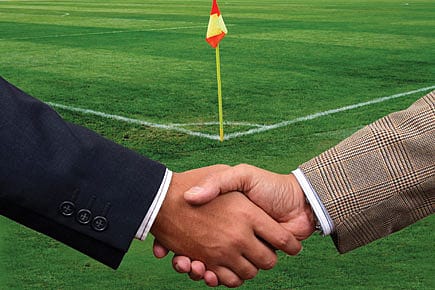
Public-private partnership has the potential to change the face of Indian sport. The challenge is the mindset.
Public-private partnership has the potential to change the face of Indian sport. The challenge is the mindset.
A disgruntled hockey team, shooting champs and chess players crying foul, politicians jockeying for positions in sports bodies. This, perhaps, is in sum what the state of Indian sports appears to be currently. But this rather depressing scenario underscores what a section of Indian business has begun talking of: that it is high time to take a holistic look at sports in the country, and at the enormous business possibilities this offers.
Let the figures speak for themselves. The size of the sports market globally in 2009 was estimated at $110 billion, growing at a compounded annual rate of 6 per cent. The Indian sports market is estimated at $20 billion, the sports goods market at $300 million and TV rights at $400 million. The sports and leisure goods market in India was valued at over $17 billion in 2008-09, an 18 per cent growth over the previous year. The Indian sports market is estimated to be growing at 14 per cent annually. In sum, it's a huge business opportunity. The big hitch, however, is that aside of cricket, there is really no sport which commands a large-scale following big enough for big monies to come in. Worse, non-cricket sporting infrastructure is poor, and is currently the sole domain of the state. Children who want to take a serious look at sports are hamstrung by the woeful lack of infrastructure, the paucity of funds and the absence of adequate sports education as a part of the curriculum. A child who looks at sport as a serious career option needs to have access to quality sporting education and, more importantly, sporting infrastructure to hone his skills.

The Liberation of Bengal
05 Jun 2026 - Vol 04 | Issue 74
A silent revolution ends the reign of fear
It is in this context that the case for a public-private-partnership (PPP) model for quality sporting infrastructure is gradually gaining ground. Gujarat, for instance, is already in advanced stages of setting up a Rs 300 crore state-of-the-art multipurpose stadium which can host upto 12 sports—both indoor and outdoor—which will be the first PPP project of its kind. It is common knowledge that the areas around such major sporting infrastructure projects also see development. Besides, such sporting infrastructure has huge employment generation possibilities, not just for building the stadia but also for maintaining and operating them.
Signs of corporate interest in sporting infrastructure are also being seen. Mumbai-based TransStadia, which is working on the Gujarat stadium and has the exclusive licence for the patented convertible stadium technology from StadiArena, UK, is drawing up plans to build 12 such multipurpose sporting facilities countrywide, investing over $1 billion. The company is examining the possibility of setting these up through the PPP model in many of these cases.
Clearly, it's a long haul. While state governments will be expected to come in with the land needed for such facilities, private partners like TransStadia will have to go for the DB-Foot (Design, Build, Finance, own, operate, transfer) model. And funding will be challenging, given the fact that such sporting infrastructure may still be viewed as real estate plays by financial institutions and banks. TransStadia's CEO Udit Sheth concedes that since the Government in India has priorities such as food, poverty eradication, healthcare and education, sports does not feature as an important point on the national agenda. Sheth's company, therefore, is also putting together a major sports business convention in end-March which is expected to see several leading business leaders, policymakers and global sporting clubs and bodies in attendance to focus on the business of sport. He admits more private companies like his need to take initiatives to 'co-create' the 'Sports Industry of India' together with government, through the PPP model.
The PPP option in sport is being tried in countries like Singapore, where the proposed $1.87 billion Singapore Sports Hub—which will be the largest PPP in the city-state—is underway. In India too, it could just be what the doctor ordered to address the crying need for quality sporting infrastructure.
The opportunities are endless. Scores of educational institutions, public bodies and corporate houses own large tracts of land, where PPPs or even joint ventures can help develop quality sporting infrastructure if more companies which work on creating such infrastructure see them as viable opportunities.
And yes, one other important thing needs to be done. Sporting bodies have to be cleansed of politicians, and the likes of NR Narayana Murthy, Anand Mahindra, Deepak Parekh and Nandan Nilekani, together with accomplished sportsmen, should be brought in to run them professionally. There could be no better example of PPP than that.
(These are the author's personal views. He can be reached at majumdar.sourav@gmail.com)