Web Exclusive
QED

Hartosh Singh Bal turned from the difficulty of doing mathematics to the ease of writing on politics. Unlike mathematics all this requires is being less wrong than most others who dwell on the subject.

EMAIL AUTHOR

Why the BJP Loves Jinnah
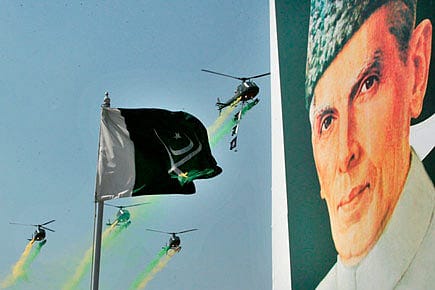
What’s with the BJP’s obsession with Jinnah? First LK Advani and now Jaswant Singh have gone out on a limb to say something charitable about the man.
10
Tagged Under | BJP | Jaswant Singh | LK Advani | Jinnah
Jaswant Singh claims Jinnah has been “demonised” in India; the truth is he has not been demonised enough.

Apart from their senility, I can only think of one explanation; they envy him his achievement. He has created a nation in their image, a nation based on the faith of the majority with no room for diversity. In Pakistan, the BJP finds its ideal.

Four years ago, shortly after LK Advani had praised Muhammad Ali Jinnah, I interviewed Narendra Singh Sarila, ADC to Mountbatten, on his book The Untold Story of India’s Partition. Asked about Jinnah, he was caustic: “He suffered from megalomania, a sense of personal aggrandisement. He acquired two large houses—one in Malabar Hill (Mumbai), one in Delhi. He was already distanced from his daughter by the time, who was he going to bequeath these to? When Advani decided to call him secular, I wrote that we must consider the effect of his actions: they resulted in murder and mayhem. How can you call such a man secular? He may have had secular views, but his acts certainly were not.’’

Jaswant Singh seems to have gone the Advani way. In one of his interviews he claims: “In the 1946 elections, Jinnah’s Muslim League wins all the Muslim seats and yet they do not have sufficient number(s) to be in office because the Congress Party has, even without a single Muslim, enough to form a government and they are outside of the government. So it was realised that simply contesting election was not enough.’’ But this is a Jinnah of Jaswant Singh’s creation, not the Jinnah of history. I will restrict myself to what happened in Punjab because this is where Jaswant Singh’s claims ring the most hollow in the face of what really happened.

In the same 1946 elections in Punjab, in a state with an overwhelming Muslim majority the League did not get the numbers to form the government. It won 75 seats out of 175 and emerged as the single largest party but did not obtain a majority. An alliance of the Unionist Party, the Akali Dal and the Congress, which included Hindus and Sikhs and Muslims, cobbled together a coalition and came to power.

With the Indian experience in democracy it is possible to look back and say the government was not just the ragtag coalition it is often described as; it reflected in some measure the diversity of pre-Partition Punjab and included Muslims, Sikhs and Hindus. It was headed by one Khizr Hayat Khan, which itself was a body blow to Jinnah’s claim of representing all Muslims in India. But typical of autocrats anywhere, Jinnah’s belief in democracy did not extend beyond what it could do for his own ambitions.

The League defied the authority of the new government. With Partition approaching, the British administrators were loath to take sides, and the police response was less than effective. Throughout west Punjab, the Hindu and Sikh minorities were terrorised. Finally in March 1947, the Unionist Party chief minister handed in his resignation. In the aftermath of the fall of the government, Hindus and Sikhs were massacred across west Punjab. The violence spilled over to Amritsar in east Punjab; once again the victims were Hindus and Sikhs. At least 140 persons were killed in Amritsar alone. Presaging the events to come, a train arrived at Amritsar station with the bodies of Hindus and Sikhs who had been killed on board.

These events preceded the butchery of August 1947. It is possible to argue over what may have happened, but what did happen was that millions were butchered in the wake of violence deliberately instigated by Jinnah. This is not a matter of interpretation, facts are not infinitely malleable and what unfolded in Punjab in 1947 is not in doubt. Often enough historians believe in telling the story of the Partition dispassionately, citing the killing of millions on either side. But the killings of August 1947 in Punjab were preceded by months of communal violence organised and instigated by Muslim League leaders. The victims were in the main Hindus and Sikhs. The man who was complicit in these acts was Jinnah. This is the man Jaswant Singh claims has been “demonised” in India.

The truth contrary to what Jaswant Singh says is that Jinnah has not been demonised enough. There is a strange complicity between men such as Jaswant Singh and a certain stream of liberal Indian thought that continues to argue that Nehru should have accommodated Jinnah’s ambition and prevented the Partition. It is a strange and baffling argument given all we know about Jinnah. By the perverse logic of that argument, we should reach out to Narendra Modi and offer him the post of PM to end the divisiveness that plagues us today. The BJP’s real problem is that they cannot lay claim to the Freedom Movement, nor are Gandhi and Nehru figures they can come to terms with. Under the circumstances, the best they can do is to devalue them. And what better way to achieve this than to compare them unfavourably with Jinnah?

OLDER COMMENTS FIRST

10 COMMENTS

Permalink

As the youth of present day India, my concern is not of whether the BJP can or cannot lay claims to the victorious and free India we dwell in, but rather to what the BJP will make India to be, for us and our future generations, if it (the BJP) comes to power again. This main, yet unaddressed concern is the greatest reason why the Party lost so miserably during elections. Had they gotten their act together then itself and drawn out a clear cut agenda for the elections we'd have been a lot better off. But then again, maybe Advani would've become the Prime Minister and like Congress is currently doing, we'd be paying lip service to Pakistan and looking after Kasab's welfare, sucking up to Gilani and the likes to accept Kasab as their national; supporting Sri Lanka's military to oust Tamilians who as a matter of fact supported India; and so many more other gross atrocities we have committed over time much to the mockful rejoice of our enemies.
That brings me to the daunting question of why must we, time and again, make feeble attempts to befriend Pakistan and lose the support and dignity in front of our own kind? Have they not done enough physical, emotional and mental damage to a lot of us, in the past and even the present, that we always gleefully agree to suck up to them?!
I'm all out in support of Narendra Modi and to me, he is the only person who can set the record straight and guarantee our and future generations that there will be a prouder and much grander India for the next few millenia at least, much to the envy of its rivals.
Hence, if Narendra Modi is the 'man of the moment', then I wish for time to stand still!

18 August 2009 | Parul B

Permalink

Sorry! I forgot to add what a great piece of article you have written. In fact, I'm glad that you have used your power, to enlighten the people, so well. Very few journalists seem to do that these days. Much appreciated!

18 August 2009 | Parul B

Permalink

Mr. Bal,

On your statement about Jinnah''s culpability for the massacre of millions before and during August 1947 :

Finally, someone has the courage to challenge the left-wing liberal historians and people like Mahesh Bhatt, Kuldip Nayar and Arundhati Roy who claim that somehow Hindus and Sikhs are equally responsible as Muslims for the massacre.

Muslim League inspired events like Direct Action day (August 1946) had already claimed thousands of lives, almost one year before the events of 1947. Were Hindus and Sikhs responsible for Direct Action day? Were they responsible for the killings in Noakhali, United Provinces (now U.P) and the N.W.F.P.?

Jinnah's statement on the eve of Direct Action day "We shall have India divided or we shall have India destroyed." should give you all the proof of the megalomania of this person. On Direct Action Day, Bengal CM Suhrawardy of the Muslim League exhorted his Muslim listeners to "jehad" and hinted to the crowd that the British police and military had been "restrained", thereby indicating that rioters would have a free hand.

It is beyond doubt that people of all religions died in the events leading upto August 1947, but it is also beyond doubt that the main instigator, the initiator and therefore the most culpable person was M.A. Jinnah.

I am not a Congress supporter, but Jaswant Singh and Advani are absolutely wrong to say that Jinnah is a secular person and that he is not responsible for partition.

18 August 2009 | Dev S

Permalink

Mr. Bal and Dev S,

It would be advisable to try being more correct than less wrong. You've mentioned the fallacy of BJP's arguments several times in your article, but not once have you verified your own arguments with a semblance of proof. More importantly, gain knowledge from sources other than the ones you culturally belong to, or the ones already disposed toward your ideals.

Jinnah was no doubt a man of many faults, but he was no lunatic gagging over the deaths of millions, nor was he inclined toward any theocracy, which would not be hard to realize if you take pains to read his speeches.

His ideology for Pakistan to people of Pakistan at the time of independence: “You are free, you are free to go to your temples, you are free to go to your mosques or to any other place of worship in this state of Pakistan. You may belong to any religion or caste or creed — that has nothing to do with the business of the state.”

Jinnah expounded on February 19 1948: "But make no mistake, Pakistan is not a theocracy or anything like it. Islam demands from us the tolerance of other creeds and we welcome in closest association with us all those who of whatever creed are themselves willing and ready to play their part as true and loyal citizens of Pakistan."

A few days later, he reiterated: "In any case, Pakistan is not going to be a theocratic state to be ruled by priests with a divine mission. We have many non-Muslims - Hindus, Christians and Parsis. They are all Pakistanis. They will enjoy the same rights and privileges as any other citizens and will play their rightful part in the affairs of Pakistan."

A couple of articles with interesting anecdotes on his take on life:

http://www.dawn.com/weekly/cowas/20011223.htm

http://www.dawn.com/weekly/cowas/20000625.htm

19 August 2009 | Irfan

Permalink

Irfan,

All the statements I have made about Direct Action Day and statements made by Jinnah and Suhrawardy are based on fact and not in any way clouded by my cultural background or my sources of knowledge. It is my ---opinion--- that Jinnah was responsible for partition.

By the way, I am Indian but I read Dawn (started by Jinnah), Daily News, Jang as much as I read Indian newspapers. I read the editorials and opinion pieces of Cowasjee, K. Shafi, Nadeem Paracha, Mahir Ali etc. Both my parents lived on the Pakistan side of the border before 1947.

Could you answer me the foll. questions :
1) If you are of Pakistani nationality, can you claim to do the same? Do you read Indian opinion pieces or only the ones that you favor (Arundhati, Kuldip Nayar etc).

2) Who, in your opinion, is responsible for partition then?

3) Is the Pakistan of today even remotely close to Jinnah's ideal of being a secular republic? Is Pakistan not controlled by an Mullah-ISI-Army nexus with little breathing space for democracy? Don't you believe that this nexus wants to keep the fires of enmity between Pakistan and India burning?

4) Is the condition of minorities in Pakistan better than that of minorities in India? Are there even any sizeable minorities left in Pakistan? Why has the population of minorities shrunk rather than grow in Pakistan since 1947?

I say that whatever the blemishes, minorities are better off and have even prospered more in India than in Pakistan because of democracy, rule of law, freedom of press, division of church and state (somewhat lessened recently).

5) The point is that Pakistan is not even equipped to study its own tragic history and reasons for partition in an unbiased way. Why are Pakistani school textbooks
still filled with hate and bigotry towards India and Hindus? Why do Urdu alphabet textbooks have an illustration of a Brahmin with a bodhi for the word kafir. ?

6) Which of my statements in my earlier post are not based on facts, according to you?

Awaiting your response.

19 August 2009 | Dev S

Permalink

@ HS Bal

I think there is more than sufficient (and conclusive) counter evidence both partisan and non partisan, to your arguments that Jinnah was some poor rabid closet fundo with a persecution complex.

I sincerely recommend the following if you have the time or the inclination:

Ayesha Jalal - The Sole Spokesman
Patrick French - Liberty or Death
Wolpert - Jinnah of Pakistan

If you think that these sources are biased read the India Office's official documents on the Cabinet Mission Plan.

Fact remains that Jinnah was happy to accept the Cabinet Mission Plan in 1946 calling for a federation of autonomous states joined by a common army, defence and foreign policy and that Congress shot it down.

The fact also remains that the sub continent has never been one unified nation even under Mauryans or the Mughals.. India's current and previous (british) incarnation is a novelty for the region given its history. (which is not to say its a bad thing but still novel)

The argument that the muslims being a minority did not deserve electoral protection/equality with the hindu majorityand therefore Jinnah and the league's call for protection of the muslim electorate was undemocratic is another point but to paint Jinnah as a demonic religious nut is sheer intellectual dishonesty.

21 August 2009 | gv

Permalink

Dev,

1- How do you believe I came across this article if I don't indulge in reading Indian newspapers? Personally, I prefer The Hindu and Outlook India, the rest are too glamorized for my taste.

2- You cannot blame a single individual for partition. It was a historical process precipitated by British policies of religious division. Even now India barely exists as a hegemonous state, there is deep cultural acrimony between residents from northern and southern stated of India. I might be wrong, I’m not an Indian resident, my opinion is based on Indians I’ve met abroad and the blogs and hateful comments crammed in Indian websites. Going back to your question, Nehru Report of 1928 did not help. Nehru and other statesmen from Congress could have helped by accepting or understanding Jinnah's 14 points and then building a mutually cognizant relationship from there on.

3 - No. Pakistan is now nowhere close to the secular ideals of Jinnah or Liaquat Ali Khan and many other pioneers. It did remain secular until the late seventies. Liquor was legal, so were Indian movies, religious concerns remained in periphery until zia's dictatorship. Pakistan has been harmed more through its porous borders with Afghanistan with unlimited supplies of Kalashnikovs and drugs all through eighties continuing till today. Feudalism has been another prime cause of political and religious profiteering.

4 - No. The conditions are worse, but again causes are more political than religious. A common Pakistani remains in harmony with individuals from any religion. Personally, a great and proud time for me was during India’s cricket series with Pakistan when you could read journals and articles from a number of Indian journalists who visited Pakistan and came back with nothing but praise for the unmitigated love showered by all Pakistanis from cab drivers to restaurant servers.

5 - Which nation teaches its children an unbiased history? Does Indian or American or British? There is no such thing as unbiased history.
Kafir means a non-Muslim and a Brahmin is a non-Muslim. I don’t know what a bodhi means. I did my schooling from Pakistan, and there was never a specific illustration for a Brahmin, I can write Brahmin in Urdu with the assimilation of individual Urdu alphabets just as I would any other word.

6 - I cannot verify the statements you attributed to Jinnah in your post, but I posted numerous other statements from Jinnah's collection of speeches and letters illustrating his secular view of Pakistan. I wish you had posted those statements too, instead of selecting the ones which suits your point of view. The fact remains that history is ambiguous filtered through individual biases of its writers and readers.

Lastly, I could go on and on about atrocities committed to my own family or other Muslims during partition, or the moral fallibility of many actions perpetrated in India today, but I sincerely hope for a day when instead of bickering about the causes and effects of partition we can build a shared sense of humanity. India and Pakistan are two distinct countries and nations now with significant variations in cultural and communal artifacts. Yes, crimes were committed at partition but who were the greatest perpetrators is impossible to argue. It is all over now. Pakistan exists and we can all argue till we are blue in the face but we will never know the true facts. I hope we can impart to our future generations a history created through empathy, and a future through human compassion.

31 August 2009 | Irfan

Permalink

Ooof, what venom against Jinnah
why has the debate stopped, this was warming up

4 September 2009 | PQ

Permalink

PQ,
If you feel venom is being poured on Jinnah, why don't you tell us your viewpoint and back it up with facts?

Irfan,
You have many incorrect points in your email of 31st August 2009. I could not help but notice the contempt that you have for India (In para 2, you refer to India as a barely existing hegemonous (hegemony = dominating or influential) state; this statement makes no sense; how can a state be both influential and barely existing?. I wish India had more "hegemony" over its friendly neighbor Pakistan so that we could influence the shutting down of the jihad factories. Did you mean heterogenous here?). You seem to have formed this opinion of India based on what you have read on blogs and hateful comments in websites. Don't you think that what you have read in these blogs/websites could represent a vocal minority? As for your Indian friends, are any of those friends non-muslim? Do you have any Indian non-muslim friends who suffered as a result of partition? Many Indians from other parts of the country do not appreciate/understand the horrors of partition. I am sorry for all the troubles your family suffered during partition. My family suffered a lot too, so that pain was not suffered by a single community. Let me reply to some of your other points:

2) I have not heard of any serious acrimony between people of Northern and Southern India, compared to what exists between Mohajirs and Punjabis, Balochis and Punjabis, Mohajirs and Pakhtoons etc. There was a crisis in Tamil Nadu about imposition of Hindi as a national language, but that problem no longer exists since English has been given official language status. There are problems in North East India, due to prolonged neglect of the region by the central government and insidious Christian missionary activity.
4) You have not replied whether there are any sizeable minorities left in Pakistan? Why has the population of minorities shrunk (to less than 5%; check CIA factbook on Pakistan) rather than grow in Pakistan since 1947? Is this how a secular Pakistan should be? Are there any minorities in top positions in any branch of government? Can it compare to India? Can a minority reach the top in Pakistan?
5) You sidestepped my point about Pakistani textbooks filled with hate and bigotry towards Hindus and India. Every country has the right to form its own version of history but this is not a 'biased' Pakistani version of history but sheer hatred and bigotry. Pakistani textbooks teach that "all Hindus are cunning and devious". See a) http://www.sacw.net/article459.html and b) www.enlightenedpakistan.org and many other websites. In b), there is mention of social sciences textbooks with themes like "Pakistan is for Muslims alone," "The world is collectively scheming against Pakistan and Islam," and "Muslims are urged to fight Jihad against the infidels." The report notes that the textbooks routinely engage in historical revisionism and place questions designed to portray Hinduism as an inherently iniquitous religion: "There is no place for equality in Hinduism. Right/Wrong."
By the way, Kafir means "non-believer" and this word has never had a positive connotation. Don't you feel uncomfortable that a book for children of ages 4 or 5 would have the word kafir and a picture of a brahmin with a bodhi instead of some other innocent word? 'Bodhi' is a 'choti' or long hair running from the back of the head. This book/picture is from many eyewitness accounts from my family that lived in NWFP before partition.
More examples of hatred/Bigotry: Why even the word 'Pak (meaning Pure)' in Pakistan? Were the non-Muslims napak (impure) in some way? I know that PAK is an acronym for three regions, but surely, the founders knew that Pak meant pure? Do you have any response to this?
6) I do not dispute that MA Jinnah made all these statements in his speeches and letters, but should I judge him by his actions or his words? It is impossible to re-concile the fact that Jinnah wanted a country based on religion (Islam) but he wanted the country to be secular at the same time.
You mention "India and Pakistan are two distinct countries and nations now with significant variations in cultural and communal artifacts. ". I agree about the nation part but what are these variations in cultural and communal artifacts? What are the cultural differences between a Pakistani and Indian Muslim, say from Punjab? Does a Pakistani feel more kinship with someone from India or someone from, say, Iraq or Saudi Arabia? If you say Saudi Arabia, then I would wish for you to wake up and stop dreaming. Saudis consider themselves even more 'Pak' than Pakistanis.
But let us not forget the fundamental cause of partition. (Irfan, this might hurt you but you will have to take it like a man. I am not being hateful but merely stating the facts). Partition happened because the minority Muslim community, while they were in power (in the form of Mughals, Tughlaks, Lodhis, Aibaks, Nizamshah, Adilshah etc), had no problems living with and dominating the majority non-Muslim population. When the British were sure to leave and the minority were faced with the prospect of having to share power with the majority, there came the calls for a separate nation for Muslims. Why could the Muslims not live with their erstwhile subjects, whom they had dominated for 500 years before the British? Let us not forget that most of the Muslim League members were derived from Muslim aristocracy. This is the sad but true fact. Creation of Pakistan was not about religion or ideology, but about power.
You say "I hope we can impart to our future generations a history created through empathy, and a future through human compassion". Pakistan could start by fixing its bigoted textbooks, reversing the Talibanization/Saudi Arabization of Pakistan, and convincing its citizens to be a little more respectful of Indians and non-muslims.

12 September 2009 | Dev

Permalink

People, this is not a HATE site
Lighten up. It's only about Jinna, a man who made some errors and Nehru who made some more, and Gandhi who made even more, and ... all of you, who cannot understand that its only a few PEOPLE, not GODS, and it is only some silly line in the sand, not some celestial separation

20 September 2009 | reginald

Add your comment

The content of this field is kept private and will not be shown publicly.
CAPTCHA
NOTE: Please enter letters [case sensitive] in the box provided before you submit your comment. This is to prevent automated spam submissions
Image CAPTCHA
Copy the characters (respecting upper/lower case) from the image.