

Blue Chip
With the US and China engaged in a trade war over semiconductors, India is stepping up to take a slice of the global business
 Ullekh NP
 |
07 Jul, 2023
|
07 Jul, 2023


(Illustration: Saurabh Singh)
A REMARKABLE EXTRACT FROM Chris Miller’s book Chip War: The Fight for the World’s Most Critical Technology captures the incredibly complex world of semiconductors in the size of a paragraph: “Chips from Taiwan provide 37 percent of the world’s new computing power each year. Two Korean companies produce 44 percent of the world’s memory chips. The Dutch company ASML builds 100 percent of the world’s extreme ultraviolet lithography machines, without which cutting-edge chips are simply impossible to make. OPEC’s 40 percent share in world oil production looks unimpressive by comparison.” Such chips are then sent to China for assembly into a phone or computer.
Speaking to Open, Miller, however, talks of countries that will become bigger players in the semiconductor sweepstakes, and one of the two countries this Fletcher University academic is betting big on is India. “I am bullish about India’s prospects in the field,” he asserts in an interview.
Not everyone is as excited as Miller about the Indian play in the world of chips. In fact, recent commentaries following the federal government’s reopening of the window several weeks ago to invite fresh applications for its ambitious ₹76,000 crore incentives scheme for setting up “fabs”, or microchip manufacturing plants, are worthy of note. An analysis was quick to announce the “floundering” of India’s chipmaking plans. While the Indian government called such pronouncements a knee-jerk reaction from certain quarters that do not want to see India’s progress in the sector, the new window had to be opened from June 1—which will remain open until December 2024—after the three proposals the government had received ran into rough weather, meaning they failed to either measure up to the daunting task or could not find technology partners with the expertise to make chips of the required size. The government opened a window for applying to this production-linked incentive scheme (PLIS) first in January 2022 and closed it within 45 days.
The Vedanta-Foxconn joint venture, which had applied for a 28-nanometre fab, couldn’t seal a deal with companies that could make them. Another proposal by ISMC, which was backed by the Abu Dhabi-based Next Orbit and Israel’s Tower Semiconductor, had to back off in the wake of a pending merger between Intel and Tower Semiconductor. The third proposal by Singapore’s IGSS Venture did not make the cut.
Even so, a survey of experts and government officials shows that Miller’s enthusiasm is contagious and that India possesses many strengths to forge ahead in the chipmaking business. Contrary to pessimistic noises from a small section of pundits, the country appears to have pluses that far outweigh the minuses, experts affirm. India expects its semiconductor market to be worth $63 billion by 2026.
Minister of State for Electronics and Information Technology Rajeev Chandrasekhar brushes aside the perception created around the “reopening” of bids. Chandrashekhar tells Open, “There are no bids. Unfortunately, after the policy was announced, a window for applications was kept open only for 45 days for fab proposals. Subsequently, changes were made in policy to also encourage legacy node fabs, and opening of the window is to also encourage proposals in line with this modified policy.”
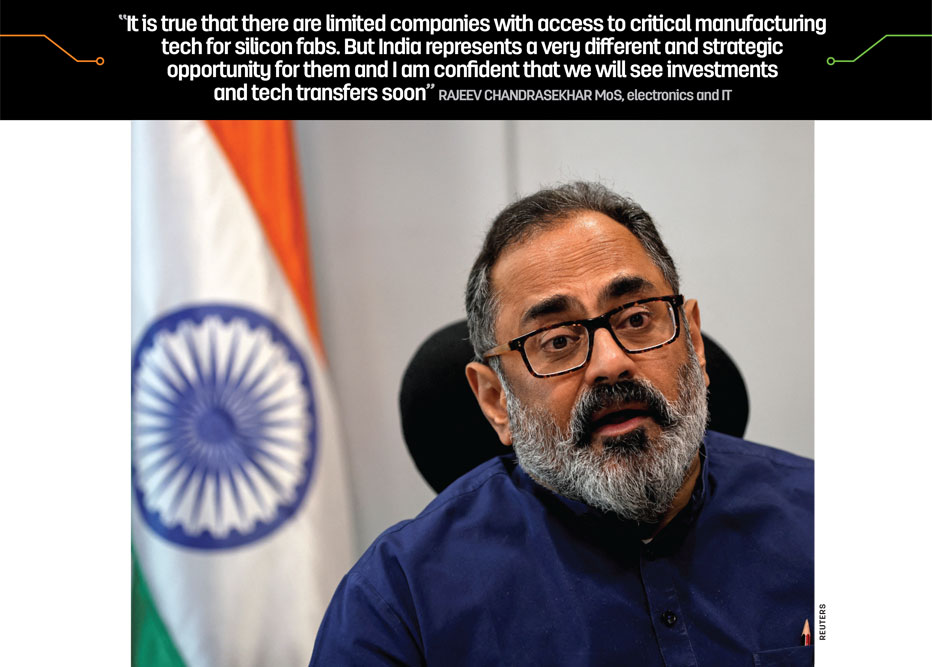
He goes on to add, “It is true that there are limited companies with access to critical manufacturing tech for silicon fabs, and that many countries are pursuing them. But India represents a very different and strategic opportunity for them and I am confident that we will see investments and tech transfers soon.”
Most experts in trade and chipmaking aver that the government was right in its response to the situation that emerged from last year’s applications. Ajay Srivastava, former additional director-general, foreign trade, Government of India, who is also the founder of the economic thinktank Global Trade Research Initiative, points out, “We need to do course correction all the time. This shows the government is wide awake.” The new window also means that current contenders can update and resubmit their plans for chips of various sizes.
India’s biggest advantage is the domestic market which otherwise depends on fragile supply chains amidst growing demand for vehicles and consumer durables in a robust economy. A McKinsey article titled ‘Coping with the auto-semiconductor shortage: Strategies for success’ had as early as 2021 given enough and more indications of where maximum demand for chips will come from within the country—catering to those segments will mean hitting the jackpot by meeting specific needs of specific industries. “Industry demand for semiconductors varies by node size. Chips in the smaller size ranges … are often used in leading-edge technology applications but aren’t required by many automakers. Our analysis reveals several knock-on effects of large-scale technology adoption that the auto industry must consider. For example, an expansive 5G rollout requires a large number of radio-frequency semiconductors manufactured at the same, larger node sizes as auto chips. The same is true for power-electronic chips needed to boot up servers and PCs…”, the paper had said. In the wake of supply chains whipsawed by the pandemic and not yet back to normal, Easwaran Subramanian, partner, consulting, Deloitte India, subscribes to the view that Indian chipmakers will click if they make semiconductors focused on these two segments that offer a loyal, regional market for them. Subramanian leads the supply chain and network operations practice for the firm in India.
Such captive markets are not the sole attraction for prospective India-based players in chipmaking. Malaysia-based Jan Thomas Nicholas, executive director at Deloitte who had co-authored a report not long ago on the Indian semiconductor business, tells Open that he is glad that India has implemented significant incentives and outreach to foreign companies to establish a stronger presence in India. “We’ve seen multiple announcements of FDI since that report was written,” he says.
Nicholas feels that one key factor that India should focus on is the development of the local domestic supply base for semiconductor manufacturers. “Established hubs such as Korea, Taiwan, Singapore, Malaysia, and Mainland China have had time to develop a robust local supplier network, on which the chip factories depend for materials, equipment, consumables, and services. New entrants will need to build this network from the ground up, which will take time and hard work to become a mature ecosystem,” he explains, emphasising that the semiconductor industry is limited by talent, and it is very difficult to develop local talent without a local industry hub.
HE GOES ON: “Countries that want to grow a domestic semiconductor industry will need to acquire these skills from other countries, because educating and training the engineers will take too long.” India has its pluses on that count, he says. “India has many capable and highly educated citizens in Silicon Valley and elsewhere that it can use to accelerate skill development at home.” Nicholas’ report said that India has “strong design and engineering talent, though it lacks domestic chip-manufacturing capabilities”.
Amidst such observations, the call to tap its market before heading to other regions where bigger players dominate is only getting louder. A senior Delhi-based government official well-versed in technology says that it is always prudent as well as commonsensical to make chips that will have a steady stream of takers within India and other developing countries constrained by supply chain woes. “Again, with most big players focusing on microchips, for example, that are of 2nm and so on, India will therefore be able to get its base for slightly bigger chips and then, after having established itself, compete with bigger players that entered the market much earlier,” he says, requesting anonymity since he is not authorised to speak to the media.
India had, in fact, thought about the importance of semiconductors much earlier than most others, including Taiwan, as early as 1983, when the country set up the Semiconductor Laboratory in Mohali.
And then what happened? How did we miss the mega opportunity that Taiwan and others tapped? “We lost track in the 1990s. Not only in semiconductors but in all manufacturing. We were busy opening up the economy and ignored building it up. China zoomed ahead of us during this time. In short, we acted stupid,” rues Srivastava of Global Trade Research Initiative. He is impressed that work is in progress to put things on track lately.
To the question if he is uneasy about the slow pace with which Vedanta-Foxconn Semiconductors is progressing, David Reed, CEO of the joint venture, tells Open that he welcomes the government’s decision to reopen applications under a modified policy. “It requires multiple fabs for the country’s electronics ecosystem to develop. We are aligned with India’s vision of becoming a global high-tech manufacturing hub and we are on course to establish our semiconductor fab in the country.”
Vedanta-Foxconn Semiconductors has signed an MoU with the Government of Gujarat and are putting in place a team comprising the best global talent in the semiconductor manufacturing sector, Reed added. “We have made several strategic leadership appointments for our semiconductors business, including Lawrence Wong Chee Yoong as senior director, human resources, Terry Daly as advisor, and Mike Young as senior vice-president for the project management office and manufacturing operations. We have a strong pipeline of global talent coming to India and working with us to ensure the success of our venture,” Reed says.
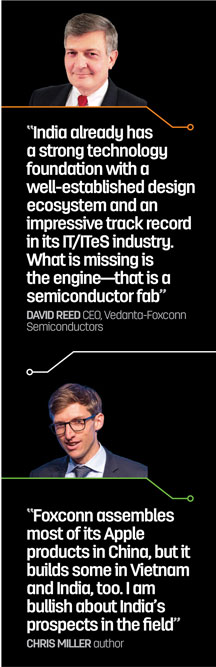
On the challenges and opportunities in chipmaking in India in a segment where the country is a late entrant, he notes, “There is a huge opportunity for India to ramp up its share in the global semiconductor ecosystem. India already has a strong technology foundation with a well-established design ecosystem and an impressive track record in its IT/ITeS industry. What is missing is the engine—that is a semiconductor fab.”
He also agrees that the key to India’s success in the chipmaking business will be local demand. “India has a growing population with a burgeoning demand for consumer goods and electronics that is currently being fulfilled largely through imports. The import of electronic goods was of the order of $51.5 billion in 2017-18, which went up to $73.5 billion in 2022-23. A high-tech manufacturing ecosystem would significantly reduce these dependencies and allow India to become a net electronics exporter once the ecosystem fully matures,” Reed says, in agreement with the argument that it is best to focus on strengths before tackling bigger challenges like taking on the high and mighty in semiconductors.
The semiconductor business is beset with endless traps. From ensuring availability of ultra-pure water (which has to be a thousand times purer than drinking water) to competition from existing and deeply entrenched players and the constant fear of new technologies becoming obsolete at a fast clip—not to mention grand incentives to chipmakers that rich nations such as US dole out—the challenges here are such that even the best battle cutthroat competition to be ahead of the game. A season of anaemic sales can be disastrous for even established players. It is to such a landscape that India is making an entry with the hope of staying afloat in the long haul.
Reed is also of the view that one of the biggest challenges is the gestation period for the ecosystem to develop. Once the government approvals are in place, it will still require time and commitment for the Indian ecosystem to catch up to countries with legacy semiconductor capabilities, he says, adding that the time to start has never been more ripe, and India can lead the charge even as other economies join the race for developing these capabilities. Like many others, including those in the government, he also feels that India offers strategic advantages for even big chipmakers. “Electronics permeates all sectors of the economy, and the electronics industry has cross-cutting economic and strategic importance. Currently valued at around $2 trillion [₹150 lakh crore], the global electronics market is expected to grow significantly given the increasing penetration of emerging technologies,” he opines, referring to 5G, the internet of things, AI, robotics, smart mobility, smart manufacturing and others.
Like author Chris Miller, Reed is upbeat about India. “Given the dominant tide of India in the global economy, it offers not only an extensive domestic consumption market but also an alternative gateway to Asian and global markets. India’s strong geopolitical standing and its diplomatic relations with several countries of strategic importance make it a lucrative base for building manufacturing and supply chains,” he elaborates.
But Ajay Srivastava cautions, “India has to sharpen its strategy to benefit substantially and not be happy merely with assembling simple components.”
Meanwhile, Rajeev Chandrasekhar, himself a former chipmaker and a technologist, sees the growth of India’s semiconductor market exceeding expectations and outperforming all other comparable countries. “The demand for a new generation of computers and devices to power computers; automotive/industrial, and wireless [segments] is relentlessly on the rise and India can be at the centre of it as both a market and as a producer of tech,” the minister says.
Chandrasekhar had earlier said that the likes of TSMC, Samsung, and Intel will have to set up bases in India. “Our market expansion, our emergence as a trusted partner in global electronics supply chains, our growing semiconductor talent base, momentum in semiconductor design, innovation, and research all make India under Prime Minister Narendra Modi a strong partner for global leaders in tech and electronics and semiconductor,” the minister adds in the interview with Open. Chandrasekhar also tweeted on June 23 that Modi’s US visit will act as a catalyst for the chipmaking sector in India. He was referring to announcements made during the prime minister’s tour of the US by Micron Technology, Applied Materials and Lam Research that they will invest in the country’s semiconductor business. He termed their commitment as a “significant and meaningful milestone” and “central piece” in the growth of India’s semiconductor ecosystem.
Although Indo-pessimism is in the air, especially when it comes to manufacturing, experts the world over insist that the country is expected to gain massively in the chip war between the US and China, which is also a war for global hegemony. As Miller puts it, if Beijing succeeds in developing its own semiconductor technology to free itself from America’s “chip-choke”, “China will remake the global economy and reset the balance of military power.” Miller reminds us that while World War II was decided by steel and aluminium, the Cold War defined by atomic weapons, the rivalry between the US and China may well be determined by computing power.
Until that happens, India has a glaring opportunity to seize the moment. Even the most sceptical among technology experts and forecasters see immense sense in India making bigger chips for local industries that face the onslaught of global supply chains to start with. “That is the way to strike gold,” says an official. Accept the limitations and then go beyond them, he advises.







More Columns
The Playful Past Rati Girish
“The day you say Modi is 'satisfied’, you can say you are paying homage to him” Open
Travellers on Trial Bhavya Dore