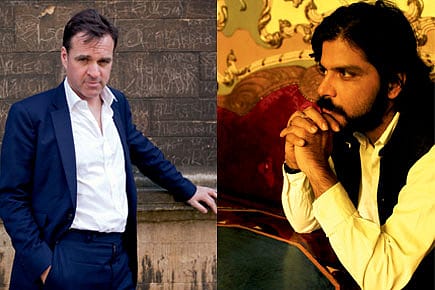
It’s very hard to disagree with anything Pankaj Mishra writes—not that I’m often inclined to. But for years, I’ve guiltily wondered why I read him, when I do get around to it, out of grim duty rather than any pleasure or enthusiasm.
This might not be worth writing about for others to consider but for the recent dust-up between Mishra and the odious, neo-imperialist, right-wing British historian Niall Ferguson over Mishra’s review of Ferguson’s book, Civilisation: The West and the Rest, in the 3 November issue of the London Review of Books (LRB). Per their wont, the British papers worked overtime to stoke it into a ‘row’ or a ‘feud’: ‘Indeed, not since VS Naipaul and Paul Theroux fell out has there been a spat like this in the letters pages of a literary journal,’ wrote Peter Beaumont breathlessly in The Guardian. Alas, to no avail: To his credit, Mishra is taking the high road, declining to be interviewed and telling Beaumont by email that he ‘want[s] to ‘confine’ his response to Ferguson to the letters pages of the LRB.’ Well played—except that Mishra ended his second (and presumably final) response to Ferguson by asserting that ‘It says something about the political culture of our age that Ferguson has got away with [his] disgraced worldview for as long as he has. Certainly, it now needs to be scrutinised in places other than the letters page of the LRB.’
Which does Mishra want, to scrutinise Ferguson’s disgraced worldview beyond the LRB, or to confine himself there? I grant that Beaumont’s one-word quotation from an email might be misrepresenting Mishra. But Mishra’s own worldview could use a little scrutiny, and the LRB, The Guardian, The New York Times op-ed page and suchlike bien-pensant periodicals are cosy havens to which the kind of writer Mishra has allowed himself to become might be inclined to confine himself. I recommend that he get out more.
To be clear, I have no intention of mounting any defence whatsoever of Ferguson. But, laying aside the ensuing exchanges of letters, which Ferguson rendered necessary with his ill-considered petulance in the first instance, it’s not necessary to expend 5,132 words—and the equivalent in one’s readers’ time—to demolish him, as Mishra masterfully did. Ferguson is despicable, and his worldview is disgraced. Case closed, next case. There’s much more to say than that, of course, but—as Mishra knows well and indeed points out in his review—it’s all been said before, many times over. Mishra’s problem is the one every writer faces: what to say, to whom, and how, when everything has already been said? But his particular challenge is how to resolve the tensions inherent in trying to be at once a dissenting outsider and a Fellow of the Royal Society of Literature. So he burnishes his dissenting credentials by going after straw men and easy targets, at great length, as if there were any readers of the London Review of Books who needed to be convinced.
‘The reception a writer receives in a favourable political context can be the making of him,’ he says with reference to Ferguson. This is a bit rich coming from a writer who has had it made since his eloquent personal essay, Edmund Wilson in Benares, was published in the New York Review of Books before he was 30. Ever since then, Mishra has very shrewdly—I use that adverb with admiration—deployed his identity as a Brown ex-colonial to maintain his position as a licensed explainer of global subjects to the liberal West.
Good for him. But his interest in the West itself, other than as a readership to be instructed, is vexingly limited. His interest in America, such as it is, is bloodless and, as far as I’ve ever been able to tell, exclusively coastal. This might not matter—we’re all entitled to be more curious about some countries than about others—if not for his proclivity to pronounce not only on the usual, obvious bundle of common-or-garden American geopolitical sins and sinners, but on American literature and culture as well. And he uses the literature to score points about the geopolitics. He says this himself: ‘I don’t think of myself as a literary critic,’ as he wrote in the New York Times Book Review in 2010. ‘I write about novels and short stories. But I am reluctant to describe what I do as ‘literary criticism’, as I like to move quickly beyond the literariness of a text—whether narrative techniques or quality of prose—and its aesthetic pleasures, to engage with the author’s worldview, implied or otherwise, and his or her location in history (of nation-states and empires, as well as of literary forms).’
Whatever. That ‘implied or otherwise’ is a nifty insinuation that leaves the self-described non-literary critic all sorts of leeway to ‘engage with the author’s worldview’. This he does to Ferguson in the opening salvo of his demolition, deploying a quote from ‘Tom Buchanan, the Yale-educated millionaire’ in The Great Gatsby to the effect that ‘Civilisation’s going to pieces’ and the ‘white race’ will be ‘utterly submerged’ if they don’t keep the darkies down, etcetera, etcetera. I have no sympathy whatsoever for Ferguson, but if you read the first paragraph of Mishra’s review, you can almost feel sorry for him, especially if you remember the job Mishra did on Salman Rushdie some years ago in Outlook.
‘Wary of Jay Gatz, the self-made man with a fake Oxbridge pedigree,’ Mishra instructs us, ‘Buchanan is nervous about other upstarts rising out of nowhere to challenge the master race.’ Mishra understands Gatz/Gatsby because he himself is an upstart who rose out of nowhere. And that’s a fine thing to be, as long as you don’t fake an Oxbridge pedigree; I (for example) am also from nowhere. But Mishra’s interest in Gatz begins and ends with this passing rhetorical use that he makes of him. In his review of Ferguson as elsewhere, Mishra is interested in America only to the extent that he can caricature its ruling elite in order to knock them down.
I’m all for that too, but I’m afraid Mishra doesn’t mind leaving his international audience with the impression that ‘men of a certain age, class and education on the Upper East Side’ (as he scornfully describes Ferguson’s constituency) represent all you need to know about America. (That’s the Upper East Side of Manhattan, in case you missed the knowing allusion. Mishra likes New York, by the way, and wants you to know it. ‘On every visit to St Mark’s Bookshop in New York,’ he writes wistfully in a 2010 Guardian column, ‘I am still drawn moth-like to the shelves where the literary and intellectual quarterlies … stand splendidly arrayed.’) He’s aware that there’s much more to my country than its discredited metropolitan oligarchs, of course; he just doesn’t believe any of the rest of it matters. So he’s happy to use Gatsby to make a point and then lay him aside.
In the novel, Gatz/Gatsby hails from the remote state of South Dakota, in the Upper Midwest. Forgive me for feeling a personal stake in pointing that out, because where I grew up is only one state away. The state between Gatsby’s and mine is Minnesota, where Fitzgerald was from. These details are arguably beyond the scope of Mishra’s review of Ferguson, but as I read it, I did find myself wondering whether Mishra has ever been to South Dakota.
I have. When I was 12, my father bought me a copy of The Big Sky, AB Guthrie Jr’s great novel of early-19th-century mountain men, off the paperback rack at the famous tourist trap Wall Drug. Has Mishra read The Big Sky? Or Larry McMurtry’s masterpiece Lonesome Dove? Or The Grapes of Wrath? Or Their Eyes Were Watching God? If he’s read these or other representative exemplars of the great and diverse adventures of American fiction, his writings give no indication. He has read John Updike, Saul Bellow, Philip Roth, Jonathan Franzen, names he trots out with tiresome frequency. Please. As if these tired, staid, often dead White men represented American literature. You might argue that Franzen, Updike and, for that matter, Fitzgerald are provincials who left home to make good writing high-toned books in the metropolis—and I might note in reply that that’s a trait they interestingly share with Mishra.
If Mishra wants to ‘engage with the worldviews’ of American writers, why doesn’t he read and cite, say, Edwidge Danticat, whose gut-wrenching memoir of her family’s immigrant experience, Brother, I’m Dying, is one of the most powerful American literary accomplishments of the past decade? Or, for that matter, John Grisham, whose subject matter, social and political concerns, and enormous readership testify to a self-critical America far from the ‘Eastern Seaboard’ that Mishra place-name-checks only in order to lampoon it? There’s something ironic about a writer whose first book was a travelogue around small-town India, and who reads in order to locate authors ‘in history (of nation-states and empires)’, being psychologically unable, or ideologically unwilling, to engage with the complexity or the provincial heartland of a country on which he is wont to pronounce with unassailable, not to say insufferable, confidence. If I object—as I do, on the record and often—to the way most American writing on Pakistan reduces that complex and fascinating country to a mere set of policy problems for American wonks to solve, then I’m obliged also to object to an internationally influential Indian writer habitually reducing America to the narrowest and most self-satisfied slice of its metropolitan establishment.
The America that Mishra has constructed in his head to suit his purposes is an abstraction summoned from reading entrails in the form of a rarefied selection of literary and topical books, perhaps supplemented by seminars and panel discussions. It’s as if I were to hang out my shingle in London, take occasional visiting professorships in Delhi or Mumbai (but not bother to travel anywhere else in India), read—let’s say—Naipaul or Rushdie on one hand and MJ Akbar or Fareed Zakaria on the other, then write erudite and overlong essays instructing Indians on all that’s wrong with their society and civilisation. I’m sure that if I were to do that, it would, as the Brits say, get up the noses of many Indians. Well, Pankaj Mishra gets up my analogous American nose.
I knew Mishra, slightly, back when we both were young nobodies on the make. I rode behind him on his motorbike on the campus of Jawaharlal Nehru University. I visited him at his refuge in Mashobra. He was my house guest in Thailand, on his first-ever trip outside India. And before his first trip to Pakistan, he asked me for contacts there, for which he never thanked me, not that the memory of that still gets on my nerves or anything. I congratulate him on his success and wish him more of the same. I appreciate his annihilation of Niall Ferguson, who deserves it.
But I wish he would consider addressing his incisive intelligence, reporting skills and narrative talents to an attempt to understand my country as the deeply troubled, various, and extremely interesting society that I know it to be. If he won’t do it, I will, but I can’t write as anything but an American. The United States of America, a historically important country in the early stages of a crisis of likely world-shaking severity, is crying out for a new Alexis de Tocqueville, a foreign writer who will depict it, with all its damaging contradictions and bad habits, unsparingly yet with human sympathy. No writer could do that better than Pankaj Mishra—if only he would get away from the Eastern Seaboard.


OLDER COMMENTS FIRST
20 COMMENTS
Permalink
I'm a little confused, not least because I haven't followed Mishra quite as closely as you seem to have. Are you talking about some general trend in his work, which is as far as I can tell absent in his critique of Niall Ferguson? In either case, wouldn't it have made much more sense to either talk about the flaws in that essay, or give some examples of pronouncements he has made on "American culture" in other essays? At least a couple would have been nice.
Permalink
Pankaj Misra is the sort of writer who has taken the easy road. It is of course easier to be the dissenter who lampoons and tears into the ugly Indian/ American/Israeli/ capitalist rather than dispassionately analyze the often complex reasons behind the actions of men and nations. But then, who cares when you are part of the left liberal elite that gets to hobble with a cabal of like minded thinkers over canapes and France's best
Permalink
Pankaj Mishra ceased being relevant-I don't know - maybe when GOST was published?
Now he's just like the overpaid twats writing for various journals and who we are asked to believe are the literary elite. Whatever. And he shouldn't do lit crit too-his own novel is atrocious.
Permalink
@ ramblingperfectionist: You raise good questions. I wrote that essay because the low-grade annoyance that had been building up in me for years just sort of boiled over when I read Mishra's review and exchange of letters with Ferguson. Generally, I agree with the other comment (Ambarish) that Mishra has taken the easy road. I am talking about a general trend in his work, and I could cite plenty of examples, but I wouldn't want to be guilty of one of the things I'm accusing Mishra of: writing overlong essays. :-) The editor of Open asked me for 1400 words, I ended up writing 2000, and he was kind enough to publish my full 2000-word essay anyway, so I really didn't have any wiggle room to include more.
Examples are all out there on the Internet - search The Guardian, for starters. One Guardian piece I thought was especially silly was last year when Mishra made a big deal out of the novelist Jonathan Franzen appearing on the cover of Time magazine - as if anyone in America even reads Time magazine anymore. That's a good example, I think, of what I call the bloodlessness of Mishra interest (such as it is) in American culture.
Permalink
Ethan,
I think your piece looks at symptoms of political criticism without nailing them down to brass tacks. You make a very substantial point about Mishra's selective criticism, but isn't that the only kind of conversation we seem able to have globally, today?You say Mishra repeatedly evokes mediocre writers like Franzen to represent American experience. I put it to you that an outsider relies at least in part on the image a society projects of itself. Is there really a wider conversation about American literature which isn't overpopulated by straight white men going on in the US, which is also accessible to those of us outside the country?
Having said that, this piece makes me think about our own role as consumers and -- in the case of the media, disseminators -- of globalised culture, and how little inquiry into it we conduct ourselves.
Permalink
Ethan,
You rate Pankaj Mishra too highly. That's the source of your angst. He is an intellectual buffoon whose supposed understanding of the hinterland of India is as shallow as his understanding of the US. I am surprised that you were so taken by his criticism of Fergusson. I found nothing new except the tired old and frequently false assertions that have been staple of left wing intellectuals in our country. He has one trait which he milks to the last drop: packaging. In that, he is little better than a management consultant. I wish he shaved his beard. I am afraid as it gets longer, he might style himself as a Tagore. Be forewarned!
Permalink
Ethan, these words rang true: "I wish he would consider addressing his incisive intelligence, reporting skills and narrative talents to an attempt to understand my country as the deeply troubled, various, and extremely interesting society that I know it to be."
Having lived there for ten years, I think I recognize in your words the USofA that I know and have grown to think of as a second home. I wish more Indians would try to understand the States in that way. (Hell, I wish more Indians would try to understand *India* in that way, but that's a story for later). I mean, to me it is a fascinating country not because of the Statue of Liberty and Niagara Falls, but because of the biker I met in Sturgis (see, I've been to SD) who told me about his journey out of prejudice and why my visiting his family farm would be a bad idea. Or the rail repair foreman I met in Nebraska who told me their neighbours from India had a look about them that just said "wealth".
I don't know if Mishra does get beyond NYC in the US, but if not, I wish he would. There's much to learn. I'd love to get you interested in reading my "Roadrunner", which was prompted by sentiments similar to your last couple of sentences above. Open's editor will know how to reach me, if I can indeed interest you.
Supriya, is there a wider conversation about American literature, you ask. I occasionally catch glimpses of such conversation (and about more than literature) in reading less well-known US journals. One I used to pore over when I lived in Austin (TX) is the Austin Chronicle. With the Web, of course, everything is accessible to us outside the country.
Ethan, full disclosure: I was critical of your "Alive and Well in Pakistan" in, I think, TimeOut some years ago.
Permalink
What a pointless essay?! Who cares whether Mishra knows much about the US; he seldom writes about it. He takes Ferguson to task about his counterfactual understand of Asia and the East, and not the US.
Your quotation of Mishra--"that ‘men of a certain age, class and education on the Upper East Side’ (as he scornfully describes Ferguson’s constituency)"--makes me wonder whether you even read his LRB review. What you take for scorn is mere irony because Mishra is quoting Ferguson who said elsewhere that Bobbit's book will ‘be read with pleasure by men of a certain age, class and education from Manhattan’s Upper East Side to London’s West End’.
Permalink
"He is an intellectual buffoon whose supposed understanding of the hinterland of India is as shallow as his understanding of the US. ... frequently false assertions that have been staple of left wing intellectuals in our country."
At least Ethan Casey did not feel the need to resort to epithets like "intellectual buffoon" and "frequent false assertions". Because at least Casey made the effort to construct arguments and spell them out, with examples. That's too much hard work for people such as this; easier by far to simply accuse.
Among other things, let's see an example to back up "frequently false assertions", perhaps?
Permalink
Ethan,
I am a Midwesterner and while we mean well to all, we aren't about to take kindly to a person from the Great Plains tagging up with us. Until I read Balagangadhara, India's only post-1947 scholar of the humanities, and his experience of coming to terms with his heritage as a young Indian scholar in the Western Europe of the 70s, I could not make sense of America. I am not sure if I do, but at least I know what I want to make sense of. I can only pity the writer whose acquaintance with America begins and ends with NYC, despite the fact I believe, the world comes to live there.
I know India better than Pankaj does, so I've never had any use for his whines and rants. Besides he is not an honest person and given to making things up. Even then, it's good to see someone cutting him down to size, so soon after the shellacking Patrick delivered earlier this year.
Permalink
@ Chana Makya: Well, Graham Greene once constructed a whole long movie review on the premise that an American character in the film had said the word "feudal," and it turned out the character had said "futile" - so I think I'll survive having misidentified Mishra quoting Ferguson. I don't think that actually damages the point I was making, either, i.e. Mishra does like New York, and he does want you to know it.
So my essay might be pointless, but not for that reason. To me, part of the point was getting some things off my chest! For which I'm grateful to the editors of Open.
Too, the fact that Mishra seldom writes about the US is kind of my whole point. He treats the US as a monolithic evil imperial entity, which is fair enough, but not if you a) drive home that point as often and as relentlessly as he does, and b) have the freedom to travel that he clearly enjoys. He could get a lucrative contract for a travel book about the US in a heartbeat, but he has little if any interest in my country as a society, beyond the East Coast and the not-very-representative books that he reads. He wouldn't want to write such a travel book, because it would "complicate" (a word he uses to attack other writers, like Patrick French, whom he accuses of failing to do justice to India) his preconceived notions.
And he needs those notions, in order to write about the US the way he does - exactly and only as the aforementioned evil imperial entity, sometimes at his customary great length. 3-4 years ago in the Guardian he wrote a long essay instructing us all about the Ivy League-educated Vietnam-era US establishment, as if he had been the first person to figure that whole thing out. I searched for that essay while writing mine, but couldn't find it. I sent him a private email at the time, more tactfully - in a friendly and collegial spirit - saying some of the same things that I ended up saying in my essay. He didn't reply. I now believe that the reason he didn't reply is fundamentally because he's not interested in debate or conversation; he's interested in instructing the rest of us from on high on how things really are. It's for the same reason that he told Peter Beaumont he wanted to "confine" his response to Ferguson to the LRB.
I'm finding these comments very instructive, because there's definitely a difference in perspective on Mishra between Indians and Westerners. I think Mishra is taken a lot more seriously in the West (among left-liberal types, at least) than he is overall in India.
Permalink
Supriya Nair asks me: "Is there really a wider conversation about American literature which isn't overpopulated by straight white men going on in the US, which is also accessible to those of us outside the country?"
Well, yes, Supriya, there is. That's why I made a point of mentioning Edwidge Danticat's book Brother, I'm Dying in my essay. See:
http://www.bookbrowse.com/reviews/index.cfm/book_number/2045/brother-i'm-dying
That's just one example; I could cite many more. Maybe sometime I could persuade the editors of Open or some other Indian magazine to give me space for an essay on "Whatever Happened to the Great American Novel?" I would enjoy writing such an essay for Indian readers. I do cite Zora Neale Hurston's masterpiece Their Eyes Were Watching God, but that's not contemporary (although it was pioneering).
I think that the white men Mishra is so fond of are tired, staid, irrelevant. Don't get me started on Updike! (White people having affairs with each other's spouses in affluent suburbs in the Northeast - talk about pointless!) Part of what's sad about Franzen is that he wants to be the kind of male-novelist-as-major-cultural-figure that it's just not possible for anyone to be anymore in America. So his appearance on the cover of Time magazine, which so impressed Mishra, was in reality just a big fat non-event. Part of that is that America, the real-live, diverse society, has moved on from needing or wanting such figures. Related to that is the decline of literature as a cultural institution in America, actually. I'll sound like a cranky oldster (I'm 46) for saying this, but kids these days are too busy playing computer games, blah blah blah. Part of it too is that people are just really, really distracted these days in America - the center is failing to hold, and no one can hold anyone else's attention.
The places to look for really interesting fiction and other literary work in America are among immigrant writers (e.g. Danticat) and provincial and popular writers (above all Grisham, who is taken much less seriously than he should be). John Grisham is the John Steinbeck of our time. And anyone in India with a couple hundred rupees can pick up a John Grisham novel, right? You might enjoy my little essay/statement "The Case for John Grisham," online here:
http://www.ethancasey.com/2011/05/review-the-case-for-john-grisham/
Regards, Ethan
Permalink
@ Dilip D'Souza: Many thanks for your comment. And I don't mind if you were critical of my book - once one has written a book, one is by definition inviting criticism. Then again, there's the question of just how critical you were ... :-) I don't recall seeing your critique in TimeOut. Anyway, Ahmed Rashid and Mohsin Hamid both like my book. :-)
Anyway, I'd love to read Roadrunner. I'll query the Open editor for your contact details, and you (anyone) can reach me directly through the Contact page of my website, www.ethancasey.com. Dilip, I could trade you a copy of my more recent book Overtaken By Events: A Pakistan Road Trip for a copy of Roadrunner - how about that deal?
I'm trying to publish book reviews on my own site as often as I can find time, and Roadrunner sounds like a natural for that.
Cheers, Ethan
Permalink
Ethan, you have got it in one! Indians in general do not take the Pankaj Mishras and Arundhati Roys of the world very seriously. They are for liberal western consumption.
Linuxman commented above that he knows India better and does not need pankaj mishra to understand it so it appears to me that it would generally be the less well informed liberal western who could actually take Pankaj Mishra seriously.
Your personal outpouring of angst is interesting and revealing for me. I can only speculate why you would want a 'brown Englishman' who makes a career of being so, to tour and understand the depths of your country!
Permalink
Dilip,
You don't have to search hard to find Mishra's patent false assertions. Among his various rants, he once claimed to have some inside knowledge about the massacre of Sikhs and went hammer and tongs after the establishment. No one doubts the heavy handedness of Indian forces in Kashmir but in this case, Mishra was so wide off the mark that the publication had to add a rejoinder censuring his astonishing claims. Needless to say, no word of apology--he just moved on to find a new straw man. As Ethan has written about his sloppy caricature of Americans, all you have to do is to read his critique of Fergusson to find his half-truths dressed up as some sort of an academic exercise. That said, it's not fair to blame him completely. One has to take to task his various admirers as well who have anointed him as, of all things, a modern day Buddha, a supreme purveyor of hidden mysterious. What he does, on other hand, is peddle banal summaries that have lost their relevance at least 30-40 years ago. I beg your pardon but I have more faith in Harvard's credentials than some ginned up correspondent.
Permalink
@Sumedha: You make a very good point, asking why I would want a "brown Englishman" who clearly has no real interest in my country to write a travel book about it. :-)
Well, for one thing it seems Dilip D'Souza has beaten him to it anyway, with his book Roadrunner, which I'm delighted to learn about. My suggestion that Pankaj could/should/might write such a book is, I think, a vestige of my earlier appreciation for his intelligence and potential as a literary traveler/reporter/narrator. I would have liked Pankaj to do more such books, like his first one. He has chosen not to, and instead has become a kind of global scold. That's a shame and a loss.
Even now, he could choose to "kick out the jams" and lay aside the scold role, and I bet he could write a great book on America (and/or on other countries and subjects). But only if he was honestly and sincerely interested in the people he would meet along the way, not if it was going to be a hatchet job.
But it's certainly not my place to tell any other writer what books he or she should write. I've got enough on my hands deciding what books I should write! I included that paragraph at the end of my essay because I wanted to end on an upbeat and encouraging note, and to pay some homage to the writer that Pankaj Mishra could be, or could have become - still could become, for that matter. But again, it's not my place to say anything beyond that about what he or anyone should or should not do.
I'm grateful to Dilip D'Souza for the genuine human interest that he has shown in my country - because it is a country, a society, a human community, in addition to being the big bad global boogieman etc., etc.
Permalink
umm.... wait... why do I care if Pankaj has something to say about Niall's views?
This like getting worked up about what Rosie O'Donnell says about Donald Trump...
Permalink
Ethan,
Firstly, I am no fan or otherwise of Pankaj Mishra; I just follow his articles occasionally in the Guardian while idly wondering how he managed to inspire such reverence.
Just stopping by to mention that I was perversely amused to find someone from the US to be upset by someone not bothering to take the time to understand the country and painting it with a broad brush based on limited experience instead.
Amused, because that's actually something people in 'the rest of the world' have come to expect from even well-educated and well-travelled Americans. In fact I'd go so far as to suggest very few Americans would even be concerned about Pankaj Mishra, as he's blabbering out there in 'the rest of the world'.
Please don't take this too much to heart - my wife is American, by the way - I just found it amusing. I also know that the sweeping generalisation I just made about all Americans can simply not be applied to you.
All the best and thanks for contributing to maintaining the quality of writing and debate in Open.
Shariq Siddiqui, in London, from Mumbai
Permalink
@Shariq Siddiqui: I take your point! And I don't take it to heart, and I'm glad to have been the source of some amusement for you. I say that in a friendly spirit, and you gave me some amusement in turn by making the point.
Ultimately, I think the job of any writer is to make him- or herself intellectually and emotionally available, or vulnerable, to the society he or she is writing about, and to write with honesty and humility. This is (per your point) more difficult for an American or Western writer, albeit not impossible. I think any writer should be judged partly thus not on his country of origin or background itself, because those are things he can't help, but on how he factors in or corrects for his background, and on his attitude (i.e. humility or otherwise).
Regards, Ethan
Permalink
Ethan, I accept your point about USA, but -- like Pankaj -- I have often wondered why Niall Fxxx has not only been getting away with his predictable, colonial and simplistic readings of history and the world, but that a lot of Europeans and Americans who consider themselves open (and honestly so) have recommended his books to me... as "thought-provoking". Everytime I have read NF, it has struck me that the only people who could find anything new in his books and views are those who have either internalised the most predictable Euro-colonial binarisms of the past two centuries, or simply forgotten all about them! In that sense, Pankaj's intervention was not just fully justified (even with the slant that you have critiqued) but long long long overdue. It should have come from major European and American writers, and much earlier. It is a pity it had to come from an Indian writer. I think that is as worrying a fact as Niall Fxxx's popularity, even in academic circles...
Post new comment