What Do You Call Picture Books for Adults?
The ‘graphic novel’ is a great marketing gimmick. So grown-ups can buy comics about men in flashy briefs, unabashedly.
Life and LEtters
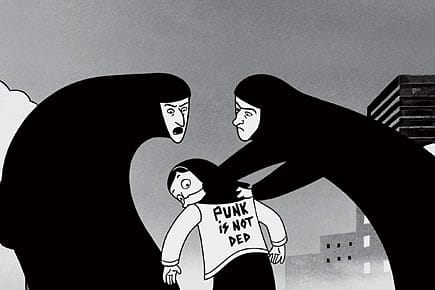
An illustration from Marjane Satrapi's Persepolis
Daredevil, Frank Miller
Moonward, Appupen, aka George Mathen
Hellboy, Mike Mignola
Floronic Man (Jason Woodrue)
Daredevil, Frank Miller

I was talking to a friend recently about my fascination with comics, specifically Neil Gaiman’s Sandman series and Frank Miller’s The Dark Knight Returns, and she interrupted me to correct me. “Not comics,” she said. “Graphic novels.” It was all I could do to keep from foaming at the mouth. I then explained to her, as patiently as I could, the excellent marketing gimmick that is the ‘graphic novel’, and how it was originally used to describe comic-book adaptations of short stories and novellas. And how Will Eisner co-opted the term to market his A Contract With God, and Other Tenement Stories to adults, instead of the children who traditionally read comic books. I then directed her to a YouTube video of Neil Gaiman explaining how he wrote comics, and couldn’t, for the world of him, understand what a ‘graphic novel’ was.

This is not unique to Gaiman. Most of the legends of the medium—Stan Lee, Jack Kirby, Alan Moore, Frank Miller, to name just a few—have insisted that they worked with comics, and that ‘graphic novels’ was just something the marketing department put on the books to make grown-ups feel better about buying them. This includes Moore’s Watchmen, probably the modern era’s quintessential ‘graphic novel’, which was originally serialised in 12 comic-book-sized issues. It’s probably worth adding here that what commonly passes for a ‘graphic novel’ in bookstores today are known as trade paperbacks, a collection of multiple issues containing a single story arc. Unlike Watchmen, Art Spiegelman’s masterful Maus and Marjane Satrapi’s Persepolis would qualify as true graphic novels, published as single volumes without any serialisation.

The graphic novel syndrome affects most Indian writer-artists working with the comic-book idiom to tell their stories. The term has been injected with a sense of gravitas by its purveyors, and as such, has resulted in plenty of extremely self-conscious and contrived storytelling. For instance, take Amruta Patil’s Kari. It’s a drone of an illustrated short story (or is it captioned paintings?) about a whiny, lesbian advertising professional that doesn’t even use the format of a comic book. Sarnath Banerjee does better with his Corridor and The Barn Owl’s Wondrous Capers, but offers little more than an honest effort. The latter is particularly disappointing in its storytelling. In adapting to the comic-book idiom, Banerjee compromises the integrity of his story, and it ends up meandering like a severed kite. If ever there was a case to be made for an editor’s guiding hand, this is it. But where does one find an editor who understands the medium well enough to mentor young writers?

The comic-book industry in the West has always straddled multiple worlds. Writers such as Moore, Miller, Gaiman and Warren Ellis, who have all written a number of path-breaking adult comics, cut their teeth writing for DC and Marvel Comics’ pantheon of super-heroes. To paraphrase Gaiman, there’s nothing like writing about grown men swinging around in brightly-coloured spandex to stop you from taking yourself too seriously.

In addition, one might add, the editors at these publishing houses, such as Julius Schwartz at Marvel and Archie Goodwin and Karen Berger at DC, set very high standards for their properties, allowing young, upcoming artists and writers to get used to the rigour of producing high-quality work on a regular basis, and under a tight deadline. Indeed, Miller’s Daredevil and Moore’s Swamp Thing are considered to be some of the best work in the history of super-hero comics.

Contrast this with the scenario in the Indian comics industry. Amar Chitra Katha and its basket of properties focus exclusively on children, and are only now beginning to publish new titles in addition to their decades-old catalogue of over 400 titles. Indrajal Comics, home to the first indigenous Indian comic character, Abid Surti’s Bahadur, has disappeared. Raj Comics and Diamond Comics, with their hugely popular superhero titles, cater to a Hindi-speaking audience, peddling shoddily produced comics to audiences who simply don’t know to expect better.

It is here that the true opportunity exists for young writers to tell engaging and intelligent stories that expand the reach of these characters beyond their current audience. Raj Comics, currently going through a rejuvenation phase, should seize this opportunity in their own right to take their properties to the next level.

One reads comics for the same reason that one might read a short story or a novel: the story. The visual medium is merely a device that enables the story to be told using certain techniques, providing a unique experience to the reader, but it is really the story that will bring him back for more. A good story with mediocre artwork will attract far more readers than superbly-drawn comics with poor story-lines.

Virgin Comics learnt this the hard way, watching their brilliantly-drawn but horribly-written titles circle the drains with no end in sight. And good writers can only become great writers if they are pushed to deliver a higher standard by the publishing mechanism, through mentorship, editorial input and collaboration. Ditto for the artists, whose responsibility it is to make the story come alive on the page.

But let me add here that this system is not necessary to produce superstars. Harvey Pekar, Chris Ware and Art Spiegelman did not have to go through the grind before delivering comic-book masterpieces. Osamu Tezuka, that legend of Japanese manga, produced amazing work as an amateur before abandoning his medical practice to produce manga. But India is yet to produce a Spiegelman or Tezuka, and we should not hold our breath. All we can do is appreciate them when they do arrive. Meanwhile, it is best to hope that the system can deliver a strong pipeline. Of course, a thriving ecosystem with mentorship and apprenticeship is no guarantee of high-quality professionals. Just look at Bollywood.

OLDER COMMENTS FIRST

11 COMMENTS

Permalink

Reminds of a time I asked a fellow writer what kind of stories he wrote.

"I don't write 'stories'," he replied haughtily, "I write screenplays with simple language that reach to the very heart of people."

Needless to say, I don't ever want to read anything from him.

16 October 2009 | allVishal

Permalink

Great, great article! Thanks for writing it.

16 October 2009 | Madhav

Permalink

One tiny nitpick... Julius Schwartz was a long-time editor at DC and Archie Goodwin was an editor at Marvel (although he did work for DC in the 90s)

16 October 2009 | Ashwan

Permalink

Art Spiegelmann's Maus series is the only "comic book" that can be called "for adults", and even this only made a caricature of an event too serious to be subjected to mythification for commercial/cynical purposes (protesting which earns you bad names like holocaust denier in societies which claim to allow free speech/debate).

19 October 2009 | Priti Mehra

Permalink

Ash - My bad. I know that Goodwin edited Batman for many years, and Julie Schwartz was the man behind Superman becoming truly super. Also, Maus was serialized due to publication constraints.

Priti - I have no idea what you're saying. First, Maus is hardly a 'caricature'; it is a serious work that presents the Holocaust and the predicament of Polish Jews in quite a harsh light. On the other hand, maybe you're saying that Spiegelman created Maus to milk sympathetic markets for money, and if you are indeed saying that, I should only wonder who the cynic is in this situation.

20 October 2009 | Sumant

Permalink

I'm not entirely sure what your argument is here.. Do you see Graphic Novels as a serious but under-developed art form? or only as an excuse to sell batman to 'adults'? A fairly rudimentary reading of 'A Contract With God' will tell you that it isn't really something that will attract anything but the most morbid teenagers, however enthused they may be by the idea of a comic.

Also, while Watchmen does actually feature 'grown men wearing spandex', it is a 'superhero comic' in much the same way The Godfather is an 'action movie'.

The first novels, incidentally, were by their very nature serialized. They appeared in much the same way most comics do today (and have for some time now)... serialized in newspapers.

While I agree with what you have to say about the present state Indian graphic novels, I don't really see the point of beating down on them. That they dont conform up to a set of canonical ideas of what literature 'should be' is probably the best indication we have of how much impact they're actually going to have on people.

22 October 2009 | Aman Rai

Permalink

Aman - I suppose we're even, because I'm not entirely sure what your argument is, either. :) But I will attempt to explain some more:

Eisner's worry was that nobody would buy 'A Contract With God', since (as you said) it wasn't meant for teenagers, and comics weren't considered serious reading by the adults at whom it was targeted. Therefore, he had to convince the adults that the book was worth their time and money, which he did using the phrase 'graphic novels'.

'Watchmen' is most definitely a superhero comic. It's a great example of how a superhero comic can actually say a lot about society, politics, propaganda, fear and morality.

Regarding serialization: Dickens wrote novels that were printed in chunks over an extended period of time. 'Watchmen' was written as twelve episodes that combined to form a long story. The difference is between episodes of a TV serial and a movie with breaks.

Finally, on Indian comics: I'm not beating them down, but I'm saying that the current crop simply isn't up to the mark. This isn't based on a 'canonical idea of literature', but just my concept of an enjoyable comic. I wonder what impact 'The Barn Owl's Wondrous Capers' or 'Private Eye Anonymous' will have on people, besides tedium. The best outcome, of course, would be that more talented writers and illustrators will step into the medium and contribute quality material to the genre.

22 October 2009 | Sumant

Permalink

the image that you have used in your gallery is not from 'Kari'.
it is a pencil sketch someone else has made from the cover image.
i would appreciate it if you could remove it or replace it.

regards
amruta

23 October 2009 | amruta patil

Permalink

Priti,
The writer's cheap shot at Bollywood should be enough to tell you where he stands in the cultural superiority wars (east vs west). He probably obtains knowledge of "alien cultures" through imbecilic claptrap like Persepolis.
Don't wince.
Laugh instead.

26 October 2009 | Pankaj Bhasin

Permalink

For childish cheap thrills, read "Moonward" by George Mathen. It is a comic book about a prophet called Nana who goes to a mountain and starts getting visions (Indian Express has a report written by Anu Kumar). It will tell you what the comic enterprise is about. Also you will understand that what is funny to some people is not funny to all people. This moon story is for people who are still children in their heads and this I am not saying only because I am political correct

29 November 2009 | Priyanka Patil

Permalink

Good article, but only focussing on the half-developed western comics forms misses whats gone on in the world's largest comics industry, Japan, over the last 50 years. I made a feature length documentary on their self-published comics sub-culture, (which is larger than the commercial comics industry in Europe and America combined!) called 'doujinshi' (you can wiki it). It is called 'The Fragile Heart of Moé', and explores whats great about Japanese comics and why every man woman and child reads comics there. I wrote a little essay about what I learnt there, and might be a useful addition to this article. Please check it out here--> http://www.comixindia.com/2009/12/05/how-to-create-a-successful-comics-p...

COMIX.INDIA magazine ( http://www.comixindia.com ) is a new b&w comics magazine in an effort to create new spaces for comics publishing in India. I've started it after learning about the Japanese comics industry inside out. I hope what I've learnt in Japan is put to good use here. Please do visit the site. SUBMISSIONS ARE OPEN!!

My filmmaking website is here-- http://www.number21pix.in , and you can also read my first comic here--> http://www.scribd.com/doc/13989157/Learning-to-See-a-comic-autobiography

OK... enough self-promotion.

8 December 2009 | Bharath Murthy

Add your comment

The content of this field is kept private and will not be shown publicly.

CAPTCHA
NOTE: Please enter the result (for example, 1+3 = 4) in the box provided before you submit your comment. This is to prevent automated spam submissions
6 + 9 =
Solve this simple math problem and enter the result. E.g. for 1+3, enter 4.