My Father, Nirad Chandra Chaudhuri
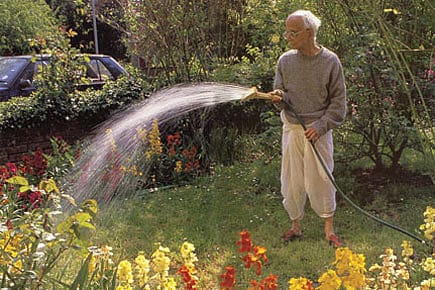
Photojournalist Dhruva N Chaudhuri recounts the delight his father took in his practised eccentricity
The first time Dhruva N Chaudhuri read his father's book, The Autobiography of an Unknown Indian, that grandiosely acclaimed and superbly intimidating work that placed him in the short list of people praised by Sir VS Naipaul, he was 17. The first time he fully understood the book was when he was well into his seventies. "I have read the book many, many times actually. Father used to give his drafts to me when he started writing the book in the summer of Independence [May 1947]. By the time he completed it in 1948, I had read it in its entirety. Nobody else in the family really had the patience to go through his drafts. Then, while he sat typing, I used to read out his corrections. Now I think, in the past five years or so, I have grasped what he was saying in the final chapters," he says.
These past few years, the 78-year-old Chaudhuri has been working on documenting his father's life. Nirad Chandra Chaudhuri lived 101 years, 50 of them after he published The Autobiography of an Unknown Indian (in 1951) as a much talked-about man, delighting in producing provocative essays such as 'Why I Hate Indians' (The Illustrated Weekly of India, 1969). The result is Many Shades, Many Frames: a semi-pictorial biography stapled together with text, respectful and formal, the work of a mild-mannered man who refers to his father unfailingly as 'Father', even in conversation. It is never 'baba' or any other term of intimacy. But this does not mean father and son were distant—Dhruva was possibly the son closest to Nirad C Chaudhuri. That's just the kind of man Dhruva Chaudhuri is: old-fashioned and somewhat reserved, embarrassed by disclosures of affection.
Nearly all the images in the book have been taken by Dhruva Chaudhuri, though a few early ones come from his father's friends. The senior Chaudhuri clearly enjoyed the attention of the camera, often dressing up for it in his trademark three-piece suits with ties, returning its gaze assuredly. In his later years at Oxford, he is even more at ease, clad at times in his home attire of dhoti and kurta, and frequently captured unnoticed by his son. "By that time, Father had confidence that I knew what I was doing. When I started taking pictures, he was encouraging, but he had very set ideas about what photography should be. He believed photos should be composed like a Rembrandt painting. So he would insist on dressing up for photographs and posing. In any case, he loved being in front of the camera. Even the film camera. I remember when the BBC and Merchant-Ivory were shooting for their documentaries, he was so comfortable. Most shots were okayed in one or two takes," Dhruva chuckles.
The dhoti and kurta look is quite the special appearance really: the slightly-built Nirad Chaudhuri, after all, was known for wearing elaborate three-piece suits and hats in New Delhi's nasty summers. In so many of his provocative books, he preens delightfully in the author photograph, in hat, bow and suit. In a startling image in this book, a frail Chaudhuri bends low over a plate of rice on the floor, dressed in a pullover and dhoti, examining the grain for bits of shingle (this was taken after his wife Amiya died). "The fact is that Father always wore the dhoti and kurta at home, never a pyjama. He detested pyjamas, he'd call them Muslim clothes. The suits were for outside the house," says Chaudhuri. As it turns out, even the suits came reasonably late in Nirad Chaudhuri's life: only after he moved to New Delhi in 1942 with a job at All India Radio. His wife Amiya taught the senior Chaudhuri how to knot a tie. "When we moved to Delhi, he thought he should dress like an Englishman because so many of his colleagues were British," says Chaudhuri.
Here, Nirad Chaudhuri also discovered a taste for coffee and fine wines. He came from a family of strict teetotallers, and his own views were similarly severe. Dhruva Chaudhuri still remembers the earful he got the day he came back thrilled after his first glass of cold coffee at the India Coffee House in Delhi. Some time later, it emerged that Chaudhuri senior had, secretly, got rather attached to the occasional cup of hot coffee. "It was a weekly ritual with Father. He would go to the Imperial Archives [now the National Archives of India] on Janpath to research Muslim history. And on the walk back, he would stop at the India Coffee House for a cup of coffee. Sometimes, he took me along and bought me doughnuts while he had coffee," says Chaudhuri junior. The senior Chaudhuri also found himself warming to wine and champagne, serving them with customary fussiness at parties hosted at his Mori Gate home. He himself was always the disciplined connoisseur, never allowing himself more than a goblet or two of wine.
Still, there was never any question of his wife Amiya wearing Western clothes, even formal attire, not even in Oxford where the Chaudhuris had quite the social life. As with nearly everything in life, Nirad Chaudhuri had had very definite notions of what women should wear. "My mother always wore a sari, even for formal sit-down dinners in Oxford. What he despised especially were women in salwar-kameezes. He called them Muslim clothes. When we went to visit him at Oxford, my wife would always wear a sari. As for my daughter, my parents didn't quite like her to wear jeans. To me, Father gifted a couple of very expensive suits but I am much more comfortable in jeans and cords," Dhruva says.
Nirad Chaudhuri's very definite views circumscribed much of his family's life. All his three sons were home-schooled, and this was entirely his decision. Nirad was convinced that his freewheeling lessons in music, history, poetry and pretty much anything that came to his mind were what his sons needed. They had private tutors in later years, but the boys had a difficult time coping with their matriculation syllabus as private candidates. Then again, while the two other boys went to college in Delhi, Nirad Chaudhuri did not allow his second son Kirti, brilliant in studies, to go to college for two years. He was determined to send him to university in London in spite of considerable financial difficulties.
Indeed, the Chaudhuri household was always under financial strain, particularly after The Autobiography of an Unknown Indian was published. In fact, these were especially difficult times because AIR compelled Nirad Chaudhuri to retire from their services for writing a book without its permission. Writing assignments from Indian publications, too, dried up almost immediately on account of the book's perceived anti-India sentiment. The then French ambassador to India secured Chaudhuri some sort of a position with the French embassy, but Dhruva had to supplement the family income as a freelance photojournalist while in college.
The senior Chaudhuri achieved a measure of monetary security only at the age of 80, when the University of Oxford awarded him a lifelong pension. His uneven, uncertain income, though, did not deter him from turning down some of the several assignments that came his way, not least among them Jacqueline Kennedy Onassis' invitation to write her second husband Aristotle Onassis' biography.
"Father was a difficult man to live with, very wilful," says Chaudhuri Jr. "I, on the whole, got along well with him because of my nature and I also had a very good rapport with my mother. She was a gem of a person."
He also had an explosive temper that was frequently on display—that is to say, whenever things were not done his way. In a recent Sunday edition of the newspaper Mail Today, former bureaucrat and minister K Natwar Singh writes about Nirad Chaudhuri: 'He was dogmatic, stubborn, self-opinioned and cantankerous.' (Singh goes on, however, to praise Chaudhuri's prose and integrity of character robustly.)
Chaudhuri's son chooses instead to share cute anecdotes about his father's well-known eccentricity. Like how he would not allow radios in his home. During World War II, when he himself worked in AIR, Chaudhuri would ask his sons to go downstairs to their landlady Mrs Pinto's home and listen to the war broadcasts. They would have to take notes, and then read them out to their father. This had to be done twice daily because Chaudhuri senior believed the radio was a disruptive presence in the home.
His favourite anecdote about his father is the one he has written in the book. That, on his wedding night, Nirad Chaudhuri's primary concern about his bride was whether she had heard of Beethoven. When she nodded her assent, he asked her to spell it out. This she did, hesitantly but accurately, leaving Nirad completely floored.
Chaudhuri kept up the tradition of unreasonable requests throughout his life. At his home in Delhi, when he hosted elegant, fussy parties, Dhruva was expected to serve wine and champagne chilled to a precise temperature. No matter that the Chaudhuri household then had no refrigerator. Later, at his Lathbury Road residence in Oxford, where he was "as happy as Father could ever be", a refrigerator had been acquired, but the imperial old man would keep opening the door to stick a thermometer into the bottle of wine to check if the right temperature had been attained.
"Father revelled in his eccentricity," says Dhruva. "In his nineties, when he wrote pieces in Bengali magazines on what women should wear, I asked him why he was doing this. He waved me aside and said 'Ektu tamasha korchhi (I'm having some fun)'. I warned him about it."
Was his Babri Masjid comment—"I say the Muslims do not have the slightest right to complain about the desecration of one mosque. From 1000 AD, every Hindu temple from Kathiawar to Bihar, from the Himalayas to Vindhyas, had been sacked and defiled"—an exercise in cultivated eccentricity? Dhruva shakes his head, without a word.
His son's censure is possibly justified. Nirad Chaudhuri, habitual resident of the list of famous Indian writers in the English language, winner of the Duff Cooper Memorial Literary Prize (for The Continent of Circe), and still the only man to author a book at 99 (The Three Horsemen of the Apocalypse), is a mostly forgotten man today, unremembered even by the long reading lists of universities. When he died in August 1999, The New York Times carried a 2,300-plus word obituary. In comparison, Satyajit Ray, another Indian with a global audience, got a 1,800 word obituary.
Yet, it is primarily Nirad Chaudhuri's idiosyncrasies that survive, the Beethoven and three-piece suit anecdotes, the sum of the legacy of a man consigned to what is now the list of 'great' writers nobody reads.