Cuisines by the Sidewalks
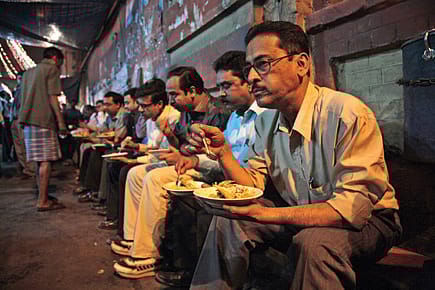
When you have around 145,000 street vendors serving over 230 varieties of dishes to nearly 10 million customers daily, it is a phenomenon by itself.
Kolkata's streets are a gastronome's delight. And a heaven-send for the common man. The sheer variety of food on Kolkata's sidewalks and its affordability make this city's street food unique in the world. From delectable biryanis, chowmeins and pastas to mouth-watering Bengali sweets and pastries, it's all there for a pittance. What's more, it's hygienic and nutritious. Kolkata's 145,000 lakh street food vendors—no other city in the country has as many—cater to nearly 10 million people, many unable to afford restaurants.
That street food can be healthy and hygienic has been proved by Kolkata's Hawker Sangram Committee (HSC), which, in association with the city-based All India Institute of Hygiene and Public Health (AIIHPH), has been conducting training programmes for food vendors on health and hygiene issues and quality control. Periodic tests by the Institute, the Kolkata Municipal Corporation and the state health department have revealed that this street food is nutritious and safe. And at an average price of a rupee for every hundred calories, it's a steal. The UN's Food & Agriculture Organization (FAO) and the World Health Organisation (WHO) have also praised Kolkata's street food and the HSC's efforts. Consequently, even the well-heeled patronise the city's street food. And, no other city in the world, claims HSC secretary Shaktiman Ghosh, has over 230 types of food on its streets.

The Liberation of Bengal
05 Jun 2026 - Vol 04 | Issue 74
A silent revolution ends the reign of fear
Also, four model food safety zones set up by the HSC in the city's central business district serve as examples in quality, hygiene and nutrition. Vendors at these zones wear aprons, gloves and face masks; cover their heads, serve food in thermocol or bio-degradable plates, serve bottled water and prepare food as per a manual published by the AIIHPH. "We produce good and hygienically packed spices, sauces, chutneys, pickles and pastes that food vendors buy from us. We thus ensure quality of ingredients and accompaniments," says Ghosh. The HSC also conducts surprise checks to ensure all vendors adhere to the norms of hygiene. "We have served notices and even temporarily stopped many vendors from selling food when they were found flouting safety norms," adds Ghosh.
Kolkata's central business district—the Dalhousie, Esplanade, Park Street, Camac Street and surrounding zones—offer a feast. Chinese, Continental, Italian, Tibetan, South Indian, Mughlai, Punjabi, Bengali, Oriya and even Goan and coastal cuisine are all there.
"No other city in the world has such a wide variety of food on offer on its streets. And it's all very tasty and cheap," says food critic Nondon Bagchi. Rakhi Dasgupta, who owns the popular Kewpies', says that given the price, most street food in Kolkata tastes great. "I had Hyderabadi biryani… in the Dalhousie area, and it was good. The price varied from Rs 15 to Rs 20 a plate, and the same quality biryani would have cost four to five times more at even an ordinary restaurant," says Iftekar Ali Khan, who runs a catering firm. Chef Adriano Casella, who was brought to the city by a five-star hotel for an Italian food fest, says he tasted a pizza at Chowringhee: "It was quite good. Maybe not quite like what would be made in a five-star hotel, but given the price (Rs 15), it was good. And it tasted quite authentic too."
Many Bengalis, nay all Bengalis who lay claim to the 'gourmet' tag swear by the nalin gurer sandesh, the kanchagolla, the malpoa or the plain old rosogolla at the food stalls around Dalhousie area, and say these are comparable to what one gets in the fancy sweet shops of the city. Food vendors around Writers' Building, the state's secretariat, say that many ministers and IAS and IPS officers order food from them everyday. "I get bulk orders from many corporate houses, including ITC. Many senior corporate executives send their peons to get their lunch from me," informs food vendor Anadi Saha, who makes and sells rotis, vegetable curries, fried rice, chicken preparations and momos near Park Street.
Food vending on Kolkata's streets serves many purposes. "Had they not become food vendors, all these 145,000 people would have been begging or [in] crime. Food vendors play a crucial role in the low-circuit economy of the city—they source all their raw materials from small shops… And they are a boon for the poor and middle-class, especially for the estimated 8 million who come from neighbouring districts to Kolkata on work everyday," says Ghosh.
The HSC plans to facilitate a micro-credit scheme, in collaboration with public sector banks, to enable vendors to purchase compact kiosks. A group of engineering students from Denmark was here last year on a project to design kiosks for them. "They have submitted very good designs. Once the Kolkata Municipal Corporation and state government issue licences and identity cards to street food vendors, as has been made mandatory under last year's Street Vendors Act, we'll be able to get banks to sanction loans to the vendors to buy these kiosks, which will be made by a local engineering firm," says Ghosh. The licences and ID cards, he adds, would also end the regime of harassment and extortion—estimated at Rs 265 crore a year—for Kolkata's 275,000 street vendors (including the 145,000 street food vendors) by the police and civic officials.
The new measures are surely cause for cheer for Kolkatan food lovers.