
Meera Nanda was offered an opportunity to rebut my article, “The Audacity of Ignorance”, and Goebbels would be delighted that his spirit is alive and well after all—repeat a lie a hundred times and render it true. Nanda does not attempt countering the plethora of scriptural evidence I offered that definitively place yoga within the Hindu tradition and trace the growth of asanas over the centuries, but she is generous in heaping scorn on Hindu Americans and pretending that makes for another argument. Fortunately, in the era of blogs, Facebook and X-Tape exposes, Nanda’s tactics can only go so far.
Obfuscate, Confuse and create a Strawman
Nanda repeatedly fails to acknowledge that “Take Back Yoga” (TBY) is all about the willful blindness in the West to the Hindu roots of Yoga, even the spiritual side of it. When I started writing my previous article on February 12, I casually looked up the website of the Yoga Journal given their role in sparking the HAF’s campaign. The ‘Daily Insight’ on their website said (all parentheses are Yoga Journal’s):
“At its core, Sivananda Yoga is geared toward helping students answer the age-old question, "Who am I?" This yoga practice is based on the philosophy of Swami Sivananda of Rishikesh, India....In 1957, his disciple Swami Vishnudevananda introduced these teachings to an American audience.... summarising Sivananda's system into five main principles: proper exercise (asanas); proper breathing (pranayama); proper relaxation (Savasana, or Corpse Pose); proper diet (vegetarian); positive thinking (Vedanta) and meditation (dhyana)...”
And the Yoga Journal refuses to label this Hindu, even as issue after issue pays copious respects to meditation-like practices in mystical Christianity or Sufi Islam. Is it any wonder that Hindus find it disingenuous? Does Nanda believes that Vedanta is also non-Hindu? It is stunning that HAF even needs to make such an obvious point but here we are. HAF also started TBY for Hindu children in the U.S. When they go to school and say they are Hindu, nobody says, ‘Oh, yeah, Hindus gave the world yoga.’ They say, ‘What caste are you?’, ‘Do you pray to a monkey god?’, ‘Does the Red mark on your forehead represent blood?’ etc. Because that’s all Americans know about Hinduism. It is not that we are embarrassed by our respect for cows, curry or karma, it is that HAF’s advocacy informs the American dialogue that we are so much more.
“But this is an American problem, why bother me with it?”, Indians can rightfully ask. Absolutely, which is why we launched the campaign in the US. It was Nanda who chose to write in India. Note that TBY talks not just about asanas, but rather about Yoga in its entirety as a spiritual practice, including asanas. This is what Aseem Shukla meant by Yoga being rooted in the Vedic tradition.
This would have been clear if only Nanda had perused HAF’s original paper on Yoga, but then the problem with some ‘scholars’ is that they ignore original sources, cherry-pick secondary or tertiary renditions, and selectively quote or misrepresent translations. For example, had Nanda consulted the Hatha Yoga scriptures, she would not preposterously continue to characterise Natha Yogis as “sorcerers, jogis and fakirs” who did not care for moksha. She says Natha Yogis only wanted to make their bodies strong. But how could they Ms. Nanda, if asanas came only in the 20th century? You cannot have it both ways.
Hiding a Pumpkin in a Plate of Rice
Nanda says she finds a “tiny sliver of agreement” in my contention that requiring everything Hindu to be traceable back to Vedic times is ludicrous. Thank God for small mercies. But she wrongly claims this supports her position. Making an ostensibly magnanimous concession of her error in claiming Vedas have no mention of pranayama, Nanda claims to stand by everything else she said. What exactly does she stand by? That European gymnastics is central to modern yoga? Then why did she fail to respond to the central thesis of my rebuttal that lays this claim to rest? I provided detailed references tracing the evolution of asanas within Hindu tradition over the centuries, from the Upanishads to 6th to 7th century commentaries on Patanjali’s Yoga Sutras, to hatha yoga scriptures of the 14th to 17th centuries and the Sritattvanidhi of the early 1800s.
She also does not respond to many other facts that I presented, such as Shiva’s 108 dance poses containing many vinyasas (perhaps European sculptors descended into India in the Middle Ages or Bharatanatyam was inspired by Native American foot stomping?). What about the fact that Krishnamacharya learnt vinyasas from his Guru who lived near Mount Kailash? Hinduism’s guru-sishya tradition has always had numerous teachings not found in any text (the Vedas themselves were an oral tradition). Or the fact that the Indian Government has recorded nearly 1300 asanas by consulting Hindu scriptures and yoga institutions to preclude foreign patents? Are there any counter-claims from the Swedish Government? Perhaps Nanda won’t allow Hindus to claim anything post-Vedic as their own. What next? Shankaracharya as Buddhist and Bhakti saints as Christians?
Nanda is also quiet when I point out that Norman Sjoman, who first studied Krishnamacharya’s work in the Mysore palace, acknowledges that the 200 asanas and vinyasas of BKS Iyengar and Pattabhi Jois are independently found in other traditional Yoga schools. Mark Singleton also names Swami Kuvalayananda, with whom Krishnamacharya spent time, as having influenced Krishnamacharya’s work. All said, Singleton finds 28 asanas out of 200 taught by Krishnamacharya’s school (which itself is only one among numerous schools of Yoga) as having “similarities” with European Gymnastics. Nanda wants to use this to pull the entire Hatha Yoga tradition out of Hinduism. Nauseating vulgarity seems to pass for scholarship these days.
The Hindu origins of Yoga asanas are so obvious that Meera Nanda’s arguments only remind me of a popular Tamil saying which roughly means “Don’t attempt to hide a whole pumpkin inside just a plate of rice”.
Disguised Hinduphobia
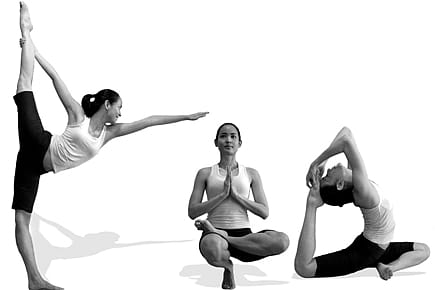
‘Scholars’ of Nanda’s ilk have always disliked Swami Vivekananda. Being profoundly alienated from their heritage and considering anything traditional as mere superstition, they are no doubt discomfited that a Sanyasi who proudly called himself Hindu was able to convey Vedanta in a manner that the West loved, and in immaculate English to boot. Nanda claims that “His (Vivekananda) interpretation of Yoga Sutras by no means reflected the mainstream of Hindu thought in India at that time“. Huh? Has Ms Nanda read commentaries on the Yoga Sutras by Shankara and Vyasa? Maybe she believes that Shankara and Vyasa are not mainstream? Or perhaps again, they were European transplants?
Yes, Vivekananda did consider moksha a higher goal than physical fitness. So what? Why does that imply Hatha Yogis are not Hindu? The same Vivekananda also once told Indian youths, who lacked a culture of physical fitness, that they can be closer to God through football than the Gita ! It is a time-honored Hindu tradition that teachings are always tailored to the needs of the student.
Finding her argument in tatters on substantive grounds, Nanda, like a true demagogue, takes refuge in criticising HAF. After all, why bother arguing when you can just shoot the messenger? One senses that Nanda’s real problem is simply the emergence of an articulate, credible, and professional Hindu voice that is bringing authentic, apolitical Hindu perspectives into the public sphere.
Why would Nanda feel that way? Since she quotes Koenrad Elst, here is Elst himself shedding light on her motives while critiquing one of her works: “I will conclude with an observation on what seems to be her sincere declaration of interest. Among the points that ‘worry’ her, she mentions this as the final one: ‘The more prominence Hinduism gets abroad, even for wrong reasons like the new age and paganism, the more prestige it gains in India’. Here, she really lays her cards on the table. It is very good that...she does not try to be clever and claim to speak for ‘true Hinduism’ against a ‘distorted Hinduism’... Instead, she clearly targets Hinduism itself, deploring any development which might make Hinduism ‘gain prestige’. Let us see if I can translate that correctly: wanting something or someone to suffer rather than to prosper is what we call ‘hate’. She hates Hinduism, and her academic work is written in the service of that hate.” Ita vero!
Admitting Defeat?
Meera Nanda finally acknowledges HAF’s point even if she wont admit it, “...hatha yoga’s interest in the body has captured the global imagination—thanks largely to Indian yoga masters and swamis who set up ashrams and schools in the West”.
These swamis did not come to the US as physical fitness instructors. They taught asanas as part of a spiritual practice aimed at realising one’s true nature, call it self-realisation, brahman, nirvana, moksha or yes, even the ‘kingdom of heaven within’. Many Americans who turned away from institutional Christianity found solace in these teachings and in the pluralistic, non-proselytising outlook of Hinduism that is able to see Jesus as a saint and interpret his teachings in a Vedantic light. That is why Yoga studios are full of Hindu symbols, chants, kirtans, and quotes from scriptures.
But what does TBY ask of non-Hindus who practice asanas but eschew meditation, chanting, kirtan etc. and who don’t read Yoga Sutras, the Gita, or other Hindu scriptures? TBY asks for recognition that the concept of asanas arose as, and remains, an integral part of Hindu spiritual practice. Strictly speaking, even when Yoga is practiced solely as exercise, it cannot be completely delinked from its Hindu roots. As BKS Iyengar says in a foreword to an English translation of Hatha Yoga Pradipika, “Hatha yoga…is commonly misunderstood and misrepresented as being simply a physical culture, divorced from spiritual goals…Asanas are not just physical exercises: they have biochemical, psycho-physiological and psycho-spiritual effects.”
Nanda gratuitously advises Hindu Americans to, “take a deep breath and get over it.” So, in the same spirit, here is mine: Nanda should learn to get her facts about the Hindu tradition straight, and from original sources. And learn to accord the same respect to Hinduism as to other religions. The days of the Hindu community cowering before self-appointed pseudo-scholars are over.


OLDER COMMENTS FIRST
19 COMMENTS
Permalink
Bravo, S Venkataraman! This is indeed a good articulation of your position and an exposure of Meera Nanda's ulterior motives that I was wondering about. The hatred in her articles is hardly subtle and she has resorted to all kinds of half lies, downright misinformation and obfuscation to pursue her agenda. Will she learn anything from this exchange? I hope so.
Permalink
Excellent and reasonable response to Meera Nanda's agenda and hate driven BS. In the future, Meera Nanda and all hate-filled people like her - the pseudointellectual, destructive, and arrogant people - should take a long pause before trying to lie and fool people.
People will read your drivel, laugh at it, and respond to it. Go home and take your hate with you. Unless you want to be humiliated and exposed again in public by Hindu Americans like Swaminathan.
Deepak Chopra has quited down after being embarrassed in public in the Washington Post by HAF.
The old days of Hindu-haters having the upper hand are over. The Godhra train burning of innocent Hindu women and children showed how deceitful and dishonest this cabal of self-righteous people are. The facts are out now, and there victims have been honored by the deafening silence of all those who hate Hindus more than they believe in justice.
Permalink
I find it appropriate that I support the work of the HAF against the Hindu-blindness of America in particular. One must work against the opportunistic stripping-away of essences that American culture in particular tends toward. It has been said that America lacks culture, and this is true to the extent that it seems to largely bounce from one faddish world-cultural reference to another, stripping away the surface aspects, using them for it's shallow purposes and discarding them later; leaving only the dualistic fundamentalist Puritanical impulse revealed behind it all.
Yet it all seems driven by an unspoken cultural desire to consider ourselves perpetual Frontiersmen, charging up some new mountain, never seen before by ANYONE! We then pat ourselves on the back and charge off for a new Eastern philosophy to conquer. So our continuous churning through cultures comes from this: a new frontier is endlessly needed- something to fill the void Puritan impulses don't give us.
Something NEW must present itself for patenting. I call it Bob's Cool Yoga Syndrome. 1) Add YOUR NAME, 2) Add YOUR gimmick, 3) Add the word Yoga, 4) PROFIT. You can seen this process repeated over and over again in American culture throughout any Eastern philosophical, medical or sporting (like karate, judo, etc.) endeavor.
Yoga was OK before America- it was a complete system of Self-culture. Yoga doesn't need us, but we need Yoga.
When I came to live in an ashram, it was precisely the Hindu cultural reference that allowed me to properly contextualize what I was learning there, along with the asanas I learned simultaneously. Frankly, I was tired of the narrow path afforded by the odd and disturbing "Jesus or Hell" options I was given for my spiritual existence.
It's inconceivable to me that yoga would have had the same profound and life-changing impact on my life that experience brought to me without the proper cultural context; and frankly, I resolutely refuse to teach yoga without it in context.
Without reference to Vedic scriptures and the gurukula system itself, whose basic premise is that improvements in the student truly come only from the teacher and other human examples (something science is actually proving these days: http://www.wimp.com/linguisticgenius/) nothing we learn in yoga about the reformation of the personality, compassion, non-violence, purification, service, and love can be understood in the fundamentally holistic, profoundly positive and complete nature of yoga.
I was at a Sivananda ashram in California. The entire culture of a Sivananda ashram is Hindu, there are pictures of saints and sages everywhere, exactly as in the homes of all my Hindu friends, special areas for spiritual practices- just like all my Hindu friends. We ate sitting on the ground, just like my Hindu friends. In the Hindu culture- I am speaking to you as a (formerly atheist) Western white male who discovered this rich tradition in my 30's- I have found a solace and an inherently compassionate SYSTEM in which all my understandings of science, psychology and my inner life are contextualized, transcended and well understood.
I think for most Westerners who bother to understand yoga, in context, it's AMAZING that a system of religious or spiritual teachings CAN be fundamentally compassionate, allowing YOU to start wherever YOU are, and come to things gradually. I have come to understand this attitude as part of the Hindu mindset in general.
Anyone who says Yoga isn't Hindu really has no idea what they are talking about, and is unwilling to allow the release of the Puritanical impulse that underlay American culture, while still feeling free to borrow liberally from the cultures of the world it has come to dominate.
I would suggest that this previously-mentioned 'adopting a Puritanical impulse while cherry-picking what you want' from other cultures introduces a narrowing mindset on yogic practices; like when one spends an entire vacation busying photographing the sights and sounds, never enjoying the immersion in the vast and expansive vista and experience of the ongoing days of the vacation.
Furthermore, one comes home with many photos, then making the mistake of thinking one has understood this place you have visited, telling all one's friends about the insights and magic of a place one never bothered to experience, yet recorded tiny slivers of moments passed.
After I left the Sivananda ashram where I lived monastically for 3 years, I discovered the Nanaimo Hindu Cultural Society, and found, to my sadness, that I was the only "white" guy there. 26,000 yoga teachers trained and no white people in Hindu organizations? Don't make sense to me…
I also found that the member's attitudes profoundly reflected what I had learned in the ashram to the point where I really felt at home there; included automatically by people I didn't know- and frankly even more than in my own Western family.
I am a Hindu. I was born in the U.S., but I didn't come from there. My true understanding of myself means that I now identify that "I came from Bharat itself and am gradually returning there."
Permalink
Nicely written. Under Meera Nanda's equation, nothing is anyones, because the fact is that today we do have a global village. That does a disservice to truly understanding contributions of various civilizations and cultures.
Permalink
Very well-written!
Permalink
Psychologists say that humans can suffer from several 'cognition biases'. One of these is the urge to say something 'new' and this urge makes one look at data selectively and distort natural and rational interpretations of data to propose 'new' theories. Mark Singleton suffers from this bias.
On the other hand, Meera Nanda suffers from the cognition bias called 'confirmation' because overpowered by her hatred for the Hindus, she latches on irrationally to any new-fangled theory that lambasts the heritage of Hindus and demeans them.
How these and other congition biases (I could give the Yoga terminology for these but let me refrain - because these people will not understand then) work is seen also in a recent article by Wendy Doniger the Bhogi applauding the work of Singleton. The article, in NY Times, is a litany of gross errors itself. For instance, it says that the Hindus created an apocryphal myth of Swami Dayanand Sarasvati that he dissected a dead human body to verify if the Hathayoga text described chakras were actually reflected anatomically or not. When he could not find them, he threw away his 'Nathapradipika'. Doniger of course imagines the story as apocryphal although the Swami narrated this story HIMSELF in his autobiography published in an issue of the Theosophist around 1856 or so.
And now we have hilarious discussions about the identity of 'Nathapradipika' in the Indo-Eurasian Research yahoogroup - another Hindu bashing egroup run by bigots like Steve Farmer. A list member Suresh Kolichala avers that Swami Dayanand Sarasvati perhaps did not consider the Hathapradipika as a Yoga text, which is why he did not call it as Hathayogapradipika. Amusingly, in chapter III of Satyartha Prakasha, his magnum opus, the Swami lists several Hindu scriptures which he considers not worthy of studying. In the list occurs the work - 'Yoga: Hathapradipika'. In other words, the Yoga affiliation of the 'Hathapradipika' was very clear to the Swami, even though he did not accept it as a useful text.
So we see that Singleton and his acolytes are simply not interested in letting the facts speak for themselves. They seem to be motivated by their own political and other nefarious agendas.
The case of Meera Nanda and the likes of Steve Farmers and Michael Witzels is a bit more extreme. They do not even conceal their agendas.
My advice to Meera etc: Practice Yoga and immerse yourselves in Hindu spirituality. That alone will cleanse your mind of hatreds, cognition errors, prejudices and other mental ailments.
Swaminathan has done wonderful service by showing the mirror to Meera Nanda. It should be apparent to any reader with a desire to know the truth that Nanda is driven by an agenda of hate and phobia and that has impaired her judgments on the heritage of Hindus.
Permalink
Meera Nanda has bitten off more than she can chew, a second time no less. I am surprised that one so educated could not care to read Koenraad Elst's scholarly rebuttal of her poorly informed lecture "Dharmic ecology and the neo-Pagan international: the dangers of religious environmentalism in India," delivered at an academic conference in Sweden in 2008. So unseeingly in thrall of her ideas is Meera that she possibly imagines no one engages with her work in any spirit but flattery. Elst's rebuttal showed up the likes of Meera Nanda, yet another one in a long line of South Asian/Progressive/rational what have yous who have no knowledge of any language other than English, and cannot care to read anything beyond what is written in the academies in the US and UK.
Meera is a votary of a science led culture, so why should it matter what the origins of yoga are? Criticise it on scientific grounds, study the claims made by the gurus, audit the billions spent on yoga in the fashionable studios of San Rafael, SoHo and the Loop, ask if these claims are sustainable. Just like Ionnides is meta-analyzing medical treatment protocols, let Meera apply the tools of evidence based medicine to yoga. What does stretching your spine backwards do to your discs? Is padmasana OK for arthritics? Does yoga really lower your BP? And so on.
Instead Meera opts to sally forth into the history Hindu tradition, for which she has no hardware or software. Surely she knows that you cannot engage with a millennia old tradition by reading up a few tracts here and there, or by casually throwing around the names of a Vivekananda here and an Elst there. What does she imagine a Hindu like me feels when he reads Meera sneeringly drop names to suggest venerable Hindus or Hinduphiles diss yoga? Recoil in embarrassment? Did she ever imagine that one Hindu might simply nod her head and move on because she has no idea who Elst is, and anyway being a follower of Ramdev, would rather take his word than Meera's? Or another Hindu like me who chooses horses for courses couldn't care less?
To criticise Meera for poor research (if we can call this research) and resorting to quote mining in the manner of creationists and purveyors of pseudoscience (UFOs, crop circles, there's no climate change, etc., take your pick) is missing the point. Meera is contemptuous of her audience and is out to bamboozle while ignoring to educate herself. Careless insult (calling HAF a lobby for instance) and a barely concealed despite for Hindu traditions is the thread that binds this rant of hers like the many others she has written before. While few with learning or grace have bothered to respond to her earlier, excepting the likes of Rajiv Malhotra, Subhash Kak and Elst, this time Meera has been bested and shown up to be the graceless ignorant hack she is.
And a few words for Manu Joseph, this is all about your talking lizard. Here's the story you should be writing, about how your correspondents seem to be stuck in some cave, unaware about what's going on outside. I thought you learned something when you published Amrit Dhillon's irony challenged rant "Don’t Hindu Gurus Care about Corruption?" while showing off your ignorance of Ramdev's national anti-corruption morcha, which is Outlook's cover story this week. And now you run an ignorant hack job by Meera Nanda on yoga? I read this magazine online, so it doesn't make a difference, I can read Swami's devastating rebuttal and rejoinder while chortling over Meera's weak and whiny defense. But what about your readers? Shouldn't they get to read this exchange in print?
Permalink
Thanks Swaminathan for keeping it honest. I hope Meera Nanda educates herself on the topic and stick to facts rather than her prejudices.
Permalink
Great rebuttal. Growing up in the US, I can say that there's definitely a feeling that to be taken seriously, to save yourself mockery, you have to distance yourself from being a Hindu. The perceptions of what it means to be a Hindu in this society seem not much different from the perceptions that the British had a century ago.
There is a barely concealed Othering and condescension that manifests exactly as is described in the article above, where everything mainstream American culture doesn't care for is taken to define the entirety of Hinduism (and how awful that the religion and the people who practice it are so backwards and mock-worthy!).
And everything mainstream American culture considers interesting, is appropriated, and the continued appropriation defended by the claim that the thing really wasn't Hindu/Indian in the first place, was it?
The implicit understanding, of course, being that white Americans are so much more rational and informed and in all ways qualified to both judge what is and what isn't really Hindu/Indian, and to be the authority in all those not really Hindu/Indian areas.
And for some reason this is the very same ridiculousness that Mrs. Nanda seems to feel compelled to parrot? Some of her points, especially in the first article, seemed to be word for word what certain white American academics and commentators have recently written about yoga.
Permalink
Swami, what a splendid sequel.
There's an anonymous quote that goes "It is better to know nothing than to learn nothing." Meera Nanda, please note.
Permalink
Meera Nanda clearly belongs to that brood, aptly called 'Doniger's children', which include the likes of Jeffrey Kripal, who not so long ago hilariously psychoanalysed a man dead for 125 years - Ramakrishna Paramhansa - in his book 'Kali's Child', in an attempt to show that the great saint was a paedophile with homoerotic tendencies. I wonder if any of these 'scholars' have the guts to 'psychoanalyse' Prophet Mohammad or ridicule Islamic or Christian traditions. I guess in this case the sword is mightier than the pen.
Permalink
It's a fashion to bash Hinduism in general and more particularly to disown the surroundings that we live and work in. While I do believe that "Letting Go" will help in the growth of Hinduism, it does not bode well to develop the habit of degenerating the very system. I guess the system, as it is in India today is conditioning our minds as is with our political class.
We will need to understand that it is the learned who become the leaders eventually. There must be something - and time has definitely proved it to be so, in Yoga - spiritual or otherwise, that it is fast coming to be accepted as an alternative to many of the ills that plague the Western society and ours too. Of course, it is only when we have the complete acceptance in mind and spirit that works in enlightening us,
We have a great deal to learn and so does Meera -- hope she does it soon --- for herself and her future readers too.
Permalink
S. Venkataraman: A very well written article. I am positive you are aware of the Tamil Siddhars and their contribution to Yoga. The Indic traditions are so wide yet almost all traditions focus on the eventual moksha. Development of the body and mind are key practices that these traditions insist.
Permalink
Very well written.
There should be a way to 'like' this post.
Permalink
Thanks Swaminathan, as you are representing the true Hinduism. Now-a-days it has became to fashion to criticize the Hinduism and other related things whether it is our god, literatures, customs or anything else. What are these Deepak Chopra, Mahrishi Mahesh Yogi, Sri Sri Ravishankar and other western guru who are selling yoga and meditation with a big profit without any responsibility. M.F. Hussain can make a nude painting of hindu gods and goddess but can't make other religion's people or gods, what is this. Where is the Nalanda's library which had been burning for six months, all of our literature is either destroyed or looted by Muslims and Europeans invaders. You are doing a good work pls. keep it up.
Regards,
Sunil
Permalink
I have been an 'unofficial' Hindu for forty years. It has always distressed me: the lack of appreciation and understanding of their Hindu heritage that I find among Indians in the West. They are caught up in a materialistic western mind-set.
When I was 19 I was tormented by the question 'Who am I?'. I would take a walk and touch a tree or a stone, trying to figure out 'Who was the I that was touching the tree or stone?' It drove me crazy. Then, one day I happened upon a copy of the Bhagavad-Gita on my father's booksellf. I read it and the light turned on. And I've never turned back. OM TAT SAT
Permalink
I have read Ms. Nanda's article. If I understand correctly, she notes that there are references to (if I may paraphrase) certain aspects of yoga in Hindu texts and evidence of practice of certain aspects of yoga in Hindu tradition. However, she then goes on to conclude that yoga does NOT have Hindu roots because the bulk of its most publically and commercially sucessful aspects in North America only occurred relatively recently and as a result of the incorporation o,f or reaction to, non-Hindu influences.
When can I look forward to Ms. Nanda's article on how the Christmas tree doesn't really have any connection to the Christian religion? After all, the New Testament contains not a whit of a mention of the Christmas tree, the concept of a Christmas tree reflects, incorporates or usurps pagan Northern European traditions and the custom probably gained acceptance in certain Christian communities at least 1500 hundred years AFTER the commonly accepted date of Christ's birth. A number of Christian communities do not use Christmas trees at all and currently, many non-Christians do. I am sure Ms. Nanda can come up with many other indicia to support the conclusion that Christmas trees are not at all associated with the Christian religion. I know that logic dictates she must agree with such a concept in spirit, regardless of whether she can summon the intestinal fortitude (or funding) to do so in print.
Permalink
first they burn the temples and libraries, then they stigmatize the culture and after they are done razing and stereotypying, they ask for written proof of whatever good is somehow left.
Permalink
There is a bigger deception about Meera Nanda. She claims to be a naturalist, secularist and humanist voice. But she actually was paid for by the Templeton Foundation, which in the words of Richard Dawkins as something which gives "a very large sum of money ...usually to a scientist who is prepared to say something nice about religion."
Wait a minute. Is Meera Nanda speaking something nice about religion ? About that specific religion on which she published books and claims her scholarship. No she is not.
The Templeton foundation is not nice to all types of religions. That would be ridiculous, considering how polarizing any religion is. The Templeton Foundation is about Christian Protestan apologetics. Every other religion, especially those religions that are not in apparent conflict with science (on issues such as evolution, the age of the earth, human mind) should rather be tarnished.
Meera Nanda is the brush that was used by the Templeton Foundation to paint Hinduism in black colors. Her arguments are not a balanced and principled critique. She picked the baton right from where the colonialists and evangelists left.
Post new comment