Web Exclusive

The Audacity of Ignorance
The HAF counters Meera Nanda’s “not-so-old, nor-so-Hindu” argument about modern-day yoga
The author is Member, Board of Directors, Hindu American Foundation
rebuttal
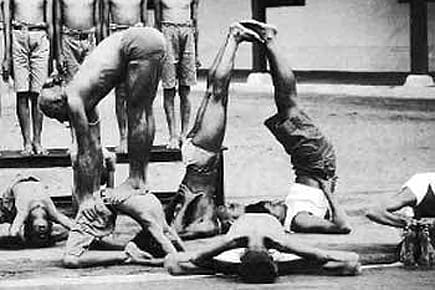
The yoga school T Krishnamacharya directed inside the Mysore Palace

The Hindu American Foundation (HAF) started a conversation on the deepening American embrace of yoga with letters to magazines and a position paper nearly a year ago. Struck by the disconnect between “Hindu” and “yoga”, HAF felt compelled to argue that delinking yoga from its Hindu roots was ahistorical, at best, and insincere and malicious at worst. The position struck a chord, and a debate with Deepak Chopra, a frontpage article in the New York Times, and a CNN segment later, more Americans are connecting the two.

Meera Nanda’s Open story alleging that Hindu texts have few asanas and that the yoga master Krishnamacharya borrowed most from European gymnastics is the latest salvo against HAF’s position, and mimics a similar rebuttal by Wendy Doniger. Nanda’s criticism of HAF’s ‘Take Back Yoga’ (TBY) campaign as being based on a false, non-existent history misrepresents TBY and maligns HAF as a casteist, sleazy political operation (Indo-American Lobby? HAF is neither Indian nor a political lobby). Where she makes relevant points about the Mysore Palace, she vastly exaggerates her case. Perhaps, as William Dalrymple said, Nanda is “overtly hostile to many expressions of religiosity.” Whatever her agenda, her audacious and flippant claims are both stunning and flawed.

What is Take Back Yoga?

Nanda concedes that American yogis say “Namaste,” quote from the Gita and play Kirtan music. Why then is she so bothered by TBY? TBY makes three key contentions:

1. Yoga is more than just asana

2. Yoga is rooted in Hinduism

3. The asana-based practice of yoga found in many Western yoga studios is inspired by the Hindu Hatha yoga tradition

An important spark for TBY came from the editorial practices of the influential ‘Yoga Journal’ magazine, which sees asanas as integral to a broader spiritual practice. So what’s the problem? The editors avoid the words ‘Hindu’ and ‘Hinduism’, but not ‘Christianity’, ‘Islam’ or ‘Buddhism’. Repeated references to Hindu teachings as ‘ancient Indian’ or ‘Yogic’ or ‘Eastern’ seemed disingenuous. ”Hinduism has a lot of baggage,” HAF was told. Similarly, Deepak Chopra calls his philosophy Vedic, Yogic, Advaitin, or Sanatana Dharma, but never Hinduism, which he calls “one-eyed” and “tribal.”

In this context, TBY asserts that Yoga is one of six orthodox Hindu darshanas and indispensable to the practice of Vedanta. Non-Hindus can practice yoga as a secular activity by limiting themselves to asanas alone, but many go further into chanting, meditation, kirtan and other Hindu practices. Another driver behind TBY is the attempt to create “Christian Yoga” by some Christians who are worried that Yoga is leading Americans to Hinduism. Other Christians oppose Yoga outright, but it is ironic that Christian leaders are more honest in acknowledging the Hindu roots of Yoga than Mr Chopra and Ms Nanda.

A Brief History of Asanas

Nanda is right that Hatha Yoga is not a monolithic 5000-year-old tradition, but requiring that everything Hindu be traceable back to Vedic times is ludicrous. Two traditions that Nanda elicits, the Natha Yogis—Shiva and Shakthi worshipping founders of Hatha Yoga—and TS Krishnamacharya of the Mysore Palace taught yoga in a way inseparable from Hindu traditions.

Nanda demeans the Natha Yogis as seeking only magical powers. But the three key hatha yoga texts tell a different tale. All three are dedicated to Lord Shiva and teach methods to obtain samadhi through yoga. Verse 4.113 of the 14th century Hatha Yoga Pradipika (Pradipika), written by Natha Yogi Svatmarama (whose name means “one who delights in the Atman”) emphatically states: “As long as the prana does not enter and flow in the middle channel and the vindu does not become firm by the control of the movements of the prana; as long as the mind does not assume the form of Brahman without any effort in contemplation, so long all the talk of knowledge and wisdom is merely the nonsensical babbling of a mad man”.
The Shiva Samhita (Samhita), written in 1300-1500 CE as a conversation between Shiva and Parvati, cautions at the start of Chapter V that material enjoyments are obstacles to emancipation; and the Gheranda Samhita (Gheranda), a 17th century text, proclaims the truth of oneness in Brahman (verse 7.4) and calls maya the greatest fetter, yoga the greatest strength, jnana the greatest friend and Ego the greatest enemy (verse 1.4). No paeans to magic here. Powers may accrue to yogis, but they are never the aim. Far from wanting to “banish the matted-hair, ash-smeared sadhus from the Western imagination”, HAF cherishes them as one of pluralistic Hinduism’s time-honored traditions.

Nanda argues that asanas, even pranayama, are not found in the Vedas. Inconveniently for her, the Maitrayaniya Upanishad presents a six-limbed discipline, including pranayama, virtually identical to Patanjali’s Ashtanga Yoga. She argues that while BKS Iyengar taught some 200 asanas, Pradipika listed only 15. Indeed, not all 200 existed at first, but a clear trend of development exists. Asana lists appear in the 6th-7th century commentaries on Patanjali’s Yoga Sutras by Vyasa (nine) and Shankaracharya (three), with “etc” following both lists, clearly indicating knowledge of more asanas. Shankara, who wrote before the three hatha yoga texts, also refers to “asanas mentioned in other shastras”. Pradipika 1.33 says: “84 asanas were taught by Shiva. Of those, I shall describe the essential four”, and Samhita 3.84 says: “There are eighty-four postures, of various modes. Out of them, four ought to be adopted, which I mention below”. This indicates that at least 84 were known by the 14th century. Finally, the Sritattvanidhi (early 1800s) illustrates 122 asanas.

Modern Yoga Traditions

The crux of Ms Nanda’s allegation is that Krishnamacharya built on the Sritattvanidhi by borrowing from European gymnastics. First, its unclear the number of Krishnamacharya’s innovations that were inspired by his guru versus gymnastics. His first writings featured vinyasas (sequences of asanas synchronised with breath) that he learnt from his guru, illustrating that the Guru-shishya parampara always had teachings not available in texts. Ms Nanda cites Mark Singleton’s observation that “at least 28 of the exercises” in Bukh’s manual are strikingly similar to yoga postures taught by Krishnamacharya’s students, Pattabhi Jois and BKS Iyengar. But even if their combined repertoire has asanas that are “similar” to gymnastics, is that enough to deny Yoga’s Hindu roots? Rather, Singleton in his book points out that his comparison should not be construed as evidence of Krishnamacharya’s having borrowed directly from Bukh, and in fact names an equally influential Indian tradition of Swami Kuvalayananda, with whom Krishnamacharya spent time. Singleton concludes that “This does not mean… posture-based yogas....are “mere gymnastics” nor that they are necessarily less “real” or “spiritual” than other forms of yoga.”

Norman Sjoman, whom also Nanda mentions, states in his book that Iyengar’s 200 asanas are found in two independent yoga traditions. “The asanas themselves are not unknown, for a similar set of asanas with different names was shown by Swami Vishnudevananda, published in his book The Complete Illustrated Book of Yoga. He was a student of Swami Sivananda, a Dravidian belonging to the Dikshitar family, the traditional guardians of the Chidambaram temple. He must have inherited their traditions. Swami Yogesvarananda brought out a book in 1970 titled First Steps to Higher Yoga containing 264 asanas”.

Many yoga traditions popular in the West, such as the Yogoda System of Paramahamsa Yogananda (from which the Bikram School of Yoga is derived), Yogi Bhajan’s Kundalini Yoga, and Satchidananda’s Integral Yoga are not in Krishnamacharya’s lineage. Also not examined: the 108 dance poses of Shiva containing many vinyasa movements. The Indian Government has created the Traditional Knowledge Digital Library, an effort being coordinated by the Council for Scientific and Industrial Research, to prevent patenting of Yoga. Thus far, they have documented 1,300 asanas with the cooperation of nine traditional yoga institutions.

TBY is succeeding in its quest to link yoga with the Hindu spiritual tradition from whence it comes. This is not a facile claim of ownership. Rather TBY roots this practice within its metaphysical framework that practitioners eventually discover on their own. Om Shanti.

+++

The author is Member, Board of Directors, Hindu American Foundation

OLDER COMMENTS FIRST

21 COMMENTS

Permalink

Thanks for your superbly restrained and informed response to the ridiculous article by Meera Nanda. From the recent slew of articles attempting to vehemently disocciate Yoga from Hinduism, it's evident that nothing fights back harder than a dying assumption!

The protesters not only are ignorant and narrow-minded in their perceptions of what Hinduism is about -- they seem fearful that acknowledging Yoga's Hinduness will somehow make them less Christian, less atheistic, less communist. This article will likely not affect those who choose to inhabit that state of denial. But I hope it reminds fellow Hindus of one of the teachings central to our faith -- that ultimately, knowledge is a far better means to fulfillment than reactionary anger and resentment.

27 February 2011 | Chitra

Permalink

There are two kinds of ideological extremists in India vis-a-vis their stand on traditional Indian knowledge. The first set claims that Vedas are the repositories of all knowledge and there is nothing to learn from any other tradition. The VHP is an example of this kind of extremism. The Islamic, Christian and Marxist fundamentalists would perhaps similarly claim that the roots of knowledge are in their respective scriptures. The second set claims that everything that is good in India either originated in, or is influenced by, the West. This school of thought first arose in British India, when the colonial rulers decided that the ruled were incapable of producing anything good entirely on their own. Meera Nanda represents this latter extreme, and reflects the same ignorance and prejudice with which the colonialists approached Hindu tradition.

27 February 2011 | Rahul

Permalink

I am a Hindu American, who moved to US when I was 13 years old, it gave me great satisfaction when I heard about Take Back Yoga campaign. In High School and college classes which teach world religion it always seemed that Hinduism was always associated with negatives, like sati, caste, etc. and most of us wondered are this the only, Hindu topics, worth teaching. All thanks to HAF efforts that something positive like Yoga, is going to be finally be associated with Hinduism in US.

27 February 2011 | Jiger Patel

Permalink

Hindus are not afraid of Jewish Kabbalah (or Kabala) or Tarot, or Chinese Fengshui etc. Why should others be afraid of Hindu Yoga? The reason is that we "Hindus" are plural in our approach, that we believe in or fascinated by or practice Kabala or Fengshui or Zen, does not make us any less Hindu by any measure. However, the baggage that the Westerners carry - their inheritance - is, sadly, different. For Christianity lays an exclusive claim to truth, they become (or so they are afraid) less Christian by following anything other (Hindu, Tao, Zen etc). This is their problem. Why should an Indian "Meera Nanda" be so much worked up to attempt to prove Yoga a "mongrel"?! Next they will say, Ayurveda is not Hindu, Vedas are not Hindu etc., kind of nonsense. We must dismiss these with the contempt they deserve. We must not allow anybody to patent this traditional knowledge which India has "OPEN SOURCED" to the world - with the license that they acknowledge it and not appropriate it, and obscure it, patent it and then start selling it in 5 Star Spas :-) Thanks for this cool and cogent rebuttal!!

27 February 2011 | Somanatha Sarma

Permalink

Nicely written and documented. They key thing to understand is that in today's multicultural world, it is important to honor and acknowledge the contributions of humanity's various constituencies. Hindu civilization's contributions have been minimized due to centuries of Islamic and Christian domination over India, followed by pseudosecular policies of India's post-independence governments. That has led to a poor understanding of Hinduism and its contributions even in US textbooks and media.

27 February 2011 | Mihir Meghani

Permalink

The statement by the Yoga journal that Hinduism "carries a lot of baggage" says it all. Even they acknowledge that Hinduism has been so demonized through propaganda by the anti-Hindu bigots, that even acknowledging the achievements and antiquity of a religion followed by 1 Billion people is difficult. Deepak Chopra is an excellent businessman and has created a very profitable corporate empire. However it's hard to trust someone as a bringer of peace and harmony when he espouses such hatred against such a large number of people.
This Yoga issue has shown the nature of the deep anti-Hindu hatred that has been promoted in the West by various interest groups (from racial supremacists to religious fanatics). I have never seen some go out of their way to not acknowledge that the Wright Brothers invented the airplane, yet there seems to be a bizzare situation with people chanting "aum" and saying namaste and quoting from the Gita, but somehow it's not "Hindu". They must be in the twilight zone.

27 February 2011 | big_oil

Permalink

Thanks Swaminathan! Great points on going into the details. However, I don't think this discussion with people like Meera is about factual accuracy of Yoga. Its about inherent self loathing that Indians are not good enough. This needs to be addressed before an honest discussion can take place.

27 February 2011 | Vinay

Permalink

Thank you for laying out the facts in a well researched, logical manner. Readers like me are indebted to folks like you who put in so much effort and energy to correct misconceptions about our heritage and traditions.

Om shanti!

28 February 2011 | Arjun

Permalink

HAF,
The Greeks came calling. They want to Take Back Democracy (TBD! TBD!). After all, the Athenians started it, and they want the new world to pay homage to them first. Apparently, just acknowledging in scholarly or history books that Athens had a democracy (with only land owning men allowed to vote..no women, no poor) is not adequate. All modern democratic nations should first play the Athens anthem, before embarking on any democratic process.

28 February 2011 | astrokid.nj

Permalink

Meera Nanda is a true blue marxist and hates Hinduism. All here writings reflect take an adversarial position against Hindu dharma. Her "The Ludicrousness of ‘Taking Back Yoga’ " should be viewed in that backdrop.

28 February 2011 | Venkat

Permalink

Meera Nanda's caricature of both Yoga and the HAF position on Yoga receives a fitting, appropriately calibrated rebuttal in this piece by Swami Venkataraman. Ms. Nanda claims that Yogic postures are entirely borrowed from Western bodybuilding, a claim that Mr. Venkataraman refutes nicely above.
Additionally, she claims that HAF's position consists of the following:
1. Yoga is Vedic (and by extension has never evolved)
2. Yoga borrows nothing from outside sources
Neither of these claims stands up to scrutiny:
1. The original HAF position paper nowhere claims that all elements of Yoga stretch back to Vedic times. Read it for yourself. Likewise Aseem Shukla's initial article.
http://www.hafsite.org/media/pr/yoga-hindu-origins
http://newsweek.washingtonpost.com/onfaith/panelists/aseem_shukla/2010/0...
2. Also nowhere does HAF claim that Yoga is purely Hindu, merely that its ancestry and pedigree is Hindu (and that acknowledging this pedigree is important). An obsession with purity and a resistance to evolution is hardly a hallmark of Hindu thinking.
Ms. Nanda is thus left with the position that we should not care that our religious practices are "mongrelized" (an offensive term, but we agree with the sentiment) or whether Hindu symbols and practices are uprooted and commercialized. On the latter, we will have to agree to disagree.
Mr. Swaminathan is to be commended for calling out the factual inaccuracies in Ms. Nanda's report. Hopefully the dialogue can be brought to a more reasoned plane from the needless invective and name-calling Ms. Nanda utilizes throughout her own piece.

28 February 2011 | Raman R Khanna

Permalink

Astrokid Nj's sorry attempt at sarcasm falls flat. Democracy unlike yoga is not supposed to lead to unity with the divine. yoga is to Hinduism just as Christ is to Christianity. Hindus invented zero and the numeral system (if you discount that Sinophile's contention, whose names I can't recall now). Also, while the term "democracy" first appears in Greek canon, its real implementation was found in Indian "gana-s". Greek historian Diororus provides ample records of Indian "gana-s". Also, first recorded cataract surgery was performed by Sushruta a Hindu "physician". HAF is not asking for recognition of zero, the implementation of democratic republic-states (gana-s), or cataract surgery. I can provide many more such examples. It is pathetic to see Meera Nanda's bumbling fan-kids give ridiculous non-arguments.

1 March 2011 | Bhairav

Permalink

Nicely done, Swami. All facts, no nonsense. It clearly puts holes all over Nanda's ludicrous attempts to rewrite the history of Yoga. I imagine this is a precursor to some book about the alternative history of Yoga. Alternative histories must be the fashion of the hour. Such ideas/books will be long forgotten over time. You can fool some of the people all of the time, but you can't fool all of the people. These "some of the people" is the intended audience of these false historians. There is still a decent amount of money to be made there. If Nanda or colleague do produce a book, they will use TBY for free publicity.

BTW, I read her rebuttal to yours. All nonsense and misrepresented facts. She sidesteps the facts you presented and goes on a rampage attempting to discredit HAF. Her logic is also twisted: For example, since HAF is seeking to have Hinduism associated, not just with Natha Yogis, but also Patanjali; this means HAF is against the lower caste Natha Yogis. This kind of misrepresentation through twisted logic is all over her writing. By doing so, she discredits her own writing (for those intellectual enough to see through her agenda based claims).

1 March 2011 | Sun

Permalink

An eye opening article and excellent point by point analysis rebutting Nanda's article.
I just hope more and more people get a chance to read this article.

2 March 2011 | Bharat78

Permalink

NIce reply with FACTS.

2 March 2011 | Bharat

Permalink

@Bhairav,
Hindus invented zero and the numeral system
Correction. "Indians" invented the zero and decimal-numeral-system. Whether the inventor was a "Sanatana Dharmist" or not doesnt matter. OK? These inventions are not a religious theme. They require brain power. I am an Atheist Indian, and Hindus have no more "claim" over these innovations than me.

Re: 'yoga is to Hinduism just as Christ is to Christianity"
Who cares what Christ is/does? Thats another baloney from 2K years ago, and will be handled separately. And listing a bunch of another accomplishments by India doesnt negate the fact that "Modern Yoga" is a modern innovation. Historians have figured that out.. not me.

2 March 2011 | astrokid.nj

Permalink

Fantastic rebuttal to a deeply flawed and as the this author alludes,ignorant rant by Ms. Nanda. Unfortunately we have in India today a lot of such westernized Indians either ashamed of or embarrassed by anything to do with Hinduism. This is reflective of the continued intellectual slavishness that we Indians display.
I have only one thing to say to Ms. Nanda - why don't you do your homework first before you blabber on anything to do with Hinduism?
Vishwanath
Chicago

4 March 2011 | K.R.Vishwanath

Permalink

A little learning is a dangerous thing but looks like agenda based learning is the worst.Trying to belittle the Hindu contribution to the world's intellectual tradition has a long antiquity. It was strategically strenghtened during the British rule when the 'antiquity of India had to be trimmed to suit that of the West'.Yoga Brahman alone can help us!!

10 March 2011 | Rajshree Vasudevan

Permalink

One should look at the institutional agenda behind the neo colonial sepoys. Meera Nanda did not get a Templeton grant for nothing, she has to push Templetons missionary agenda. It is no surprise that chooses to quote on Mark Singleton. First this Singleton starts with a wrong premise and looks at the Yoga traditions during the British period. Instead, if he looked at the differences between 'modern Yoga' in 19/20 century and Yoga during 17/18 centuries he would be able to make claim for 'modern Yoga' but he did not.

So, there is no evidence to claim that 'modern yoga' is different from pre British Yoga.

In an interview Singleton claims:
"For one thing, in spite of their assertions of religious and cultural independence from abroad, many of these men (and occasional women) borrowed significantly from Western philosophical and esoteric concepts. It was these people, and particularly the immensely successful Swami Vivekananda, who first brought yoga to the West, and who, to a large extent, shaped early American and European understandings of yoga."

So Vivekanada was shaped by "early American and Europen' understanding of yoga? Ofcourse Singleton did not give any examples of what Vivekananda borrowed from 'West'.

Euro centric racism at best. According to him Nothing good can come out without 'West' yeah right!

10 March 2011 | Mallika

Permalink

From what I understand, the HAF sees that most of the yoga community acknowledge that yoga is a practice originated in India and they do make references to India and Eastern philosophy, but not to Hindu roots. Actually, most of today’s western yoga teachers (myself included) will claim that yoga is not a religion, but science, a universal knowledge, a path.
People in general are snobs and we live in a snobish world. We admire those of royal blood, those who came from a ‘’good family’’ of a long lineage. We even prefer pets of a good breed. And this is true for the whole world. I have to say it is very true for India. One only has to think of the caste system that is still (in 21st century!?) present in the Indian society. I have to say that I find the caste system one of the most unjust, unfair, so racial and so utterly wrong. Perhaps the HAF should be fighting another battle for Yoga – that of uniting all brothers and sisters of Hindu India and not separating them through a system so cruel. I for one, and I am sure there are many others like me, respect the Hindu tradition, read the scriptures and try to live by this universal knowledge (that can be found in the scriptures in all religions) but will never claim to be part of a religion that still labels people as the untouchables or the impure ones. And doing this by using the authority of God.
Is Karma yoga Hindu? Yes, I guess it is as it is mentioned in one of the most loved Hindu text, The Bhagavad Gita. But is the concept Hindu? Are the Hindus the only ones that are practicing this form of selfless service of others? When I think of Karma yoga I think of Mother Teresa. Was Mother Teresa a Hindu? No. But was she a Karma yogi? Yes. Or is she not allowed to be called that because she practiced another religion? When I think of the concept of Ahimsa I think of Ghandi. And yes, he was a Hindu. But is it wrong in quoting a Sufi poet Rumi while talking about Bhakti (devotional) yoga because he wasn’t a Hindu poet?
I wonder what Ghandi, the father of the Indian nation would say about the Hindu elitists from the HAF. I think they should go back to reading the scriptures and understand them better. They should also better understand the word Yoga. The word itself means to Unite and the word itself holds the strongest message in this argument – UNITE - which is opposite of separate.
Yoga today is uniting the world in a practice that is a practice of peace and of finding the true self. Maybe it is a new religion that will unite all others. Whatever it is, it is about the union and not about the separation. Haven’t we separated from each other enough?
Yoga is a universal knowledge that has been there long before a human called it yoga. So was an Oak tree long before a human called it Oak. The ego of it all is surprising to me, or perhaps not so if you understand the human nature.
It is not all about us. The human being is not the centre of the universe. There are so many other beings on this wonderful planet of ours that have been here long before we came and started labeling everything – even God. You can’t take back something that does not belong to anyone. It just IS and it is here for all of us to share.

2 April 2011 | yogini

Permalink

Yogini,

You need to reread the article and improve your knowledge. Your wise crack about Caste is a hilarious, don't you see the schizophrenia here, Caste is completely Hindu but Yoga, Karma, Vedanta are Universal , so that you can plagiarize without guilt.

Yoga is not a 'new religion' it is old Sanatana Dharma in all its glory. Stealing the core of Hinduism and claiming it new religion is Grand Larceny.

B.t.w, your understanding of Karma Yoga is completely flawed. And M.Theresa was not a KArma Yogi. She was expecting results in the Heaven for her service.

Original Yogi is believed to be Lord Shiva.

12 April 2011 | Mallika

Post new comment

The content of this field is kept private and will not be shown publicly.

CAPTCHA
NOTE: Please enter letters [case sensitive] in the box provided before you submit your comment. This is to prevent automated spam submissions
Image CAPTCHA
Enter the characters shown in the image.