Web Exclusive

The Ludicrousness of ‘Taking Back Yoga’
Meera Nanda’s original essay on the origins of modern-day yoga have provoked some fairly extreme reaction. Here she joins issue with the HAF’s Swaminathan Venkataraman, and says “facts are stubborn things and have to be respected.”
mythology
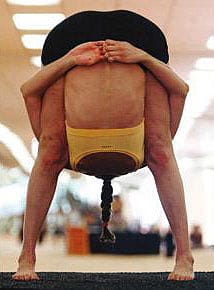
A perfect asana performed by Ruth Pope at the 2003 International Yoga Championship at Los Angeles

The Hindu American Foundation (HAF) is not pleased with my recent essay that questions its campaign to claim modern yogic asanas for the glory of ‘5000 years old’ Hindu dharma. Swaminathan Venkataraman, who sits on the board of directors of the HAF, finds faults with my not-purely-Hindu, not-all-that-ancient and not-so-spiritual history of modern yoga.

I fully understand why Venkataraman and his fellow travellers would want to discredit the alternative history of yoga that is being pieced together by well-respected historians and scholars—the history that I referred to in my essay. Indeed, they have no choice but to shoot down this history, since the entire rationale for their campaign to ‘take back yoga’ (TBY) from Americans, Europeans, Christians, Muslims, Jews and other non-Hindus rests on the assumption that Vedic or Sanskritic Hinduism is the mother (“the mother tradition,” to use the HAF’s vocabulary) of all of yoga, modern asanas included. After all, how can Hindus accuse Americans of “stealing” yogic asanas if it can be demonstrated that these same asanas have incorporated many elements of European and American physical culture, which share neither the metaphysical assumptions of Hinduism nor its goals of spiritual enlightenment? How can you take back something that wasn’t all yours to begin with? No Vedic-Hindu origin story for yoga, no TBY—it is as simple as that.

While I understand the HAF’s compulsion to stick to the myth of yoga’s immaculate birth from assorted Hindu-Vedic sutras and shastras, facts are stubborn things and have to be respected.

The hallowed tradition

A good place to begin is that tiny sliver of agreement that I do find in my critic’s complaint. Venkataraman says: “Nanda is right that hatha yoga is not a monolithic 5000 years old tradition, but requiring that everything Hindu to be traceable back to Vedic times is ludicrous.”

My point, exactly! Indeed, my goal in writing the essay was to show that, to quote myself, “yoga is neither eternal nor Vedic,” that “it is a fundamentalist view of history to draw an unbroken line connecting the 21st century yogic postures with 2000 years old yoga sutras [and] the supposedly 5000 years old Vedas” and that “a tremendous amount of cross-breeding and hybridisation has given birth to yoga as we know it [making] yoga a unique example of a truly global innovation…” it is precisely the evolution of yoga through the modern era of colonialism, muscular Indian nationalism, Vedic scientism and commercialisation of Hindu spiritualism at home and abroad that I sought to highlight in my essay.

It is not I, but Aseem Shukla, the leading light of the HAF and the force behind the TBY campaign, who is making the ludicrous attempt to trace modern yoga back to a monolithic 5000 years old tradition. It is Shukla who has insisted repeatedly in his many writings that “the Vedas and yoga are synonymous and as eternal as they are contemporaneous”; that Patanjali’s Yoga Sutras composed around second century BCE have “formed the philosophical basis of practical yoga for millennia”; and that “yoga and yogic practices date back more than 5000 years.”

While we are on the subject of HAF’s original positions—and not the watered-down version of Venkataraman—it is the right place to set the record straight on the question of the mostly low-caste tantrics and hatha yogis who have always walked outside the Vedic-Patanjali tradition. It is most touching to have Venkataraman assure us that “HAF cherishes them as a part of Hinduism’s time-honoured tradition.” But surely there is a lot of back-pedalling going on here, for HAF at first saw them—right alongside cow-curry-caste—as a blot on India’s image abroad. In the opening salvo of the TBY campaign, Aseem Shukla wanted to spruce up India’s image by replacing the “colourful and harrowing wandering ascetics” with “the spiritual inspiration of Patanjali.”

This brings us to the hierarchy of different kinds of yoga. Venkataraman thinks I am “maligning” HAF as “casteist” when I refer to the well-attested fact that nearly all the hatha yoga classics are the works of Nath siddhas who, as David Gordon White puts it delicately, “were not members of the literati” but were grassroots alchemists, sorcerers, jogis and fakirs who sought immortality in their own bodies and in this life. The hatha yoga asanas they developed were meant to make the body strong and immune from death—not to still the mind to realise the pure soul, or purusa, as the Yoga Sutra teaches.

Orientalism

Well, if the HAF is already bristling at my reference to hierarchy of different kinds of yoga, here is something else they can bristle about: their self-Orientalisation. The HAF’s campaign to install Patanjali’s Yoga Sutra as the sacred canon of transnational yoga continues the time-tested tradition of that paradigmatic neo-Hindu and Hindu nationalist, Swami Vivekananda. As I have shown in great details elsewhere, Vivekananda imbibed the occultist, spiritualist and Theosophical currents that were quite fashionable in the United States during the years he spent there after his address to the World Parliament of Religions in Chicago in 1893. In his lectures on Raja Yoga, delivered before admiring audiences in New York, Vivekananda interpreted Patanjali’s Yoga Sutras as providing a “scientific” method for “seeing God,”—indeed, “becoming God” and acquiring “absolute power” over all of nature. His interpretation of Yoga Sutras by no means reflected the mainstream of Hindu thought in India at that time, but was tailor-made to provide a practical guide to Western seekers of spiritual wisdom. Very much in tune with the scholarly fashions of his day, Vivekananda looked down upon hatha (postural) yoga, calling it “nothing but a kind of gymnastics” which can help “a man live long, but only [as] a healthy animal.”

Times are different now, and hatha yoga’s interest in the body has captured the global imagination—thanks largely to Indian yoga-masters and swamis who set up ashrams and schools in the West. Naturally, far from looking down upon asanas as Vivekananda did in his time, Hindus in general and the HAF as their advocate take pride in their popularity. Yet, the typical neo-Hindu tendency of “spiritualising” all things of Indian origin remains strong: so the HAF “only” tries to “take yoga back” and subordinate it to a very similar set of spiritual ends that Vivekananda spelt out.

The underlying attitude is that the secularised, health and fitness oriented postural yoga is somehow inauthentic, fallen, tainted with Western decadence and devoid of psychological and spiritual meaning. Hindu purists seem incapable or unwilling to credit non Hindu Americans and other yoga practitioners with their own ability to integrate the asanas they do with their own sense of spirituality. Thus the HAF takes on the role of a stern parent who has to teach a wayward child what his/her real interests, aims and beliefs ought to be – and all of them, invariably, turn out to be what the “5000 years old” tradition teaches! The old prejudice – or rather chauvinism – of “Hindu India” as the guru of all nations is what animates the ideologues of the HAF.

Historical facts

Let me address the concerns Mr Venkataraman has expressed about the accuracy of the factual claims I have made in my essay.

I will admit one error of fact right away. Thanks to Venkataraman and the legion of others who have expressed their displeasure in the comments on the original article, I realise that I was plain wrong about pranayam, or breath control, when I wrote that “anyone who goes looking for references to… pranayam, neti, kapalbhati or suryanamaskar in classical Vedic literature will be sorely disappointed.” In fact, there are plenty of references to pranayam, or pranayam-like practices, in Vedic literature, including the Maitri Upanishad and the Bhagavad Gita. I was clearly careless here.

As for the rest, I stand by what I have stated in my original essay.

My critics, including HAF through Mr Venkatraman, have already indulged in endless rounds of nitpicking, and I don’t want to respond by picking some more nits. I will rest my case by citing what Koernraad Elst , a much-beloved figure among the gentle Hindu traditionalists and fire-breathing Hindu nationalists alike, has to say. (I never imagined that I will ever be on the same side as Mr Elst, but in this instance, he happens to be right on the mark). In his take on this who-invented-yoga debate, this is what he writes on his website:

I don’t think any other asana postures, except those for sitting up straight, have been recorded before the late-medieval Gheranda Samhita, Hatha Yoga Pradkipika and such. In the Bhagavad Gita, Krishna calls on Arjuna to “become a yogi,” but he gives no instructions in postures and breathing exercises. Libertines practising the whole range of Kama Sutra postures got more exercise in physical strength and agility than the yogis of their age who merely sat up straight and forgot about their bodies.

Those who live in glasshouses…

In an article titled The Rape of Yoga, Aseem and Sheetal Shah of the HAF lament that the $6 billion dollar strong American yoga industry has “appropriated the knowledge of countless yogis without so much as a nod of gratitude toward Hinduism, the faith that gifted them with this treasure.”

My advice to Shukla, Shah and the rest of the Hindu-American community: take a deep breath and get over it. Those who live in glasshouses don’t throw stones on others. In this world where people travel, and ideas travel at the speed of light, we all live in glasshouses.

As the recent disclosures by Norman Sjoman and Mark Singleton, which I have summarised in my much-attacked article, have shown, modern postural yoga has borrowed key movements, rhythms and sequences from the Western traditions of body-building, gymnastics, drills and dances.

Modern yoga was, of course, put together in India, by Indians, but with a whole lot of Western input. So let us not be so touchy and such purists about its Vedic-Hindu origins. Let us enjoy the mongrel that this thing called modern yoga is.

All power to mongrels!

+++

Meera Nanda is a visiting professor of history of science at the Indian Institute of Science Education and Reserach, Mohali

OLDER COMMENTS FIRST

25 COMMENTS

Permalink

Truth has to respected for what it is. It has been subverted historically in India to benefit the creamy layer for long.

Kudos to Meera Nanda and OPEN for putting these humbugs in their place.

We need & look forward to more such articles from you both in future.

26 February 2011 | Shantharam

Permalink

"All power to Mongrels " - what a cunning slogan by commie Meera Nanda to inject fear and hatred among non-hindu yoga practitioners. Its easy to see the attempt to divide yoga practitioners into two categories (commie style) 1.Native / original 2. Modern/ mongrel and then creating fear in so called mongrels that Natives are trying to take back or deny Mongrels their accomplishments. Very similar trick used by commies to cause conflict between classes, used by missionaries to create victim-hood in Dalits/lower castes and hatred against other castes for harvesting souls.

Meera Nanda should get it straight that we are not talking about dog breeding but something more scientific. All yoga practitioners today traceback their intellectual property to some Guru who has been in practicing it in a strict Hindu sense and not acknowledging that and giving due credit to roots is nothing but plagiarism and piracy.

Meera Nanda with a degree from sub standard university like JNU, New Delhi lacks the scientific temper and might not find plagiarism and piracy as a disgraceful malpractice. She should realize that most westerners have more common sense and hence enough good sense in determination roots of a scientific process, acknowledging it and giving due credit.

27 February 2011 | psecular

Permalink

Dear Ms Nanda
The article states at the end that you are a visiting professor of the history of science but you seem to be strangely ignorant of the historic roots of the religious philosophy of Sanatan Dharma.
You have been fairly caught in the trap of the Orientalist view of Indian/Hindu /Sanatan dharma traditions.
It is important to first understand what Sanatan dharma or Hinduism is , not from the point of view of some or the other western or proto western expert like you but a simple humble practicing Hindu woman, for example which yours truly happens to be.
The syncretic culture we call as Hinduism today has its roots not in the Vedic age but in the Indus Valley Civilisation which preceded it by a couple of thousand years. The script has not yet been deciphered but the pictorial analysis of the famous Seals No 420 and 222 as well other smaller faience amulets bring out evidence of the worship of Shiva and Shakti as well as sacred animals, plants and trees which are a revered part of Hinduism today. It is an interesting and stubborn fact which contradicts your understanding and your stand that the Proto Shaivite figure of Seal No 420 is seen in a posture which has been identified by both Indian Yoga experts and your ‘western’ experts as the ‘Mulabandhasana’ ( See for example Artibus Asiae Vol. 48, No. 1/2 (1987), pp. 89-108).
Understanding the Vedic corpus as a pristine product of the so called Indo Aryans who are supposed to have entered India about 1500 BCE is an error committed by the early Orientalists, do not get taken in by it. As it has been handed down to us the Vedic corpus has vast contributions from the Indus Valley Civilisation and its successors, the tribal populations of India, apart from the strictly brahmanically understood authors ( Read R S Dinkar’s संस्कृति के चार अध्याय, it may help you). Again, a linguistic analysis by DD Kosambi, for example has brought out the Dravidian and Austric origins of so many of the words used. Sanatan Dharma therefore is very complex, too complex to be understood by your blinkered vision?
To come back to the simple practicing Hindu today, when she does her daily Yoga it is very much a part of her daily worship and meditation not as a glamorous spandex clad neurotic seeker of New Age peace but a continuation of an age old practice.
It is clear that over 5000 years Yoga has evolved and changed, there are significant differences in what is being today and what was done a 100, 500 or 1000 years ago but the question here is of ‘origins’. Perhaps you understand the word? That is a study of how it all began…and there perhaps 3500 BCE has an edge over the period of European colonialism from about 400 years ago that you seem to be trapped in.
You are however more to be pitied than censured; I hope some of this dialogue helps you gain some understanding.

27 February 2011 | Sumedha

Permalink

Behind all the theatrics of English language, Meera presents a typical Indian mentality of not able to accept that anything can come out of India. Seal of approval is required from the West before Indians can sheepishly follow it. The veil falls off when Meera very cleverly brings fakirs into the picture while refering to "Nath siddhas". What do they have to do with this? But anyway the carelessness shown with Pranayama is also evident everywhere else in the article. Typical mumbo jumbo from Meera like "a tremendous amount of cross-breeding and hybridisation has given birth to yoga as we know it [making] yoga a unique example of a truly global innovation…” makes it hard to converse intelligently with her on the topic.

27 February 2011 | Vinay

Permalink

Nanda misses the point that in a multicultural society like America and in a world where we are becoming more connected every day, yoga as she even acknowledges as having developed mostly in India, must be acknowledged for its Hindu roots - sutras, vedas, scriptures, gurus, and what not! Saying that does not take away from the contribution of any non Indian or non Hindu yoga teacher who then caters yoga to his or her yoga student. However, ignoring its cultural moorings is an injustice to the one billion people who share this cultural legacy. Nanda echoes a caste, cows, curry approach to Hinduism, where the only thing Hinduism owns are social negatives and the exotic.

28 February 2011 | Mihir Meghani

Permalink

Learn about Yoga on Hindupedia, the online Encyclopedia of Hinduism

http://www.hindupedia.com/en/Yoga

28 February 2011 | Krishna

Permalink

Ah.. good to read this article.
The old prejudice – or rather chauvinism – of “Hindu India” as the guru of all nations is what animates the ideologues of the HAF. B E A U T I F U L (ok ok ultra-Nationalists.. dont let me have it)

You know, when I read Koenraad Elst's take on hatha yoga a while ago ("Consider it a modern innovation"), I was laughing heartily too. How often do see these two kinda agreeing on something :-)

28 February 2011 | astrokid.nj

Permalink

Could Ms Nanda please name those westerners who influenced yoga and led to this so-called hybridization? And more importantly, if she's bringing in Nath Siddhas and jogis and fakirs as those who enriched this tradition, could she tell us which western nation did they go to to learn their physical exercises? Again, if Hatha Yogis developed yoga, were they western influences? Madam Nanda doesn't seem to be able to back any of her claims with solid evidence of her claims of western influence. We would genuinely like to hear stories about westerners who influenced the yoga traditions. And if she can't come up with this, may be we could suggest some kapalbhaati to help her rid of the fat in her cerebrum? Or may be a shirshasan to calm her overactive imagiation.

28 February 2011 | Archie

Permalink

Plagiarists, liars, thieves. Sufficient number of traditional Indian creations are now "patented" by and known after others' names. The Pythagorean theorem, the Backus-Naur form, neem, what not. Now yoga. While one can change books and magazines with repeated lies, one cannot change facts. Every academician who buys these lies better understand that. Compromise on truth for a politican is a game. But compromise on truth for an academician is no less than prostitution.

28 February 2011 | Kumar

Permalink

Meera Nanda thinks she is clever quoting Elst when Sarvesh has already refuted those claims with numerous citations.

People interested in real scholarship may check the following article:

http://bharatendu.wordpress.com/2011/01/02/yoga-asana-the-hindu-legacy/

In fact in the comments of your earlier article Sarvesh had challenged you to a debate.

Why don't you accept the challenge instead of hiding?

28 February 2011 | Julian

Permalink

Brilliant critique by Dr Meera Nanda, a scholar of international repute, of an aspect of Hindu fundamentalist world view. No wonder some of those fundamentalists are unleashing their fury.

28 February 2011 | Dr Pritam Singh

Permalink

As Meera noted lets not nitpick if factual accuracy and details are not of interest. However, the question begs why is Meera Nanda after HAF a non-political advocacy group largely involved in awareness campaign about Hindu way of life. Bastardization of Yoga is a genuine concern. Even Govt. of India of India recognize it and launched the Yoga project. Can Meera point out what's her real intention in writing this provocative article? She is wrong on many counts in the article, the tone and posturing seem inherent hatred than any genuine concern, not to mention the Pranayama mistake she admits. Its imperative that people like Meera should not use their academic position to be a lose cannon.

28 February 2011 | Vinay

Permalink

This is the nth time I am trying to post this, did not appear yet!

Plagiarists, liars, thieves. Sufficient number of traditional Indian creations are now "patented" by and known after others' names. The Pythagorean theorem, the Backus-Naur form, neem, what not. Now yoga. While one can change books and magazines with repeated lies, one cannot change facts. Every academician who buys these lies better understand that. Compromise on truth for a politican is a game. But compromise on truth for an academician is no less than prostitution.

1 March 2011 | Kumar

Permalink

"Modern yoga was, of course, put together in India, by Indians, but with a whole lot of Western input. So let us not be so touchy and such purists about its Vedic-Hindu origins. Let us enjoy the mongrel that this thing called modern yoga is."

OK, so you did change your stance.
I thought it was the Christians who were touchy about the Indian/Hindu origins of Yoga. Indians just practice/teach it, they in general don't care about the origins and how its changed over a period of time (most Americans too). Some may respond to a points raised or questions asked, though even those responses aren't completely wrong or even seriously considered.
So to say that Indians should 'get over it', is basically a lame attempt of loosely standing by your original point of view. The 'mongrel' named Yoga will continue to evolve though it will ALWAYS have it Origins in Indian traditions and will be identified such. Plus, we have a billion people, any attempt to 'claim' Yoga will be overcome by sheer numbers alone.

Good job though, you got some comments! lol

1 March 2011 | Pulkit Naam

Permalink

Meera Nanda said:
"My critics, including HAF through Mr Venkatraman, have already indulged in endless rounds of nitpicking, and I don’t want to respond"

Madam, showing fidelity to facts does not constitute 'nit picking'. It is a requirement of a scholarly article. Since you don't want to respond it can be inferred that you have no answer and HAF is on the right side of facts.

Also, you seemed to be trapped in a Semitic mindset and fail to recognize that Yoga as a an integral part of Hinduism is always evolving unlike set in stone/book Semitic religions. Hinduism is always evolving with new insights of rishis like Ramana Maharshi, Sri Aurobindo, Sri Ramakrishna and myriad others unlike Christianity or Islam where the revealed covenant is final.

So, can we expect an article from you regarding the 'phenomena' of 'Christian Yoga' and how it conforms to Nicene creed?

2 March 2011 | Mallika

Permalink

@kumar from Feb28
Plagiarists, liars, thieves. Sufficient number of traditional Indian creations are now "patented" by and known after others' names. The Pythagorean theorem, the Backus-Naur form, neem, what not

Isnt it sad how people dont give credit to India? Here are a list of some more things of Indian origin...
Da Vinci was an Indian sketch - Goodness Gracious Me - BBC
http://www.youtube.com/watch?v=hjWd9a8Ck8U

2 March 2011 | astrokid.nj

Permalink

There is lot of discussion these days about the Hindu origins of yoga-asanas or the postures, how many of them are really Hindu and how many are "imported" from the west.

The Politics
Prima facie, this is just a continuing exercise – anything Hindu would first be attributed to some western source and then its roots would be traced to ancient texts and practices. And that has to be certified by some westerner for Indians to believe the Indian orgin. The list is just too long, but we look at two examples – the Pythagorean Theorem finds a much earlier mention in Baudhayana's Sulba Sutra (Seiden berg's Mathematics in Ancient India). Similarly Panini is to be rightly credited for the first usage and conception of Backus-Naur form (The Panini-Backus Form in Syntax of Formal Languages by Subhash Kak and TRN Rao).

So it is only fair that one would be skeptical about the motivation behind the questions on yoga-asanas. And the reasons are many -
1. Yoga is a Hindu system and asana is not isolated but an integral part of yoga. And the way it is taught in the east and west too, is not as isolated postures although skin-deep researchers seek to isolate them.

2. Yoga is of late famous and plagiarism is at its best – there are slogans like "Christian Yoga", and there are attempts to detach yoga from Hinduism so that one may not credit Hinduism for its important contributions.

3. People are looking at Hindu practices and asking Hindus to prove that they are Hindu, without establishing any prior non-Hindu presence of those practices. This is the same arrogance we see in most of the recent time debates.

4. Most of those who raise these questions have average or below agerage knowledge of the practical and experiential side of Hindu traditions.

5. The critics have ignored the bulk of yoga, mudras, the philosophy, the associated subjects and have selectively talked of asana-s, which makes one suspect their motives.

There are questions about the antitquity of yoga postures and their origin. While it is obvious that things evolve over time, and that people cannot talk of yoga itself not being Hindu, the west-lovers and Hindu-haters have picked up a selective question – of the asanas alone, which "cannot be found in ancient texts". The texts on Hatha Yoga are surveyed for instance, but as is known to any practitioner Hatha Yoga involves rigorous physical *discipline* in its six-limbed yoga but not rigorous physical flexibility training or health training. Soon after dealing with initial physical postures the hatha yoga moves inwards, deals with mudras and bandhas – whose knowledge and practice is not easy without the basic knowledge of asanas. And in turn, the bandhas etc have their own purpose in kumbhaka etc that are needed in the subsequent limbs of yoga. So there is no point in looking for a repertorie of yoga-asanas in hatha yoga texts.

The next thing to be kept in mind is that knowledge in Hindu traditions has always been taught and learned within the fold of guru-sishya parampara-s or the teacher-disciple lineages. While there are many texts published these days, bulk of practical knowledge still remains within these – because the knowledge is not deductive but experiential. So the same question about asana-s would be applicable to mudras too – there are several known and practiced by Hindus, hundreds of them, and how many could really be traced into texts in print? Even the celebrated Yoga Sastra of Patanjali deals exhaustively with the yogic worldview, its philosophy, its approach and methodology and not with specific techniques.

But the real question for a Hindu, and a grnuine one, would be why at all does one need to establish these? It was Krishnamacary who taught, it was Matsyendra who taught, and there is no known legacy of asana-s or mudra-s in the west proven by anyone who is doing this questioning, which could be (again just a speculation even if it were there) the source of the asana-s in yoga.

Living Traditions
Moving from the politics of the topic to the topic itself, the most important thing to understand is that Hindu traditions are living and experiential, and that information would be found in the practicing oral traditions. To survey libraries harldy helps one arrive at truth.

Then we should understand how inseparable asana is from the rest of yoga. Yama-niyama are prerequisites of asana, and asana is not just a physical posture – it is a combination of breath control, a physical posture, holding the mind in a particular place in the body, display of certain mudra-s, control of specific muscles and nerves and so on.

More importantly, asana-mudra-bandha are not part of "just some yoga school", but forms an important part of several traditions – the most celebrated natya sastra or the traditional dance. The dance section in Vishnu Dharmottara Purana devotes a complete chapter (23) to asana. Besides, the importance of mudra-s and assisting necessity of asana-s in dance can never be exaggerated, and every traditional Hindu school of dance stands proof – if only the arm chair critics are ready to take the pain of surverying those. These traditions have centuries of legacy, and cannot be wished away by them.

Similarly all the traditional martial art schools involve asana-training.

Each school uses the asana-s that suit its approach and purpose. While hatha yoga involves more rigorous physical discipline, raja yoga emphasizes asana-s much less. But in all these traditions the asana-s are prescribed depending on the practitioner's needs and are kept within the tradition.

Keeping aside the yogic part, asana-s for health as they are seen in the most terrestrial sense, are also not new to Hindus. Surya Namaskara-s, the well known Sun-salutations have centuries of legacy. While the mantra-s are found in many places including Aruna Ketuka(the first prapathaka of Taittireeya Aranyaka), the Surya namaskara-s, along with the compilation of mantras, asana-s, their sequencing, and the whole procedure as is known today, are arranged by the great Baudhayana, who is among the most well known seers for arranging several such prayoga-s or applications. He is the author of a set of Kalpa Sutras, a limb of the Veda. They contain Sulba sutras (geometry of altars), Srauta Sutras (this is the primary text for ritual procedures), Grihya and Dharma sutras. Besides, there are several ritual procedures he created, including the celebrated Mahanyasa and graha worship.

And the Surya namaskara-s of Baudhayana prayoga krama enjoyed an uninterrupted legacy, till date. While these are known in oral tradition, old manuscripts are also available. While the antiquity of Surya namaskara-s is indisuptable, Samartha Ramadasa (Sivaji's Guru) is also known to have practiced those, which rule out the possibility of their import in the past two centuries.

Saura or the worship of Surya/the Sun God was one of the six major religions in India, but is now not visible more than as a small aspect of Vaishnava and as the celebrated Gayatri. Surya is worshiped as the giver of health, the father of the doctor-god twins Asvins, the sustainer of life.

Besides, most of the martial art traditions and traditional physical practice traditions are extinct – thanks to thousand years of invasions.

The other source of asana-s is the prescription of Ayurveda, as is known, prescribed and practiced traditionally. The inseparable knowledge of postures and physiology can hardly be questioned. Besides, the very approach of Ayurveda is to discipline man to heal with secondary emphasis on treating him with external medication.

Conclusion
So the critics actually have lot of homework to do, to survey -
(a) the various yoga traditions
(b) the martial art traditions
(c) the dance traditions
(d) the upasana traditions
(e) the ayurveda traditions

at the least, and know what are in practice and what are extinct, before pronouncing any judgment. Importantly, it is not the published material but the oral practising traditions that they need to survey, and evolve a picture of what is available and how much is lost in the past centuries.

3 March 2011 | Shankar

Permalink

"Modern yoga was, of course, put together in India, by Indians, but with a whole lot of Western input."

What nonsense? Where is the proof? Where is western contribution in any of the age old traditions?

"My advice to Shukla, Shah and the rest of the Hindu-American community: take a deep breath and get over it. Those who live in glasshouses don’t throw stones on others. In this world where people travel, and ideas travel at the speed of light, we all live in glasshouses."

Glass house is what you live in, not Hindus. The world is still answerable, why Subrahmanya Candrasekhar's noble prize is delayed by decades, why wireless is still attributed to Marconi and not JC Bose, why the Pythagorean theorem is not renamed as Baudhayana's, why neem could be ridiculously patented by the west. And now Meera, you are answerable for trying to justify the west's misappropriation and theft of yoga.

3 March 2011 | Shankar

Permalink

Wow what howls over a non-issue. Most people I know do yoga just as an exercise. So if you want to do it as a meditation, fine. If you do it just as an exercise that is fine too. You can't force some one to say - hey acknowledge this is from Hinduism. I enjoy Yoga (the plain exercise form) and don't care two hoots whether it is from Hinduism or not,

3 March 2011 | Salim

Permalink

OPEN - why won't you publish a rebuttal to this outrageous article from HAF.

It's the tactic of the scoundrel to resort to attacks when no facts refute scurrilous and outrages assertions.

Meera Nanda joins Wendy Doninger and her ilk. So ready to defame Hinduism and accusing practicing Hindus of being religious bigots.

your arguments don't hold water. Whatever scholarly degrees you have sure don't say much for JNU.

We recognize you and your ilk of having an axe to grind. Denigrating our beliefs, values and culture... without any kind of objectivity or open mindset.

5 March 2011 | Rohit Rajyagor

Permalink

Was rather unpleasantly surprised to see articles like this and the previous "not as old as you think" (articles which flatten and stereotype, and disregard the most essential part of the picture, the bigotry and cultural appropriation that some Hindu Americans are reacting to) in a magazine I'd previously thought of as being quite aware of certain underlying hierarchies and inequalities.

My full response can be read in the post below:
The Ludicrousness of The Flat World Myth: http://guriaking.org/transit/?p=98

I hope that articles like Mrs. Nanda's prove to be the exception and not the rule, in the future.

5 March 2011 | GK

Permalink

Astrokid.NJ,

The attempt to mock is done when there is no ability to factual counter.

6 March 2011 | Kumar

Permalink

@Kumar Mar6
Mockery is a powerful tool to show ludicrousness of certain positions. But since you sound sincere, I will argue once again.

Lets take your Pythagoras example. Take a look at
http://en.wikipedia.org/wiki/Pythagorean_theorem#History
The origins of this theorem can be traced to Babylonians ~ 1900 BC
Indians probably discovered it independently, or maybe there were some cultural inputs from neighbouring cultures.

If you think about the Theory of Evolution, although Darwin gets all the credit, Alfred Russell Wallace had also reached then same conclusion around the same time, if not earlier, but Darwin beat him to proper publishing.
If you consider discovery of planet Neptune, worked out by math calculations based on observed perturbations of Uranus, an English Mathematician (Adams I think) worked it out first. But the French (levellier I think) , although working it out later, beat him to it in terms of publishing and publicizing and the actual discovery.
Thats the way it. First come first. That doesnt mean scientists and Historians dont actually value the other independent discoverers too. They are quite well respected. And then we move on.. not getting hung up. We move on with improving on that discovery/invention for even greater use.
Most of the cultures of the world have contributed to the worlds knowledge. Even the extant hunter-gatherer cultures in the Amazon do. Nobody denies India's actual to contributions. But getting hung up on it, and claiming that others are "liars, plagiarists, theives" is plain nonsense.

9 March 2011 | astrokid.nj

Permalink

I totally agree, what about all the other inventions that we have had for quite a long time. Nobody will doubt your sincerity if you could write a piece about that. You sound like someone who has had a bad time in the Republic of India and want to get back in any way possible.

10 August 2011 | Srikanth

Permalink

Ms. Nanda would have a lot of credibility on her opinion on Hinduness (or lack of it) of Yoga, if she weren't a serial basher of Hinduism. Throughout her career, she has demonstrated an agenda against Hindiusm. Take a look at her book list. This article is just a minor addition to her body of work: unfair and not founded in fact, but it does add to her emotional response to and general argument against Hinduism.

She is Indian, but not a Hindu, so she has plenty of axe to grind. Much of it legitimate, but separating Yoga from Vedas or Hinduism is not one of them.

I support her in her general arguments against non-secular trends in India, and especially the unhealthy rise of Hindu nationalism. But seen through the light of her crusade against this trend, her attempts to distance yoga from Hinduism lose all their steam. She has an agenda and a motive and truth unfortunately is the victim in this and another article she has written in this magazine.

The crux of her argument is this: any trend or practice that hasn't remained rigidly unchanged for centuries, can not be said to have started centuries ago, and can not be claimed to belong to any tradition that is centuries old. Really?

Are you the person that was born decades ago? Do you still qualify, in your present form, as the daughter of the couple that gave you birth decades ago? Are you sure you haven't had some unpure and unholy influcences along the way?

14 March 2012 | rabi

Post new comment

The content of this field is kept private and will not be shown publicly.

CAPTCHA
NOTE: Please enter letters [case sensitive] in the box provided before you submit your comment. This is to prevent automated spam submissions
Image CAPTCHA
Enter the characters shown in the image.