Not as Old as You Think
…nor very Hindu either. There is telling evidence to debunk this nationalistic myth
YOGA
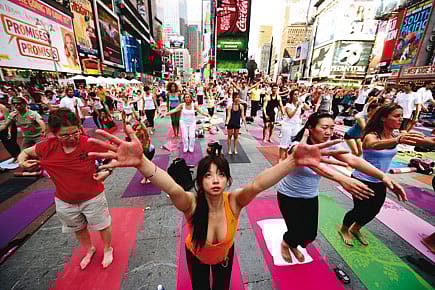
A mass yoga session organised at Times Square in New York to mark the summer solstice (Photo: AFP)
BKS Iyengar at his Ramamani Iyengar Memorial Yoga Institute in Pune (Photo: GETTY)
The yoga school T Krishnamacharya directed inside the Mysore Palace
A perfect asana performed by Ruth Pope at the 2003 International Yoga Championship at Los Angeles
Yogic asanas featured in the Encyclopaedia Londinensis, published from London

No one denies that Hinduism’s most sacred and ancient texts, including the Bhagvad Gita, describe different kinds of yogic practices. But what does this ancient and sacred tradition of yoga have to do with what people all around the world do in yoga classes in gyms and fitness centres today?

To most Indians, such questions are nothing less than sacrilegious. Yoga is for them what apple pie and motherhood are for Americans: a living symbol of their way of life.

Indians tend to affirm their claims on yoga by trotting out the familiar icons of the ‘5,000-year-old Vedic tradition,’ which supposedly stretches from the Pashupati seal of the (actually very unVedic) Indus Valley civilisation to the Bhagvad Gita and the venerable Yoga Sutras of Patanjali. Yoga, Indians like to solemnly declare, is ‘eternal’ and ‘timeless’ and all the great yoga masters, from Swami Vivekananda to BKS Iyengar to Baba Ramdev of our own time, have only restored or reinstituted an ancient practice. It is also commonplace to hear Indians—even those who are not particularly spiritual themselves—blame Americans and other ‘decadent’ Westerners for reducing their spiritually rich tradition to mere calisthenics.

Lately, Hindus in America have started flying the saffron flag over American-style yoga, which consists largely of yogic asanas and stretches. The leading Indo-American lobby, Hindu American Foundation (HAF), has recently started a vocal campaign to remind Americans that yoga was made in India by Hindus. Not just any ordinary Hindus, but Sanskrit-speaking, forest-dwelling Brahmin sages who learned to discipline their bodies in order to purify their atman. The purist Hindu position, articulated by the HAF, is that all yoga, including its physical or hatha yoga component, is rooted in the Hindu religion/way of life that goes all the way back to the Vedic sages and yogis.

There is only one problem with this purist history of yoga: it is false. Yogic asanas were never ‘Vedic’ to begin with. Far from being considered the crown jewel of Hinduism, yogic asanas were in fact looked down upon by Hindu intellectuals and reformers—including the great Swami Vivekananda—as fit only for sorcerers, fakirs and jogis. Moreover, what HAF calls the “rape of yoga”, referring to the separation of asanas from their spiritual underpinning, did not start in the supposedly decadent West; it began, in fact, in the akharas and gymnasiums of 19th and 20th century India run by Indian nationalists seeking to counter Western images of effete Indians. It is in this nationalistic phase that hatha yoga took on many elements of Western gymnastics and body-building, which show up in the world-renowned Iyengar and Ashtanga Vinyasa schools of yoga. Far from honestly acknowledging the Western contributions to modern yoga, we Indians simply brand all yoga as ‘Vedic,’ a smug claim that has no intellectual integrity.        

It is the hidden history of modern postural yoga that is the main theme of this essay. But first, some background on the great ‘take back yoga’ movement.

YOGA IN AMERICA

Yoga is to North America what McDonald’s is to India: both are foreign implants gone native. Not unlike the golden arches that are mushrooming in Indian cities, the urban and suburban landscape of the United States is dotted with neighbourhood health clubs, spas and even churches and synagogues offering yoga classes.

Some 16 million Americans do some form of yoga, primarily as a part of their exercise and fitness routine. When everyday Americans talk about yoga, they mostly mean hatha yoga, involving stretches, breathing and bodily postures.

Many styles of postural yoga, pioneered by India-origin teachers—the Iyengar and Sivananda schools, the Ashtanga Vinyasa or ‘power yoga’ of Pattabhi Jois, and ‘hot yoga,’ recently copyrighted by Bikram Chaudhary—thrive in the United States. The more meditational forms of yoga, popularised by the disciples of Vivekananda, Sivananda and other swamis, are less popular. Americans’ preference for postural yoga over meditational yoga is not all that unique: in India, too, hundreds of millions follow Baba Ramdev, India’s most popular tele-yogi, who teaches a medicalised, asana-oriented yoga with little spiritual or meditational content.

By and large, the US yoga industry does not hide the origins of what it teaches. On the contrary, in a country that is so young and so constantly in flux, yoga’s presumed antiquity (‘the 5,000-year-old exercise system’, etcetera.) and its connections with Eastern spirituality have become part of the sales pitch. Thus, doing namastes, intoning ‘om’ and chanting Sanskrit mantras have become a part of the experience of doing yoga in America. Many yoga studios use Indian classical or kirtan music, incense, signs of ‘om’ and other paraphernalia of the Subcontinent to create a suitably spiritual ambience. Iyengar yoga schools begin their sessions with a hymn to Patanjali, the second-century composer of the Yoga Sutras, and some have even installed his icon. This Hinduisation is not entirely decorative either, as yoga instructors are required to study Hindu philosophy and scriptures to get a licence to teach yoga.

‘TAKE BACK YOGA’

One would think that yoga’s popularity and Hinduisation would gladden the hearts of Hindu immigrants.

Wrong.

The leading Hindu advocacy organisation in the United States, the aforementioned Hindu American Foundation or HAF, is hardly beaming with pride. On the contrary, it has recently accused the American yoga industry of ‘stealing’—even ‘raping’—yoga by stripping it of its spiritual heritage and not acknowledging its Hindu roots. Millions of Americans will be shocked to learn that they are committing ‘intellectual property theft’ every single time they strike a yogic pose because they fail to acknowledge yoga’s ‘mother tradition,’ namely Hinduism. HAF’s co-founder and chief spokesperson, Aseem Shukla, exhorts his fellow Hindus to ‘take back yoga and reclaim the intellectual property of their spiritual heritage.’

The take-back-yoga campaigners are not impressed with the growing visibility of Hindu symbols and rituals in yoga and other cultural institutions in the US. They still find Hindu-phobia lurking everywhere they look. They want Americans to think of yoga, the Yoga Sutras of Patanjali and the great Vedas when they think of Hinduism, instead of the old stereotypes of caste, cows and curry. They would rather, to paraphrase Shukla, that Hinduism is linked less with holy cows than Gomukhasana (a particularly arduous asana); less with colourful wandering sadhus and more with the spiritual inspiration of Patanjali. It seems this yoga-reclamation campaign is less about yoga, and more about the Indian diaspora’s strange mix of defensiveness and an exaggerated sense of the excellence of the elite, Sanskritic aspects of Hindu religion and culture.

The ‘who owns yoga’ debate gained worldwide attention last November, when The New York Times carried a front-page feature on the issue. But the dispute started earlier, with a battle of blogs, hosted online by The Washington Post, between HAF’s Shukla and New Age guru Deepak Chopra. Shukla complained of the yoga establishment shunning the ‘H-word’ while making its fortunes off Hindu ideas and practices. He accused the yoga and New Age industry, including Indian gurus like Deepak Chopra, Maharishi Mahesh Yogi and others, of using euphemisms like ‘Eastern wisdom’ and ‘ancient Indian’ to repackage Hindu ideas without calling them by their proper name. Chopra, who does indeed shun the Hindu label and calls himself an ‘Advaita Vedantist’ instead, declared that Hinduism had no patent on yoga. He argued that yoga existed in ‘consciousness and consciousness alone’ much before Hinduism, just like wine and bread existed before Jesus’ Last Supper, implying that Hindus had as much claim over yoga as Christians had over bread and wine. Shukla called Chopra a “philosophical profiteer” who does not honour his Hindu heritage, while Chopra accused Shukla and HAF of a Hindu-fundamentalist bias.

NEITHER ETERNAL NOR VEDIC

This debate is really about two equally fundamentalist views of Hindu history. The underlying objective is to draw an unbroken line connecting 21st century yogic postures with the nearly 2,000-year-old Yoga Sutras, and tie both to the supposedly 5,000-year-old Vedas. The only difference is that, for Chopra, yoga existed before Hinduism, while Shukla and HAF want to claim the entire five millennia for the glory of Hinduism. For Chopra, yoga is a part of ‘timeless Eastern wisdom’. For the HAF, ‘Yoga and the Vedas are synonymous, and are as eternal as they are contemporaneous.’

The reality is that postural yoga, as we know it in the 21st century, is neither eternal nor synonymous with the Vedas or Yoga Sutras. On the contrary, modern yoga was born in the late 19th/early 20th centuries. It is a child of the Hindu Renaissance and Indian nationalism, in which Western ideas about science, evolution, eugenics, health and physical fitness played as crucial a role as the ‘mother tradition’. In the massive, multi-level hybridisation that took place during this period, the spiritual aspects of yoga and tantra were rationalised, largely along the theosophical ideas of ‘spiritual science,’ introduced to India by the US-origin, India-based Theosophical Society, and internalised by Swami Vivekananda, who led the yoga renaissance.

In turn, the physical aspects of yoga were hybridised with drills, gymnastics and body-building techniques borrowed from Sweden, Denmark, England, the United States and other Western countries. These innovations were creatively grafted on the Yoga Sutras—which has been correctly described by Agehananda Bharati, the Austria-born Hindu monk-mystic, as ‘the yoga canon for people who have accepted Brahmin theology’—to create an impression of 5,000 years worth of continuity where none really exists. The HAF’s current insistence is thus part of a false advertising campaign about yoga’s ancient Brahminical lineage.

WHAT VEDIC ROOTS?

Contrary to the widespread impression, the vast majority of asanas taught by modern yoga gurus are not described anywhere in ancient sacred Hindu texts. Anyone who goes looking for references to popular yoga techniques like pranayam, neti,  kapalbhati or suryanamaskar in classical Vedic literature will be sorely disappointed.

The four Vedas have no mention of yoga. The Upanishads and The Bhagvad Gita do, but primarily as a spiritual technique to purify the atman. The Bible of yoga, Patanjali’s Yoga Sutras, devotes barely three short sutras (out of 195) to physical postures, and that too only to suggest comfortable ways of sitting still for prolonged meditation. Asanas were only the means to the real goal—to still the mind to achieve the state of pure consciousness—in Patanjali’s yoga.

There are, of course, asana-centred hatha yoga texts in the Indic tradition. But they definitely do not date back 5,000 years: none of them makes an appearance till the 10th to 12th centuries. Hatha yoga was a creation of the kanphata (split-eared) Nath Siddha, who were no Sanskrit-speaking sages meditating in the Himalayas. They were (and still are) precisely those matted-hair, ash-smeared sadhus that the HAF wants to banish from the Western imagination. Indeed, if any Hindu tradition can at all claim a patent on postural yoga, it is these caste-defying, ganja-smoking, sexually permissive, Shiva- and Shakti-worshipping sorcerers, alchemists and tantriks, who were cowherds, potters and suchlike. They undertook great physical austerities not because they sought to achieve pure consciousness, unencumbered by the body and other gross matter, but because they wanted magical powers (siddhis) to become immortal and to control the rest of the natural world.

Far from being purely Vedic, hatha yoga was born a hybrid. As Amartya Sen reminded us in his recent address to the Indian Science Congress, universities like Nalanda were a melting pot where Buddhist Tantra made contact with Taoism from China. By the time Buddhism reached China through Nalanda and other centres of cultural exchange along the Silk Route in the north and the sea route in the south, Taoists were already experimenting with qigong, which involved controlled breathing and channelling of ‘vital energy’. Taoist practices bear an uncanny similarity with the yogic pranayam, leading scholars to believe that the two systems have borrowed from each other: Indians learning exercise-oriented breathing from Taoists, and Taoists in China learning breathing-oriented meditation from their Indian neighbours.

But this Taoist-Buddhist-Shaivite synthesis was only the beginning. As we see below, hatha yoga was to absorb many more influences in the modern era, this time from the West.

FABRICATING ANCIENT TEXTS

The problem for historians of modern yoga is that even these medieval hatha yoga texts describe only a small fraction of modern yogic postures taught today. BKS Iyengar’s Light on Yoga alone teaches 200 asanas, while the 14th century Hatha Yoga Pradipika lists only 15 asanas, as do the 17th century Gheranda Samhita and Shiva Samhita.

Given that there is so little ancient tradition upon which to stand, unverifiable claims of ancient-but-now-lost texts have been promoted. The Ashtanga Vinyasa system of Pattabhi Jois, for example, is allegedly based on a palm-leaf manuscript called the Yoga Kurunta that Jois’s teacher, renowned yoga master T Krishnamacharya (1888–1989), unearthed in a Calcutta library. But this manuscript has reportedly been eaten by ants, and not a single copy of it can be found today. Another ‘ancient’ text, the Yoga Rahasya, which no one has been able to trace, was supposedly dictated to Krishnamacharya in a trance by the ghost of an ancestor who had been dead nearly a millennium. Such are the flimsy—or rather fictional—grounds on which rest Hinduism’s claimed intellectual property rights to yoga.

This sorry attempt to create an ancient lineage for modern yoga is reminiscent of the case of Vedic mathematics. In that case, Swami Shri Bharati Krishna Tirtha, the Shankaracharya of Puri, insisted that 16 sutras in his 1965 book, titled Vedic Mathematics, are to be found in the appendix of Atharva Veda. When no one could find the said sutras, the Swami declared they appear only in his own appendix to the the Atharva Veda and not any other! This ‘logic’ has not prevented Vedic maths from emerging as a growth industry, attracting private spending by well-heeled Indians seeking to boost brainpower and public spending by state governments that have introduced it in school curriculums.

SECRETS OF THE MYSORE PALACE

New research has brought to light historical documents and oral histories that raise serious doubts about the ‘ancient’ lineage of Pattabhi Jois’ Ashtanga Vinyasa and Iyengar yoga. Both Jois (1915–2009) and Iyengar (born 1918) learnt yoga from T Krishnamacharya from 1933 till the late 1940s, when he directed a yoga school in one wing of the Jaganmohan Palace of the Maharaja of Mysore, Krishnaraja Wodiyar IV (1884–1940).

The Maharaja, who ruled the state and the city of Mysore from 1902 till his death, was well known as a great promoter of Indian culture and religion. But he was also a great cultural innovator, who welcomed positive innovations from the West, incorporating them into his social programmes. Promoting physical education was one of his passions, and under his reign, Mysore became the hub of a physical culture revival in the country. He had hired Krishnamacharya primarily to teach yoga to the young princes of the royal family, but he also funded the travels all over India of Krishnamacharya and his protégés to give yoga demonstrations, thereby encouraging an enormous popular revival of yoga.

Indeed, Mysore’s royal family had a long-standing interest in hatha yoga: Mummadi Krishnaraja Wodeyar III (1799–1868), Wodeyar IV’s ancestor, is credited with composing an exquisitely illustrated manual, titled Sritattvanidhi, which was first discovered by Norman Sjoman, a Swedish yoga student, in the mid-1980s in the library of the Mysore Palace. What is remarkable about this book is its innovative combination of hatha yoga asanas with rope exercises used by Indian wrestlers and the danda push-ups developed at the vyayamasalas, the indigenous Indian gymnasiums.

Both Sjoman and Mark Singleton, a US-based scholar who has interviewed many of those associated with the Mysore Palace during its heyday in the 1930s, believe that the seeds of modern yoga lie in the innovative style of Sritattvanidhi. Krishnamacharya, who was familiar with this text and cited it in his own books, carried on the innovation by adding a variety of Western gymnastics and drills to the routines he learnt from Sritattvanidhi, which had already cross-bred hatha yoga with traditional Indian wrestling and acrobatic routines.

In addition, it is well established that Krishnamacharya had full access to a Western-style gymnastics hall in the Mysore Palace, with all the usual wall ropes and other props that he began to include in his yoga routines.

Sjoman has excerpted the gymnastics manual that was available to Krishnamacharya. He claims that many of the gymnastic techniques from that manual—for example, the cross-legged jumpback and walking the hands down a wall into a back arch—found their way into Krishnamacharya’s teachings, which he passed on to Iyengar and Jois. In addition, in the early years of the 20th century, an apparatus-free Swedish drill and gymnastic routine, developed by a Dane by the name of Niels Bukh (1880–1950), was introduced to India by the British and popularised by the YMCA. Singleton argues that “at least 28 of the exercises in the first edition of Bukh’s manual are strikingly similar (often identical) to yoga postures occurring in Pattabhi Jois’ Ashtanga sequence or in Iyengar’s Light on Yoga.” The link again is Krishnamacharya, who Singleton calls a “major player in the modern merging of gymnastic-style asana practice and the Patanjali tradition.”

SO, WHO OWNS YOGA?

The HAF’s shrill claims about Westerners stealing yoga completely gloss over the tremendous amount of cross-breeding and hybridisation that has given birth to yoga as we know it. Indeed, contemporary yoga is a unique example of a truly global innovation, in which Eastern and Western practices merged to produce something that is valued and cherished around the world.

Hinduism, whether ancient, medieval or modern, has no special claims on 21st century postural yoga. To assert otherwise is churlish and simply untrue.

+++

Meera Nanda is a visiting professor of history of science at the Indian Institute of Science Education and Research, Mohali

OLDER COMMENTS FIRST

108 COMMENTS

Permalink

Apparently this author visits a CHRISTIAN college in US called "Trinity College" whose motto is "For the Church and For the Nation" along with many other Christians..

This CHRISTIAN College in US organizes many programmes related to religion..

Info on the Christian College's site about her participation :- http://www.trincoll.edu/Academics/AcademicResources/values/ISSSC/events/

And info about this very CHRISTIAN college :- http://en.wikipedia.org/wiki/Trinity_College,_Hartford

It is very obvious that Christian are scared of Indian Culture and Religion, hence is using these agents to separate Yoga and its VERY HINDU roots..

Their agenda is to take away the credit from Hindu society...

People.. please boycott this Magazine and other agents of Christian Nations who are working against the interest of Hindus..

BOYCOTT this ANTI Hindu Magazine..

Boycott Meera Nanda..

- A Citizen exercising his right to freedom of speech.

11 February 2011 | Citizen

Permalink

Sigh! Another eminent historian.

11 February 2011 | RJ

Permalink

i dont have any problems with saying that postural yoga becomes popularised in the 18th-19 ce.. that hathayogapradipika has significantly lesser asanas than light on yoga, even that the names of many asanas have changed.
i also grant that hinduism has no special claim over yoga.
my point is this :
while she historically locates the popularisation of yoga from mysore and krishnamacharya (that the 'rape of yoga' begins from india).
she is entirely unable to comment on the role that 'postural' yoga plays in 'spiritual' yoga. she calls it meditative yoga, which i find a bit problematic. meditations are maintained through mudras, which are also postures of sorts.
since yoga means the union of mind, body and spirit, it is difficult to imagine a kind of yoga that does not involve a physical, postural component.
also, if one looks at the ascetic cults of india, be it nath, sahajiya buddhist or sidha or sahajiya vaishnav or any other.. they all consist of certain outward ritual combined with yogic (in the larger sense of the word) practices, in afct i would go on to claim that any religion that aims at unification with the god-head has to make use of processes with we refer to as yogic.
also her comment that sadhus to postural yoga to gain magical powers is laughable.
postural yoga prepares the body for certain things but spiritual developement occurs by the larger processes of yoga which as i have already said cant be simply classified as postural or medititative.
also it is not rare that a sadhu accquires spiritual powers and uses them, but it is really rude on her part to say that sadhus undertake austerities just to acquire magical powers. the powers are a by produt of tasks that lead to ultimate self realisation, anyone who focuses on these powers loses their way.

11 February 2011 | kaustubh das

Permalink

"To most Indians, such questions are nothing less than sacrilegious."

I could not read past that sentence. The most Indians I know have no clue about Yoga and are worried about their next meal, a loan shark or being generally lost in the squalor and filth that is urban India. This seems to be a discussion on a first world problem where the device is something with purported origins in the third world.

A historian is expected to do better.

11 February 2011 | True Man

Permalink

Modern humans of the 21st century seem to think that they invented globalisation "now" and everything that came before was indigenous to a particular geographic/ religious location. i feel though that the statement "Hinduism has no special claims on 21st century postural yoga" is too extremist. Yoga is Hindu and traditional but we as Indians as need to give proper respect to the western and indian modern minds who have developed and structured "Yoga" into a system fit for modern humans who don't do too much physical activity.

11 February 2011 | Arul.M

Permalink

Does "Open" follow editorial verification of what its columnists write?

For someone, to mention that Yoga has "no mention" in the Vedas, shows his/her deep and wide knowledge indeed.

Truly a future Padma awardee indeed.

11 February 2011 | Anu

Permalink

Not that I am a religious person, neither do I follow any sort of Yoga. But I really find it amusing to read the claim that contemporary yoga has NOTHING to do with Hindu religion/way of life.

Does that mean we can claim Coke or Pepsi or Hollywood has NOTHING to do with the US?

This whole case is based on a flimsy argument which does not hold any water.

I am a big fan of Open magazine. I just hope this article is an exception.

11 February 2011 | Gaurav

Permalink

Steel was there even before Industrial revolution, theory of relativity was explained in many ancient books before Einstein mentioned it, air was there even before scientists started describing its molecular formula…we can argue meaninglessly mentioning everything existed before.
It is true the concept of Yoga was conceived, defined, practiced and propagated first just like Christian started the conversion first across continents. Westerners may not like Indians or Hindus taking credit which they deserve but paid coolies cannot talk childish and trying to paid color to obvious truth!
Yoga & meditation is the highest form of yoga and not your gymnastic posture Yogas. Atman or Spirit is not in your tights or legs or arms !!! So get some basic lessons on Yoga before start representing West which is easy now a days and get paid heavily as well !!!

11 February 2011 | Amar

Permalink

Article with no research what so ever. Yoga is a gift by India just like gun powder, paper, silk by China or laws by Hammurabi. I have not heard anywhere that Yogasutras written by Patanjali more than 2000 years back were condemned by Hindus. Yoga is a unique gift and we have seen many Yogic asans in Harrappan seals and contemporary Hindu religion is nothing but a result of unique synthesis of Vedic and Harappa religion. Indians should be proud of this great gift although they should behave like Indians and should not claim or demand anything

11 February 2011 | Neeraj

Permalink

I have to stop reading Open Magazine from now onwards. Deprecating Hindu religion still remains a shortcut to become an Intellectual. Next time we will hear and read that Christian missionaries working in middle east and north Africa invented Yoga.

11 February 2011 | Neeraj

Permalink

To say that YOGA has nothing much to do with HINDUISM is like saying that Einstein was only a Physicist and not a Scientist. Hinduism is not like other narrow religions built on one man and his or her one book. It is a big edifice under which all that we can think of is readily available. Some people with vested interests like the present writer cannot do anything to reduce its greatness or demean its noble beliefs.

11 February 2011 | JAK

Permalink

i have not seen such a callous distortion of history. Should Open not check the facts before publishing? Or can anyone come and write anything in this mag?

11 February 2011 | Durgesh

Permalink

Is this really the level of research of this mag? It's appallingly reductionist!!

Firstly, please decide which angle your article seeks to cover...because you've simply muddled such intense subjects into one convenient mish-mash. Is it the authenticity of yoga you sought? It's ancient origin and timeline? It's criticism by yogis such as Vivekananda, Its application in the modern world? or Hindutva Claims? Because frankly, if you were going to combine all these to prove your 'theory' then it's a ridiculously naive article. Coming to the point - your foremost concern is with Hindutva extremism with relation to yoga..which is fair. But how can something that insipid be your base to uproot yoga's origins from India entirely?? The two matters are separate.

Your research tactics are incredible superficial. Please remember that India's past is thousands and thousands of years old..and so multi-faceted that by simply reading some version of the Vedas you found 'proof' that Yoga is not a Vedic entity! (Particularly since Yoga for Indian yogis is a state of mind first, asana much later). You need look deeper into facts and understand ancient CONTEXTS, the mind of ancient yogis to know why even though an asana may or may not be mentioned in the Vedas explicitly...it is the legacy of a "Vedic (state of) mind". And you cannot make claims on just scriptural 'evidence' - it needs to be validated on linguistic, philological, anthropological etc. counts as well...because so far your theory fails on those grounds. And in the thousands of years that passed between its origin and Vivekananda, the approach to yoga had become so different, instead of Embracing and Uplifting life; ascetic practices became so paramount to yogis, that his criticism was for the loss of its meaning...for the needless asceticism & denial that came to define yoga.

One can't even begin to explain the reality of your misjudgment here; but suffice it to say that as far as patent on who 'owns' yoga is concerned...It originated, or was rather delivered to the Indian mind...but minus some fundamentalists (who nobody takes seriously anyway)...it was always intended FOR HUMANITY. Don't know who you've been talking to (clearly just hindutva brigade)...but THIS is the spirit of the Indian Vedic mind and philosophy through centuries.

11 February 2011 | rijuta

Permalink

Seriously, how did this article get past the editor?

11 February 2011 | Idzap

Permalink

This is all true enough, but it is true of ALL so-called ancient traditions (from Democracy to Bharatnatyam); all of them are modern creations based on a mix of ancient roots, mixed-up origins and modern creativity.
Still, it IS an Indian invention. Its just that its mythology and false history are ALSO Indian inventions.
The Hindu right is a bunch of windbags with nothing better to do and hardly deserving of too much attention.

11 February 2011 | Omar ali

Permalink

A very interesting article. Well the jingoistic and cynical reaction this article has evoked is not surprising. Any idea or argument which goes against a widespread ingrained belief is bound to be opposed, ridiculed and denounced.

Congratulations to the author for writing this article and Open magazine for publishing it. Bravo!

11 February 2011 | Colonel

Permalink

So there were Vedic traditions, then they were adapted for modernity by the Indians during a brief period, then exported, and then you want to say two things at once: 1) they aren't sourced in the traditions despite you just saying they were; 2) even if they are, it isn't the US's fault. Then you cite Deepak Chopra, the smarmy swami and an embarrassment of regurgitated hokey eastern mysticism, for credibility?

OK.

Maybe you should actually spend some time addressing the "spiritual light" movement in the US - spiritualism without the work or responsibility. Or perhaps the tide of severe Hindu nationalism which has started with Indian economic prosperity and rise of the BJP and exported itself to the ex-pats in the US who are tired of being known for curry and mocked for religious symbols. Something you, the author, had half-heartedly addressed in previous publications.

Unfortunately that would take an actual grounding in economics, social policy, and anthropology rather than milk-sop, divorced from the facts post-modernist theory.

12 February 2011 | aka

Permalink

It seems like another attempt to malign Hinduism vis-a-vis Digvijay Singh and his ilk. If the question is about the origin of the Yoga, lets discuss it and debate it. But maligning Hinduism in the name of an argument is outright blasphemy. As it a foregone conclusion that any attempt to malign Hinduism will go unchecked(unlike Islam which responds with violence), this article is in continuation of the tradition of anti-Hinduism movement that has afflicted our media houses, so-called intelligentsia and self-proclaimed secularists. Hope sense will prevail on such authors before its too late. Open magazine has lost my respect for publishing such ill-researched article.

12 February 2011 | Prashanth Vaidyaraj

Permalink

Given the kind of hate Meera Nanda has towards anything Hindu since her 'Frontline' heydays, it would not surprise me if she writes an article that everything in India that was Hindu was a bane and bad for the civilization. But fortunately for Indians the Islamic invasion was a blessing in disguise and with the advent of Christianity Indians got a breather and a civilized way of life. Poor Hindus had only ganja-smoking and ash smeared, naked sadhus as ancestors until the western world decided to give Indians a better life here. Thanks Meera Nanda and Open for letting me know that Yoga and Hinduism are as far away from each other as Zion and Islam :-)))

12 February 2011 | Prashanth Vaidyaraj

Permalink

This viewpoint has been popularized of late by Mark Singleton, also referred to in this article. Singleton is not a "US scholar", whatever that means. He is from the UK -- the author of this article should do a little research before writing.

The theories in this article are lifted wholesale from Mark Singleton's "Body Yoga". Who is Singleton? Singleton has no online presence that I could find anywhere, associated with any reputable university in any capacity. He is a "scholar" simply because he self-identifies as one in his book Body Yoga. The reasons behind the book can be gleaned from its introduction. Singleton quite clearly comes across as a Western supremacist who is disgusted with the idea that India should get credit for something popular in the West. His justification is simply that he doesn't want to get into colonialist arguments. He's good at couching his arguments in literary-speak. His book is full of phrases like "Iyengar was not available for comment in spite of repeated requests" as though that somehow proves guilt about something. A very unconvincing book that dozens of devout Christians practicing Yoga have devoured because it makes them feel better.

12 February 2011 | Armchair Guy

Permalink

PS. I was mistaken about Mark Singleton -- apparently he does teach at a college in the US. But it's not clear what makes him a "scholar". It's hard to find any peer-reviewed publications by him, and his Ph.D. is at the divinity school -- which makes him suspect in my opinion. The introduction in his book is telling, however.

12 February 2011 | Armchair Guy

Permalink

As someone pointed out, Meera Nanda's ignorance is exposed by her assertion that the Vedas don't have anything to do with yoga. Anyway, I came across this article in another blog recently, where someone posted some links to some other articles that conclusively debunk Meera Nanda's mendacity on yoga and also expose her agenda. I am providing that commenter's comment here:

*******************
(1) On yoga’s inseparability from Hinduism: http://is.gd/X8sg2c, http://is.gd/HHYcTS, http://is.gd/Xz6REB

(2) M. Nanda’s polemics deconstructed before (http://is.gd/6RrA6Y, http://is.gd/nPKoDL, http://is.gd/ceC5qc).
*******************

12 February 2011 | Shankar Das

Permalink

But as they say, hatha yoga is better than none !

12 February 2011 | sherb

Permalink

In ancient India, there were two primary traditions: The Brahmana tradition based on the four Vedic texts, the brahmin class and the sacrificial rituals. And the Sramanic (or Samana) tradition of Samhkya, Yoga, Buddhism and Jainism which does not recognize the Vedic texts are revealed texts nor does this free-thinking tradition accept the superiority of the brahmin class. Hence, even the religious Yoga's origin is non-Vedic (in fact, it was anti-Vedic). Of course, Vedas contain very little that is relevant to a modern man. It contains obscene bestiality rituals associated with horse sacrifices.

12 February 2011 | Sree Vikarama-raja-singan

Permalink

Seems like a hatchet job on the Hindu American Foundation that has done an excellent job campaigning for Hindu rights in the USA and the world. Is OPEN magazine now giving JNU Marxists a column? What are words like "HAF’s shrill claims" doing in a piece in this?

12 February 2011 | sanjay

Permalink

Meera Nanda has some good points about the origins of modern yoga both in India and the West. Krishnamacharya and his disciples are the primary reason for the growth of yoga in then 19th to 21st century. I have no doubt that many of the asanas were developed in the past 150 years but once again Meera Nanda presents her inability to actually engage in the dialogue that is known as history. She has a strong bias against sanskritization and brahmanism, which is sometimes quite necessary but I believe it clouds her analysis.

She is correct that the Vedas as in the Brahmanas and Samhitas do not mention Yoga at all. The Brahmanas and Samhitas are entirely focused on the mantras and execution of yagnas specifically Soma yagna. They are not as much interested in any other type of practice or knowledge. Yes, these portions of the Vedas can give us insight as to the Vedic world but they don't give us anywhere near the complete picture. It is like claiming a book on criminal procedure law gives us knowledge information about other areas or subjects, which is true to a minor extent insofar as giving us information about those areas that relate to subject being studied and its particular relevance.

The Vedas as such are not concerned with yoga, politics, economics, agriculture, law and so on. When we do get information about these subjects, it is only in relation to the yagna or ritual. It is well known that along side the Vedic tradition was also the Sramanic tradition, which some would consider the origin of Upanishads. Buddhism, Jainism, Ajivikas and others were born out of and grew within the Sramanic tradition. While we can't say for sure that the Vedic system or beliefs are entirely found in the Indus Valley, we can stay to some level of certainty that the sramanic beliefs did exist there. The Pashupati seal is an indication of the Sramana tradition or at the least that meditative poses were employed. We can't make a conclusion about any other asanas or the philosophical/religious significance of that time. The problem with Nanda is that she takes these issues, which have a lot of current academic debate and contention, and gives authoritative statements. There is a huge debate on these issues right now in various circles not only between "western" and indian scholars but also between the west. A great resource is Dr. Thomas McEvilley.

Furthermore, Nanda's pointless and rather banal tirade against the "sadhus" is nonsense. Are some people motivated to be yogis to gain powers and the like, yes, that is undeniable and so is the converse that some are not motivated by powers. Some are motivated because they want enlightenment, some are motivated because they have nothing else and find a sense of comradrie with others who have forgone the binds of society and others are motivated to just be free and wander amongst other reasons. I think Nanda's lack of even an attempt to be objective becomes apparent here.

Asanas are a physical action and as any athlete will know and attest to, reading a description of an action will not teach you that action or even give you any sense on how to do it. Nanda's argument about the lack of asanas in the really ancient texts is very unscholarly. Even in the Ramanya and Mahabharata, which were war epics, there are hardly any detailed descriptions of all the varied fighting styles, poses, stances and techniques for warfare with various weapons. According to her logic, we must assume that the martial arts of that time wasn't developed. Physical acts must be taught directly. Or even sex, apparently before the advent of the kama sutra the various sexual positions weren't yet developed because they weren't written down, which I would hypothesize is nonsense. Here, Nanda shows her utter lack of understanding physical activity and methods of learning.

I have no real love or hate for the HAF, I think they are hindus who are reacting and actually don't know much about the complexity and contradictory nature of hindu thought. To say that yoga is entirely Vedic is a fallacy, yoga is a hybrid of many different experiences and ideas of which some are Vedic (specifically the Upanishads). Here I refer to both "spiritual" and physical yoga. HAF needs better scholars, who aren't simply there to glorify hinduism and be an apologetic when the problems of hinduism are brought up. Anyways, these are just my very brief two cents on this.
- Mukunda

12 February 2011 | Mukunda

Permalink

Meera Nanda is clearly ignorant about the antiquity of the Asanas.

Please see my research article, quoting from source texts: "Yoga Asana the Hindu Legacy" http://bharatendu.wordpress.com/2011/01/02/yoga-asana-the-hindu-legacy/

- Patanjali of course meant Asana, specific postures
- Postures, with specific names, were well known before Mahabharata, as Mahabharata mentions Asana name like Virasana
- Many ancient texts that predate Hatha Yoga texts like Gheranya Samhita & Hathayoga Pradipika by several centuries, mention Asana names and praxis in detail. E.g. Vyasa Bhashya, Shankar's Bramha Bhashya and Vivarana, Raja Bhoja's Marttanda. etc. Therein yoga postures are clearly mentioned by name.
- Nastika sources, both Jaina and Bauddha, record the Asanas by name. Mahaveer attained Siddhi while he was in a specific Asana called Godohanasana
- Ancient frescos, Bas-relief as old as 6th century already show standard postures.

Visit http://bharatendu.wordpress.com/2011/01/02/yoga-asana-the-hindu-legacy/ for a detailed treatment.

I challenge Meera Nanda / Open Magazine for a debate. Let me know the format and time, if you are up for it.

Regards
Sarvesh K Tiwari

12 February 2011 | Sarvesh K Tiwari

Permalink

Meera,

Thanks for a wonderful article. I have learned so much from this piece. Most of the comments to your article are negative. But not a single one of them has given a valid counter argument. They have attacked you instead of refuting the points you have made.
This is typical of the kind of people who form groups like the HAF. They are incredibly incurious about their own religion. They are super sensitive to even the slightest slights. They do nothing - absolutely nothing - to promote things associated with their culture. But when something becomes popular, they bask in reflected glory and claim credit.
Keep up the good work.

12 February 2011 | pj

Permalink

Reading through the article, one gets the impression that for Meera Nanda, yoga is only hatha yoga - the yoga of physical postures. Unfortunately, for millions of people in India and elsewhere who practice hatha yoga, yoga is nothing but hatha yoga. For them, yoga consists of asanas.

Aseem Shukla and the HAF have been fighting precisely against this mass delusion. Their intent is to get yoga practitioners to recognize the basic concept of yoga - the unification of the mind, the body and the atma - leading to purification. The word "yoga" means "to yoke" or "to join". This basic concept of yoga has roots in Hindu philosophy. Yoga actually is an entire philosophical system in itself. It is one of the six orthodox Schools of Hindu Philosophy. There are several forms of yoga - gnana yoga, karma yoga, bhakti yoga and so on. Every form of yoga has as its ultimate goal - moksha or liberation.

Hatha Yoga is, in fact, a later entrant. The earliest literary mention of Hatha Yoga is in the 15th century Hatha Yoga Pradipika, compiled by Yogi Swatmarama. Hatha Yoga also has roots in Hindu philosophy as it focusses on purification of physical body leading to purification of the mind. The yoga postures - or asanas - that we know as yoga today evolved from here.

Nanda is probably right in saying that the corrupt, bastardized and reduced version of yoga that is "Western yoga" or "modern yoga" has nothing to do with Hinduism. Western yoga is nothing but hatha yoga asanas adapted to Western conditions. The Western yoga of swinging and stretching arms and legs is a drop in the vast ocean that Yoga is in its philosophical entirety. Its followers are probably rightly condemned to remain ignorant of the manifold physical and mental benefits that a wholistic yogic discipline has to offer. And incense sticks, Hindu hymns and Om chantings do not make yoga, as yoga is a mental discipline that relies on control of the senses. It is not spiritual or physical entertainment that requires pleasant smells and sounds. Nor is it some kind of ritual.

12 February 2011 | Chaitanya S

Permalink

A thought-provoking feature that seems to have provoked all kinds of unrelated idiocies among NRIs who think their imagined communities have been maligned by the uncovering of historical truths. So many modern religious essentialisms are founded on myths, be they Hindu, Muslim, Buddhist, Christian or what have you. A brave job undertaken against the tide of fundamentalism. Well done.

12 February 2011 | igloo

Permalink

So shrill Hindutvawadis must me countered by shrill Hindu-haters? This article can at best be called “ardhasatya.” Many of Nanda’s facts are, well, facts. She just chose to be selective about them. It would give her writing more credibility if she’d covered trends like the so-called Christian Yoga, which *is* nothing more than cultural theft. It’s not exactly a revelation that yoga, like many old physical arts, has traveled wide and gained from an open give and take. No one denies the Buddhist roots of traditional Asian martial arts, which incidentally has gone through just as many changes—but there seems to be a big movement to white out yoga’s Hindu heritage. These people would no doubt be grateful of Nanda’s contributions.

12 February 2011 | SOB

Permalink

PJ go read the article by Sarvesh which refutes the propaganda of Meera and her fellow travelers like you.

In fact he openly challenged her for a debate. If you or her fancy yourself to be such experts on the history of Yoga then accept the challenge instead of taking pot shots.

12 February 2011 | Julian

Permalink

I doubt if the author had done any research apart from collating references of arguably doubtful scholarship, to support a an already existing worldview. In that sense, this article is not really worthy. What about other points of view and/or research that supports that? Don't they exist? Don't they deserve a mention? I am not saying the article should be a he said she said back and forth, but a good article - and especially articles of this nature that puts forth a surely to be controversial conclusion - is to present all relevant ideas to inform the reader first.

However, this writer cherry picks her arguments and research (has there been any effort to refer to other research?), jumps to unwarranted conclusions (there is nothing in the brahmanas or sutras, so there was or is no yoga tradition at all), mixes her arguments (is this only about the origin modern yogic postures and practices, about hatha yoga as an way to yoga, whether it is about yoga as a spiritual path to the union on of the soul and brahman), and goes off on irrelevant tangents (are we to believe that an tradition that lives even now has adapted and incorporated other influences? Has what we known as Hinduism ever been a unified religious code? The "fact" that the Puri Shankaracharya "invented" Vedic Mathematics proves that the yoga of postures was similarly "invented" in modern times?). The inescapable conclusion therefore is that this is partisan journalism out to "prove" an existing opinion, facts be damned.

What is today known as yoga may or may not be a descendant of the tradition of yoga that existed in India from ancient times, but this is not the way to argue it. A patronizing tone and an implicit assumption that the average reader is a moron will only get you so far.

13 February 2011 | Nathan

Permalink

Great article!! I've practiced Iyengar-based yoga for 20+ years, having learned it after over a dozen years of training at a major Iyengar teaching center in the Washington, DC area. There, senior instructors were baffled about the origins of the Iyengar-keystones, the standing poses.
With Mark Singleton's book, The Yoga Body: The History of Modern Postural Yoga, the mystery is cleared up; much of it comes from Nils Bukh, the Danish proto-fascist, as far from Patanjali, Ghandi, etc. that you could get.
I was first shocked by this revelation, but then appreciated the great historical irony.

13 February 2011 | john kavanagh

Permalink

Thank you very much for the article. I gave up practicing yoga because my priest said it was Hindu stuff, and Christians should avoid that. Now, I can show this piece to him, and continue to practice yoga and get its benefits. Thank you Open, thank you Nanda

13 February 2011 | Warren Hastings

Permalink

The author should use the word 'many' instead of 'most' in her sentence: "To most Indians, such questions are nothing less than sacrilegious."

'Most' can only be used if the author has taken a survey of Indians and the poll showed that greater than 50% of the Indians found the views sacrilegious. Since I did not find any reference to aforesaid survey, 'many' is appropriate to use.

Elementary!

13 February 2011 | Nerus

Permalink

Yoga as we know today is not related to Hinduism as we know today. Thats doesnt mean Hinduism should not claim to posses roots of Yoga. The pic you chose for the topic itself says what Yoga you are speaking about. Anyone with a little knowledge of Yoga can identify the pic as a fancied warm up exercise. If you call that as Yoga and say that sort of Yoga is not related to Hinduism, thank you for the discovery but we know that already.

13 February 2011 | Jim

Permalink

JIM seems to have viewed only the first of the five photographs. The second and subsequent ones show sarvangasana, shirshasana and B K S Iyengar. Are these asanas warm up exercises and does not Iyengar represent yoga? The problem is we come to conclusions first and accept or reject evidence based on the conclusions.

13 February 2011 | s krishna

Permalink

You can see the original asanas here:

http://www.yogavidya.com/freepdfs.html

13 February 2011 | sfauthor

Permalink

I'm shocked that such an article was published by Open. It's clear that the writer has an agenda of her own. Yoga may or may not be fully 'enshrined' as a Hindu tradition, though an attempt to completely dis-regard/dis-associate a society from one of its many practices is ridiculous. Credit should be given where its due and to admit that Yoga has origins in 'India' and 'Hinduism' is not the end of the world.

I'll revel in knowing that this article will have no bearing on people's opinions or the future of yoga in the US and most readers will see it for whats its worth. The average American can and does imbibe values from other religions/cultures openly, such openness of thought and reason is lacking in the writer of this piece.

Open, I'm very disappointed, you've let your readers down.

14 February 2011 | Anonymous

Permalink

"the physical aspects of yoga were hybridised with drills, gymnastics and body-building techniques borrowed from Sweden, Denmark, England, the United States and other Western countries. "

What a big joke!!!
I can only laugh out loud at the writer's stupidity :D

15 February 2011 | chaitra

Permalink

For the record, what is Hinduism? And who cares what 'Swami Vivekananda' has to say about it? Mordern day reformers are not 'Hindu Scholars'. Vivekananda does not represent classical Vedanta.

I am writing this article to school these stupid mordern day historians about what 'Hinduism' is, and the philosophy of VedAntA. That is necessary for anyone to conduct a fair and unbiased research on yoga.

There were so many religions in ancient India. Tarka, Nyaya-VaiSesika, Charuvaka, Sankhya, Jaina, Boudha, Purva MimAmsA and Uttara MimAmsA. The last one is also called VedAntA and is divided into Advaita, Vishishtadvaita, Dvaita, etc. Hence, lumping all these as 'Hinduism' does not help.

VedAntA relies on the impersonal and unauthored authority of the VedA. Its unauthoredness means 'Not authored by either man or a supernatural being'. Contrary to mordern scholars' theories, rigorous logic is used to prove that the VedA is eternal and just exists for ever, without destruction (not relevent to mention how is done here). It is not a text.

Unauthoredness, therefore, makes its conclusions devoid of partiality. Any other religion can be rejected by a single argument 'You say God exists because your book says so and your book exists because god gave it. This is a flaw of mutual dependancy. Your religion, therefore, is nonsense'. In other words, Islam, Christianity, etc. are just childish foolishness compared to the lofty ideals set by Vedantins. Even the Mimamsakas would wipe the floor with these religions in a debate.

However, by proving the unauthoredness of knowledge, it is deemed impartial, as neither God nor anyone else 'wrote' it. The sects which rely on this logic are 'VedAntins', or those who follow the VedA.

Now, with that out of the way, let us first clarify one thing. The Upanishads are also VedA. They are part of the Rk, Yajus, Sama and Atharvana. There are 32 Brahma VidyAs. To practice these upasanas, one needs to undertake karma yoga, which is purificatory acts to cleanse oneself of papa karmas. This is followed by jnAna yoga, which results in direct vision of the Self. Ceaseless meditation then results in Bhakti yoga, which is uninterrupted and loving contemplation on Brahman's auspicious qualities, like the flow of oil.

This is the philosophy of the Upanishads. Now, to undertake this sort of meditation, asanas are a must for a healthy body (to withstand the rigors of meditation). These asanas are described by patanjali's yoga sutras.

Therefore, this nonsensical article shows a complete lack of knowledge in the philosophy of VedAntA. The very fact that the VedA talks about the AtmA and various kamya karmas like sandhyavandhanam warrant the requirement of certain postures and yoga asanas.

In mordern days, foolish people use these asanas for health purposes. The real purpose is ONLY Atma vidyA and none other. The health is just a side benefit. Hence, the article's claim that this mordern yoga is different from that described in Gita and other texts is based on lack of knowledge of VedAntA.

And even if you REALLY want to patent these postures, then go ahead. No one cares about stupid health benefits, so long as we have the mighty intellect of VedAntA with us.

Next time, do research properly and then comment. And for the record, I am not one of those NRIs who don't come back to their country. I live in South India, where the Vedic heritage is very much alive.

Get a life.

15 February 2011 | anonymous

Permalink

Can someone sum up the central point of this article please? it just seems really long and awkward and I can't be bothered to read it.

15 February 2011 | Vasa

Permalink

The editor of the magazine must have been smoking something powerful to have agreed to carry drivel like this. The lady writer is clearly tuned in to the Yoga controversy in the West and has smelled an opportunity to sell herself to the Americans and insert herself into the international seminar circuit. I have lost all respect for the Open magazine.

15 February 2011 | sanjay

Permalink

Great article. It's also accurate according to the most modern historical and archaeological research. Of course, that hasn't stopped those who have bought into their own cultural legends from commenting.

15 February 2011 | Anonymous

Permalink

SOURCE: www.sandeepweb.com

Meera Nanda’s Ignorance Revisited

Tuesday, 15. February 2011 - 6:23 PM

About two years ago, writing about how Meera Nanda proudly strutted her ignorance, I observed two things at the outset:

Perhaps it takes only a Meera Nanda to have the guts to strut her ignorance with such confidence. It took me a few days to digest what she actually wants to say.

Now, two years later, we see that she’s lost none of these two distinguishing traits that mark her as a writer–I’d have said “intellectual” and “scholar” but she’s herself left enough records to show otherwise—of ignorant and confounding mass of words. Exhibit N, 12 Feb 2011: Not as Old as You Think.

The byline in itself is enough to prevent you from reading the ignorant nonsense of oceanic proportions. It says Yoga is not “very Hindu either. There is telling evidence to debunk this nationalistic myth.” But I did myself a disservice by swimming through her verbal scum because scholarly falsehoods are more dangerous.

One of the first things that confronts you when trying to write a rebuttal to any piece of Meera Nanda is: how the hell do I respond? As you sift through her textual muck, you detect a few patterns, which all lead up to the whole picture:

1. Hinduism is bad
2. Hindutva is worse
3. There’s nothing positive about either/both
4. Nationalism is dangerous
5. Everything associated with Hinduism is negative/bad/dangerous by default

Her current piece though is novel and deceptive because it preempts “objections” by “Hindutva fanatics” and “nationalists.” Here’re the “objections:”

Indians tend to affirm their claims on yoga by trotting out the familiar icons of the ‘5,000-year-old Vedic tradition,’ which supposedly stretches from the Pashupati seal of the (actually very unVedic) Indus Valley civilisation to the Bhagvad Gita and the venerable Yoga Sutras of Patanjali. Yoga, Indians like to solemnly declare, is ‘eternal’ and ‘timeless’ and all the great yoga masters, from Swami Vivekananda to BKS Iyengar to Baba Ramdev of our own time, have only restored or reinstituted an ancient practice. It is also commonplace to hear Indians—even those who are not particularly spiritual themselves—blame Americans and other ‘decadent’ Westerners for reducing their spiritually rich tradition to mere calisthenics. Lately, Hindus in America have started flying the saffron flag over American-style yoga, which consists largely of yogic asanas and stretches. The leading Indo-American lobby, Hindu American Foundation (HAF), has recently started a vocal campaign to remind Americans that yoga was made in India by Hindus. Not just any ordinary Hindus, but Sanskrit-speaking, forest-dwelling Brahmin sages who learned to discipline their bodies in order to purify their atman. The purist Hindu position, articulated by the HAF, is that all yoga, including its physical or hatha yoga component, is rooted in the Hindu religion/way of life that goes all the way back to the Vedic sages and yogis.

Here are just a few problems with this: she doesn’t present any evidence to her claim that the Pashupati seal is un-Vedic. Equally, she doesn’t cite any article or authority that says that BKS Iyengar and Ramdev have restored the ancient practice." She also doesn’t include any evidence to support her claim that the HAF’s definition of Hindus who “made Yoga in India” were the “Sanskrit-speaking, forest-dwelling Brahmin sages.” This done, she claims with same arrogant air of confidence that

There is only one problem with this purist history of yoga: it is false.

What follows this is pure and naked nightmare. Of the textual variety. Here’s how it begins.

Yogic asanas were never ‘Vedic’ to begin with. Far from being considered the crown jewel of Hinduism, yogic asanas were in fact looked down upon by Hindu intellectuals and reformers—including the great Swami Vivekananda—as fit only for sorcerers, fakirs and jogis.

Really? Who even claimed that asanas were Vedic, to begin with? The mention about “Hindu intellectuals and reformers,” Swami Vivekanada, et al is a case study in selective quoting. I’ve dwelt on this issue earlier so it doesn’t merit repetition here. But the real question to ask is this: why did he and others “look down upon” asanas? Because they’re mere aids, which if relied upon exclusively, can be disastrous. As I’ve said at least thrice in the past, while debunking the spiritual profiteer Deepak Chopra, asanas are not Yoga and vice versa. However, in Meera Nanda’s clever-by-half spin doctoring,

Moreover, what HAF calls the “rape of yoga”, referring to the separation of asanas from their spiritual underpinning, did not start in the supposedly decadent West; it began, in fact, in the akharas and gymnasiums of 19th and 20th century India run by Indian nationalists seeking to counter Western images of effete Indians.

This is barefaced falsehood. The Chandogya Upanishad dating back to at least the 1st Century BCE, says that:

A hundred and one are the arteries of the heart, one of them leads up to the crown of the head. Going upward through that, one becomes immortal. (8.6.6)

The Crown of the Head is the Sahasrara Chakra of the Kundalini Yoga. One wonders how you can have this conception without first having a system of Yoga that defines and explains it. But Meera Nanda propounds that it’s perfectly logical to build the third floor without first laying a foundation. And in a bizarre twist of facts and history, she claims that this “separation” started in the 19th and 20th Indian akharas by Indian nationalists! The rape of yoga is precisely that. Here’s the thing: no Hindu has a problem with gurus and gyms teaching asanas. But to call that as Yoga outrages people. But there’s worse:

Far from honestly acknowledging the Western contributions to modern yoga, we Indians simply brand all yoga as ‘Vedic,’ a smug claim that has no intellectual integrity.

Sure. Most Hindus don’t have a problem acknowledging the West’s contributions to asanas. We come from a culture that has honoured the contributions of the Kushans, essentially as “foreign” a race as it can get. And I have little doubt in my mind that had Newton lived in India, he’d have been honoured as a sage, a Rishi. But what this comment from Nanda shows is how her intellectual integrity works. We don’t fail to notice how cleverly she equates Yoga with Asana, an intellectual treason that she shares with the demigods of the Marxist-Secular pantheon and peddlers like Deepak Chopra. “Modern Yoga” eh? Yoga—and I shall never tire of repeating this—is a unified system of which asana is simply a minor component. And Yoga is derived from the Vedas. As an aside, I recommend reading Sarvesh’s really excellent and in depth piece that conclusively demonstrates how you cannot delink Yoga from Hinduism. There’s nothing like “modern Yoga.” And then she does a sudden zig-zag and states that the main theme of her essay is to unearth the “hidden history of modern postural yoga.”

Thus far, we have been handed these menu items on her grand feast:

1. Yogic asanas
2. Vedic Yoga
3. Asanas divorced from their “spiritual underpinning”
4. Modern Yoga
5. Modern Postural Yoga

I challenge you to detect one, exactly one logical thread that connects and leads to these conclusions. This is followed by a no-brainer rant on the HAF, which among other things, makes veiled attacks on everybody from BKS Iyengar to Baba Ramdev without—sigh, as usual—a shred of evidence. However, this rant gets interesting towards the end:

Many yoga studios use Indian classical or kirtan music, incense, signs of ‘om’ and other paraphernalia of the Subcontinent to create a suitably spiritual ambience. Iyengar yoga schools begin their sessions with a hymn to Patanjali, the second-century composer of the Yoga Sutras, and some have even installed his icon. This Hinduisation is not entirely decorative either, as yoga instructors are required to study Hindu philosophy and scriptures to get a licence to teach yoga.

Meera Nanda inadvertently drops the boulder on her own feet. The sinister reference to “Hinduisation” apart, she lays bare what she has chosen to “criticize.” Did she wonder why Yoga instructors are required to study Hindu philosophy to qualify? I leave the reader to figure the answer out.

And then she launches a tirade against the Take Back Yoga campaign of the HAF, which is similar in tone and content to the previous sections until we get here:

The take-back-yoga campaigners are not impressed with the growing visibility of Hindu symbols and rituals in yoga and other cultural institutions in the US.

This is a classic case of giving the dog a bad name. If you read several of the HAF’s campaigns, the truth is otherwise: the HAF is more concerned about the way in which these symbols and rituals are represented, and not with their growing visibility. And further,

They still find Hindu-phobia lurking everywhere they look. They want Americans to think of yoga, the Yoga Sutras of Patanjali and the great Vedas when they think of Hinduism, instead of the old stereotypes of caste, cows and curry. They would rather, to paraphrase Shukla, that Hinduism is linked less with holy cows than Gomukhasana (a particularly arduous asana); less with colourful wandering sadhus and more with the spiritual inspiration of Patanjali.

The same technique applied again. If you scan news reports of the last 10 years at least, you find that the debates that raged on Sulekha (very popular then) were about how the US academia and media distorted Hindu concepts and portrayed India in general and Hinduism in a negative light. Then the California textbook controversy where US school children were taught that Hindus worshipped monkeys. If you were a Hindu parent living in the US, how’d you react is a question Meera Nanda never asks. In the same vein, Nanda doesn’t talk about the instant, manufactured outrage when even a frission of perceived insult to Islam occurs in the US. Still further,

It seems this yoga-reclamation campaign is less about yoga, and more about the Indian diaspora’s strange mix of defensiveness and an exaggerated sense of the excellence of the elite, Sanskritic aspects of Hindu religion and culture.

It’s obviously too much to expect Meera Nanda to understand or even have an iota of knowledge about Yoga but we don’t fail to notice her contempt for what she brands is the “excellence of the elite, Sanskritic aspects of Hindu religion and culture.” Any aspect about Hindu culture, tradition and philosophy requires a holistic and “360-degree” view if you sincerely want to understand it. Thus, if you want to understand Yoga darshana (Philosophy), you must at the least have a superb command of Sanskrit and the Vedas. Else, you’ll spout retarded nonsense like “this yoga-reclamation campaign is less about yoga…and an exaggerated sense of the excellence of the elite, Sanskritic aspects of Hindu religion and culture.” Going by the sheer amount of bile she’s generated about “elite” and “Sanskrit,” we wonder if she favours disbanding a quest for excellence.

What follows is truly mind-numbing for the sheer leap of logic.

This debate is really about two equally fundamentalist views of Hindu history. The underlying objective is to draw an unbroken line connecting 21st century yogic postures with the nearly 2,000-year-old Yoga Sutras, and tie both to the supposedly 5,000-year-old Vedas.

Wait, don’t let the acrid stench disgust you yet. Meera Nanda has shown nothing that proves that this debate is about “fundamentalist views of Hindu history.” All she has given us so far is some incomprehensible terminology: ref the menu items from #1 thru #5 above. As for her note about drawing an unbroken line, again, she hasn’t shown that Yoga didn’t exist in the Vedas or that Yogic postures/asanas are not Yoga. Actually, the fact is the exact opposite: today’s Yoga is the same as it was at the time it was conceived, in the Vedas. No amount of word play and semantic masturbation will make the truth a falsehood. Not especially when even a drop of evidence is absent.

Oh wait, actually she presents “evidence.” Here:

Anyone who goes looking for references to popular yoga techniques like pranayam, neti, kapalbhati or suryanamaskar in classical Vedic literature will be sorely disappointed.

This is so absurd that it’s brilliant. Some of the immediate places that somebody desirous of learning Asanas and Pranayama will go to are the following:

* An exponent of these physical practices
* An instruction manual
* An audio tape/CD that explains these instructions
* A VCD/DVD

“Classical Vedic literature” won’t even figure on such a person’s list. But he’s not Meera Nanda. Even more brilliance ensues.

The four Vedas have no mention of yoga. The Upanishads and The Bhagvad Gita do, but primarily as a spiritual technique to purify the atman.

By mentioning Vedas and Upanishads as separate works, her erudition has truly dazzled the Heavens. One doesn’t wish one’s enemy to be in Meera Nanda’s position. Her claim that the Upanishads do mention Yoga simply means she has negated herself. It’s kinda shocking that Meera Nanda as a visiting professor isn’t aware that the Upanishads are part of the Veda. Equally, her other claim that Upanishads mention Yoga “primarily as a spiritual technique to purify the atman” is again a falsehood because:

Asana had already acquired a technical sense during mahAbhArata, and even before, from upaniShadic times. That patanjali does not need to define Asana itself, but simply add more specific qualifiers to it, also shows that the concept of specific Asanas was already a common knowledge. Such names of Asanas as padmAsana, daNDAsana, bhadrAsana, svAstikAsana, and vIrAsana, vajrAsana etc. were so very common and well known among the Hindus already from very early days. By as early as the 6th century we find the yoga authors not only mentioning them by name, but in a sense that it was such a common knowledge that simply indicating a few names appended by ‘etcetera’ is sufficient to indicate them all.

This also punctures Nanda’s other preposterous claim that

Patanjali’s Yoga Sutras, devotes barely three short sutras (out of 195) to physical postures, and that too only to suggest comfortable ways of sitting still for prolonged meditation…

And then she writes something that so horribly stretches the limits of ludicrousness that you wonder how this even got published in a mainstream, serious magazine.

Hatha yoga was a creation of the kanphata (split-eared) Nath Siddha, who were no Sanskrit-speaking sages meditating in the Himalayas. They were (and still are) precisely those matted-hair, ash-smeared sadhus…Indeed, if any Hindu tradition can at all claim a patent on postural yoga, it is these caste-defying, ganja-smoking, sexually permissive, Shiva- and Shakti-worshipping sorcerers, alchemists and tantriks, who were cowherds, potters and suchlike. They undertook great physical austerities not because they sought to achieve pure consciousness, unencumbered by the body and other gross matter, but because they wanted magical powers (siddhis) to become immortal and to control the rest of the natural world.

How does one even take this seriously much less respond to it? What next? Some oppressed or tribal guy who conceives a new posture to ejaculate without intercourse or masturbation? Some backward lady who can transform herself into a snake at will? More nonsense follows:

Far from being purely Vedic, hatha yoga was born a hybrid. As Amartya Sen reminded us in his recent address to the Indian Science Congress, universities like Nalanda were a melting pot where Buddhist Tantra made contact with Taoism from China…Taoists were already experimenting with qigong, which involved controlled breathing and channelling of ‘vital energy’. Taoist practices bear an uncanny similarity with the yogic pranayam, leading scholars to believe that the two systems have borrowed from each other: Indians learning exercise-oriented breathing from Taoists, and Taoists in China learning breathing-oriented meditation from their Indian neighbours…But this Taoist-Buddhist-Shaivite synthesis was only the beginning.

And then she uses this ridiculous and misleading “premise” to somehow link it to BKS Iyengar, Pattabhi Jois, et al.

The problem for historians of modern yoga is that even these medieval hatha yoga texts describe only a small fraction of modern yogic postures taught today. BKS Iyengar’s Light on Yoga alone teaches 200 asanas, while the 14th century Hatha Yoga Pradipika lists only 15 asanas, as do the 17th century Gheranda Samhita and Shiva Samhita.

Even if we grant her her nonsense, we can’t overlook her falsehood yet again. What she fails to mention is the fact that there are a few “basic” asanas and that a small variation in any of these asanas can be given a new name. For example, Matsyasana (Fish pose) is, broadly speaking, a variation of the Padmasana (Lotus pose) as it’s impossible to do Matsyasana without first doing Padmasana. This way, you can experiment and come up with your own variation and give it a name. Because BKS Iyengar teaches 200 asanas and the Gheranda Samhita teaches 20 doesn’t prove anything. If anything, it simply proves the all-inclusive nature of the system of Yoga (notice, I’m not using the word Yoga here). Meera Nanda follows this up with an attack on Iyengar, Jois, and their common guru, Krishnamacharya on the grounds of fabricating and/or inventing ancient texts. This is a charge they should answer if they want to. But the point is, why does Meera Nanda hold them as a kind of final authority on Yoga or asanas? She doesn’t stop there. She unearths some research by a Swede student and some Mark Singleton, who as far as my research has informed me, have no credentials that establish them as authorities on the subject. The “research” basically talks about how Krishnaraja Wodeyar III and IV hired Krishnamacharya to teach “Yoga routines” to the princes and how his “Yoga routines” incorporated some exercises and techniques borrowed from the West. Note again her use of “Yoga routines” instead of asanas as if the two are interchangeable.

Her monumental nonsense concludes thusly:

Hinduism, whether ancient, medieval or modern, has no special claims on 21st century postural yoga. To assert otherwise is churlish and simply untrue.

This “conclusion” is basically the same refrain found in her entire piece. What we really have is this: a presumptuous article written in dense and cryptic prose containing a mass of accusations hurled liberally at people and organizations, and backed by almost no or false evidence by a person thoroughly ignorant of the subject she’s writing about. In other words, it’s a mere smear-pamphlet. Not only does this raise questions about her academic credentials but, and more seriously, damages the credibility of Open magazine as a publication that carries unbiased, factual, and well-researched articles.

15 February 2011 | Sahana

Permalink

Shame on you Open for publishing such a ridiculous article

15 February 2011 | Geeta

Permalink

Madam Meera Nanda,
Have you heard of U-Turn Theory.
www.iisc.ernet.in/prasthu/pages/PP_data/uturn.pdf
Why don't you all experts have debates and fight it out over the issues and let the viewers then decide what is right or wrong. You say something...another expert says another thing.....it confuses lot of naive readers

15 February 2011 | Dinesh

Permalink

Thank you. I doubt many comprehend the full impact of the Theosophical Society. Sure they were goofy and bogus but they somehow managed to have a wide re-framing influence (perhaps in the same way popular fiction, such as the Indiana Jones movies can reframe history while also being a bit silly). Their impact in Shri Lanka is also under-appreciated. When I say 'appreciated' I'm not implying a positive attribute. I'm not even saying they intended most of what they did, nor saying they were clever manipulators, I'm saying they are an under-appreciated a big splash in the pond of history for better or worse. (I highly recommend Peter Washington's book "Madam Blavatsky's Baboon).

On the general topic, it would be great to see a follow up article where you can, not debate per-say, but address some of the comments that seem to challenge actual points of fact (such as when things appeared in recorded history) and correct if needed. Otherwise, I'm disappointed in the largely irrational backlash. I'm sorry that happened and I enjoyed your article.

15 February 2011 | Allen

Permalink

"yogic asanas were in fact looked down upon by Hindu intellectuals and reformers—including the great Swami Vivekananda—as fit only for sorcerers, fakirs and jogis."

Vivekananda has a series of books on the different types of yoga (karma, raja, jnana, etc.) -- which, of course, include the asanas. On the contrary to looking down on the asanas, he took the time to enrich their meaning.

15 February 2011 | drew hempel

Permalink

From Vivekananda's Raja Yoga:

http://www.scribd.com/doc/395573/Raja-Yoga-by-Swami-Vivekananda-

"The next step is Asana, posture: a series of exercises, physical and mental, is to be gone through every day, until certain higher states are reached. Therefore it is quite necessary that we should find a posture in which we can remain for long. That posture which is easiest for each one is the posture to use. For one man it may be very easy to think in a certain posture, but this may be very difficult for another. We will find later on that in the study of these psychological matters there will be a good deal of action going on in the body. ...But the main part of the action will lie along the spinal column, so that is the one thing necessary for the posture is to hold the spinal column free, sitting erect, holding the three parts -- the chest, neck and head -- in a straight line. Let the whole weight of the body be supported by the ribs, and then you have an easy natural posture, with the spine straight. You will naturally see you cannot think very high thoughts with the chest in. This portion of the Yoga is a little similar to the Hatha Yoga, which deals entirely with the physical body; the aim of the latter is to make the physical body very strong. We have nothing to do with that here because the practices are very difficult, and cannot be learned in a day, and, after all, do not lead to any spiritual growth."

15 February 2011 | drew hempel

Permalink

What do you expect from a magazine like Open. Furthering imperial colonialism is their stated motto. Its common knowledge that Yoga came from America even though the country didn't exist till four centuries ago.

16 February 2011 | Peter Gade

Permalink

My understanding is that Yoga as a spirutal practice means one is attempting to realise one's absolute relationship to everything, osmething that happens by virtue of a change of awareness and so consciousness and perspective, and that this can happen through various different approaches, each one supplimentary to the other, with individual asanas and routines being prescribed for particular individuals remedially, as and when required.

My experience of Hinduism since childhood is that Asanas are definitely not part of the orthodoxy, whereas they may be practiced by Hindus, primarily of the Shaivite ( Worshippers of the Deity Lord Shiva) tradition. It has to be understood that in India such classifications are very loose and aspects of everything seem to pervade in each other to some extent or the other.

I would definitely say that this article deals with the claims by the 'tea party' element of Hindu culture, bearing in mind that that culture encompasses over 1 billion people, many of whom if asked would deny that Yoga is part of the Hindu religion as a whole. The author is quite right in that respect. I am writing this from no more than 40 years experience amongst Hindus in India and within the diaspora.

What is more concerning to me is how Hatha Yoga is sold as a fitness routine to very materialistic people, who then claim they are being spiritual...it is a big joke to many millions of simple minded but very spiritual people I know.

16 February 2011 | Avdhut

Permalink

Well, the editor of Open magazine is a Christian. And he decided to carry this hit-job against Hindus despite knowing that Meera Nanda is a rabid communist who writes regular propaganda. Did not take long for the Christian editor to bare his fangs against Hinduism, did it? Who gave him the money to start this magazine? The church?

16 February 2011 | sanjay

Permalink

I thought attacking hinduism as being a definition of being "cool" was a thing of the past. But Open Magazine shows that is not the case. For a long time, India's pathetic economic growth rate was pinned on the backwardness of hindus and hindusim, and not on Nehru-Indira socialism by Meera Nanda's predecessors. Now that that theory has been proved conclusively false, the same people move on to finding new things to denigrate hinduism. Attacking advocates of the hindu religion like the HAF, attacking hindus and hinduism in general, saying yoga has nothing to do with hinduism is just a business as usual.

But coming back to this article, why does Nanda spend so much time and energy on saying yoga has nothing to do with hindus and their religion ? Well, she wouldn't have bothered had yoga been unpopular. But fact is yoga is very popular, considered to be hip in the West, which to Nanda is a strict no-no. So what does she do ? She says yoga has nothing to do with hinduism or India. It is too cool to be associated with these diabolical entities - India and hinduism. And those who say yoga is a part of hinduism are nasty fascist bigots who would put the Nazis to shame.

Sure, and by the way, Coca-cola has nothing to do with USA. I dont know who these people are fooling ? And I include the Open magazine editors among these people. There are enough anti-India and anti-hindu magazines in India. I dont need to buy Open magazine to get my fill of this behaviour. So congratulations Manu Joseph, you have just lost a reader.

16 February 2011 | Raghav Hegde

Permalink

The author clearly has an agenda and is using rhetorical tricks. The article is false in so many ways, it is sad to see.

Asanas are only a part of Yoga and anyone honest and educated knows it. Redefining Yoga and Hinduism to score rhetorical poinsts is unnecessarily destructive.

The good news is that the "anti-Hindu" crowd is exposing itself with its angry and destructive reaction. Many Indian media members, whether Christian or not, have gotten away with dishonesty for too long. This kind of poor scholarship and writing will only hasten the demise and diminish the credibility of these writers and editors.

16 February 2011 | Honestyplease

Permalink

As Hinduism has no "unified spiritual command" compared with many other forms of religion or sects, it is open to criticism and differne t views as most of the people, even the very learned like Nanda, do not grasp its essence fully. While there some insightful points brought out in the article. it finally ends up being another Hindu bashing theme. To be a Hindu and take pride in the rich traditions and even imagine Yoga is a part of your culture is a shame and sin for such knwledgeable persona like Nanda. I did not expect such a lopsided article bashing Hinduism from Open Magazine. Indeed, this is very sad.

16 February 2011 | A.RAMACHANDRAN

Permalink

It is good to see that nowadays there are lot more debate of claims made by religious fundamentalist. I don't know whether the claims made by Nanda are true or not but it surely gives a good window for debate more on this topic.

But my take on this article is, we all know that yoga is useful for our health. So instead of promoting who invented yoga, if someone is so interested in it then (s)he should practice it and get benefited from it. Why to give it a religious picture?

And by the way, a request to all the people commented here (and outside the scope of the magazine) who are pro-religious, please look things from scientific point and not religious point. Religion is an divisive and exploitative phenomenon, come out of it. It teaches nothing.

16 February 2011 | Arup

Permalink

Rama is also not mentioned in the vedas that means Rama is also not a hindu...
What a canard basis of proving a point. Stop fooling hindus ... stop this non sense writing.
Jai Hind.

16 February 2011 | Shallabh

Permalink

GOSSIP .Yoga is a hindi word and not the gym .
http://vedastra.blogspot.com/2010/05/meditation-yoga-and-vedastras.html

16 February 2011 | kd gupta

Permalink

verbal diarrhea. the author has no clue what she is talking about. for sure she is not a yogi

16 February 2011 | Veena

Permalink

Let us assume that Ms. Nanda is indeed correct that hatha yoga is of recent origin. Still, who says sanatan dharma cannot evolve new practices and techniques ? Even if they are of recent origin, these techniques were developed around the larger framework of Yoga philosophy. It is no-contradiction to say that Yoga is a hindu spiritual practice. In fact, to see it merely as physical exercise takes it out of context and misinterprets it's nature - all it does is prevent the student from experience more profound aspects of yoga like samadhi.

17 February 2011 | Bhaskar

Permalink

Meera Nanda, please take some time to examine the stuff you write about with such confidence. Your article suffers from all kinds of errors of fact and reasoning. Your claims are so far-fetched that only those predisposed against India and her civilization are likely to take you seriously.

To those who have misunderstood the crux of the matter to be religion vs objectivity and modernism, please know this:

http://www.huffingtonpost.com/rajiv-malhotra/hindu-view-of-christian-yog...

OR

http://www.sandeepweb.com/2011/02/15/meera-nandas-ignorance-revisited/ht...

OR

http://www.sandeepweb.com/2010/07/29/guarding-the-white-masters-fortress/

17 February 2011 | Uday

Permalink

It's so long but nothing of substance. When someone says "in a country that is so young and so constantly in flux, yoga’s presumed antiquity", you know that they already have concluded that Hindus needs to be taught everything (meaing converted to Christianity to liberate them) because they're are ignorant.

I think she needs an overview on Vedas when she says "The four Vedas have no mention of yoga. The Upanishads and The Bhagvad Gita do". She'll not have time to learn about Upanishad but atleast *read* Upanishads and their origin.

17 February 2011 | tripathisan

Permalink

Namaste,

Nicely writen article, but from a very wrong stand point. This article clearly stems from the misunderstanding of what HAF means when they say Hinduism - a term that was imposed upon people who considered themselves as people practicing 'Sanatana Dharma'. There is no one founder, no one book and no one source. It is a continuous development of thought that happened for many thousands of years accepting every new thought from the world outside. Yoga and its purpose (to unite with higher Self) has always remained the same in the Indian thought from Rig Veda, Agamas (perhaps older than Vedas), Tantras, etc. While the author acknowledges the practice of yoga by misguided Tantrics and puts them into Hindu fold, the author cleverly refuses to acknowledge the wonderful science of Tantra as a basis for this. Seems a bit mischievous.

Just picking up some physical postures and calling it yoga and coming out with new postures in the name of yoga is one thing. But when one wants to get to the core of yoga, one cannot do so by divorcing Hindu thought from it. Whether Deepak Chopra wants to call it, "Ancient Indian", "Eastern" etc, the fact remains the same. Since someone decided to use the term "Hindu" and "Hinduism" to denote this "Ancient Indian" or "Eastern" peoples, why don't they use the same term now to *acknowledge* the roots of yoga? Isn't it a conspiracy to remove all the good things that came out of Hinduism (aka Sanatana Dharma) and leave only some dry rituals and evil practices by perverted Hindus into Hinduism? It is like equating Christians with witch hunters and Muslims with terrorists, which would amount to deliberate disgrace to world's greatest religions. Please stop this.

regards,
Ashwini

17 February 2011 | Ashwini

Permalink

Alas... Open magazine has lost one of his loyal fan...
I have never expected this kind of article in Open magazine.. What Meera has done is nothing new... If you need to gain publicity than Hindu bashing is the way to go...
What a difference between the "Meera" of Krishna times and this "Meera"...

17 February 2011 | Milind Makwana

Permalink

This Article is a fine example of propaganda and all the "facts" have been created from pure fantasy, I think the author lacks any knowledge in this area. please get your facts right and then start discussing about Yoga, forget Hinduism even Buddhists wrote on the Vedic Yoga as early as 6BCE.

17 February 2011 | Anonymous

Permalink

All along Vedas, Yoga and all other great works was part of our Sanathan Dharma. At later point of time Sanathan Dharma is being called Hinduism. Even Deepak Chopra in his debate admitted that Yoga is part of Sanathan Dharma.
No one can deny this.
Meera should go and read the history before teaching someone.
Meera you should first start respecting and be proud of your culture. If you do not do this, its like insulting your mother.

17 February 2011 | bharat

Permalink

Meera Nanda must be laughing all the way to the bank. Hindutva-vaadis have an Achilles heel. They react to baiting. They are like the bulls and Nanda is an adept at showing them the red flag.

The success of an article is measured by the number of readers who read and comment on it. The favorable or hostile nature of comments does not matter. The fact is that she has created the wave and trapped otherwise busy people into rebutting or praising her. I am sure Open magazine appreciates her a lot more now. Like TRPs for the TV channels, finding targets to provoke is the way to go.

BTW, I disliked the article too, and agree largely with the rebutters.

17 February 2011 | Naras

Permalink

LOST FAN CLUB-OPEN MAGAZINE
After I found the Open Magazine airing artiicles aboput the Nira Radia Tapes and bringing to light the shadowy activities of famous personalities like Burka Dutt and Vir Singhvi, I developed a strong affinity to read Open Magazine as I found it to be bold and fearless and neutral. However, featruing the above article by Meera Nanda, though , took the sheen away and am dismayed whether I can still call Open Maganzine , that OPEN! Much has been written criticising the article. Therefore there is no need to repeat and beat ones chest. Suffice to say that Hindu bashing and destrying its ancient linkage is fashiionable. Subject to varying intrepretations you can argue to the days end about what is right and not. If Open Maganzine is honest, it should not publish such articles without verfiying the facts presented with someone who is qualified and can vouch for its contents. I f you take emotions apart from the responses it will be clear as a day light the shallow research of Meera Nanda.

Regards,

RAM

17 February 2011 | A.RAMACHANDRAN

Permalink

Food for thoughts:
Let us take the music example: If one can date a music genre one can certainly not date what is the source of this music genre, because musical emotion is not a object.
Or in the case of love: one can date the word somewhat historically, but one can certainly not date the object, the feeling itself.
So regarding yoga, one can maybe date some codifications of it and interrogate the origin of the word, but it impossible to anyone to date the subject, since yoga does not source itself to one single subject, emotion, feeling or spirit, not more than a music or love does.

17 February 2011 | Frederhilde

Permalink

Hari Bol
I am from Poland and been in the Hare Krishna movement for 38 yrs . India on getting freedom should have deleted the word Hindu and called it Sanatan Dharma. Hindu is a labelled word like the Abrahamic faiths. Prabhupada Srl La was also of this opinion.

It was WWII which opened the eyes of the West ( if you like to call so) to diffrentiate between religion and spirituality. Sanatan Dharma unlike the Abrahamic faiths of commandments and books has eternal works almost infinite. It is a miracle that these works are kept and for the world to read and find solace.

I feel that many in the West and even the English educated Indian elite including Sanatanis understand very little Sanskrit. This is root of all the problems. I have been learning Sanskrit for the past 25 yrs. I have understood very little.

Many in the West put up a show ( a false pretence) that they are experts in Sanskrit. Please take them with a pinch of salt. Sanskrit is not an easy language to comprehend , unless and until you have lived through it thoroughly.

I doubt whether the author of this Yoga article ever has learnt Sanskrit thoroughly. The interpretations look like a surface read or a copy and pasted approach. This author reminds me of the writers in medevial Europe who used to provoke Jews just by writing to provoke. The author must be following medievial lessons of Europe to provoke Sanatanis.

From my rudimentary knowledge , I would say that Taitterya Upanishad has some parts in Yajur Veda. There are many more examples like this. This post is not enough for this.

Sanatan Dharma is an ocean . In one life time even if you study 20% of the texts it is an achievement.

I would advice all Sanatanis not to get provoked by such writing. Yoga is from Sanatan Dharma.

Let them keep on churning, we will keep on chanting.

Hare Krishna Hare Rama

17 February 2011 | krishnadas

Permalink

No doubt the article is provocative. It certainly challenges what is "common sense" for most Indians, myself included. I too am quite surprised by the claims being made here. But going by the text, it appears that the author has done some research and read the relevant texts. So her views certainly merit serious examination, even if they ultimately turn out to be wrong.

And OK, lets even assume the author is a "rabid leftist" and really has it in for Hinduism, but does that have anything to do with the facts as they stand? Aren't the facts independent of who is stating them? An unpleasant fact is still a fact, whether your ideological friend or ideological enemy tells it to you. Same goes for fictions.

Why not simply address the facts as the author has stated them and see if they are really facts? Some of the rebuttals cite passages and sources to refute the author's argument. Now that is the real spirit of intellectual debate. But what about the rest (the majority)? If all you can do is identify the religion or the ideological orientation of the author or editor (or say that you're "so goddamn disappointed!"), then you're essentially saying that you have no real argument, and (by implication) that the author is right. Is that really what you wanted to convey?

17 February 2011 | Yogi Commentananda

Permalink

Even though Meera Nanda tries to be pretend logical her attitude is clearly the one of a professional who wants to benefits her earning by branding Yoga through her may be "xyz Yoga" as many other brands are doing.

She tries to prove that since Yoga was not mentioned in the Vedas it is not a Hindu related. She show her naive understanding about Hinduism in doing so. My questions:
1] How about lighting a diya not mentioned in Vedic scriptures. Do you want to say it is not Hinduism?
2] How about meditation is mentioned as "Dhyan" and not meditation in Hindu Scriptures. Do you dare to call it as "Dhyan" when mentioning it publicly? No you won't. Because you are afraid of getting branded which may hamper your profession in western culture.
3] Aren't you doing any "Om" chanting which is mentioned in Vedas when you do your so called "Postural Yoga". If possible omit the word and substitute any other word over there so as to get rid of Hinduism from it. I am sure you will feel the void over there by any other word.

Do show off your liberal,logical, rational thinking which you are not able to do in the above article but show your "anti thoughts". Let me say you have done an unsuccessful attempt like many others including Mr.Chopra.

18 February 2011 | Padmanabh

Permalink

I second what 'YOGI COMMENTANANDA' :-) says above

Are the right-wingers all done frothing? Or do we have some more irrelevant-to-the-article Jai Hinds, OMs, Hari Bols to come.

Open Magazine,
Can I suggest that you start including inline references in your articles? (other top notch online magazines have that.. like slate.com) That makes for a fully evidenced story and very satisfying to read.

18 February 2011 | astrokid.nj

Permalink

Nice article. I have been always wondering why Yoga has been equated to just Asana. This article gives a plausible explanation.

19 February 2011 | Kishore S Kumar

Permalink

Please dont misinterpret Swami Vivekananda.

Read his book 'RAJA YOGA' . Its all about kriya yoga.

The author of this article has no competence or knowledge whatsoever to even talk about this topic

19 February 2011 | vipul

Permalink

"The success of an article is measured by the number of readers who read and comment on it. The favorable or hostile nature of comments does not matter. The fact is that she has created the wave and trapped otherwise busy people into rebutting or praising her."
__

In other words, Nanda's opinion is akin to asking Hindus "Have you stopped beating your wife?" :)

As for comments, I agree that not everyone may have the intellectual capacity to rebut her stupid arguments, but then again, people are aware of the pattern than exists among Hindu-bashers and JNU crowd. I agree with you - for a Hindu, it is a tough choice between
a. ignoring verbal diarrhea like Meera Nanda's, or
b. trying to clean it up, or
c. simply criticizing her for creating that verbal diarrhea.

Looks like Meera Nanda's kind of anti-Hindu attitude is quite evident in one of the comments which felt threatened by others using words like "Om", "Hari Bol" etc. Why so much enmity and hatred towards people using such words in their comments? Is there a logical reason behind it?

20 February 2011 | Kaffir

Permalink

NOT AS OPEN AS YOU THINK........

Enough has been said about the article, the magazine OPEN, and much venom has been heaped upon the writer of the article. But I would like to comment on the kind of intelligent people who break from the mainstream by identifying with a completely opposing (usually negative) view from the mainstream. This is a smart strategy to garner attention. And such people are usually very intelligent. But when the value of such an effort is only to increase one's own self-importance rather than promote a particular way of thinking with integrity we can only condemn it. I call this the Judas approach to seeking success, because even such a smart (even if short-sighted) approach has no staying power. And it feeds the needs of people like the present Governor of Connecticut Mr. Dannel Malloy’s who wants to tax yoga in his state. What are they going to do next, tax the sunbathers for the use of the sun!! I think I have made my point.

There is a saying by an Indian saint (I think it was Sri Aurobindo) who said "a year for a potter but a minute for a stick" i.e. things made with great effort, heart and commitment can be destroyed in a matter of minutes. I believe the writer of "Not As Open As You Think" has done exactly this.

A short comment by "Armchair Guy" refers to peer-reviewed publications. To me this is indicative that many of the readers of this article who have commented here are familiar with the scientific method and are not just "ornery".

In my opinion for the kinds of controversial claims the article makes it provides no real substance to back up those claims. I have seen 10th graders essays with more substance about the life of the flea than I find in this article which makes such revolutionary claims. In a nutshell the article is saying that India or Hindus may have started the ball rolling on Yoga but other countries, including those in the west are the ones who took it further esp. with Hatha Yoga.

My perspective is that Yoga is an integral part of India's heritage. The argument I offer to support my point is simply one argument i.e. if Yogic practice did not originate in India then why is it that the practice of yoga in all it's diversity and depth is known only in India, and spoken to in the Vedanta. Why is it that yoga is known only in Hindu India in it's complete fullness i.e. Hatha, meditational,karma yoga, jnana yoga and bhakti yoga.

The mystics throughout the world, as far as I am concerned, are truly the only true claimants of spirituality. But why is it only in India that Yoga is revered so much, practiced to the degree that it is and has virtually leaked into the west FROM India.

I think the Government of India needs to claim Yoga for what it really is, a part of the heritage of India. The west tried to claim the "neem" tree with all it's medicinal properties and attempted to take out a patent on it but lost the legal battle. Because it is part of India's heritage. Others in the west tried to take out a patent on "basmati" rice but lost. The Texas based RiceTec company which attempted to seek a patent on "basmati" is now known as "Texmati" because the former is part of the Indian heritage.

Ms Meera Nanda is not very different from RiceTec excepting she has no science behind her. Going by her article Ms.Nanda is not as open-minded as she tries to be. She is just another user of the Judas approach.

20 February 2011 | LostLyric

Permalink

Interesting article, but yoga is not just physical asanas. My recent book;
Knowing the Unknown - I Mysteries of Life - Past, Present, and Future
(details available on website: www.knowingtheunknownbooks.com) explains in detail various aspects of Yoga - including Asanas as one aspect. If you have time to read the book, you would enjoy this and look at the meaning of life from religios and scientifc perspetive.

20 February 2011 | Manohar Lal

Permalink

The simple fact that thousands of people are successfully practising and mastering these techniques without the dirty baggage of religion or spirituality, proves beyond doubt that there is nothing spiritual or religious or godly in these mental exercises and breathing techniques.

It is the same thing as that happened with karate, kung fu, our own kalaripayattu and our own various dance forms. Even a few decades ago these were falsely believed to have been inspired or communicated by gods and goddesses. But when outsiders and even atheists, non believers and believers of other religions and even bad people mastered these and excelled over the traditional believers and propagandists, the hollow claims and beliefs were exposed.

20 February 2011 | AR

Permalink

All the channels of our history were, and still is controlled by the savarna hindus. So it actually has a lot of lies, false imagination and claims and is one-sided, narrow minded with over 70% of the population and history being left out throughout the centuries. We know little to nothing about the Indus Valley people with even their language being decimated with not even a single branching sub language. This clearly suggests that they were cruelly subjugated after stealing all their knowledge. The remnants of the Indus Valley people, together with the unsung Charvakas, Adivasis and Dravidians were branded as backward-low castes, after appropriating and assimilating their knowledge into the mythologies. But their folk traditions and history has survived till date though muted as of now but ready to come out in the open as more and more backward and low caste people successfully go up the rungs of education and power.

It is fairly certain that meditation, transcendental meditation, yoga and other mental exercises and breathing techniques were really atheist practices because the indus valley, the adivasi, the charvaka and the dravidian traditions were all mainly deep-rooted in atheism with a small mixture of nature worshipping. The early vedic hindus did not even understand these techniques. That's why they mistakenly imagined and first wrote about meditation, yoga etc. to be means and ways to achieve boons like bows and arrows or maces or swords or quiver and other weapons of mass destruction from the gods and goddesses to annihilate enemies. It was only very late by the time bhaghavadha purana was written that they fully understood the potential to use or misuse these mental exercising techniques. Meditation, yoga et al was until then ways of exercising to keep the mind and senses empty, serene and peaceful, devoid of any external or internal distractions and disturbances. But the bhavaghavadha purana instead viciously exhorts and teaches to fill the empty and calm mind and stimulate the senses instead with krishna. The vedic hindus had finally managed to fully understand and master the secret of the indus valley people and the charvakas and dravidians and adivasis. And worse, they succeeded in maliciously injecting mental images of gods and goddesses and chantings, hymns and verses into the calmness and serenity of the mind and senses... the first recorded attempts of brainwashing.

There are attempts to falsely portray a seal found from Mohenjodaro as pashupati seal. According to the vedas and puranas, vishnu was the first god to be born. Vishnu first created the earth and then water and finally the sky. Then vishnu gave birth to brahma through his navel. brahma gave birth to narada, daksha and veerani. daksha and veerani married and gave birth to 5000 children and these became humans. One of daksha's daughters married kashyap, another son of brahma, and their children became the animals of the world. And many of kashyap's other grand children also became different animals of the world and finally, the remaining of them became plants and trees of the earth. This is the hindu thesis on the origin of the earth and life. Pashupati comes very late in the pantheon of gods. So in short there cannot be a pashupati before the many other gods and goddesses. And there is certainly no evidence of any other gods or goddesses from the indus valley and the claim to the seal as pashupati is just that; a self-proclaimed claim of fundamentalists without any basis.

20 February 2011 | Sunil

Permalink

Meera Nanada has twisted the fact because it was the Americans who decided to patent yoga in the first place which has brought about a natural reaction from many Hindus to protect that which should be available freely available to all. It is the Hindus who are fighting to keep the Yoga free from commercialism and blatant abuse and application for patent to Yoga by self-proclaimed western Gurus of this and that technique. Yoga is a gift from the God to humanity.
This article attempts instead to makes the Hindus look like the cause of the problem. This article is naive to say the least and a lot of damage has been done because of her brainwashing the American public against the Hindus through this article.

21 February 2011 | kiran

Permalink

This article is a typical example of why India will always be a pawn of other countries/ cultures and never be a free, independent state. Even the citizens of the country refuse to acknowledge or back up their own cultural beauty and heritage. They argue amongst themselves (Chopra versus Zed) so that the westerners don't even have to do it for them. Yet they are blissfully unaware that they are being manipulated. This article written by Ms Nanda is another example of this. You actually have someone of this heritage arguing vehemently against their own culture! It is amazing really. I would urge people to think and look at how many people of other countries argue in a similar fashion? Just think about it. Do people not remember that it was not so long ago that western historians set about to destroy Indian culturea and its magnificence in order to rule? Do people not think that this taking of Yoga from its true origins is a form of pillaging and undermining a nation's pride and culture? How naive are Indians that they don't realize the trick that is being played on them? The beauty of it is that the west does not even need to say it themselves - they get the Indians themselves to do themselves down before anybody else! It truly is astounding - have Indians learnt nothing?

22 February 2011 | The trurth will out

Permalink

Strange article that is written with absolutely no knowledge of HAF or yoga in the USA. There is an indian liberal position that roughly corresponds to: bashing an organization with the word hindu in it is always good. This is essentially the main idea in this article.

Yoga is the USA is promoted without any reference to hinduism and as a form "ancient indian wisdom". It is also being patented and protected as a unique american invention. This is the context in which HAF has explained that yoga has a deep hindu connection in india. And that this should be acknowledged openly.

22 February 2011 | al_beruni

Permalink

Is the blogger, even aware of she is writing. Her blog seems to be riddled with self-contradictions. Keeping them aside, a very poor understanding of Yoga has been proposed. Yoga is not only about physical postures. It was a mental and physical cleansing activity. Yoga of today's form does have a vedic root. If u can call it Hindu is totally a subjective matter. What people practice today maybe totally different. But to even claim that Yoga was not present in Ancient India, with a blog such as this is a disgrace to fair journalism ( actually even to any form of human intelligence, but I am ready to be a little kind to those less endowed with it)

25 February 2011 | Ankit Ratan

Permalink

The writer is a well-known rabid communist who habitually baits Hindus and mixes with Christian right-wing in the US. What I am curious about is why did the editor of tthis rag decide to hide this fact from his readers and prevent them from putting the article in the correct perspective. Any explanation, Mr Manu Joseph?

26 February 2011 | Sunray

Permalink

Very interesting, article , In a way it is true that yoga is not originated in Vedic period, we have evidences of yogic postures in Indus valley civilization which was 1000s of years before vedic period.

But the role of Patanjali in documenting the Yogasutra is the most important event in the history of yoga and it was done in Vedic period . I believe the same is also applicable to Ayurveda as well,

the funy thing is Hindu is the people who live near the River indus, so defenitly yoga belongs to Hindus , but the origin may not be Vedic

26 February 2011 | Dr.Kiranlal

Permalink

The author is not correct. There is no doubt that yoga developed, and that modern yoga has aspects that are clearly western. However, that does not mean that its Hindu root should be brushed under the rug.

27 February 2011 | Mihir Meghani

Permalink

The HAF is indeed shrill! They discredit themselves by their jingoism and ignorance.. are they so insecure that they have to bring in the easy bogey of the 'Christian missionary' for any argument they make? Congratulations to the author for writing this article and Open magazine for publishing it.
Well done Meera Nanda - we need to have more of these myths debunked!

27 February 2011 | Annu J

Permalink

C'mon we invented only a few things and that too a long, long time ago and now the Christians/Westerns/their agents are trying to take away the credit for that too. Give us a bone, guys.

We really don't care much that we haven't done much that's significant for thousands of years but in antiquity we were great.

28 February 2011 | YT

Permalink

So where does Patanjali's Yoga Sutra fit in? Have you read them? Are you aware how old they are? Are you trying to teach the world that the Yoga, the spiritual practice behind it, the Mooladhara Chakras, are all Not from India? What are you out to prove to the world? since Yoga might have been intercepted by some imagined gymnastics by Krishnamurthi, and hence is not all Indian? What are you trying to tell the world? Are you telling people that Yoga is just moving different musclegroups to attain different postures? And that it has nothing to do with stillness of the mind and concentration while doing that? That it has nothing to do with meditating on the Higher Power while doing Yoga? or controlling one's breath? Tell me from your research, which other culture has all these mentioned in the history of their evolution? I've told before, and will again: just because the Pizza Hut in India serves Paneer Pizza, does not make Pizza originate from India. So also with Yoga..Be proud and own up that Yoga does indeed belong to India, and proud that it has been welcomed and taken up by all cultures around the world, particularly in the US. Learn to be proud when you should. Please do not try to undermine the importance of one country, to appear nonbiased. Unless something has truth, it will not be accepted.

9 March 2011 | Shaalini

Permalink

“All the four Vedic Samhitas refer directly or indirectly to the yoga system and the yoga traditions. In the first three Samhitas there are direct as well as indirect references to Yoga.
But the ATHARAVAVEDA gives the clear conception of Yoga describing the eight mystical circles (Chakras) and the nine gates of the human body – the golden sheath and the mystical wheel containing the thousand spokes. Therefore, it may be held that the Vedic seers and sages were aware of the nature, importance and implication of the practical aspects of Yoga.”

9 March 2011 | Mukunda

Permalink

Do western gyms teach postures that are not in traditional yoga? Yes.

Were the major postures and stretches in Hindu scriptures? Yes, many are ancient. the Tirumandhiram of 500CE contains many, and Asanas are mentioned in Pantalaji’s Yoga Sutras, probably abiout 200 BCE.

16 March 2011 | Tandava

Permalink

Meera Nanda
Khajurao and Konarak go back 800 to a 1000 years and the Kama Sutra another 1000 years. Some stone some manuscript and I bet you would still wish to give credit for this to Madonna.
Incidentally Patanjali's Yoga sutras go back 2000 years and certainly all the postures possible are based on body and can be likened to Gym postures.
When I did the iyengar Yoga, they clearly said we need to get the body aligned before turning our thoughts to breath. Attention to the mind in the pranayam is not delinked, merely delayed.
You really don't like these HAF people.
Dont debunk the whole Yoga story because of a group you dont like who might be claiming too much.
I do not like the tone of your article at all.
As for the contents I am sure they can be disputed as well.

21 March 2011 | Bindu Tandon

Permalink

thank you for an interesting read, nice work.

29 March 2011 | Chris

Permalink

Well to all those who railed against the article and tried to reinforce the Hindu ownership of yoga, nothing ever remains the same, ever. Only third rate human behaviour has remained unchanged since the beginning of human history. What a bunch of whiners.

6 April 2011 | hoomanbeing

Permalink

i think its unfair for them to state that we westerners are totally ignorant to what yoga stands for. i am a practicing buddhist and i have deep respect for Hinduism. i even study it as much as i can and revere it deeply. this was the main reason why i took up yoga. practicing Buddhism i realized the similarities it had to Hinduism (yes and differences.) and i feel that people who search through that and find that it works for them is great. Why can we gain the same benefits that Hindus have... i dont completely agree with as system who has a Caste belief who should be telling anyone what to do. if the practice is pure than it will only help us improve our true self and make us and others more in tune.

6 April 2011 | crimsonkimono

Permalink

What an illuminating article! I can't wait for the companion piece on how Christmas as celebrated today has marginal connection to Christianity. After all, there is no mention of the observance of Christmas in the Bible and current scholars generally agree that the most commonly recognized trappings of Christmas in North America (including the date) were incorporated well after Christ's death in an appropriation of pre-existing pagan customs (such as celebration of the winter solstice) or were created out of whole cloth in the last century (a la Rudolph and the Grinch). Perhaps most damningly, a number of protestant Christians TO THIS DAY either look down upon or openly condemn those who claim to be Christian and yet also purport to celebrate Christmas. Ergo, Christianity has no special claims on 21st century Christmas celebrations in America and it would be churlish to claim otherwise.

I know that I have but touched upon the subject but I am sure that Ms. Nanda, with her scholarly integrity and you with your journalistic integrity, will get right on this to give it the fulsome treatment it deserves. After all, you wouldn't want the general populace to think that you and/or Ms. Nanda's real intention was to do a hatchet job on only one particular religion would you?

10 April 2011 | DEnte

Permalink

When is your article linking the origin of Yoga to Abrahamic Religions being printed?

18 June 2011 | Raj Surya

Permalink

What's next ? She''s working on an article claiming India was established by Western and Viking warriors and that Brahma, Vishnu and Shiva are simply borrowed concepts from the Holy Trinity.

Can she change her name to Victoria Something and stop insulting the name Meera.

Foolish historians. Their continuous strife to publish and this free Internet platform creates such junk.

8 August 2011 | your name

Permalink

No profundity of scholarship here. Just venomous hate. Wonder why. One good way to get rid of hate is to have children to love. Does she have any? Doesn't look like it. So who's out there ready to wed or bed her? Purely in the name of charity and public service.

She makes the mullahs sound sane by comparison, and that's truly frightening.

20 August 2011 | Zakhvi Baig

Permalink

No profundity here. Just venomous hate.Wonder why. One good way to get rid of hate is to have children to love. Wonder if she has any. Doesn't look like it. Next question is: is anyone ready to wed or bed her? Purely in the name of charity and public service.

She makes the mullahs sound sane by comparison. And that is truly frightening.

20 August 2011 | Zakhvi Baig

Permalink

Oooh..lookee, the new Arundhati Roy on the block!

26 August 2011 | Anon

Permalink

I've been wondering about this for a while - this confirms that there are others who think outside the box.

3 September 2011 | Open to new ideas

Permalink

This article is really useful for me. I am a yoga lover. Yoga Outfits

26 January 2012 | Yoga Outfits

Permalink

What about the poses found in Indian Temples?.Yoga is developed after 4th century.
Classical Bharathanatyam, Kalaripayattu, Silambam , kuthuvarisai and numerous other Indian martial arts and dance forms all contain yogic poses. Of course, before British Yoga was not looked upon in the predominantly vegetarian mainstream Hindu culture where physical body was given the least importance.Yoga was familiarized and esteemed by westerners but they had no part in creating it.
Another thing the article said right is about the veda and yoga The modern brahmin dominated Indians think that yoga is from vedic traditions but people who created vedas were a different race from the people who created yoga.Originally mantras or chanting were not part of it.

21 February 2012 | PlagiaristicWest

Permalink

Fantastic article. For anyone interested in more, see Joseph Alter's book, "Yoga in Modern India," or Liz Kadetsky's "First There is the Mountain."

22 February 2012 | Katharine

Post new comment

The content of this field is kept private and will not be shown publicly.

CAPTCHA
NOTE: Please enter letters [case sensitive] in the box provided before you submit your comment. This is to prevent automated spam submissions
Image CAPTCHA
Enter the characters shown in the image.