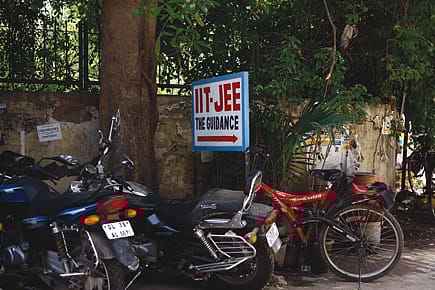
Now that the results are out, the media is awash with IIT-JEE success stories. There are stories of extraordinary teenagers who have ‘topped’ the entrance examination, small town youth who, against all odds, have gained a place at the top of our hierarchy of educational desires, and delirious parents whose every sacrifice now stands justified. Amid all the exuberant reporting, there is one town that figures prominently as the El Dorado of competitive success. Instead of a name, Kota is now a promise. What are the different ways in which this promise plays out? Let’s begin with a slightly longer view of Kota’s place in the national imagination.
In February 2005, the small village of Narhi Nagra in Uttar Pradesh suddenly found itself Shanghaied into the public sphere. The national media reported that Saurabh Singh, a 17-year-old from a ‘poor family’ had ‘topped’ the International Scientist Discovery examination conducted by the National Aeronautics and Space Administration (Nasa). It was a rags to (possible) riches story, and the media focused on Saurabh’s modest circumstances. There were also a number of newspaper ads for a ‘coaching college’ based in Kota that claimed him as one of their great success stories, as well as promises of financial rewards by the UP government, much publicised expressions of pride in his achievements by his headmistress and townspeople, and a meeting with the then President Abdul Kalam. It was also reported that Saurabh had stood first in an exam that both President Kalam and the astronaut Kalpana Chawla had also taken, but neither secured his ranking. After a sustained period of media euphoria, another set of news stories began to trickle in. It was now reported that Nasa denied any knowledge of the examination, that Kalam had never appeared for it, and that Saurabh’s subsequent claims that it had actually been conducted by Oxford University had also been refuted by the venerable institution. According to reports, the police had begun an investigation on whether Saurabh Singh’s exploits might be in the nature of a ‘national fraud’. Now, newspaper photos showed an apparently tense Saurabh (mobile phone in hand), watched by suitably worried looking relatives and fellow villagers. After having traversed a combination of regional, national and transnational spaces, we—the media audience—were now firmly back in the small village. In later media reports, there was a sense of disappointment about how everyone had been ‘tricked’ by a young man’s chest thumping.
What is the culture of contemporary India that throws up stories such as Saurabh’s? A useful place to start is the media’s obsession with ‘Indian idols’: the incessant search for messianic figures who will ‘make India proud’ on the global stage. From fashion designers to artists, the pursuit (and manufacture) of the Global Indian is a big preoccupation. Whereas Americans can assume global superiority, Indians must continually engage in offering evidence of it. Saurabh, till his fall, was part of this process.
Saurabh’s ‘flights of fancy’ are also mired in what might be another peculiarity of contemporary Indian culture: the system of competitive examinations for jobs and entry into professional courses, and the massive complex of ‘coaching’ institutions that prepare students for these. So, it was reported that Saurabh had been sent to Kota to prepare for the IIT-JEE, and that he had later returned with a Nasa certificate proclaiming his accomplishment. ‘Kota’ is the name for a number of overlapping dreams of ‘making it big’: it is a technology machine. For many small-town people in India, a merciless system of highly selective examinations is one of the key avenues of social mobility, often paving the way for a journey from Samastipur to Stanford.
For many a poor parent, fees for their wards’ (usually, but not always, sons) coaching prove a drain on their limited resources, and, ironically, might be compared to trying to scrape together a daughter’s dowry. If, after all this, the child is still not able to secure the desired admission, the consequences can be calamitous; a family already in financial debt might suffer a sense of collective failure all the more acutely. Under such circumstances, it is not surprising that children seek ways of minimising the family’s collective pain. Having been sent to Kota to secure admission to an engineering college (and perhaps having failed at it), Saurabh Singh’s actions might be more sympathetically viewed as those of a young man dealing with a complex social situation—one where avenues of social mobility for someone of his background are few and any breakthrough demands great effort and luck.
The culture of competitions in India has now become firmly enmeshed within the rise of new consumer and commodity cultures that also proclaim the ‘virtues’ of individualism in hitting big time. The privatisation of key areas of economic and social life has produced an arena of fantastic dreams for the future, catered to by equally exaggerated promises of success. Within this sphere, it is the relatively less well-off who are likely to take the greatest risks, basing their decisions on the barest promise of a life beyond their present circumstance. It is here that the coaching colleges of Kota, the hunt for ‘Indian idols’, and Saurabh Singh’s imaginative landscape and hopes for the future come together.
But the pressure-cooker that is Kota is more than a place where IIT dreams come true. It is also the site of a terrifying experiment in education that might define the ways in which youngsters think about issues of politics and social justice in ‘New India’. The Rajasthani city sits at the juncture of a new spirit of educational entrepreneurialism, technocratic learning, and global transactions in education as a commodity.
Starting from the early-1990s, Kota has become the centre of a booming ‘competitions coaching’ industry, primarily centred around preparing students for engineering and medical examinations. While difficult to pinpoint the exact reasons for how the city’s kachauri culture was also able to nurture a coaching one, the Kota legend points to small beginnings by engineers at a local industrial house, some of whom had been laid off work. It apparently all began with private tuitions for a small group of school students seated around the dining table. As the 1990s unfolded, many more Kota based engineers and science graduates engaged with the spirit of New India through furious educational entrepreneurialism. This was the beginning of Kota’s coaching industry. A techno-fetish, combined with perceived opportunities for engineers and infotech specialists at a global level, set the stage for what now exists as an almost parallel universe: the Kota System of education.
Along with numerous small operators, Kota has a handful of large institutions that enjoy national fame. These have sprawling campuses, with cavernous ‘reception’ areas and massive class-room complexes. The campuses appear far better equipped and maintained than those of most universities in India. Adjoining them is a slew of new suburbs full of multi-storied hostel buildings. These are ‘dormitory suburbs’ of a new kind, spaces for the remaking of educational thinking. There are, as one Kota resident told me, upwards of 600 such hostels.
One of the most striking features of the city is the number of children—usually in classes 8 and above—who, while enrolled at a school, either do not go to school or attend school for only one or two days a week. This was already the case with students preparing for competitive tests: school enrolment was simply a tool that allowed them to take Board exams. Participation in the various activities that school-life enables was not the point. Exams of different kinds were the exclusive goal, with all else seen as distractions. Increasingly, however, even this situation is witnessing a dramatic change: it is now common for school-going children who are not attending IIT and other coaching to prefer going to ‘school-coaching’ classes, rather than attend regular school. School-coaching, which operates in parallel with entrance exam coaching, is seen as a guarantee of better Board results. Regular schools don’t appear to mind, since they receive full fees and do not have to spend as much on teachers’ salaries and other facilities. Indeed, the system works so well (and, profitably) that some of the larger coaching institutes have established their own schools that act as feeder bodies for their school-coaching as well as post-school coaching businesses. Everyone is happy with schooling without schools, and education without the slightest taint of ‘liberal arts’ thinking.
The potential of the Kota System has most recently been recognised by a Korean company that is setting up an IIT/medical coaching institution in the city. Rumour has it that they will be paid according to the number of students they are able to attract. Perhaps mindful of how New India views education, the company’s office is located at one of Kota’s new shopping malls.
On my way back on a train from a recent visit to the city, I was talking on phone to a friend about the Kota System, whose many products the media will one day identify as members of ‘civil society’. At the end of my conversation, a young man on the top berth peered down to tell me that his own schooling had been through school-coaching and that he was now a ‘teacher’ at the same institution. Did he not miss the experience of going to a regular school, I asked. “No,” he said, “the school was only needed for the Board exams. What else?”
+++
The author is professor of sociology at the Institute of Economic Growth, New Delhi


OLDER COMMENTS FIRST
18 COMMENTS
Permalink
One would think that over the years, as incomes and financial security improve, as job opportunities across various sectors increase, parents would encourage their children to get an education and study what they love. Instead, the craze for doing well in competitive examinations has reached a fever pitch, and children are constantly pushed into what are considered lucrative careers, interests and aptitude be damned.
By the way, the story of Saurabh Singh is what inspired one track of Serious Men, I am guessing.
Permalink
Relatively well-researched, but there is more to the story. Owing to facts mentioned in this article, these students do not have any practicals exposure whatsoever. They cannot do a single experiment that they are supposed to learn during their schooling on the own — the physics and chemistry labs specifically. Consequently, even if they get into IITs, they can't do a single practical session there, have no practical knowledge and are bound to fail miserably. How they pass their board practicals exam is another whole new question! Because the coaching centres teach the students on just scoring in these exams and not on understanding and knowing the underlying subjects (which was the goal of these exams!!!), their knowledge in anything that is on the basics of the subject is something that does not exist. They learn pattern matching, and this is it — no real understanding of the subject, really. These coaching institutions are doing a great disservice to the nation and its educational system. It is high time the boards and IITs take cognizance of this.
Permalink
This sounds like a right wing 21st century madrasa !
Permalink
the root problem is the valorisation of science, technology and individual greed over the humanities and altruism. schooling of any kind has always been geared to the needs of the mainstream development of society and so it is not surprising that coaching institutes have replaced schools given the importance of competing rather than learning. unless development is redefined and decentralised altruistic living is brought back to the centre of human development there is very little possibility of reversing this trend. so it is futile to expect the boards and IITs to take note of the proliferation of coaching classes when society as a whole is not bothered about this.
Permalink
I disagree with some of the comments and the premise of this article that the rote learning preached by the central education board curricula are implicitly better. Having had first hand experience of these competitive examinations (IIT-JEE, DCE-CEE, etc.) and the effort that goes into preparing for them, I can confidently say that the people who get through to these elite institutes have a very strong grasp of the fundamentals of the sciences they study.
The article fails to make distinction between the actual examinations and the 'coaching institutes' that are supposed to prepare students for the former and takes potshots at both of them at the same time. Further, it does not provide objective evidence in support of the assertions it makes and fails to provide a solution to the problem it presents.
In my opinion, these coaching institutes aren't the 'end of education', rather, simply the output of a highly pressured system, wherein a large number of candidates are contesting very few seats at these institutes and an inherently flawed education system. I, for one, didn't study at these 'coaching institutes' or didn't gain much from studying at higher-secondary school. Studying non-stop for a year sitting at home worked for me. I missed out on the 'science lab experience' but I never got to use burettes and pipetes in my Electronics and Communication Engineering degree.
Here's the real problem: The higher-secondary education system isn't diverse or broad enough for a smooth transition into engineering colleges. The subjects we learn in higher-secondary schooling usually never have any use in our engineering years. Now go find a solution to that!
Permalink
This article attempts to makes various points through nicely narrated anecdotes. Indeed, anecdotes have their place in building a narrative. I will hazard a risk and say that in this case, the narrative seems to be how "Kota" represents the lack of socio-cultural "virtues" and the meaning of education for the middle and lower class of the society.
Although I think anecdotes need a base support from statistics, which is completely missing in this article. Also, I find that the anecdotes are hand picked and do not representative of the the other side, or may be it does. I suppose I belong to the Samasthipur to Stanford part of the story. I am not a Scientist at a University in the land of opportunity! Hence, I am perhaps biased in saying that the Kota system provided me an opportunity to get exposed to a wider world of not only science and education but much more.
Also, I disagree with the previous comment by Lisa about coaching lacks the ability to teach "the real understanding" of the subject. It seems much like in the tome of the article a sweeping generalization based on personal experience or worse a prejudiced view based on the various articles such as this.
Sorry for being over critical but I think it is very easy to talk trash about the Kota system but it would be nice to see someone actually taking the time to understanding it better and presenting the various aspects in a balanced way.
That said, I think it is definitely a great start of a long conversation that needs to be had. I enjoyed the article.
Permalink
Really happy to know that people have started realizing and talking about the harm caused by the kota effect. More students are destroying their career in Kota than any other place.
The media and coaching classes maintain silence about the malpractices because both benefit from it.
Permalink
This was a good read indeed!
Humiliating punishments, teachers who knew almost nothing and zero practical lab exposure for subjects that really needed them were all part of my 'real' school experience. And, I studied in one of the better (not the best, but still) schools in a big city.
It is not the aspirations of the parents, the children or even the institutions who profit from them that are the problem. They're just the symptoms of a lousy education system. If our mainstream schools offered real quality education, families and students wouldn't be exploited like this. Maybe the schools could have system where students who have an aptitude for science or maths are picked and coached by the school for a small fee. I don't know. The schools should be competing for students who top these exams on the basis of the education imparted to them by the school.
It's complicated problem, like most problems in our country, characterized by a lack of will by the authorities to do anything about it; in this case, both the schools and the government.
Permalink
Thanks for raising concern regarding the issue that plagues the Indian education system. Educationists are worried about this but have failed to do much about it. In fact these institutes have given a new unwanted meaning to the word coaching. In fact what they offer in these institutes is not coaching at all. Coaching as per strict definition is one-to-one method of imparting instructions. The genuine coaching is a very effective method of imparting knowledge and skills provided the coach himself/herself is skilled /knowledgeable. In so called competitive coaching, the word coaching has only historical connotation- it once started with one-to-one method. There may be small element of one-to-one in commercial institutions but the emphasis is not on it as this is not commercially viable for business houses aiming at minting money. The ones who are available for one-to-one basis in these institutions are not as skilled as those who engage lectures. Off course 'Super 30' in that sense is far better model and unfortunately less talked and less known than Kota model. Do we need to replicate that model is not the issue. The issue is education kills 'coaching' as Professor Yashpal has said. Initially it started with dropping after class 11 or 12, later with side-by-side tuitions, still later 'coaching' in stead of education at classes 11 & 12 and now from class 9th itself!
Education aims at overall development of individual. This does not come from learning a specific subject. Learning a specific subject is only means and to some extent specialization for future career. Non scholastic aspects and soft skills of a person are having far greater implications than scholastic aspects. A private firm would like to have an engineer who is honest, dependable and committed rather than having a dishonest engineer. Please do not get me wrong, I do not wish to say that those who go through 'coaching' system lack values what I want to say is that this aspect is not built-in in the system. The students who undergo 'coaching' have all these desired virtues not because of the institutes but because of their parents, society and earlier schooling. However, even the so called education these days has lost focus on these virtues. Value education (or the new term soft skills) is something that is discussed in seminars only.
Another malaise associated with this hype regarding successful candidates of competitive exams (IAS, State AS, IIT etc) is meeting treatment as third rate citizens to rest of the students. Some of them may be having great knack for music, performing arts and other forms of scholastic disciplines. A student who fails to qualify or the one who chose less rewarding subjects is treated as 'useless waste' of the educational system. The society has no expectation from this student; he/she is looked down upon and consequently s/he also forms low opinion about himself or herself. Consequences may be – (i) the one who has qualified may develop a feeling that s/he is born to rule others and rest of them are subhuman, (have you closely watched manners of Indian administrators/managers- subordinates are subhuman for some of them, they believe that employees are inherently lazy, shirkers, corrupt etc (Theory-X of McGregor) and try to put forward their half baked ideas, bully their subordinates when they raise issues regarding flaws in schemes/instructions and results are known to all of us--- failure in implementation) (ii) The one who had failed consequently succeeds or gains a position where s/he can have influence and realizing that s/he did not get his/her due, retaliates the system (results- amassing great wealth, corruption, ill treatment, mutual disrespect). Disclaimer- fortunately not everyone is like that. But is it not appropriate for educationists, policy makers and society to set the system right?
Dhirendra Devarshi, Jaipur
Permalink
But Kota is simply the best-known logical extension of what as far as I know is a nationwide phenomenon. In Tamilnadu where I grew up and went to school we had Rasipuram...
Reading the comments so far I am surprised no one has mentioned the IITs' culpability (and IIMs too because the MBA coaching scene has built up to being not much different) in this growing mess. The coaching setup has come to exist because there is a belief that the entrance exams to these institutions can be "cracked", through a combination of rote learning and brute problem solving. Design less deconstructible exams, with different patterns testing different facets of a student's abilities each year, and these Coaching Centres might be forced to go back to actually teaching - rather than coaching - students.
Permalink
Anish, here is the really real problem: How much of the engineering degree that one gets from the IITs or other places useful for the life beyond? If one has to go for an MBA after IITs (which many do), why go through the engineering stream would be an auxiliary associated question. The last time I checked there are physics laboratories as well (apart from from pipetting!), and that was related to a degree in ECE! Further, it is the experimentation spirit, to learn through experimentation rather than to learn from books which is the point! One can pattern match and clear the tests to get into the institute, but what then — does that take true scientific spirit forward? Does it really fulfill the purpose of the exam? Is the spirit of the exam, with which it was started years ago, still maintained?
Sid, I stand by my "sweeping generalization"! Clearing one exam cannot and is not the goal of schooling! The schooling is for feeding to other disciplines as well — an engineering degree as panacea to all problems is a narrow-minded vision, and the Kota system is feeding to that narrow-minded vision, ignoring innovation and ingenuity, and making exams as mere pattern matching exercises. It is clear for the Kota model that one doesn't need to know and understand the subject to answer the questions in the exam — you just have to have looked at the same or similar questions a number of times before. You can do the experiment yourself — just ask anybody who has cleared JEE through the Kota system anything that is a little bit away from the examination pattern, and you will know the difference yourself!
Even within IITians, it is rather fashionable to declare that they cleared the JEE WITHOUT any coaching, even if they had gone through such coaching!! Why this sense of shame of having gone through the coaching programs if these programs were so good in making the students understand the basics, I wonder! For the training centres and the schools that are hand-in-glove with such centres, taking away quality schooling from the students — it is plain business. I am sure there will be a lot of opposition to this article and to comments like mine! After all, so much money is riding on this. Further, which Kota-trained JEE-passed IITian would want to agree that they lack the fundamentals and the experimental spirit that science (and life in general!) very much requires!!! The parents should do some soul-searching! No point in blaming the students — they are just out of school.
Right to Education is passe — what the students need is Right to quality education; who is to ensure that? If the boards were strict about practicals, quality of teachers and real student attendance, then this situation would not have arisen! Who is to tell the boards? Jan Lok Pal?
Permalink
a similar entrance class exists down south in kerala wer de 17 yr old me ws tortured n made a doctor.....pls read my blog on http://rjvachas.blogspot.com/2007/12/de-gr8-pc-entrance-saga.html
Permalink
You might be right. Something is wrong somewhere , a nation of a billion should have produced a few nobel/fields laureates . Though I must say that education at IIT is as close to liberal arts as can be at a technical institute .
But there is something to be said about making bricks that fit into a large wall , speaking as one , it is also an important societal function :)
Permalink
long article:) ..
being at Kota I would say .. coaching at Kota is still a good option as you have some of the brightest minds of country there.. but schooling stands important
'school-coaching'(coaching classes training for boards as well) is bad option and it actually undermines schooling.
Schools and coaching should be kept seperate.
So you go to school regularly and augment with coaching classes for entrance exams.
Permalink
Quite researched work,as I would say...but we should never forget the fact that most of the brightest minds in our country are the result of these type of bodies only.though i don't completely support the privatization or the commercialization of these institutes,but if ,after getting the pre-requisites for the graduate colleges from the capital of education of India,students excel themselves in their coming life,then,i would like to ask that what is the harm in promotion of such institutions which are strengthening our country's educational background against mos of the advances countries of the world???
Any answers???
Permalink
The author has a point that Kota system robs the young mind of the opportunity to stand and stare and explore , so very essential to make the life worthwhile.
But, I believe, Kota is just the offshoot of a faulty system which does not take into account of child's ability to explore and imagine and create.
IIT-JEE initially(in 60s,70s and possibly 80s) brought about a fresh change in education system where it laid emphasis on problem solving as opposed to the earlier prevalent system of learning by rote. This emphasis on problem solving enabled its students to do well in tests like GRE and bought them a ticket to USA and some of them did well there as most of the other Indians there for reasons well known.
However, it was realised that problem solving is more of a case of learning techique rather than of some basic innate intelligence (which IITs were looking for) and coaching institutes sprang up.
It was here that IITs made cardinal mistake of making IIT-JEE tougher and tougher year by year to keep IIT JEE beyond the grasp of coaching institutes, without realising that by doing this they played right into the hands of coaching institutes. Now it became extremely tough for anybody to crack JEE without special help by these coaching schools.
IITs being torch bearer in technical education , every other engineering school (with a possible exception of BITS, pilani which maintains some sanity in its entrance examination with better results) follows suit. Engineering education being a passport to jobs (in a growing economy based on Industry), a mad rush to coaching schools became almost necessary. Kota just perfected the art of maximising the returns from such demand.
IIT and and other engineering schools must devise some better way of admitting students. They are looking for raw intelligence and not the practiced learning masquerading as intelligence. This will save the innocence of school children.
Permalink
Very well written.
Permalink
Much of what has been said is true and a lot is not.
1. Almost all of the above is not limited to Kota alone. Everybody who has ever prepared to JEE seriously would tell you that same is the case with every city. But that, of course, does not justify what is being done.
2. Saying that these students have no understanding of the fundamentals of their subjects is utterly wrong. These students have cleared IIT-JEE, an exam designed to test the same. I absolutely disagree with the opinion that luck, rote learning or pattern matching can get you through JEE. These students are the best problem-solvers in the country. That these students have no practical exposure in performing experiments is a different thing.
3. Then, the only valid con I see of 'the Kota system' is that it deprives the students of 'the social experience of the school' and liberal arts education. There is no significant loss in here if it happens after Xth. These students anyway do not choose liberal arts courses for their XIIth board (only choose courses relevant to IIT-JEE are chosen). Now, if they have already studied the (Phy, Chem, Maths) topics at coaching classes, in more depth, from better teachers, it is okay not to go to the college to study the same again.
Post new comment