Are We Ready?
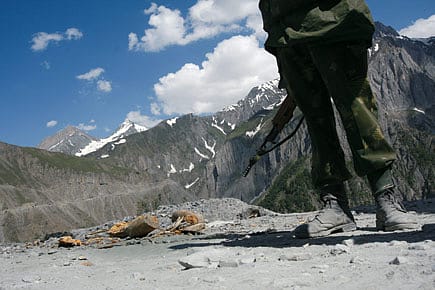
What has the Kargil war taught us? How do we ensure there is no repeat? What has changed in strategy, tactics and technology in the past 10 years?
It was a victory, a famously televised one. Yet, the mood in Kargil is not of jubilation but sombre reflection. Even in July, as the rest of India sweats, there is snow on these peaks. What were once obscure markings on military maps are now household names—Tiger Hill, Tololing, Jubar. Snow-clad peaks they were then, ten years ago. Snow-clad peaks they are now. The difference this time is that they have the Indian Army on alert.
Soldiers are dug into bunkers and surrounded by gun batteries of the 8th Mountain Division and the 121st Independent Artillery Brigade, along with the 56th Artillery Brigade. They keep watch. But being alert is not all there is to it.
What has the war taught India? How can we ensure that a repeat does not take place? What has changed in strategy, tactics and technology over the past decade? Your correspondent went to the Kargil heights in search of answers.
THE MORE YOU SWEAT IN PEACE, THE LESS YOU BLEED IN WAR
Military Lesson 1: Don't be caught by surprise

The Liberation of Bengal
05 Jun 2026 - Vol 04 | Issue 74
A silent revolution ends the reign of fear
The greatest lesson of Kargil is that there's little worse than being caught off guard. Indian intelligence knew all along that an influx of militants from Pakistan is routine in Kashmir. Even a casual glance at the map makes the strategic importance of Kargil and Turtuk obvious. Together, they form a sort of jugular vein connecting the Ladakh highlands with the Kashmir Valley (incidentally, they are the two places India recaptured from Pakistan in the 1971 war). Yet, complacency got the better of the military establishment, which failed to pay attention to human intelligence and surveillance. The two underpin any military deployment.
It is an abiding shame for the Indian defence system to have got wind of the Pakistani intrusions from a shepherd who had gone looking for a missing yak to those heights. All the talk of the world's third largest standing army holding fort turned out to be bluff and bluster—all yak yak, so to speak.
"The major lesson learnt is the need for constant vigil all along the Line of Control (LoC) and the need to ensure physical occupation of all strategically or tactically important areas," says Major General Suresh Khajuria of the 8th Mountain Division that oversees this area.
What Needs to be Done: Boost intelligence
Face it, the Army needs human intelligence that works. Place more feet on the ground for information collection, and that's just a start.
The Army needs more officers who understand the Balti language, for example, which is spoken locally in Kargil. Other than that, technological inputs garnered from airborne drones and other infotech-backed spy devices could serve as backup. All these inputs also need to be integrated.
"Equipment and machines cannot replace troops; they can only assist the soldiers. Boots on the ground are a must," observes Major General Khajuria. Some old rules of warfare never die.
Status: Major upgradation
There are plenty more boots on the ground. Back in 1999, only one brigade took charge of the entire area from Sonmarg to Drass. Now India has an entire division, about 24,000 soldiers, for the area between Kargil all the way up to Leh.
More importantly, technology has evolved. The last ten years have seen a transformation in the way the Indian soldier fights. Three aspects stand out. There are as many as four modern electronic devices deployed to ensure that improvised explosive devices (IEDs) planted by enemy intruders can be neutralised and mines detected. As a result, convoys between Srinagar and Leh move with much more assurance now.
The Indian Army at Leh also uses the new ghosts of wrath—unmanned aerial vehicles (UAVs) to watch over vast areas that were not under surveillance ten years ago. The forces have Indian-made Dhruv UAVs plus the superb Israeli-made Herons. However, given the vastness of the terrain, the number of such UAVs is inadequate.
In the Kargil War, the intruders had an advantage in the dreaded radar fire finder. This could tell precisely from where India was firing its Bofors guns and direct fire right back at the source. The result was a high casualty rate. Now that India has acquired the TPQ 37, the latest artillery locating radar in the world, "The enemy has lost the previous advantage of firing freely," in the words of an officer who commands a Bofors battery in the Drass sector. "We can now locate, indeed pinpoint, the source of shelling and hit hard right back." India has more artillery than Pakistan in this sector, so this can be an edge.
Moreover, India now has access to foreign and indigenous spy satellites. "Now any big Pakistani formation cannot escape scrutiny," according to a senior officer in charge of system analysis at Drass, "While weather and cloud cover do have an effect on satellite imagery, we have a very good team of specialists who look into the imagery every day and have the equipment to analyse information across the whole sector, which was earlier not the case."
Military Lesson 2: Increase fire power
The robust Bofors gun was the hero of Kargil. India needs to beef up its 155-mm and 130-mm guns. In the Kargil War, these played a big role on the ground, especially in capturing heights such as Tiger Hill. However, even then, there was a shortage of rounds—which had to be imported on an emergency basis. Sadly, Indian-made ammunition is deficient in quality, and this is a serious shortcoming in times of war.
What Needs to be Done: Rapid procurement
India needs at least 400 units of a world-class field gun of 155-mm calibre. "India needs to act very fast in adding new field guns to the Army," says Gurmeet Kanwal, director of the Centre for Land Warfare, a think-tank, "That order has been in the pipeline for many years, and still has not materialised. Without better fire power, India cannot assure theatre dominance in Kargil in the years to come." Cautionary words.
Status: Guns are on their way
India has floated a fresh tender for 155-mm field guns, but drafting them into the artillery will take at least three years. The Army is raising another artillery brigade, but this is to face the Chinese frontier in the western sector.
Military Lesson 3: Integrate Indian armed forces
The Indian Army and Indian Air Force played a stellar role in the campaign to oust the armed intruders from Kargil. The Air Force's Operation Safed Sagar, the code name given to the air operation, made good use of fighter planes like the Mirage 2000 and MiG-21 to achieve high-altitude strike targets. The Air Force flew as many as 580 strike missions, supported by around 460 Air Defence missions like Combat Air Patrol and escorts, and about 160 reconnaissance sorties. In all, the tally was a stupendous 1,200 sorties. In addition, according to analysts, helicopters made about 2,500 air runs, transporting more than 800 troops, almost 600 casualties and close to 300 tonnes of load, besides flying scores of operational strike missions. Yet, the operation revealed the need for better Air Force coordination with the Army.
What Needs to be Done: A war-time integration plan
While the country's ground, air and sea forces are under distinct command structures, war time requires closer integration in an operational sense. Planning on this needs to be fast-tracked. Kargil's joint operations were a window of opportunity through which a common operational doctrine could have been built. The country is not prone to military takeovers, so the Indian civilian leadership must overcome its fear of allowing closer coordination among the three forces.
Status: Plans are hanging mid-air
The long proposed post of Joint Chiefs of Staff has been hanging fire, though defence analysts say it is entirely possible to set up an operational structure that can be validated in real time and will be acceptable to all concerned.
JAW JAW IS ALWAYS BETTER THAN WAR WAR
Diplomatic Lesson 1: Rid Pakistan of delusions
Pakistan cannot change the status quo in Kashmir. It had to eat crow in Kargil, losing the war, global sympathy and international stature as well. Ten years ago, it had attacked India with high-precision planning and modern weapons, yet had to abandon its own soldiers in the conflict. It made no tactical gain whatsoever. Nor did it achieve an uprising in the Kashmir Valley in support of the armed intrusion.
Net net, there was no change in status quo on the ground. India still has two-thirds of Kashmir, and there will be no redrawing of borders, ever, as the Indian leadership has made clear. This, strangely, still eludes Pakistan.
What Needs to be Done: Neutralise Pakistani propaganda
India needs to deploy astute diplomacy to make its neighbour confront the immutability of its position. On its part, Pakistan is evidently trying to strike a grand bargain on Kashmir, arguing that no status quoist solution to the dispute—such as the LoC being turned into an international border—is acceptable to it. Given its assistance to the US in its War on Terror since 9/11, it is also being too-clever-by-half in trying to entangle the Kashmir issue in a larger geo-political puzzle, absurdly presenting a resolution of this 'core dispute' as a way to contain Islamist extremism, even Al-Qaida. This propaganda must be opposed at all levels, and India must clarify that Kashmir and 'global Jihadism' bear no relation.
Status: Pakistan still high-strung on J&K
India's western neighbour has not given up its claim, hollow as it is, to Kashmir yet. It sees Kargil's outcome merely as a back-to-baseline whistle in a long drawn out tug-of-war. Indian armed forces must therefore be ever prepared for another misadventure on its part.
Diplomatic Lesson 2: Rethink MAD logic
The Kargil War underlined one big dilemma. Going in for a nuclear arsenal without calling Pakistan's nuclear weapon bluff has cramped India's conventional war options, on which superiority was assured.
Thus, in a supreme irony, India has seen a post-Pokhran depletion in its ability to project power within the neighbourhood. The thing with nukes is that these weapons tend to level the battlefield, according to George Perkovich of the Washington DC-based Carnegie Endowment for International Peace, and author of the influential book, India's Nuclear Bomb.
"Mutual nuclear deterrence did limit India's options in Kargil and will subsequently," the author says, "Deterrence is great when you can impose it on the other guy; when the other guy can impose it on you, the result may be stability and less risk of a major war. That's good, except when the other guy does something that makes you want to teach him a big military lesson. Then you can't. You have to live with him. One way to think of this is self-deterrence."
What Needs to be Done: Alter the nuclear doctrine
India has a clear nuclear superiority over Pakistan. It makes calculatedly rational sense for India, therefore, to abandon its policy of no-first-use of nuclear weapons.
Status: India wants peaceful intent halo
India maintains its pacific nuclear doctrine of no-first-use, presumably because this plays to the peace galleries and goes well with the country's self-image as a non-aggressor. However, it is a disadvantage against Pakistan as much as China, since deterrence depends on the glare-down effect—the suggestion of menace in having half a finger on the nuclear button.
Diplomatic Lesson 3: Thwart Pakistani pinpricks
The Kargil War and the commando attack of 26/11 on Mumbai have demonstrated a perverse obstinacy in Pakistan; those who call the shots there fail to make a proper assessment of the balance of power. They may persist with disruptive tactics that needlessly test India's patience.
What Needs to be Done: Pressure Pakistan
Indian diplomats, if they must persist with warm handshakes with their Pakistani counterparts, must press for accountability. Above all, the joint information sharing mechanism that was once agreed upon must actually be made to work—the 26/11 investigation being a litmus test. India can threaten the core interests of Pakistani diplomacy by rejecting cooperation on the composite dialogue between the two countries.
Status: India seems to be softening
Instead of mounting pressure, India's Prime Minister Manmohan Singh appears keen to resume the composite dialogue suspended after the 26/11 attacks! In a joint statement issued at the Non Aligned Movement (Nam) summit in Sharm el-Sheikh, an Egyptian resort on the Red Sea, the issue of terror seems to have been delinked from Indo-Pak talks, to the satisfaction of those who want closer Indo-Pak ties sans (!) preconditions. This has also pleased the US; judge from US Secretary of State Hillary Clinton's utterances on her visit to India. But is India ready to move on from 26/11? It's not for nothing that Indian officials are now in damage-control mode.
Diplomatic Lesson 4: Track the US perspective
It was the then US President Bill Clinton's intervention that brought the Kargil War to its final close, despite India already having gained a decisive victory. The US view of developments in the region have changed since, but not as wholly as India would like.
What Needs to be Done: Educate the US
The US has also had lessons to learn from its effort to oust Soviet forces from Afghanistan. The militia it helped arm along with Pakistan eventually turned out to be an even bigger problem. In other words, short-term objectives can cloud long-term prospects for peace. India needs to gamely remind the US of this.
Status: Each country for itself
Apart from working towards a consonance of views, India can scarcely do anything more than offer its sage advice. This makes it plain that India has little choice but to use its own resources and intelligence to ensure that what Bill Clinton called the "most dangerous place on earth" doesn't go back to being so again. It's India's call. The Indian political leadership needs to bridge the gap between robust military capability and weak strategic intent. Neither the magnificent men in uniform nor the wizardry of attendant weapons will help with that. What is needed, crucially, is a transformation of India's strategic culture. The wars of the future will be won in the mind as much as by jackboots on the ground. Ultimately, the mantra remains self-reliance.