BHOPAL, JAIPUR AND RAMNAGAR
HOW COME a country that is losing acres of forests and dozens of wild animals by the hour has time to debate, of all things, wildlife tourism?
It was late evening at Delhi’s India International Centre. After a rare screening of Pradeep Krishen’s Electric Moon, an excellent satire on desperate brown sahibs and their ingenious ways of conning unsuspecting foreign wildlife tourists, a few guests were animatedly discussing the merits of a proposed ban on tourism in critical tiger forests. An elderly lady stood there listening for a while, before popping the exasperated question.
The answer may seem obvious, but it is not. Wildlife tourism is mostly concentrated in areas where tigers and other big animals are relatively abundant. So the nature of tourism has a direct bearing on India’s more successful conservation stories. Since such success stories are still few and far between, the country had better not take chances.
On the surface, battlelines appear drawn between the Government and the wildlife tourism lobby on this very idealistic premise. Scratch this surface, though, and it becomes a no-holds-barred battle between sarkari power and private profit. What makes this an almost even contest is the presence of big corporate chains, the not-so-secret stake of many renowned conservationists, and the unusual interest of many top forest officers in wildlife tourism.
On 9 September 2010, the Jabalpur High Court asked the National Tiger Conservation Authority (NTCA) and Madhya Pradesh forest department to respond to a public interest litigation (PIL) seeking an immediate stay on tourism in core forest areas. Chief Wildlife Warden HS Pabla, the top custodian of wildlife in Madhya Pradesh, was on a tour, but he promptly swung into action. A few minutes before the midnight of 14 September, he emailed some of the state’s top tourism players, warning them of the PIL and urging them to join hands ‘to protect’ their interests.
Open has a copy of this tell-tale email sent out by Pabla. It reads:
‘This is to let you know that a PIL (WP no. 12352/2010 – Ajay Dube Vs NTCA and Others) has been filed in the high court of MP Jabalpur, which, among other things, seeks a ban on tourism in the core zones of tiger reserves. The applicant has also preyed (sic) for an iimmediate (sic) stay. Although the government of MP will oppose this application, lodge owners, travel operators, guides etc may also like to implead themselves as affected parties if you want to be sure that this PIL doesn’t succeed. As the case may have serious consequences for you people, kindly take whatever steps you think will be appropriate to protect your interests. As I am travelling and do not have the mail IDs of all of you, kindly inform others who will be affected by this case.’
Not surprising, then, that when the PIL subsequently came up for court hearing last week, around a dozen interventions were submitted. Among the interveners were a slew of hotel associations from Bandhavgarh, Kanha and Pench, and a few NGOs.
While the NTCA told the court that core critical forest areas were “required to be kept as inviolate for the purpose of tiger conservation, without affecting the rights of Scheduled Tribes or such forest dwellers”, in his reply, Pabla claimed that he (as chief wildlife warden) was the supreme authority on such decisions in the state, and that tourism aided the protection of forests and wildlife. The next hearing is scheduled on 6 December.
Meanwhile, in Rajasthan, there are some questions best answered by Principal Chief Conservator of Forests RN Mehrotra, the man who orchestrated the controversial tiger reintroduction programme that suffered its first casualty last week, when a male tiger was poisoned to death. Busy relocating a few villages in order to secure an ‘inviolate tiger habitat’ in Sariska, Mehrotra must have had his hands full. But the boss of the state forest establishment has still got time for a new, and secret, pet project.
For many decades, the medieval fort of Kankwari, where Aurangzeb is said to have imprisoned his brother Dara Shikoh, lay in ruins deep inside the Sariska reserve. Today, while hundreds of families are being moved out of Kankwari village, the fort atop a hillock a few hundred yards away is getting a silent makeover.
Forest officers in the field are tight-lipped, and Mehrotra has not replied to queries, but state Chief Wildlife Warden HM Bhatia admits that the renovation was funded by the state tourism department. “Our policy is to promote eco-tourism,” he explains, “We do not allow people to stay inside forests, but we will work out an arrangement keeping the safety of tourists and the security of wild animals in mind.”
In New Delhi, NTCA officials say they are not aware of any renovation or eco-tourism proposal at Kankwari, adding that any non-forest activity would need official clearances from several central authorities. Says former Rajasthan PCCF BD Sharma: “If the tourism department has funded the renovation, the purpose is obvious. But eco-tourism cannot happen inside core areas. Whether they make it a day or night facility, how will they justify the disturbance, especially after removing an entire village from that area?”
+++
THE PROPOSAL to ban tourism in critical tiger forests was not an idea chanced upon by a bureaucrat in a eureka moment. It has been a legal necessity since the 2006 amendment to the Wildlife Protection Act, 1972, that requires all critical tiger habitats to be ‘inviolate’—out of bounds for human use. As a result, more than 50,000 forest dwelling families have been earmarked for rehabilitation, and many thousands have already been moved out.
To many, it does not make any moral sense to have lodges and resorts inside a forest where villages have been uprooted to facilitate conservation. Ashish Kothari, member of several government panels and a champion of forest dwellers’ rights, feels such hypocrisy that allows speeding safari cars and plush tourist facilities in national parks after forcibly evicting local villagers only results in loss of popular support for conservation.
But when Dr Rajesh Gopal, member-secretary of the NTCA, accepted that government policies had no room for double standards, the tourism lobby went up in arms. Ironically, most conservationists who have always been quite vocal in demanding the eviction of villages from core forests have somehow preferred to maintain a diplomatic silence this time round. Not surprising, because most of them either run businesses or have made serious investments in high-profile reserves across the country.
Soon, Environment & Forests Minister Jairam Ramesh stepped in to issue a statement that the Ministry never had any plan to ban tourism, but it would be strictly regulated in the 39 Project Tiger reserves, particularly in designated core areas. He also said that the Ministry was working on detailed guidelines for promoting eco-tourism in line with the carrying capacity of individual reserves.
Far from clearing the picture, this has triggered fresh speculation about the nature and extent of ‘strict regulations’. So even as the Ministry works on the promised guidelines, some industry bigwigs and conservation heavyweights are busy finding ways to influence these clauses.
In public, the tourism lobby has been arguing its case on what it calls four crucial spin-offs for conservation. First, tourism brings in money and can make our cash-starved reserves financially self-sufficient. Second, wildlife tourism creates awareness and builds a stronger constituency for conservation. Third, the presence of tourists keeps a forest safe from poachers and other intruders, as evident from the relative abundance of animals and trees in tourism zones in any forest. Fourth, tourism absorbs local workers and reduces their dependence on forests for livelihood.
Forest officials promptly counter these arguments. They point out that the forests are not leased out to private managements in India, and anyway, the Centre has increased the budget manifold in the past five years. While accepting that tourists do amount to extra pairs of vigilant eyes, they add that all tourism zones already had a hearty abundance of animals before they were designated as such, and, in fact, successful conservation efforts behind such abundance were the reason these areas were earmarked as tourism zones in the first place.
Samir Sinha, a senior forest officer now with Traffic-India, wants the wildlife tourism sector to put its money where its mouth is. “On paper, wildlife tourism creates mass awareness for conservation and financially empowers the local workforce. What we have on the ground are mostly tourists who casually litter our forests and bribe guides to chase wild animals. Most resorts hire locals for menial jobs and pay a pittance,” he rues.
Dr Gopal points out how tourism has become brazenly intrusive: “Isn’t the result (of irresponsible tourism) there for everyone to see? They surround animals with vehicles, build resorts blocking wildlife corridors, dump garbage in eco-sensitive areas, and even exploit local villagers. Even the Tourism Ministry accepted such issues in a recent report. Nobody is against tourism, but they must act as responsible stakeholders.”
Many in the wildlife tourism sector, on the other hand, wag fingers at the dictatorial, corrupt and vindictive ways of the forest department. In most upscale reserves, last-minute permits and reservations are available at an extra cost. In Ranthambore, for example, hotels could get away with almost anything if they obliged forest officers by hosting their private functions or offering jobs to their relatives. In Corbett, if a hotel-owner pointed out instances of illegal tree-felling, he would be singled out and his safari permits would get squeezed. The list of such backroom manoeuvres is long.
A senior officer in the Ministry of Environment & Forests (MoEF), in fact, accepts that a section of forest officers are against the so-called proposal for a blanket ban on tourism in critical tiger habitats as it would affect their earnings. Now, he adds, these officers should be happy, as stricter regulations would offer better avenues for “milking” tourism.
+++
THIS TRADING of charges blurs the larger picture. And that picture is scary. Each upscale tiger reserve has its ‘carrying capacity’ (maximum number of tourists it can accommodate in a day) worked out. Compare that figure with the annual occupancy count in the hotels around that reserve. Depending on a reserve’s profile, the occupancy will be 30–100 per cent higher than the maximum number of people who can enter the forest for a safari.
Unfortunately, exact occupancy figures are not available simply because nobody is keeping a tab. But take Corbett, for example. Even in the peak season with all tourism zones in operation, the reserve cannot accommodate more than 700 tourists on safari a day. The hotel occupancy ought to be significantly less if you factor in day visitors (who do not stay overnight) and tourists who go on both morning and evening safaris.
There are about 100 small and big hotels around Corbett. At a conservative average of 30 double-bed rooms per property, that amounts to 3,000 double-bed rooms or 6,000 tourists a day. At an average high-season occupancy of 25 per cent, it translates to 1,500 tourists a day—more than double the number that can enter the reserve.
On a yearly scale, the mismatch looks more ominous. Factoring in the monsoon closure, a maximum of 190,000 tourists can enter Corbett in a year. In 2008-09, actual entries were recorded at about 180,000. But non-wildlife tourists visit Corbett round the year. Based on our previous assessment, a more modest average occupancy of 20 per cent adds up to 220,000 double-rooms a year or more than 400,000 tourists.
Clearly, hundreds of thousands of tourists, who apparently have no interest in forests or wildlife and do not even bother to visit the reserve, crowd around our forests regularly. Some come for extended sessions of corporate unwinding, others for rowdy weddings. More and more multi-star hotels come up behind high walls to accommodate them and choke forest corridors. These throngs, almost entirely with no motive other than leisure, end up raising levels of sound and light pollution with their late-night parties, draining vital resources like water, and leaving behind tonnes of garbage. Whether tourism is banned or regulated inside core forests, this monstrous non-wildlife crowd will continue to swell beyond the jurisdiction of the forest department, unless other agencies of the Government step in to staunch the flow.
Hotels within a stipulated distance from a forest should be allowed only if they maintain a generous open land to built-up area ratio. Any use of water and electricity by a hotel, above a reasonable quota specified according to its land size, should be steeply charged. A strict no-sound-no-light policy should be enforced in the late evenings, and a steep garbage tax levied with a carry-it-back policy. Once non-eco establishments transfer this substantial extra cost to non-wildlife tourists and refuse to offer them DJs by the pool, this crowd will gradually shift their corporate junkets and marriages away from forests.
+++
WHAT ABOUT the other bulk of tourists who insist on entering forests for wildlife safaris but are usually in picnic mode? Is it not the responsibility of hoteliers and tour operators to ensure that their clients follow rules, learn to respect the wilderness and possibly go back better educated?
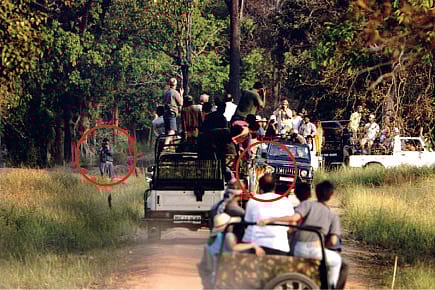
Unfortunately, just about no one follows even the basics of the existing MoEF guidelines dating back to 2003. For example, the minimum mandatory distance between two safari vehicles should be 500 metres. At all times, a tourist vehicle or safari elephant should maintain a minimum distance of 30 metres from a wild animal. The photographs on these pages tell the real story.
While a number of players blame such irresponsible tourism for hurting the reputation of this sector, there is little effort to form a self-regulatory body to enforce strict industry norms. Instead, some pass the buck to forest staff, blaming them for turning a blind eye to such unruly tourists just because they come from ‘friendly’ hotels or tour operators. Others shrug, saying that “the good guys are just too few to control the bad ones”.
The result is one big mess. Travel Operators for Tigers, a campaign for responsible use of wild habitats in India, sums up the malaise by observing that wildlife tourism often suffers from badly motivated tourists, poorly informed guides, apathy towards local communities, excessive tiger-centricism, and vexed relations with park officials.
So, even the strictest of regulations will remain vulnerable to manipulation, unless the new guidelines institutionalise some transparency. There are a few pioneering eco-tourism projects that stand out in forests otherwise overrun by the rent-a-tiger tourism mafia. These rare green efforts may soon be forced out of business if the profit-spinning mafia continues to buy its way and forest officers get away with bending rules.
Says PK Sen, former director, Project Tiger: “The new set of guidelines should be made binding through legislation, with provisions for strict punishment for violation. However, its implementation will still depend on individual states. Legally, a shift from the core to the buffer areas is inevitable. We may not have too many good buffer forests today, but if the tourism lobby really means well, it can use its clout and money to encourage community conservation efforts around critical tiger forests. It will help both conservation and tourism.”
Implemented fairly, no pro-conservation regulation may hit the wildlife tourism sector too hard. The few who already have their eco-advantage will find it easier to cope, because, as conservationist Bittu Sahgal points out, it is high time “we offered real nature experiences and not expect tourists to just gawk at the tiger and pay for the privilege”.
Successful eco-tourism businesses can inspire a paradigm shift. As for outsized luxury properties, there is no reason why they should mind investing in buffer conservation so that the big animals begin to show up there. The rest, who have made crores by exploiting the Government’s investment in conservation and vulnerability of officials to corruption, might also continue to do well in whichever sector they switch to.
+++
The author is an independent journalist


OLDER COMMENTS FIRST
14 COMMENTS
Permalink
A brilliant piece and time for introspection for all.
Permalink
An eye opening report on how dismal tiger conservation is in some of our states. Jay has aptly pointed out how it is it is not just the usually blamed locals and the poachers who are adversely affecting our best Parks. It is people like us who go as tourists but do not realise our responsibilities towards the wild spaces we go to appreciate. It also highlights the central core of the problem - that of corruption, be it of the officers who have monetary stakes in the tourism around their fiefdoms or the conservation NGO's who otherwise are seen to be holier than thou but have their stakes in resorts around some of our best Parks. Finally it is the tiger and the local people who bear the brunt. How much deeper will we all sink in this mire? Disheartening but apt report!
Permalink
Your piece on tiger politics is excellent and very important. How does one pressure the two departments to cooperate and make a reasonable plan? And nowhere is there emphasis on involving local people except, as you point out, for a few low-paying jobs.
Permalink
Would a temporary ban on tourism in some of our prized reserves be truly misplaced? That tourism is a vital adjunct to conservation is a valid argument if the said tourism is informed and discerning. But given that most of our sanctuary crowd is the same as our zoo crowd, give or take a pair of binoculars, wouldn't it be wiser to spare our wildlife the mindless intrusion for a while at least? By the way, when was the last time an intensive care unit was thrown open to the public: isn't Sariska a similar situation, with its founder population floundering?
Permalink
Top officers must pay for colluding with private players. Who they are representing? Certainly not the govt. Is it some kind of a retirement scheme with full benefit and all? Action must be taken and promptly.
Permalink
What Dr Schaller pointed out, to me, is the crux of tiger conservation in India. Why are the local people being left out of tiger conservation. They deserve better than being just drivers and cooks and earning a pittance while rich people (conservation NGO's included) get richer charging the earth for a nights stay for tourists around tiger Parks. Perhaps if the local people (as trusts where the funds go to the community as a whole) have the priority to start tourism resorts there and the tourism department instead of funding the white elephant of a forest department can actually start training the local people to start and manage tourism ventures for the high paying tourists. Now that would work would it not? But then a lot of rich people will not get a lot richer and the tourists might actually have to listen to the "primitive locals/triballs" on how to behave in parks.
Permalink
The day you stop tourism in core areas, that day you would have driven the final nail in the tiger's coffin. Different from other tourists, I have been living with the villagers of villages dotting the perimeter of the Kanha National Park. As such, even though I am a mere tourist, I know the problems of the people and the forest intimately.
Let’s not talk of tigers for a while. Let’s talk of people.
If anyone wants to really understand how intimately the lives of the villagers dotting the perimeter of National Parks have come to depend on eco-tourism, he merely needs visit any of these national parks in the monsoon months. These are the months when the parks are closed for tourism. What you will find is almost all villagers idling, whiling away their time and living off the earnings they made during the tourist season. The corner chai shops are full of people sitting and reclining on the benches and talking. There is no work – farming is only worth the name – and there is all the time in the world. They drink less tea and talk more. The chai shop is not doing brisk business. That will happen once the tourists arrive. Everything around the villages is in a suspended animation.
The entire economy, the very survival, of these villages has come to depend solely on ‘eco-tourism’. And in that term lies the rub as well as the challenge.
The rub is that there is no such thing as eco-tourism. The average tourist is tiger-centric. Show him the tiger and he is ready to part with good money. He might deign to look at the other, lesser denizens of the forest if there is a chance that he will get to see the tiger. Remove the tiger from the Parks and your tourism will collapse. The rest of the eco-system does not matter.
So whether or not tourism is good for the conservation of the tiger, it is certainly good for the conservation of people in these villages.
But what about the tiger? The NTCA authorities seem to think ill of tourism. The article in question has given good evidence of that and also of the politics being played. NTCA wants that tourism should be limited to the buffer regions of these parks and the core areas should be out of bounds. The census data on tigers makes it clear that most surviving tigers are in the core areas of the National Parks. So the moment you clamp down on tourism in the core areas, the tiger-centric tourist will disappear. With that the economy of surrounding villages will come crashing down. This will be a direct incentive for poaching because the grassroots poacher – the one that actually gets his hands dirty, not the one sitting way up in the pyramid like Sansar Chand – kills a tiger not in order to get rich but merely to survive.
Banning tourism in the core areas has all the potential of sealing the fate of the tiger.
What needs to be done is rather simple.
Limit the number of jeeps allowed entry into the park.
Do not give any fresh permit to make resorts around National Parks. There are too many as it is.
The larger resorts import naturalists from outside. They do so because these ‘naturalists’ can speak English, a language that leaves villagers all at sea. It is the villager-guide who knows far more about the forest because he has grown up there in that environment. The so called naturalist keeps asking these villagers and then mostly translates the knowledge so acquired to the elite/foreign tourists. Would it not be better if it is made compulsory that the naturalists can only be from the area concerned? As corporate responsibility, it should be the duty of the resort owners to run programmes to teach English to the village guides? This will further strengthen the earning of the suns of the soil and improve economy of these regions.
Give menial jobs to villagers in the National Parks. Previously, just about a decade back, several guides, drivers and other villagers found employment during rainy-season in the Parks. These employments were in the nature of patrolling and keeping the forest healthy through various little measures. This practice has been stopped. It should be allowed again.
So, the challenge is to involve people to protect tigers successfully. The challenge is to educate the average tiger-tourist. I have seen several tiger-centric beings becoming interested in the forest itself. It’s just a matter of graduation. Most of those who come to the jungles for the first time come for the tiger. A sizeable percentage of these can be ‘converted’ to real eco-tourists. The younger lot, which has grown up with the concern about environment being drilled into them right from the school level, is a better target. If the NTCA comes up with a meaningful programme of educating and involving these youth, there will be a higher chance for the tiger to survive.
To save the tiger, you do not have to direct all your attention to the tiger. You have to target the people. Because if it is the people who have decimated the tiger, only they have the power to see to the resurgence in their number.
So, let’s not talk of the tiger and its conservation. Let’s talk of the people. The people who are in responsible positions in the NTCA. The people who can become eco-tourists in the real sense. And the people who live in areas adjoining the National Parks.
Permalink
Yea, Mr Avinash, don't give fresh permits to ensure the monopoly of the existing resorts. Yes, involve locals in menial job for a penny so that you can unload some of your white man's burden. Yes, continue tiger rush in core areas because you are not sure if the magic of tourism can convert buffers to good forests where tigers roam...come one, who are we fooling?
Permalink
Mr. Raj, the evidence is there for all to see.
1. The tourists rung the danger bells in sariska. Till that time the forest officials were telling everyone that the number of tigers had increased.
2. In Panna, it was Mr. Raghu who had written several times (these documents are actually available for reference) regarding the goings on within the perimeter of the national park. And yet, as late as 2009 the forest department, very high officials, not just the field director, maintained that the "situation was never better"! (these reports are also available) It was the increasing tourist reports regarding non-sighting that finally started the bells ringing. In 2009, when the forest department claimed that "the situation was never better", there was not a single tiger alive in the national park. What did the forest department do to Mr. Raghu? They barred him from entering the park. That is our culture - remove the whistle blower. And the whistle blowers can only be those who are not part of the department.
3. When the well-known wildlife researcher, Mr. Raghu, was verbally complaining to many of his friends who were high up in the forest department, what did they do? They told the panna field director to take care of Mr. Raghu. Good. Extinguish the whistle-blower. That way the whistle stops.
4. In Bandhavgarh there are four zones: Tala, Magdhi, Khitauli and Panpatha. Most tourism is in Tala. Nobody wants to go to the other zones. There is some toruism in Magdhi. Virtually zilch in Khitauli and Panpatha. A situation that has been obtaining for years. And yet, Tala has a huge number of tigers. Magdhi has a few. Khitauli has probably one. Panpatha, one. If tourism were so bad, can you explain why there is this huge glut of tigers in Tala inspite of that zone being crowded?
5. In Tala recently, a tigress was killed by a recklessly driven jeep by the forest officials. Everyone knows that. Investigation is on. Nothing will happen and no forest official will be punished because nothing ever happens. But initially they tried to shift the blame to tourists. Oh, it is so easy to blame the tourists and tourism in general. In reality, had the tourists not reported the incident (they did, not the offending officials), we would have probably read in the news reports that "a tigress was killed probably in territorial fight with another tigress!" That is what appeared in the newspapers when a few days ago a male died in sariska. Now we know that it is a poaching incident.
4. Have you ever seen, really seen, how dependent the life of the villages bordering the national parks is on tourism? I am not your armchair conservationist. I live there, even though basically I am a tourist. I have a small house sufficient for myself. I know a great number of people personally. I have involved myself there in various capaciities and so know how they earn their bread. Idealism does not work, sir. The reality is that these villages will die of penury if you close down tourism in core zones. The buffer has nothing. Why would a sane man dish out good money to see nothing?
THE REALITY IS THAT EITHER THE PEOPLE LIVING IN THE VICINITY WILL SURVIVE TOGETHER WITH THE TIGER OR BOTH WILL PERISH.
Permalink
Mr. Raj, the evidence is there for all to see.
1. The tourists rung the danger bells in sariska. Till that time the forest officials were telling everyone that the number of tigers had increased.
2. In Panna, it was Mr. Raghu who had written several times (these documents are actually available for reference) regarding the goings on within the perimeter of the national park. And yet, as late as 2009 the forest department, very high officials, not just the field director, maintained that the "situation was never better"! (these reports are also available) It was the increasing tourist reports regarding non-sighting that finally started the bells ringing. In 2009, when the forest department claimed that "the situation was never better", there was not a single tiger alive in the national park. What did the forest department do to Mr. Raghu? They barred him from entering the park. That is our culture - remove the whistle blower. And the whistle blowers can only be those who are not part of the department.
3. When the well-known wildlife researcher, Mr. Raghu, was verbally complaining to many of his friends who were high up in the forest department, what did they do? They told the panna field director to take care of Mr. Raghu. Good. Extinguish the whistle-blower. That way the whistle stops.
4. In Bandhavgarh there are four zones: Tala, Magdhi, Khitauli and Panpatha. Most tourism is in Tala. Nobody wants to go to the other zones. There is some toruism in Magdhi. Virtually zilch in Khitauli and Panpatha. A situation that has been obtaining for years. And yet, Tala has a huge number of tigers. Magdhi has a few. Khitauli has probably one. Panpatha, one. If tourism were so bad, can you explain why there is this huge glut of tigers in Tala inspite of that zone being crowded?
5. In Tala recently, a tigress was killed by a recklessly driven jeep by the forest officials. Everyone knows that. Investigation is on. Nothing will happen and no forest official will be punished because nothing ever happens. But initially they tried to shift the blame to tourists. Oh, it is so easy to blame the tourists and tourism in general. In reality, had the tourists not reported the incident (they did, not the offending officials), we would have probably read in the news reports that "a tigress was killed probably in territorial fight with another tigress!" That is what appeared in the newspapers when a few days ago a male died in sariska. Now we know that it is a poaching incident.
4. Have you ever seen, really seen, how dependent the life of the villages bordering the national parks is on tourism? I am not your armchair conservationist. I live there, even though basically I am a tourist. I have a small house sufficient for myself. I know a great number of people personally. I have involved myself there in various capaciities and so know how they earn their bread. Idealism does not work, sir. The reality is that these villages will die of penury if you close down tourism in core zones. The buffer has nothing. Why would a sane man dish out good money to see nothing?
THE REALITY IS THAT EITHER THE PEOPLE LIVING IN THE VICINITY WILL SURVIVE TOGETHER WITH THE TIGER OR BOTH WILL PERISH.
Permalink
Avinash, your views are spot on "THE REALITY IS THAT EITHER THE PEOPLE LIVING IN THE VICINITY WILL SURVIVE TOGETHER WITH THE TIGER OR BOTH WILL PERISH." but the way it is being done now (which I think the article highlights well), the tiger will go because of the badly managed tourists and then the locals will have only the trees to cut and the earth to mine and sell. Sariska and Panna were brought to notice not because of the tourists but because of scientists working there. Like you I too think the local people should be the first to benefit from the presence of the tiger and I would like to see the government and the NGO's working to help them manage the tourism. I do not think this is being done around any tiger reserve. I do not agree that the local people should get only menial jobs - because the monetary benefits from that are too low - why would they happy being cooks and drivers? Surely they deserve much better. They should be helped to manage high end tourists - and it is possible - work in Arunachal Pradesh and parts of the snow leopards range they have done that.
Permalink
Avinash, your views are spot on "THE REALITY IS THAT EITHER THE PEOPLE LIVING IN THE VICINITY WILL SURVIVE TOGETHER WITH THE TIGER OR BOTH WILL PERISH." but the way it is being done now (which I think the article highlights well), the tiger will go because of the badly managed tourists and then the locals will have only the trees to cut and the earth to mine and sell. Sariska and Panna were brought to notice not because of the tourists but because of scientists working there. Like you I too think the local people should be the first to benefit from the presence of the tiger and I would like to see the government and the NGO's working to help them manage the tourism. I do not think this is being done around any tiger reserve. I do not agree that the local people should get only menial jobs - because the monetary benefits from that are too low - why would they happy being cooks and drivers? Surely they deserve much better. They should be helped to manage high end tourists - and it is possible - work in Arunachal Pradesh and parts of the snow leopards range they have done that.
Permalink
Vidya, thanks. But if you read my first comment, I didn't talk of only menial jobs. I talked of their managing high end tourists. In fact, in that comment I wrote that as a part of corporate responsibility, the high end resort owners must be made to coach the locals in English so that they can be the naturalists. I argued there that the import of naturalists from other areas must stop just because they know english. I argued for the menial jobs along with these and other high end jobs. Everyone cannot land with the high end jobs.
As for scientists highlighting the problems, I do not disagree with that. However, Raghu alone in Panna was cutting no ice with the authorities. Neither did it happen in sariska with scientists alone. And the recent example of tala didn't involve any scientist at all.
I am not against managing tourists better. I am not even against reducing tourist flow into the core areas. But I am totally against stopping tourism in core areas. I feel confirmed in my mind that the day you do that, you have written an epitaph for the tiger. Please believe me, nobody, but nobody will go as a tourist in the buffer areas.
Buffer areas of Kanaha, Bandhavgarh, Panna, Pench etc. are different from those of Corbett. In the latter there are still some tigers in the buffer. In the former group, there is either no tiger at all or such small number that the chances of sighting one are next to nil. And there is no point in denying the fact that most tourists are tiger-centric.
I do not want this situation to continue either. Therefore I had argued that the tourists need to be educated so that this tiger-centric nature of touurism gently is coaxed away.
Permalink
some news that followed in MP...
http://timesofindia.indiatimes.com/city/nagpur/MP-PCCF-pro-tourism-stanc...
http://www.indianexpress.com/news/pil-on-tiger-tourism-mp-turns-to-affec...
http://www.bhaskar.com/article/MP-BPL-tourism-is-preferred-than-tiger-to...
http://www.thehindu.com/news/states/other-states/article952546.ece?sms_s...
Post new comment