Marketing Brand Rahul
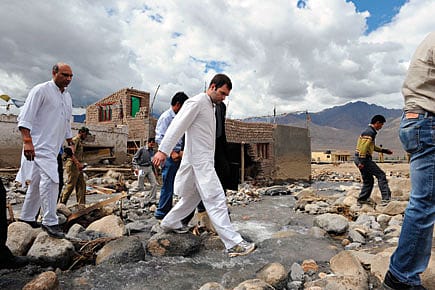
Not so long ago, he was a mascot of the youth. Now he wants to be seen as the voice of the aam aadmi. Great branding it may be, but success is harder fought
Even before he entered active electoral politics, Rahul Gandhi was a man with superstar status in India. Little was known about him, except that he belonged to the first family of Indian politics and was expected to succeed three prime ministers before him from the Nehru-Gandhi clan. And since two of them, his father and grandmother, were victims of political assassinations, he grew up almost in secrecy with rings of security around him, and went overseas for higher education.
Before he entered public life, Rahul Gandhi's training in business theory might have seemed irrelevant to his predestined role in politics. But, looking back at how he has pitched his image to the country, it appears that he has put his business knowledge to practical use. His brief association with The Monitor Group in London would have acquainted him with a theory of 'competitive advantage' put forth by the consultancy's chief founder, Michael Porter: you win either through a cost advantage or through a strategy of differentiation. Top brands always pick the latter, offering something others do not. And these brands also insist on being brands in the truest sense: they pack together a set of values that stay relevant. The making of the Rahul Gandhi brand, too, is set on differentiation. At a time when most of his generation are busy being part of an emerging India of urban prosperity, he has become the voice of the rural poor.
Unlike most politicians who gain fame only later in life, Rahul has not had the luxury of a clean slate. Spotty details of his pre-electoral existence were the stuff of living room chatter at one time, be it his time at Harvard (his withdrawn presence is remembered by many), love for superbikes (much reported), or Spanish girlfriend (not Colombian, as he corrected an interviewer in 2004). All this was before the General Election of 2004. Before he ran for the Lok Sabha, before he asked Indian voters to decide whether the BJP-led regime back then was "feel good or no good", before he was elected from Amethi in Uttar Pradesh, and before he became a general secretary of the Indian National Congress party (in 2007).
The images you see now are not of Relaxed Rahul. Not of his watching tennis or cricket. Nor of any superbike. The last such bike he owned was a Suzuki cruiser, but the latest bike ride he took—one that turned him into a superstar of a different sort—was on a regular motorcycle owned by a faceless villager agitating against police violence being wreaked on farmers demanding better compensation for their land being acquired by the UP government.
With that ride, Rahul's message was clear: he is a man of the masses, one ready to abandon his elite Special Protection Group (SPG) security to ride pillion on a farmer's motorcycle to join a rural sit-in. That ride, early in the morning of 11 May, helped Rahul sneak past a local police cordon to reach the twin villages of Bhatta and Parsaul, where farmers had gathered to protest the Mayawati government's land acquisition drive along the Delhi-Agra Expressway that is under construction.
Later that night, Rahul was in police custody, arrested for the first time in his life. During the course of a single day, he had taken a bike ride on a villager's bike, joined a group of farmers otherwise hostile to politicians, and even got arrested like an ordinary citizen—demanding to be shown a proper arrest warrant—and whisked away by the local police despite his SPG cover.
The police were all set to leave him at the UP-Delhi border, letting him return to the capital. "Instead, he insisted on being shown the arrest papers," recalls an associate who had accompanied the Congress General Secretary, "The police official heading the local police contingent, which included jawans of the Rapid Action Force, said that the papers were lying at the police station. As Mr Gandhi insisted on seeing the papers of his arrest, he was taken to the police station."
A few days after he returned from Greater Noida, Gandhi led a delegation of farmers to meet Prime Minister Manmohan Singh, demanding a judicial probe into the violence unleashed by the state police on the farmers. He spoke of "heaps of ash" he'd seen, the possible remains of farmers he alleged were killed by the police in Bhatta and Parsaul.
The visit to the PM was made a day after Mahinder Singh Tikait, founder of the Bharatiya Kissan Union, was cremated in his village in Western UP. Tikait is best remembered for his ability to rally thousands of farmers for an agitation. In 1988, his famous Boat Club rally in the heart of Delhi sent a clear signal that he had the capacity to lay siege to the capital if the concerns of farmers were ignored. On 15 May, Rahul may have led far fewer farmers—eight of them in all from Bhatta and Parsaul—to meet the PM, but his move was watched across the country by millions. Of course, Tikait never entered the electoral arena. Rahul is in the thick of it. But what farmers have longed for is a voice that reaches Delhi's corridors of power.
And what better than Rahul's?
"He wants to be identified with the bottom of the pyramid (BOP)," says Dilip Cherian, an image guru who tracks politics closely. And, Cherian believes, Rahul has adopted exactly the image he needs—of a man who stands for the poor. His record as a politician bears a consistency of approach that is remarkable. Images available to the public show him as a champion of India's have-nots: Rahul leading a poor child by his hand, Rahul carrying one on his shoulder, Rahul seated on the floor having a meal in a poor Dalit's house. Even for his meetings with visiting foreign dignitaries like David Miliband and Bill Gates, he preferred a rural setting. And when he spoke of a country where everyone can dream, his emphasis was on 'everyone'.
When Rahul Gandhi first travelled to the tribal areas of Orissa, on 7 March 2008, the budget session of Parliament was on. While fellow parliamentarians were busy working on the politics that would play out at the Centre, news of 'Rahul's discovery of India tour' began filtering through to audiences. His first stop was in Orissa's ore-rich but poverty-ridden tribal district of Kalahandi. This would be Gandhi's first visit to Lanjigarh, but not the last one, and also where he first articulated what he saw as the country's core challenge of the times: bridging the 'two Indias' emerging, "one having access to education, health and employment, and another that was lagging behind." A few days later, he would refer to the Two Indias in his budget speech in Parliament. The UPA Government had fulfilled its aam aadmi promises, he said, with the National Rural Employment Guarantee Act and Forest Rights Act. These were revolutionary legislations, he added, that would change the lives of the poor. If his concerns seemed to echo the Left's, it was because the Left—an external supporter of the UPA then—had claimed credit for exactly the same legislations (and the Right to Information Act as well). By making his point, Rahul wrested at least some of the credit back.
Having refused to join Manmohan Singh's Cabinet, Rahul had the luxury of raising issues of governance in much the same manner as the Left, and across the policy spectrum too. After the Left-UPA divorce in 2008 and the UPA's re-election in 2009, he, like the National Advisory Council (NAC) led by Sonia Gandhi, found himself freer still to play critic. "He is trying to fill up the political space vacated by the Left, taking over the role of the aam aadmi's leader," says political analyst Mahesh Rangarajan. "The CPM is in bad shape, its worse since the 1970s, and Maoists are not going to be in electoral politics. So the BSP has to be his and the Congress' major opponent as a political force fighting for the underdog. The political future of his party and his own depends on this," he adds.
Addressing a 'Save Forest' rally at Bhawanipatna in Kalahandi district, Rahul had announced: "Kalahandi ka, aur Adivasiyon ka Delhi mein ek sipahi hai; uska naam Rahul Gandhi hai" (For Kalahandi and tribals, there is a soldier in New Delhi; his name is Rahul Gandhi)." At Ijurpa, in Lanjigarh, a group of Dongria and Jharnia Kondh tribals opposing an alumina refinery planned there sought his help. More than two years later, during another session of parliament, the first monsoon session of the 15th Lok Sabha with the UPA back in the saddle, the lawmaker from Amethi once again left parliamentary proceedings behind for a meeting with tribals in Kalahandi. There was a marked change in his appearance. He wore his trademark white kurta-and-pyjama attire with sneakers, but this time, he also sported a beard. "You were fighting for your land and your faith," he told a congregation of tribals in Lanjigarh, "and I said to you: 'Look, I stay in Delhi. Your voice is being suppressed here, but I am your soldier in Delhi. But when I reached back and started making enquiries, I found that the voice of tribals is reaching Delhi and even outside India. I got to know that you were getting yourself heard in far places, and you were fighting for your rights. And, most importantly, that you were fighting peacefully… I did what I could, but this is your victory."
The victory in question was a rejection by the Union Minister for Environment and Forests Jairam Ramesh of the alumina mining project. The Vedanta Mining Corp, against which local tribals had complained to Gandhi on his 2008 visit, was denied clearance for mining in the area, despite protests from the Biju Janata Dal-led state government.
Between the two visits, there was another marked difference. The helicopter in which Rahul flew to address the gathering did not land at the Vedanta helipad this time, despite an invitation by the company, as it had in 2008. His team now had instructions not to take any favours from Vedanta, a name synonymous in tribal minds with the exploitation of resources that were rightfully theirs.
"To me, the Orissa tour and all such tours are a journey in understanding and getting close to the people," he had told journalists in Bhubaneswar on the fourth day of his Orissa visit in 2008. "All I do is understand what poor people are faced with,'' he said in defence of his visits to poor people's homes, adding that the only difference he saw between the poor and rich was a gap of opportunity.
At the Congress' 2010 plenary in New Delhi, it was clear that Rahul wanted the party to plug this gap in earnest. The smaller issues he has taken up since also seemed similarly aimed. In February 2011, for example, he led a delegation to the PM to demand a relief package for handloom and powerloom weavers who owed an estimated Rs 3,400 crore to banks. Rahul suggested that their loans be waived. Five days later, Finance Minister Pranab Mukherjee announced a Rs 3,000-crore bailout package for weavers in his Union Budget speech. Though Rahul's meeting with the PM came nearly a month after the Minister of State for Textiles Panabaka Laxmi had informed weavers in her constituency (in Andhra Pradesh) that such a package was on its way, in UP, the state's weavers—who are electorally significant in eastern UP—were left with the impression that it was Rahul's voice that had been heard in New Delhi.
There is almost a pattern in the way Rahul reaches out to the underprivileged and the manner in which the Congress rallies together to help sustain his pro-poor stance. The perception that everyone in the Government and the party is all ears for any utterance of his, is part of the package.
Take for instance Rahul's 2008 trip to Bundelkhand, a drought-hit area that straddles UP and Madhya Pradesh. In November 2009, when the Centre announced a special package of over Rs 7,000 crore for its development, the Congress hailed it as yet another Rahul victory. The party made it very clear that he had been pushing for it.
Surprise visits are also part of the leader's persona, all the better to project him as a serious man committed to the cause of poverty alleviation. In April 2010, he landed unannounced in Haryana's Mirchpur village, where a 70-year-old Dalit man and his disabled daughter were burnt alive by a group of Jats. Over 15 Dalit houses had been set on fire. After he reached the village, accompanied by Congress leader Prithviraj Chavan, his SPG
crew went around to the afflicted Dalit families posing as journalists. They said they wanted to speak to them about the incident in private, and took them aside to a spot where Rahul was waiting; the idea was to avoid any hype that a visit in full media glare would create. Such secrecy has worked in Rahul's favour before. Of late, UP has been the chief target of such visits, with the Mayawati government protesting his actions furiously. But the Hooda-led Congress government in Haryana didn't dare display any irritation on his Mirchpur visit. The only Haryana government official present on his arrival there was Naib Tehsildar Dheeraj Chahal, and that too by chance. As usual, the media was kept out. Yet, as usual, the visit attracted more than enough media attention.
The publicity machinery around Rahul ensures that the press is never denied details of visits such as these. Brands, after all, need to be consistent in the values they espouse. They can be as 'low-profile' as they like in that endeavour, assured of how even this can raise their profile.
"Almost whenever he makes interventions, the outcome is favourable, and secondly, he makes calibrated interventions," says Cherian, "I think he intervenes on subjects that he feels there is something to be done about."
Every move is clearly thought out. "His team members are doing research all the time. The idea is only to expose him to issues that give him some traction," adds the image guru. Rangarajan reads a political statement in the issues Rahul takes on. Land, for example, is an important political issue, and an economic one as well. Best of all, it transcends caste and community affiliations. "In the farmers' agitation in Western UP right now," says Rangarajan, "it is a case of crony capitalism, with the state taking away farmers' land." On current trends, he adds, expect Rahul to replace Sonia as the Congress' chief campaigner soon. It would mark a shift in the first family's core appeal: with the politics of sacrifice yielding to the politics of activism.
That shift would be catalysed by a popular trust that it would serve the country well. In itself, brand consistency has served Rahul rather well so far. But brand reliability is always harder earned. India hears him, no doubt.
But is that enough?