He sounded excited on the phone: “Come on over,” he said, “I want you to meet someone.” It was late at night, but this was a very dear friend, an entrepreneur and bike-racing champion. It took me an hour to our Khan Market rendezvous. In a few minutes, a car stopped in front of us, and out came Mahendra Singh Dhoni. He was accompanied by a friend, who from his puffed-up air looked like he might have been the Prime Minister’s media advisor. Dhoni looked relaxed. We shook hands and went to a café. He asked for a “light coffee” and we got talking.
The conversation veered towards cricket. “I can see you are not much of a cricket enthusiast,” he said, throwing a soft gaze at me.“Cricket died for me in April 1986…” I said. “…do you remember that match?” He smiled: “I was just five then.” As we sat there, a middle-aged woman came up to us and requested an autograph for her son. A man came by for a photo together. Dhoni obliged. Soon it was time to leave. We rose, and Dhoni and I shook hands—firmer this time.
I wondered how Ravi would have been after meeting Dhoni. And I thought of 18 April 1986. And 13 October 1983.
Ravi was my cousin, my maternal uncle’s son. They lived in a house next to ours in Srinagar. He was at the university, and a sort of role model. Like him, I wanted to use Old Spice aftershave, and have a poster of Srikkanth on my cupboard. In June 1983, India won the World Cup. My memory of the day is faint, except that I was woken up by the celebrations. I was just seven and understood little of the game. But in October that year, everything changed. That was when India and West Indies came to Srinagar to play the first-ever international in the state.
The teams arrived a day before, I think, and were put up in a hotel close to the Sher-e-Kashmir Stadium. They were received with traditional fanfare. On match day, Ravi and I reached the stadium early, walking past sniffer dogs. West Indies won the toss and chose to field. Gavaskar and Srikkanth walked in to open the Indian innings.
And then it began. The stadium was nearly brought down with deafening cries of “Pakistan zindabad” as green flags—both Pakistani and the identical Jamaat-e-Islami banner—hid the overcast sky. Many in the crowd held posters of Pakistan cricketers. The West Indies team were stumped; they didn’t know why they had so much support on Indian soil. Gavaskar was caught on the 16th ball he faced at a score of 11. The Indian side crumbled in 41 overs for 176. Later, as West Indies played, the Indian fielders were booed. A half-eaten apple hit Vengsarkar in the back. India lost. Many years later, Gavaskar would confide to Rahul Dravid that the fastest he had seen anybody bowl ever was Malcolm Marshall that day in Srinagar. Kirti Azad, who hit two defiant sixes in a lost cause, recalled that day many years later: “It was like playing in Pakistan against Pakistan,” he said to me at a function.
Returning home after India’s defeat, Ravi and I did not speak a word. He tried to comfort me by treating me to a bottle of Gold Spot.
By 1986, my political education was complete. I knew what India-Pakistan matches were about. Some of it I learnt in June 1984 when Operation Blue Star was on in Amritsar. A mob attacked the Hanuman temple next to the Amira Kadal bridge and threw the idol into the Jhelum. By now, we’d started following a forced blackout on Independence Day.
So, on 18 April 1986, when India and Pakistan were playing the final of the Austral-Asia Cup in Sharjah, I bullied my grandfather to buy me crackers from Maharaj Bazaar in the heart of Srinagar. At the ground, you could see Arab ‘Sheikhs’ in the VIP enclosure throwing money in the air whenever Pakistan hit a boundary. But India managed to stay afloat against all odds.
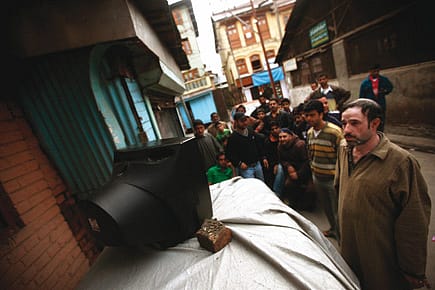
The last over. My heart was pounding my ribcage. The last ball. Pakistan needed four to win. Javed Miandad was on strike. Chetan Sharma had the ball. I had a matchbox in my hand. Sharma bowled a low fulltoss and Miandad hit it for six. The stadium erupted. Miandad and No 11 batsman Tauseef Ahmed ran to the pavilion jubilant. My matchbox went limp with sweat. Every combustible item in the Sharjah ground was on fire.
A few seconds later, it was Diwali in the Valley. Throngs of people came out to celebrate Pakistan’s victory, and in the nippy April weather, they drank gallons of Limca to celebrate. I wrote in a memoir of the day: ‘I lay huddled in a corner of my house, ashamed, like that wealthy father in an Indian movie whose daughter had eloped with his driver.’
In less than four years, we would have to leave our home. The jeering of Indian cricketers had turned into a call for azaadi. In 1997, Ravi, who had become an academic and refused to leave Kashmir, was dragged out of his bus with two other Hindu colleagues and shot dead.
Twenty-five years after Sharjah, as India registers yet another World Cup victory, I know enough to keep away from all the jingoism. Victory or defeat in cricket means nothing to me. As I write this, people have convinced Omar Abdullah to grant land to Suresh Raina, whose family once lived in Kashmir. My father had tears in his eyes when India won. He looked at me expectantly. I couldn’t tell him that my feelings of 1986 remain. In More Die of Heartbreak, Saul Bellow called these feelings ‘first heart’. My first heart remains close to that failed yorker bowled by Chetan Sharma.


OLDER COMMENTS FIRST
22 COMMENTS
Permalink
Lovely article. I loved it. Reading it I went back in time watching that match as a kid. But today is a different day. The cup is in our hands and Javed Miandad is an old man who can only clap in the sidelines and applaud Dhoni's captaincy.
Permalink
wow. that's some experience. I feel you..
Permalink
Thanks Rahul for writing this piece. We are living in an age where intellect of a journo is determined by how well he can justify stone pelting and hatred towards anything India. So I am sure you will get very few comments on your piece.
Sometimes I ponder if religious fundamentalism has taken over the call for so called "azadi". Now I believe its a bitter truth that no one even dares to acknowledge.
Permalink
the article left me spell bound. . i guess this is what one can call. . written from the heart
Permalink
These all incidents will haunt the indian diaspora like anything, Even after knowing how much resentment there is against India among kashmiris still india claims kashmir to be its integral part, i dont understand why. Dear Indians trust me our hearts are never with India no matter what. I repeat with ''INDIA'' not indians.
Hope the indian government realises it soon before iits late.
Permalink
beautifully written. thank you. I would love to read that memoir of yours. and may Ravi rest in peace.
Permalink
Excellent write up...I had forgotten orange flavored "Gold Spot" long ago.The infamous/ famous loss of India against Pakistan had developed a sort of fear-psychosis, with India losing almost every one day cricket game against Pakistan, and that too for years.
you write up has once again freshened some of my childhood memories of Kashmir,its people and the sort of emotions attached to this game in the valley of Kashmir.
Permalink
i so much identify with the author's write up....totally agree with u....
Permalink
India in 2011 seems to have left he India of 1986 far behind but having read comments attributed to Pakistan's Ambassador-at-large I wonder whether the Pakistanis are still living in that moment,refusing to let go of it.
Religion has never been far from the cries for 'azaadi' in Kashmir; however, the sad fact remains that our 'progressives' have never gotten round to admitting that fact.'Azaadi' for Kashmiri Muslims will translate to Ghulami for the rest of the Kashmiris-unless the newly azaad awam decides to do away with the Kaffir menace for once and for all.
Permalink
Very good post, i still have that "first heart" feeling but after the world cup win it subdues a bit. Sorry for your loss in Ravi
Permalink
This same thing with muslims is being repeated all over India. Not all muslims of course, but too many. Too many to be ignored. God save the muslims from their own actions.
Permalink
Beautifully written... Although i feel that the day is long gone now.
The Kashmiris resentment for India is not going to go away easily or in near future. And frankly i feel, we have given way too much importance to how the one-third of the junta in the state feels about a cricket match played by India. Or Pakistan.
Lets forget all of the above, and lets must live this moment of victory the best we can as Indians.
Permalink
Very beautifully written. And kudos to open for publishing this when the rest of the press shies away from publishing the naked truth when it comes to kashmir or to justify any and every action of kashmiris.
Permalink
Beautifully written, Rahul.
I remember one more piece in this magazine about the writer watching the India-Pakistan match in Srinagar with the locals. The writer managed to complete the whole article without one direct reference as to which side the locals were supporting.
Permalink
Agreed, well written. But the fear that the country is divided on religious lines is true. That the existence of Pakistan is on false grounds hardly gets a chance to be proven. But the logic of Pakistan fails repeatedly. Only blind reconciliation can succeed for people. It is happenning but very slowly. People like Manmohan Singh and party like Congress cannot do it. Some kind of Regime change may work. Anna Hazare may be the hope foir the future.
Permalink
With the help of Allah and on behalf of the 90 percent Muslim majority of the Valley, I assure you that your temples, lives, property and honour would be protected by us as you return to your original homes here: Geelani Sahab
Permalink
Its clear that the separatist movement is about religion and any talk of it being a secular movement does not wash. Its clear from the slogans that are used by the protesters, from the lack of participation by non muslims and from the plight of the Kashmiri pundits who were driven away. The Kashmiris have not shown any remorse for what they did to their pundit brothers and have created their own funny story about all the pundits having been miraculously transported by Jagmohan to "defame the movement".
Permalink
The Kashmiri separatist movement has been entirely about religion. This is clear from the slogans that the protesters use, from the lack of participation of non muslims in the movement and from the plight of the Kashmiri pundits who were driven away from their homeland. Also, the separatist movement has been about joining Pakistan or at least having some special relationship with Pakistan as is again clear from slogans used (e.g. Pakistan se rishta kya etc) and the only reason they talk about independence nowadays is because it is embarrassingly obvious that Pakistan is falling apart.
Permalink
beautiful words to your emotions....
I don't follow cricket, all the euphoria around it seems misplaced somewhere, but this article brings back memories associated with game, all the loved ones, the departed souls and relocated family members... the green fields, men in Light blue, the Gold Spot Cricket books...
Thanks Rahul....
Permalink
i lost words to comment, just goosebumps
Permalink
My heart bleeds for Ravi. Excellent post.
Permalink
Excellent piece. Great job done Rahul.
Cheers
KK
Post new comment