Elephantine Speed
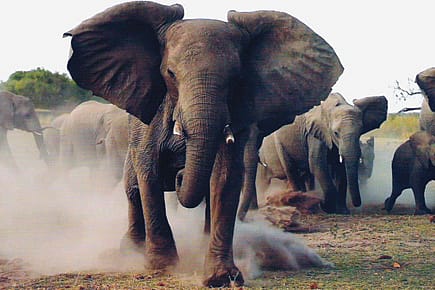
The physics behind the charge of a bull elephant had remained somewhat of a mystery till recently.
Can elephants run? A strange question for anyone who has ever witnessed the charge of a bull elephant, but pertinent given the elephant's size. Most animals transit easily from a walk to a bouncy run, often with all four limbs off the ground, but nature has obviously not designed a four-tonne elephant to bounce or float in air. So how do elephants manage to move fast with such efficiency?
They seem to have an exceptionally stable and efficient way of moving fast. After all, a human runner exerts force thrice his body weight when running, while an elephant manages to move by exerting a maximum force of just 1.4 times its body weight. Moreover, the elephant's centre of mass shifts by less than a centimetre while moving fast, a feat no human runner can match. Put this together and an elephant's cost of transport is one-third of a human's, weight for weight.To understand this pachydermal ability, Belgian scientists studied Asian elephants in Thailand. It was no easy feat: it required an 8 metre long force platform with reinforced concrete foundations. Spurred on by a mahout to their equivalent of a run, the forces generated by 34 different elephant, ranging from a 870 kg baby to a 4 tonne adult, were measured.
Most animals while running convert the energy stored in muscles into bouncing kinetic energy by bobbing up and down, but while walking they convert stored energy into swaying energy by a gentle pendulum-like motion. Elephants, the study showed, tended to fall somewhere in between. In the first half of their stride they bobbed from side to side to maintain a constant level, while in the second half of the stride they bobbed up and down like a runner.
"They don't really run in the classical sense," says Heglund, one of the authors of the study. "They can't quite kick it into second gear, so they're stuck halfway in between." So an elephant manages a half-run, half-walk, keeping at least two legs on the ground even at full speed. In short, the answer is the front legs walk while the rear ones trot.

The Liberation of Bengal
05 Jun 2026 - Vol 04 | Issue 74
A silent revolution ends the reign of fear