The Right Thing to Do
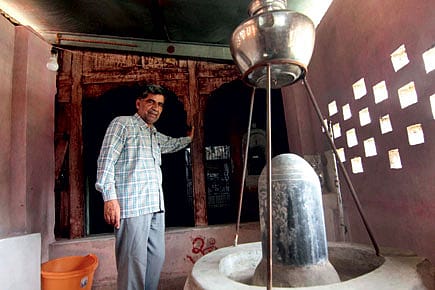
Even during Kashmir's worst years of insurgency, says Ghulam Mohammad Malik, a retired Muslim teacher who has been protecting a temple in Srinagar for over a decade now, no one ever raised an eyebrow at his presence there
I have lived in this locality all my life. A lot of Kashmiri Pandits used to live here earlier. I remember, during my childhood, there used to be an annual festival, Kande-vurus, in which both Kashmiri Pandits and Muslims would take part. Sweets would be distributed among the people. Thousands of Kashmiri Pandits from across the Valley would come here to take part in the festive gathering. Those were happy times.
However, things changed after 1990. Kashmiri Pandits sold their houses. Only two Kashmiri Pandit houses are left in this locality now.
This school was established in 1959 by the Rupa Bhawani Trust in the memory of Rupa Bhawani, a mystic poetess who used to live in the house next to this school. Pandits believe she had spiritual powers. Like the Kashmiri mystic poetess Lal Ded, it is believed that her in-laws would mistreat her. Legend has it that she took her life by jumping into a well. And when people tried to save her, only some of her hair could be recovered. After her marriage, she came to live here in the Khankah-e-Sokhta locality in Nawakadal, Srinagar. It is said that her husband would often complain that she would leave home early in the morning and return home late at night. Legend has it that one day, her husband saw her walking on the Jhelum, and crossing it on foot. After her death, people spoke of seeing her in different parts of the Valley. Her legend grew and she became a revered religious figure among Pandits.
Back in 1995, I had retired as a government teacher and was looking forward to a relaxed post-retirement life. However, people from the locality requested me to look after the school. There was a respectable Pandit teacher, Sheela Kaul, who used to run this school. When she passed away in 1996, the Muslims of the locality performed her last rites. Before her death, she had handed over the school to some young teachers, but they couldn't look after the school affairs properly. Earlier, the school used to be very popular and respected, and once had 1,200 students. Getting admission to this Pandit school used to be tough.
Since I had been a teacher all my life, the people believed I could look after the school properly. They asked me to take it over. So it is that I started taking care of the school and the temple housed inside it. When I took over the school, only 23 students were studying there. I did not change the name of the school—Vidya Bhawan means a temple of knowledge. When I joined the school as principal, I felt the need to renovate the temple. But I made sure that it remained functional for devotees. I incurred all the expenses for the renovation from my own pocket. I even brought a new Shivling all the way from Allahabad and placed it inside the temple.
There was no photograph of Rupa Bhawani in the temple. I discovered one of her photos in a religious book, got it enlarged and placed it inside the temple for devotees. In fact, I sent a relative to Delhi to get the photograph enlarged and framed. I also collected many small photographs of Rupa Bhawani from other books and kept them inside the temple. I would light incense sticks inside the temple every day. I also renovated the kirtan hall, where devotees pray. Since I was the caretaker of my school and the temple, I would even decorate the temple. I made every effort to keep the temple functional during all these years of turmoil in the Valley. No one asked me to do it. And I was not doing a favour to the Pandit community. I did it because it had to be done, because it was the right thing to do.
The temple belongs to the Rupa Bhawani Asthapan Trust, whose office is based in Jammu. I even approached them to seek their consent to officially become caretaker of the temple in Srinagar. In 1999, I travelled to Jammu twice, and signed a deed with the Trust to look after the temple.
This is perhaps the only temple in Srinagar which has never closed down during all these years of turmoil. I ensured that it remained functional throughout the turbulent 1990s. There are many temples in downtown Srinagar which are still in a bad shape, some of them just a little distance away from this school. Seeing this temple stay functional and in good condition, the valley's Pandits had requested me to look after other temples too. But I can't; I am too old.
I remember that the military once came inside the school premises to search for arms. They damaged the wooden ceiling of the temple in the search operation, but they didn't find anything. Sometimes, militants who belong to this locality would come to hide inside the school, but after I became its principal, they stopped.
They knew me, since I had taught all of them.
I don't do this for money. I look after the temple in the school because it is my duty. It has to be done. It is my responsibility as a Kashmiri. No one came to hurt me all these years or asked me why I was looking after the temple. Kashmiris are not communal by nature. Kashmiri Pandits should return to their homeland now. The struggle of Kashmiris is political in nature.
I work on nominal wages in this school. I pay a monthly rent to the Trust. I don't take a salary from this school. Whatever we earn here, we distribute among the school's teachers. Now, we have a roll of 104 students in the school.
As long as my health allows, I will continue to look after the temple and school.
As told to Majid Maqbool