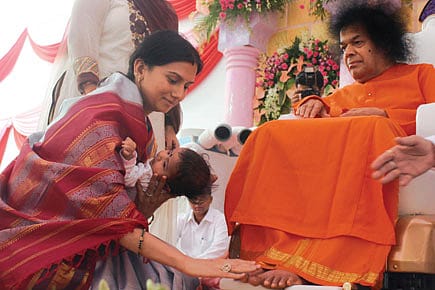
It is confusing to see a healer in a wheelchair, but the miracle man made the irony disappear. When Sai Baba visited Bombay this week, waiting to fall at his feet were some of the most powerful men in the country. It was a familiar world at his feet, where usually presidents, ministers, RBI governors, corporate chiefs and Supreme Court judges arrive. There is something frightening and melancholic about it—to know that your country, your life, in a way, is run by people who believe in the powers of a godman.
The endurance of Sai Baba as some form of a god is astonishing. He has been publicly accused of sexual abuse and his miracles would increasingly appear naïve today even to his devouts (PC Sorcar once claimed he was just a bad magician. Sorcar, famously, converted Sai Baba’s sandesh-from-thin-air into rasagulla). Rationalists have for long tried to discredit Sai Baba. Once they even filed a case against him for producing gold chains from thin air. They said that if they were created through supernatural means, they devalued the precious metal by increasing its supply. But in the end, Sai Baba has triumphed. Faith, as always, has beaten reason.
Some people are repulsed by the sight of influential men falling at the feet of godmen. The sentiments of the believers in the paranormal are protected by law, but those who believe in reason cannot be guarded in this manner. They go through life, especially in this country, not with the chuckle of superior disdain as people imagine, but on some days with great rage. Days when they are reminded that men who run the country seek extraterrestrial help, that criminals donate kilograms of gold to temples to absolve themselves of their latest crime.
There is this unsung decency about atheists, as they are loosely called. They know there is no hot weather hell, there is no punitive rebirth as an earthworm, yet they never hope to benefit through evil. They do not create traffic jams, they do not create noise, their charity is never a pathetic transaction. In their moments of confusion, at the most they would say, ‘I believe in a Force’. It is not a great line, but it is a pure line—they really do not expect the ‘Force’ to do them any favours, like increase their salary. They just go about their lives without harming anyone, even though they know nobody is watching. You may say this is too much generalisation, that most bad people are bad because they are godless. But that is the astonishing thing. From what I have seen, most criminals (and criminals who have given themselves fancier names) are great believers in God.
There is a spiritual movement among the urban affluent to understand life through a guru who is differently dressed but is not expected to do magic. Sri Sri Ravi Shankar has filled this slot through entrepreneurial brilliance.
A few years ago I interviewed him at a Malabar Hill house (of course). On the floor were seated Vinod Khanna, Nagma and others like them. On a throne was Sri Sri. I was supposed to interview him in front of his devotees, some of the most influential people of Bombay. There was a vacant chair facing Sri Sri. When I sat in it there were gasps. I was expected to sit on the floor (a journalist before me indeed had sat that way). But then I am such a boor.
I asked him questions like why he spent so much time with the rich (Vinod Khanna laughed in a good-natured way at the foolishness of a young reporter). Sri Sri would reply by saying my facts were wrong (and the gathering would laugh at me), or he would snub me by saying that if only I smiled more often I would understand everything (and the gathering would laugh again). As I was leaving, he said something about me (which I could not get) and the crowd burst out laughing, this time louder.
I really do not know why these people were there on the floor, listening to someone who said something like, ‘Don’t fall in love. Rise in love…We are all one.’ Surely, they have heard all this before they met him?
People who do not seek divine mediums, who know that ‘scepticism’ is merely a name given to higher intelligence, they do have their just rewards. They go through life with a clarity of mind which is like a clear, beautiful day.
It is also called joy.


OLDER COMMENTS FIRST
31 COMMENTS
Permalink
true.
Permalink
Hi Manu,
"They do not create traffic jams, they do not create noise, their charity is never a pathetic transaction."
- You obviously haven't heard of Dravidar Kazhagam in Tamil Nadu.
But there's a bigger issue. You seem to suggest that atheists are decent etc etc. That's a very narrow and wrong way of looking at things - no better than saying that 'Whites are decent, Blacks aren't; Hindus are decent, others aren't; Mumbaikars are decen, Delhiites aren't and so on.
It's far better to instead divide people at large as decent and indecent, and then make further subcategories. Only that matters. Like Viktor Frankl said while narrating his experiences in Auschwitz: "From all this we may learn that there are two races of men in this world, but only these two - the "race" of the decent man and the "race" of the indecent man. Both are found everywhere; they penetrate into all groups of society."
Permalink
There is this unsung decency about atheists, as they are loosely called. They know there is no hot weather hell, there is no punitive rebirth as an earthworm, yet they never hope to benefit through evil.
I'm an atheist, so thank you v much, but before we all get too carried away, Stalin, anyone? Mao, perhaps?
Permalink
Yes, we are the truly enlightened ones. No seriously we are (wink, wink). What is amazing is the amount of intellectual and creative insight some of these ardent followers show in their respective professions. Precisely why they want to be chided, patronised, told like children when it is alright to let themselves go and when not to, displays a rather lopsided development of personality. Or maybe an unfillable void or unquenchable thirst to be taken care of, being looked upon, judged and advised. Reeks of infantile insecurity (not that I begrudge them this, no, we are all insecure and we all have our demons, but it's their pathological denial and self-delusion that I find tiresome).
By the way even a casual flip through any of the speeches and an objective perusal of the "extraordinary documents and books" written by these godmen reek of a cocktail of self-contradicting mish-mash of Western and Eastern philosophies. Well, as long as it gets the followers through the night. Faith is a beautiful thing to have, but these cults give me the creeps.
Permalink
I do hope the writer felt equally frightened when Dalai Lama was received by the CM when visiting Tawang. Or if the Pope ever visits India, and is received by some head of state.
Oh wait, but that doesnt qualify for Hindu bashing!
Permalink
I just dont understand why the journalists (representing the so called modern generation) are hell bent upon popularising the western way of life (be it good or bad) and desecrating the spiritual Indian way of life despite the fact that the Westerners look upto India and its spirituality to redeem them of the worldly affairs and give them some peace of mind.
Comeon, tale some pride in being Indian, have faith in its spirituality, morality and stop worshipping the so called modern and progressive western ways; Things like onen night stands and other supposedly progressive ways have done nothing good to their society. Dont make Indians go through the same mindless acts and fall into the abyss of immorality before it realises its folly.
Permalink
Take pride in India's spirituality and morality? What a laugh. The earlier these self-styled godmen are denounced as charlatans and shown the door, the better it would be for us poor gullible Indians. Not that it's going to happen in our lifetime, but we can always hope. By the way, Manu, your analysis was spot-on.
Permalink
The ideas are nicely put forth. . But its the experiences the individual has in his life and the way he is brought up that puts him in the category of good or bad ; theist, agnostic or atheist. . Clarity of mind would be better in case of atheist because he doesn't give fate as the reason, but that doesn't mean he isn't bad. . Well lot of thoughts after I read this. . Kudos for a nice read. .
Permalink
I liked the article very much. Going through the comments, one can see more number of reactions had come from theists. One even brought the concept 'Hindu bashing'. That's the problem when we articulate our reasoned views. 'They' feel disturbed and come up with silly notions as they always do in their religious matters. They are staunch we cannot change that. That's their way of life. We atheists just keep our journey. Manu really expressed some views of a real atheist. ( And Dravidar kazhagam is no longer a party which it claim to be.)
Permalink
Atheism and decencyshare the same relationship as alcohol and immorality. None. Except in the minds of the prejudiced.
Permalink
In your well-articulated piece, you rightly deplore the culture of worshipping gurus and spiritual healers to the extent of self-debasement. While it is true that leading a life based on reason makes one feel free and in control of one’s life, it doesn’t offer much help when one is faced with situations in life that one would rationally consider utterly hopeless. No doubt, reason provides one with the intellectual ammunition to fight the hardest battles in life, but it is faith that gives one the reassurance and solace of a shield. That shield is hope; the rational may consider it pointless and absurd, but for some that might be all that is needed to face life.
Mr. Joseph, have you ever asked yourself why the chatty rickshaw guy takes the shorter less congested route even though it is more profitable for him to not do so? Have you ever wondered what makes the friendly narial pani vendor grin so wide when you thank him for the delicious drink? These are simple, honest and “god-fearing” people who may not be very intelligent, ambitious or knowledgeable, but they wake up every day with a clean conscience and go through their modest business with the purity of mind, which you seem to think is the sole property of atheists.
I urge you, Mr. Joseph, to stop tying all believers into a crude bunch of people who create traffic jams, make unnecessary noise and look down on non-believers as if they were aliens. Similarly, stop glorifying all non-believers as unsung heroes, for there are some who have no beliefs, no ambitions, no fears, no hope and hence no direction in life.
And then perhaps you will realise that being rational takes more than just picking faults in the faithful. It requires that you take all the relevant facts into account; otherwise you will just come across as a resentful and defensive cynic.
PS: Thank you for such a thought-provoking article; I eagerly look forward to your next one.
Permalink
From
Manu Joseph
Dear Mr Vishwanathan and others who have similar views,
Obviously, every person has the right to believe in any form of spiritual philosophy however illogical it may seem to others who have different views (In fact, though this may sound satirical I honestly believe that we have a right to be confused, especially in spiritual matters. Philosophy, all sorts of philosophy, to me, is nothing more than an expression of this confusion. And the best quality of god is that It gives many people hope, false hope but still hope instead of despair). Needless to say, non-believers and believers are at the same level of spiritual incomprehension and we have our own ways of finding meaning. My piece has to be read in the context of my contempt for the overt symbols of religious stupidity which is far more potent and dangerous than agnostic stupidity. If faith blinds people so much that they can't see through low grade magicians and frauds, then it is dangerous as it is evident in the world today. I did not mention this point because I presumed it was self evident but now I think I should have invested more words in clarifying this aspect.
MJ
Permalink
Mr. Joseph's article highlights complex social behavioural patterns distinct to Indian society. Indians have habitually ignored rationality and reasoning when it comes to flocking around spiritual leaders and adoring their eccentricities. That the mighty and informed joined the gullible makes it a complex social phenomenon. While Mr. Joseph's analysis stands out for its substance, its innate bias is tempting and too obtrusive.
Just like the Pope calling Indian Christians as Hindu Christians, these could be part of what the Supreme Court described Hinduism - as a way of life, implying that such behavioral patterns could reflect in all social segments. Like the early Christians in Kerala following local Hindu rituals in their way of life, there are abundant instances to cite Sai Baba type idiosyncrasies in Christian and other social grouping. The Christian clergy doubles up as the religious and spiritual leadership, which followers of Sanatana Dharma miss, a reason why god men are in demand.
As for the foibles, the discourses of the Christian clergy could sometime resemble kindergarden moralism, which even their rich and mighty listen to with fervor, though practicing those morals might be anathema. Some rituals of Anglican groups like the Pentacoastal Church challenge civility and could give tough competition to Sai Baba school of tricks.
Similarly, like the high and mighty prostrating before Sai Baba, the Christian clergy in the country, especially Kerala, have massive influence over governance systems, with the officials from the respective denominations often showing more loyalty to their high priests than to the political leaderships. While appreciating Mr. Joseph’s attempt to highlight such behavioural paradigms, I would look forward to similar analysis on social templates of other groups so as to understand the complex society that is India.
Permalink
Its funny how people first notice the religion of the person posting views against a religion. When and atheist is pointing out to the surroundings, people first connect the examples to some religion and then compare it to the religion of the person who posts it and then come to a conclusion that the person is anti_________ . Why do people often miss the forest for the trees? (err, is that the way its said?)
Anyways, Manu, nice article.
Permalink
Well, as the old man himself said (before Mr Frizzy Fraud turned up)....
Sabkaa Maalik Fake
Permalink
One of the comments (evidently critical of my earlier post) is right in pointing out biases in the way people respond to polemics. (Interestingly when I was pointing to some biases in Mr. Joseph’s piece, this particular post was pointing to biases in my comments.) And he finds it funny that Mr. Joseph's surname could have been the basis for my comment. I would suggest that it is not unusual because Mr. Joseph wrote it. The whole Indian secular and liberal press has reported and celebrated India's unique god men. And I have found reviews and responses of various hues to such reports irrespective of the surname of the journalist.
While appreciating the work done by Mr. Joseph, I only suggested him to broaden his spectrum of analysis. However, since the social identity of the journo has inevitably crept in, I could also like to suggest that I have rarely seen any Christian journalist (but for some like T J S George) daring to critically write about social mannerisms or primitive rituals of Christian groups or clergy. The chunk of work in Indian journalism has focussed on godmen and Jihadis while nearly none might have enquired about fundamentalist thinking among some Christian groups, which even affects other broad-minded Christian denominations, which have done yeoman service in the country. (As seen in Mangalore where the Catholic Church was critical of the functioning of some hardcore evangelists, which had given fodder to Hindutva extremists)
Biases are so strong in our polemics today that discussing religious conversion is seen as blasphemy. Considering the concerted focus on Islamic fundamentalism, it is not surprising that the media and social leaders in Kerala are now crying foul over Love Jihad, blaming it again on Muslim fundamentalists. No such hype has ever fallen on hardcore evangelist groups triggering social unrest in backward regions. But for Sister Jesme’s book and some beat reporting on the Abhaya case, how many newspapers in Kerala, especially those owned by Christian families, have dared to go beyond the superficial on issues pertaining to the church or the clergy?
A journalist is supposed to be objective, though the moment he or she gets into analysis, his or her innate personal biases creep in. Mr. Joseph is known for his professionalism and near-total objectivity. But ultimately what we read are his perspectives on the things he sees. Hence that can be subjected to dialectics irrespective of the merit of the article. The nature of reviews might have been different had Mr. Joseph analysed Mr. Ravi Shankar's Art of Living and whether that man really means business (not the commercial one). Though not a follower of his school of thought, I feel he has strong contributions to his credit which are worth examining (along with mannerisms).
Like Marx said religion is the opium of the masses. The sedation could then be in the air.
Permalink
Very well written article. However, in the case of the Sai Baba and a few others, it appears that the blind devotion of his followers may have ultimately benefited the society at large in terms of the development projects that were financed by his trust. I wonder whether a modern day rational thinker would have had such practical benefits notwithstanding the intellectual enrichment he/she may have provided.
Permalink
Millions of people (among them former atheists and rationalists) consider Sathya Sai Baba their spiritual guru, not because of blind faith but because of the personal experiences they have had with Him. 'The Decency of the Atheist' (13 November) is unfairly contemptuous. A believer has never denied an atheist his right of disbelief, so why does the atheist (and the so-called rational) want to deny the believer his faith? I don’t see a valid reason as to why the rational’s sentiments are hurt because he has no right to judge spiritual personalities, their activities and the people who go to them, since it is a subject he knows ill about anyway. What makes the atheist think only he is rational? Is he implying that a believer is foolish? Sorry sir, it is insulting and discourteous.
Permalink
Right from the title ‘The Decency of Atheist’ (13 November) the writer’s bias against Sri Sathya Sai Baba is manifest; thereby losing any claim to objectivity. It is surprising that the writer does not grudge atheists and ‘rationalists’ their disbelief, but grudges the belief of the believers. Obviously, the lakhs of people who throng to Baba have had truly miraculous experiences which have led to and reinforced their faith; something that a magician, the last refuge of Baba’s critics (and to whom the writer too has predictably run), is unable to provide. That these lakhs of people thronging to Baba include some of India’ s finest minds like Nani Palkhivala and Justice P.N. Bhagwati and most of our famous classical artists, should have made the writer pause and reflect. Moreover, magicians ask for, hide and then ‘magically’ make your own ornaments reappear; they do not produce new ones of immense value and variety and then allow you to keep them. They also do not cure thousands of people or confer bliss on them.
It is very unfortunate that in your magazine which has many excellent articles, such an unresearched aberration like this (which should have been titled ‘The Indecency of the Atheist’), has appeared.
Permalink
It is again the time to explore Nirgun!!
Permalink
Lets start off on a critical note, Mr Joseph, shall we? While your godmen arguement is admittedly spot-on; I could not help but beg to differ with the rationale behind your noble atheist arguement. Though your illustration of corrupt ladies and not-so-gentle men in society turning devouts for the sake of 'instant salvation' is possibly true; your notion of the do-gooder atheist perhaps pushes the envelope of logic a tad too far.
My reaction, like the others surely bears the weight of my personal ideology, though I choose to be (for lack of better words) analytical, shall we say? While the problems of religion and society in the west was a deceptively simple affair - with the division of the church and the state during the times of the Enlightenment and the Renaissance signalling the inadvertent focus on man thereafter - the story in the Indian context is at best, a bubbling mish mash of complexity.
Given the presence of multiple prominent faiths and the divisions inherent within the Indian society, coupled with the distinct interactions therein, your logic seems to rely on gross oversimplification at times. Surely the notion of atheists doing random favours is a nice idea, but who's biting the bait?
While we surely do not need god men and women (glorified and reeking rich agony aunts/uncles?) to fill our lives with vacuous yet seemingly wonderful (and redundant) advice, we could do well with some nice helpful atheists running about saving the day and not honking at traffic signals. The world would then be a better place. I think you have the ideas in place, my humble opinion is you need to expand on them, and this time, ditch the all-encompassing blanket of logical inconsistency. Back up your arguement and you'll probably make an even better journalist then. Whotsay?
All the very best, and do keep writing.
Rahul Ganguly
Permalink
As an atheist my self I have to say your generalization of atheists as some kind of perfect do-no-harm being is grossly overstated. We function just like the rest of society, with good and bad people doing good and doing evil. Trying to paint us as better than the rest does no good to either the atheist cause or your credibility.
Permalink
If not for the article, some of the comments here have been truly enlightening. This is what works best for all of us.
Debate and discuss. In the end, everybody is free to follow his own belief.
Permalink
Dear Author,
If people falling on godman's feet. Whats your problem?.
Try concentrating on educating people instead of wasting energy on criticism..
Just. suggestion..
Permalink
I was carefully going through all the posts...And yeah, as Gautam said, in the end, it's the personal choice to whether believe or not in God or Godmen...Has any theist proved the existance of God for others to see or had any athiest come up with a theory which properly substantiates his beliefs?! If you could show me some X (sorkar for that matter) claiming baba is a fruad, i could show you Y who feels his prayers were answered.
So lets stop pondering over this topic of God, for centuries hasn't been able to prove his existance nor his inexistance
Permalink
correct me if i am misreading this: aren't you conflating scepticism with atheism? i would be happy if atheism could lead to the promised land of 'clear, beautiful day also called joy'. my scepticism -- and experience -- however, leads me to believe that more often than not, it is quite the contrary with atheists. they do arrive at clarity, but that's usually by way of simplification; it's also called reductionism, and it makes bitter old men.
this is a very nicely written piece though. i'd like to know more about the kind of an atheist you are.
Permalink
‘The clear confession of a confused mind’ is what I would name this article of yours as. The contradiction in calling one an atheist who does not believe in god men and who believe in a Force instead, is your indirectly announcing atheists as divine sparks, just like theists.
Taking an example of Sai Baba and Sri Sri you have, without your knowledge, stepped into the portals of wisdom; and confusion is the first step. P.C.Sorcar demonstrated that, which all of us can do, only if we know. Transforming a sweet from one form to another is not a miracle but a mere knowing of the fact that nothing is magical. What P.C. Sorcar did was flaunting his ego. It’s astonishing and yet ridiculous that a man like him has still not come up with something like a Super Specialty Hospital, or a Water Project catering to the needs of millions of hapless villagers which the godman did, silently, to the extent of denying the Nobel Peace Prize. THIS DEMARCATES GOD OR A SUPERNATURAL BEING FROM US. God is a silent worker. Sai Baba knows that he has come here for a purpose and we have to emulate that. Politicians have flocked around him, to make amends for, all they felt, once upon a time was right to them, or found themselves lost when they did not achieve their desired purpose. The god man simply gave them a chance to start over all again. The value of gold is null and void when it comes to death. Only special people get the privilege to obtain gold free of cost. Had we been special, with our limited needs and demands and desires, we would also have been equal beneficiaries.
People find it easier to tarnish the name of those who do good so as to save their business and that is exactly what those lousy people condemning this Godman of sexual abuse did, cause they had no other way. If that was true, then instead of landing up in jail, how did people find him in the moon??
Sai Baba triumphed because he was clear in what he was doing, in his intentions, and people bought it. That had to happen.
Considering the healer himself seated in a wheelchair, sources came up with the fact that this godman has taken upon himself the various disasters that would have befallen us by now, irrespective of the fact whether we are devotees or not, atheists or theists. Sometimes even individual’s pain.
Sri Sri quoted from Neale Donald Walsche’s uncommon dialogue with god Conversations with God. We do not fall, we rise in love. Real love transforms us to better human beings, a Hindu a better Hindu, a Muslim a better Muslim, a Christian a better Christian. Real or pure love doesn’t see any distinction, doesn’t have separatist feelings.
Rich people are gold mines for godmen who wish the well being of all- all stratas of the society. The rich has to be appeased to help and reach out to the not-so privileged. The sentiments of those who believe in reason, is no guarded by law, for, with change being constant and reason falling in the periphery of change, reason is bound to be inconsistent, changing. Laws are man-made and faith alone can bring rewards as it is constant.
Sri Sri has told you to smile. Acceptance of what is and letting go and considering ‘this too shall pass’ are beliefs, that once imbibed, will bring a natural smile to all.
Clarity comes with the death of mind. Mind is illusion. To be what one is, at all circumstances, is the definition of a true human being and with this article you have given a glimpse of your true self which is valuable.
Permalink
Aparajita. greater bullshit has never been committed to any website (maybe even words) than what you have just written over here.
There could yet be salvation for you, child, if you seek help.
Permalink
Very well put! I agree with your views a 100%.
Permalink
Most of the comments following your article have proven your point: "Faith, as always, has beaten reason." !!
I believe in God. I do not however, believe in godmen. And about the person under discussion, I feel he makes a mockery out of faith with his abracadabra act.
Permalink
i must add, i totally disagree with the way you've shaped atheists in such a positive characterization....in my opinion there are a lot of people who believe in god and a productive contribution to society and an equal number among atheists who dont see reason in being such a harmonious cog in the wheel of society. i think atheism and belief in godmen etc is an irrelevant factor to how a person stands in his nature and actions......with regard to society on a whole....i personally have met an equal number of atheists who wear their "intellectual superiority" on their sleeve to those who simply "understood" the composition of people and the factors that lead up to existing characterizations of man........
however i do agree that those who live on "faith" resort to character assassinations and thought breaking process like "it's all about faith" etc, to avoid answering questions directly.....
Add your comment