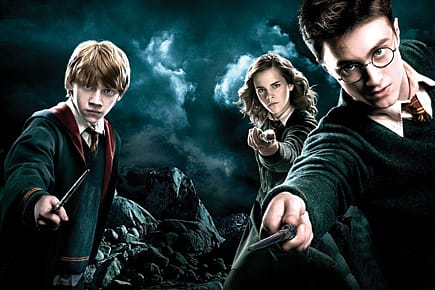
Joanne K Rowling killed children’s literature. Since the first Harry Potter book was published, children’s fiction has been stultified and trapped. No one prints anything other than fantasy and wizardry, and it’s almost as if the real world does not exist. Kids don’t have adventures unless they have magical powers, or have a Greek god as one parent. Worlds cannot be imagined without witches and elves, universes don’t happen unless there are strange four-dimensional dark forces that want to subvert them. The least a boy hero can be is the apprentice of a magician wearing a cowl and carrying a staff. Teenage love stories have to feature ageless vampires.
Do children read anything else anymore? No. Their heads are inhabited completely by worlds unlike the one they live in. They will never read David Copperfield, Sherlock Holmes bores them, and they will never even know Holden Caulfield because the back cover does not carry a blurb. Films without special effects are too drab. It doesn’t work without the dinosaurs, the monsters, the ogres, the walking trees, the flying unicorns. The new King Kong is an exercise in jerk-off excess and an insult to the original, but hey, the original was black and white and used stop-motion puppetry. Now, you have terrabytes to play with.
I didn’t watch Titanic, and I haven’t watched Avatar. Quite simply, I am uncomfortable with films where the principal virtue comes from the money you spent on it. So, if you spent a bit more, would it be a better film? Yes, it would be, and if you spent a lot more, it would be a lot better, in terms of what you are defining as good. When all you are creating or reading or watching are ‘epic’ battles between elemental forces of Good and Evil, are you learning any life skills at all?
Today’s children do not feel, like we used to when we were exposed to media. No one cries when someone dies in a book, no one’s lip trembles when great tragedies strike people on screen. Today’s children know the difference between fiction and reality like we never did. Attention spans are low; language has been altered by SMS, Facebook and Twitter; engagement is entertainment. It’s just a story, they are all acting. But how well-equipped will they be for the life that stretches before them, the world that will surround them as long as they live?
How will the exploits of vampires and werewolves, wizards and witches help these children know their worlds better? They will have no wands, and no broomstick to ride on. One of the benefits (if that is the right word) of reading as a kid was that it taught you something, even though you never realised it. Winnie the Pooh was a delightfully philosophical read. Treasure Island did teach you about courage, and the Mallory Towers series did tell you what right and wrong were, in a broad but undeniable sense. If you read Huckleberry Finn, you knew about the horrible injustices and cruelties men were capable of, and if you read The Wizard of Oz, you knew what a heart is, and a brain, and why some places are not Kansas. And you learnt love, heartbreak, longing and acceptance from Little Women.
Take a look at the children’s section in a bookstore, and it’s all about saving the world. First of all, all sorts of creatures that defy all scientific logic are running amok, and secondly, every boy or girl in any story has some form of mystical power, a higher calling, a connection with a neverworld. Where has the simple life gone, where William and the Outlaws got grimy and went home with a black eye, where Billy Bunter had a soul and Herbert Vernon-Jones, the Bounder, had honour? If all you are interested in is fighting the Great Cthulu, and wrapping yourself in your Invisibility Cloak, you could be in for some nasty surprises sometime in the future.
Yes, Joanne K Rowling has ruined it all. When will the next Heidi or The Secret Garden be written, which brings everyone back to earth?


OLDER COMMENTS FIRST
34 COMMENTS
Permalink
You sir, have hit the nail right on the head!
As a mom, I am witnessing the sad lack of coping abilities in the current generation, first hand.
The books I read while growing up (Malory Towers, Little Women,Treasure Island, Agatha Christie's, etc.) inspired one to go beyond personal shortcomings to solve problems and achieve greater personal heights.
Whereas, today's books, just teach the kids to escape reality and hide in an imaginary world when the going gets tough!
I don't actually think there is anything wrong with a dash of fantasy and magical reads, but only in moderation. The problem arises when they become the sole genre read by the kids.
A health mix is what is required. The problem is, once the kids get hooked to the fantasy/ magic thing, its tough to get them to read something else!
Permalink
Muggle view, this column.
Ha ha, entertaining though
Permalink
Mr. Deb,
With due respect you seem to have read nothing other than the blurbs of the Harry Potter series or even worse, just watched the flashy movie version and assumed the worst.
Thing is, one of the main characters, Professor Dumbledore says exactly what you are saying, "It does not do to dwell on dreams and forget to live." He also believes in equality, in fighting for what is right, in patient discernment and in believing that even a person with the worst reputation can be turned honest. The biggest message of Rowling's books is that love is the greatest magic.
So before we launch a witch hunt, let us just read deeper. And today's children are hooked to much more, the ever increasing tide of Ramayana, Mahabharata, Aesop's Fables, and Panchatantra could tell you that.
The thing is, "The more things change the more they remain the same."
Permalink
Your view forced me to comment. I find your viewpoint childish to some extent. I am not a Harry Potter fanatic but the novels certainly teach things beyond what you've come to grasp. Children do read other stuffs too. Base your deductions on proper data, not your emotions. And how the hell are u gonna know what a Titanic or an Avatar is about if u haven't seen the movie, just the price tag. I am not defending the movies here, if so u think. I myself am an iitian and I am ashamed to see how petty and irrational your views are. Titanic certainly has something more to offer than just the most expensive movie of the earlier decade tag. You haven't seen it, and yet you pass judgment. How juvenile can you get? Watch it, for your own sake. It'll do your stupid mentality a lot of good. You must be dumb to think that the movie's "principal virtue" comes from its price tag.
Permalink
Your views are really juvenile. I'll prove it to u. Your logic is that the movie Titanic's principal virtue comes from the money spent on it. The same logic should hold true for novels. So, by that argument, world's longest novel, Remembrance of things past derives its principal virtue from the 'words spent on it'. U see my point? Like these movies which u haven't seen and are very proud to flaunt it, I am very sure u haven't read the Harry Potter books too. Not a single one of them. So, stop commenting. And go, instead read some. And there's a reason why the books you mention are called classics. And also why Harry Potter would never be able to achieve it(though it should come close). And i personally think it's better if those classics be read when u are mature enough to grasp the full import of it. Where is the harm in letting children get lost in the 'other' world for once. They wouldn't be able to do it once they grow up. But the timeless classics u mention would always be there to remind them that our 'earth' is no less than a certain Hogwarts.
Permalink
Secret Garden is a good Friday read, there is no doubt. But other than that concluding remark, it is hard to argue with any seriousness (critics must bear in mind this is supposed to be a humour column according to an acquaintance who has been a regular reader of Mr Deb for many years now), that children's literature of the colonial period or post-colonial "Judeo-Christian" period was better than what globalisation has produced in our more evolved times.
Witches were always bad people, Rowling has made them heroic, given everyone access to the inner struggles of a once despised community of "the other" (all shrouded in black, prisoners of strange 'devilish' sexual habits, as a inquisitor said in 1706 before lighting fire to the stake where 'deviants' were being burned in the Gujarat of those days, and "backward" in all manner of thinking and living), and she has bravely taken people one step higher towards understanding "strange people" and their internal problems of leadership, direction and survival. In inverting the prejudice, JK Rowling has made it easier to end some of the worst cultural defects that make world peace so difficult to achieve. She is therefore a great writer. She is giving us a gentler generation.
Permalink
Mr Deb,
I am a sixteen year old student and I came across your article when my father gave it to me for something to read. I am astounded to think that you believe that children of my generation are incapable of facing the trials and tribulations that life has to offer us simply because we read fantasy novels. Obviously, you haven't done a complete research for your article, because if you had you would realize that all these novels have a moral at the end. Each and everyone of them tell's us to have faith in ourself and to never give up on our dreams. The exact kind of advice that our parents give us on the dinning table, only J.K.Rowling gave it to us in a 7 part series. All the characters face obstacles they overcome through hard work and patience. Some, by using wands and others with lightning speed and super human strength. What of it?
You should also know that the people of my age DO read things besides fantasy. We read Dickens, Blyton, Sir A.C.Doyle, Bronte, Austen and even Dan Brown. Jane Eyre and Mansfield Park are one of my favorite books, as is Vanity Fair. Little Woman was gifted to me when I was 13 and I still feel sad every time Beth dies. But, along with these classics I read the Modern classics. Harry Potter and The Twilight Series. I enjoy Harry Potter more as I think that it gives us a wider outlook of life.
You haven't watched Avatar or Titanic. Yet you say that the only reason the movies were a success was because of the money put into it. The money helps, yes, but it is not the sole reason Avatar has grossed over 2.5 billion dollars. It is because the movie is an experience. The movie has opened doors for a whole new genre of films. Everything is going to be in 3D in a couple of years and for that everything is going to cost money. Which means, in about 15 years you will never enter a movie hall.
And just so you know, J.K. Rowling did NOT introduce fantasy to us. It was there long before she even learned to spell her own name. The Wizard of Oz (probably the only correct thing you said), Alice in Wonderland, Christmas Carol (the three ghosts), and even The Chronicles of Narnia by C.S.Lewis. All classics. All made into movies with high budgets. All box-office hits. All read by children today. And once read by you (hopefully).
So before you go around publishing articles based solely on opinion and not facts, I suggest you research a bit, so that next time my Dad gives me something to read, I won't rush to the laptop and waste my time on someone completely devoid of imagination, hope and, any insight whatsoever on the 21st century.
With regards,
Naina.
PS: Please feel free to email me if you have any further opinions on this matter.
Permalink
Dear Mr. Deb
I'm a fifteen year old girl who recently chanced upon your article and I'm sorry to say this, but your article just seems like a poor attempt to critiscise a genre of book you dont like to read. I would even go as far as to question you on your research for this article. Did you even talk to children of our generation? Did you even make the effort to ask the girl next to you reading Harry Potter about whether she believes that she can take on the world without a wand?
"Joanne K Rowling killed children’s literature. Since the first Harry Potter book was published, children’s fiction has been stultified and trapped. No one prints anything other than fantasy and wizardry, and it’s almost as if the real world does not exist."
Do you actually believe that fantasy is the only genre children of today read? Because if that is so, youe sadly misguided. Fantasy is only a genre, there are many other books that are being printed today, have you forgotten Meg Cabot, the esteemed author of princess diaries? Correct me if i'm wrong, those books are meant for children and the protagonist "Mia" is just a normal teenager living in the city of New York. Perhaps, the next time you walk into a book store, you should try looking beyond the section where the "Harry Potters and Percy Jacksons" are stacked and what you find there will definately surprise you.
You claim that Mrs. J K Rowling has killed literature. Can you really say that? I would say that she has improved childrens literature and taken it to whole other level. She proves to be an inspiration for anyone who has an imagination that is bigger than themselves.
"How will the exploits of vampires and werewolves, wizards and witches help these children know their worlds better? They will have no wands, and no broomstick to ride on"
Perhaps you are right, How will vampires and warewolves help the children know thier world better? They wont. But then they will also know the difference between fiction and reality. If you believe that these books are misguiding us and delluding us about how the world is, then really, all you are doing is insulting the intelligence of all the children reading your article. We KNOW the difference about fiction and reality. We live in a world of media and technology where we are exposed to everything and every aspect of life. There is no fooling us. When we read Twilight, we might enjoy it and hope that we could be like the characters but we will ALWAYS know that in the real world, that is simply impossible. As for them not teaching us anything, ALL of these books have a moral. An "in between the lines" meaning, if I may. They all teach us that if you want, you can change the world. You can live through hard times and learn something from it. And WHAT is wrong with that belief? The belief that you can change the world? Had it not been for this belief then most of the major revolutions would not have taken place. Politics would not have existed. After all is it not the sole purpose of politics, to change policies and question them for the betterment of society?
If youre promoting that this belief system, is wrong then i will not feel even remotely biased in calling you a "Jadded and bitter man who has lost his spark and hasnt achieved what he wanted in life"
Also, if you havnt seen Titanic and Avatar then you really have no right to comment on something that you have not experianced, yourself.
I think I would like to conclude by telling you that even today, books like Little Women are being read and enjoyed by us. We are learning from them as we are learning from books like Harry Potter. Ofcource books are meant to teach you something, but they are also meant to transport you into a world of awe and wonder that makes everything in your life, all the problems you are facing seem a little better. And for that, we will always be thankfull to Mrs. Jk Rowling and other brilliant authors like her. So maybe now, you can sleep a little better at night, knowing this.
Also. Winnie the Pooh, my dear sir was not even remotely philsophical. There is NOTHING philosophical about an obese honey eating bear. YOu want philosophy, go pick up a Paolo Coelho book.
With regards,
Smriti
Permalink
Dear Mr. Deb,
I am 25 years old, and i agree with the 15 year old. I am a designer, and had it not been for such visionary books to read, my imagination would have been confined to set parameters. Every artist thrives on imagination - and it is distinctly different from reality, and everyone is well aware of this, even an illiterate.
Regards,
Shruti
Permalink
I agree with Preeti. Secret Garden is the best of the books mentioned (why only Friday reading, should be read whenever the mind is without fear and head is held high). People are too stuck up to appreciate good literature these days.
Permalink
This is easily the most pompous piffle I've read in a long time. Not only is it patronizing towards young people in general, it's also ignorant, lazy and amazingly presumptuous.
Today's children do not feel? WTF?
I'd pick apart every paragraph of this piece of tripe - and maybe I will, later on my blog. Oh, but blogs don't count, right Mr.Deb?
Permalink
Its a smart way to start an article. Write a hard hitting statement against a billionaire author. Sure to get a few forwards, comments and eyebrows raised. But its a completely different to not like a book and comment about a 15-year olds perspective.
I know a lot of people who havent liked a lot of fantasy novels, but they have never accused Joanne of killing reality. She is explaining interesting virtues of friendship, love and sacrifice via magic. What is wrong in that?
And if you are a proponent of reality, should I assume your logic is to go by price tag? That if an experience is expensive it must be better?
I am afraid you have killed reality yourself with your naive point of view.
Permalink
I absolutely agree with the above comment. Since when did reading JK Rowling mean a lack of appreciation for the classics. I was among the Harry Potter boom generation ( if you want to put it that way). That doesn't actually mean I haven't read the classics you mentioned. For the record, I have read all of them.
If anything, I think authors should be thankful to Rownling for having brought the kids back to books. Do you actually think that these books were doing well before Rowling ? Sadly, the answer is a big NO.
Permalink
I refuse to believe this is the actual opinion of Mr.Deb. This is possibly a trick by him to gauge if the new generation is up to responding to and countering asinine pieces of crap about them. He has done remarkably well , indeed so well that there is crap in just about every line he wrote. Hats off to you, Mr. Deb.
Wait, you say, this is his actually his opinion? Not a trick?
God save the IIMs.
Permalink
Buddy,
Wizard of Oz is not earth and enough has already been said abt your stupidity. We call you types Peter and I will have no qualms in calling you a pompous old prick.
Remember, the books you criticize will become the classics of tomorrow. Too bad u may not live to eat dung for the things you said in this article
Permalink
Have you ever played the game "Far Cry 2"? I expect not, but let me tell you this. Kids will learn much, much more about Africa and its unique set of problems from playing this game than from any work of textual fiction (or non-fiction)
Your broad brush treatment conveniently ignores video games (and many other modern genres) altogether. There are literally thousands of games that are poignant, philosophical and can affect people who play them deeply.
Do you also disapprove of the magical nature of Ramayana, Mahabharatha and our epics in general? Or are they ok because they are allegorical and contain deep philosophical truths? If that is so, then I'd argue that you are simply setting up Twilight and Harry Potter as strawmen that you can conveniently demolish. Sure, they are popular, as Enid Blyton was during her day. There were enough cliches, colonialist overtones and not to mention, blatant racism in her tales as well.
In short, I think this piece sounds like you suffer from an era bias, that all too common tendency to strongly believe that cultural artifacts from one's own era were always better.
Permalink
One man's rant. It should be labeled as such. There's no analysis or insight, only personal preference is stated. I like vanilla icecream. What do you like? Guess even iit-iim can't teach you anything if you don't drink when led to the water
Permalink
But The Wizard of Oz and Winnie the Pooh ARE fantasies. And Treasure Island has pirates. So your examples of realism are ...Little Women, Malory Towers, Heidi and the Secret Garden. Which are all so relevant to our life today.
Permalink
I don't get it. How is something like The Wizard of Oz any less fantastical than Harry Potter? Or the fact that Huck Finn talks about things like the chances of hidden treasure if you go to a haunted house and start digging under a tree?
Each and every Children's series had its own fantasy - even Enid Blyton used to write about gnomes and pixies and such mythical creatures - remember a book called The Faraway Tree? It won't remain Children's fantasy without... fantasy. Each and every series also has a lot of philosophical learning included in the books - be it Tom Sawyer, The Faraway Tree, or Harry Potter and the Deathly Hallows. Its all mixed in to create a good story.
I'm inclined to agree with Krish in the comment above - he's put it as well as can be put - you suffer from an era bias. The amount of fantasy in childrens books has not changed. The amount of technology in so called children's movies has, yes, but that just betters the viewing experience.
Children, as with everyone else, go to a mythical world for escape, but they're grounded enough in this age to get back to reality.
My two cents.
Permalink
Okay I get the Message.
Dont Dream, Dont Imagine, And dont ever try to be creative.
If some one tries to tickle you sensation to imagination, kill them.
If some one tells you a story. Mutilate them.
In case I'm not clear, I see that "stupid" movie of star trek, very much unreal. Very impossible technologies being presented, like hollow grams and displays.
I think I over heard some very prominent scientist thanking the team of star trek for the fantasy, for had it not been for them , many of the advances in technology that we see today may not be here.
A quick note about the "stupendous" invisibility cloak of JK Rowling. I heard that military scientists are thinking of implementing it on their uniforms. How stupid of them, ISN'T IT ?
"I disagree strongly with what you say, but I will defend to the death your right to say it." Voltaire
Permalink
I Have just 2 words to say.... "GROW UP"
Permalink
To add to what have already been said, young people will always go for cheap thrills (fast food, slick movies, swanky games, useless gadgets), hell, even we older people have trouble resisting them.
It's their parents' job to show them that there are other kinds of joys in this world as well: deeper and more meaningful (reading, loving animals and nature, learning new things.)
Don't blame an author for doing her job well. In fact, she has been a potent force to bring back reading in fashion for kids.
And please don't tell me that you are unaware of the fact that fantasy mirrors reality. The wizards in Harry Potter books have it as, if not more, difficult than regular kids, in spite of having magical powers. They have their own set of problems which mirror a real kid's problems. Hence the identification and popularity. It's not mere escapism.
Permalink
When you go to weddings, there is always this one slightly older uncle who will start a long monologue on how this is not a wedding and we should have seen the weddings in his day. This reads similar to that, except it's about books and someone gave the uncle some publishing space.
Permalink
Err.. It's Herbert Vernon-Smith, the Bounder not Herbert Vernon-Jones. Did you actually read the series?
Permalink
so you are gonna love this...........
http://www.dailymail.co.uk/news/article-1263658/Scrabble-change-rules-al...
Permalink
Dear older uncle,
Why are you adding IIT- lets commit suicide- and-IIM-lets-screw-up-an-online-exam details to your profile? We kids, hate when people roam around with those tags and expect us to emulate them.
And we love reading and studying. Just that we dont want to lock ourselves up, and spend 4 years on coaching classes trying to make it to institutions. Sad, Rowling was not in your day and age, else you would have known that Journalism was your calling and wouldnt have wasted money on seats which would have been used elsewhere.
if you are so happy and glad at being a journo, why sport that tag of IIT-IIM. Is that to tell us that we should not mess with you? Or that we are scumbags?
Nice rant against fantasy fiction. This was a reality rant for you. Grow up while you can. I hope I killed your fantasy highly educated world for you.
Permalink
seriously. grow up.
kids who will read, will read anyway; and rowling has only added to the treasury. i don't know where you get your completely skewed, illogical, and screechingly loud analysis from; but you need to discard it. cus you're wrong.
Permalink
I had thought to stay away from this debate, but then yesterday I took the kids to watch Alice in Wonderland.
Sayonee (10) thought the best part in the movie was thinking of ‘six impossible things before breakfast’ and Nayonica (7) thought the coolest bit was when Alice returns the Bandersnatch its eye – an Ew!-eyeball-finds-eye-socket-click!-moment or an-art-of-negotiation-or conciliation-or redemption-moment, depending on how you want to look at it.
Enough life-skills learnt for Rs 140 each, I should think.
It seems to me that disgruntlement with fantasy creeps up on us somewhat like the music being too loud, around middle age. This is peculiarly evident among Indians (despite the fact that we want our kids to know our rather fantastical mythological texts by heart before they turn four). That’s why, probably, we have such a large number of thinly-veiled autobiographies masquerading as fiction in the adult market, and very few of the likes of Samit Basu, who have escaped the trap, in the same space.
Why do children like fantasy? There must be many theories, but I daresay it’s because they can believe in the impossible things – they can construct and support and endorse in their minds a world that doesn’t fit into the framework of known things, a truly creative world that brings together contexts never before thought of, or made of elements that have never before been put together this way. Their suspension of disbelief is not illogical (the most incisive hole-finder in an imaginary construct will be a child); they will ask questions of it, but they can relate to it once they are convinced of its internal logic. Not all fantasies succeed with children, nor do all children reject a Dickensian world, so generalizations are at best, just that. Which makes me wonder about the exact facts this article is based upon. As a sometimes-journalist, I would try to imagine that one would analyze data from at least six bookstores in a city and a smattering nationally, and enquire about what sells and what doesn’t. However, my journalist friends tell me opinion pieces are about what you THINK, and thinking, like imagining, doesn’t necessarily have to be based upon facts, so well...
Of course, I agree that children should read all kinds of books, but to rue the fact that they like fantasy is weird. A genre can gain sudden prominence because of many reasons – a successful series, a set of media tools that nurture the genre and so on, all of which has probably happened with fantasy. But children’s love of fantasy is not a new thing. Before we misguidedly insist on teaching them that books are for instruction and life-skills, children have the right idea about books: they are for fun, for leaps of imagination, for entertainment, for being the fairground-distorting-mirrors to life, in which sometimes you see things from such a new perspective that you never forget. They are not necessarily for showing you life is to be dealt with this or that tool, but for changing the way you look at it, adding a new dimension, turning the predictable trajectory askew. It may be gratifying to lament how or how little young people engage with what WE used to thrive on, but at the risk of being simplistic, it’s like asking yourself why you use e-mail when you could write a beautiful letter on rice paper.
Come on, surely it’s obvious that Harry Potter is as much about boarding school, and parents and growing up and coming of age, and competition and hormones, and friends and foes, as it is about Quidditch and spells and Invisibility Cloaks; Artemis Fowl, as much bonding, bravado, greed, good-evil greys (more life-skills); and Eragon (perhaps, going on to do the best with what you’ve got - yes, a life-lesson)… One can go on and on: Septimus Heap, Percy Jackson… all parables, allegories. And those writers that can stretch and work a child’s mind like playdoh and show you all sorts of fantastic, 'gotcha!' shapes and forms and hues your thinking could take -- David Almond, Neil Gaiman, Philip Pullman … They will show you that you may be mistaken to have thought that children’s publishing today is some kind of homogenous, undifferentiated lump. Scrape the surface and the lights and darks will leap up and surprise you – and perhaps even make you change your mind.
In any case, why would you think life is only about life-skills, and how are Good and Evil not part of that? How can you unilaterally decide this psychologically complex riddle: that the collective experiences of fantasy that include ideas of right-wrong, fairness-unfairness, violence-nonviolence, life-death, among other issues, do not go to feed children’s minds? What makes you think Aslan’s death and Pettigrew’s betrayal don’t cause children to feel anything? And if young people are robotic pachyderms, is it to do with the books they read or movies they watch, or is it because of the reality they see around them? Good and evil are not fantastical, discrete emotions in the custody of winged dragons and pointy-hatted witches – they are HUMAN values. Fantasy may introduce new shades of grey to those values, but they are not very different from the clouded tones they have acquired in real life anyway; and children’s values and life-skills are, I’d reckon, more a by-product of how they model themselves on adults around them.
We are so good at stuffing values down our children’s throats in a world that is already rendered valueless, or at least hazy and contradictory in terms of values, that we forget that children are naturally more sensitive and imaginative than we adults are. Young people are just fine – they just want to make their own choices, just as you did. And the world hasn’t gotten ‘better’, has it, now that your –and by the looks of it, my – generation is in charge, having made its noble reading choices? Here we are - the great generation of trembling lips and moist eyes and high EQ, we who actually ‘felt’ when someone died, we who read the right books at the right time... But look at the news headlines – our ‘rightness’ doesn’t show, does it? And what can I say, we haven’t even been able to get our children’s reading habits right. That should, for sure, make us question our methods. Having examined myself to some extent, I, for one, can safely bet on the fact that our children – including those that believe in lightsabers and spells -- will do at least no worse than we are doing.
If you really would like to do something beyond expressing opinion, please spare some space in your magazine regularly and frequently to disabuse readers of the misconception that ‘only fantasy’ is available for children/young readers. The media gives negligible space to children’s books, and journalists have an opinion on children’s and young adult books mostly only to grab eyeballs when a trend from abroad is mirrored here, or when the fancy takes them.
In sum, I think fantasy is just cool; it’s the reality that sucks.
However, I take consolation in the fact that you yourself once drew inspiration from George Lucas (that extraordinary imagineer of special effects), and, yes, from your mention of The Wonderful Wizard of Oz in an article bemoaning fantasy, I can see that you haven’t quite escaped its enduring spell. Had Dorothy ended up demonstrating post-cyclone disaster management, The W.... W.... of O.. might well have been a great book, but it would not have been the unforgettable Wizard of Oz.
So when my seven-year-old snatches away her older sister’s UNO cards and won’t return them, declaring that ‘All of Didi’s powers are in them’, please excuse me if I can only giggle at that. To fear that the fantasy virus is corroding her brain and heart – besides killing all of children’s literature -- would only be an over-reaction.
Permalink
serious xenophobia against youth culture here.. extremely convoluted logic..inspired by George Lucas, lauds Samit Basu and yet deplores the genre of fantasy while citing the Wizard of Oz as a testament to the simpler and lovelier times of reality fiction. there's a reason why IIT-IIM writers suck.. they have unshakeable faith in their superiority but alas.. zero imagination and appreciation of the arts.
Permalink
Long live my Tenida Ghonada and FELUDA!
Permalink
Sayonee !! What an astoundingly beautiful name, Ms Vatsala Kaul Banerjee!!
About fantasy for kids, yeah, we should have more of it. Rowling rocks. Others, dunno. On Alice etc, the Tea Party Heroes vs evil Red Tyrants is an old boring stuffy allegory done to death (but watch Sarah Palin on her Tea Party Express bashing all these healthcare-for-all Obama types and you know that reality in this story is a whole lot worse)
Permalink
Sorry, personal, but couldn't resist.
@ Ockham, thanks... she's named after the 1998 Junoon song 'Sayonee'. Check it out on youtube.
Permalink
Dear Mr. Deb,
It's unlikely you'll manage to make it to the bottom of the long list of rants that precede me, but I never lose an opportunity to chuck in my two cents.
In the first place, you have, unfortunately, made a bit of a shambles of perfectly decent opportunity to expose some of the greater flaws of the Harry Potter series. You could, for instance, have argued about the quality of writing. Or, if you felt unequal to that task, maybe even shown how Rowling has cheerfully picked and mixed a couple of thousand examples, words, and ideas from the long literary tradition that came before her, and you, and me, resulting in a book that, while arguably entertaining, is also (arguably) decidedly unoriginal.
Secondly, what you did decide to do, brave soul that you are, is suggest that fantasy ITSELF is the death knell to children's literature.
While you're severely overestimating J.K Rowling's talent if you think she single handedly introduced fantasy to children literature, there is no indication that fantasy is detrimental to a child's imaginative upbringing and your omission of basic journalistic evidence in the form of 'actual facts' only probably means that there are none. Unless of course you so far underestimated your readers as to 'not bother' with the facts. But surely not.
Finally, in suggesting Ms. Rowling has er..'ruined' literature for children, you also, unwittingly, of course, bring into the mix Stan Lee, J.R.R Tolkein, Charles Kingsley, Kenneth Grahame (maybe all our kids will think garden toads can own mansions and avoid their responsibilities?), and a host of other extremely illustrious writers that put shame to your and my humble opinions.
But then, taking on all of fantasy literature for children, Mr. Deb, is a task that I believe is clearly far beyond your abilities.
Permalink
Dear Sandipan,
One Mr. Harold Bloom couldn't agree with you more!
Wall Street Journal - July 11, 2000
"Can 35 Million Book Buyers Be Wrong? Yes."
http://www.opednews.com/populum/linkframe.php?linkid=111331
Add your comment